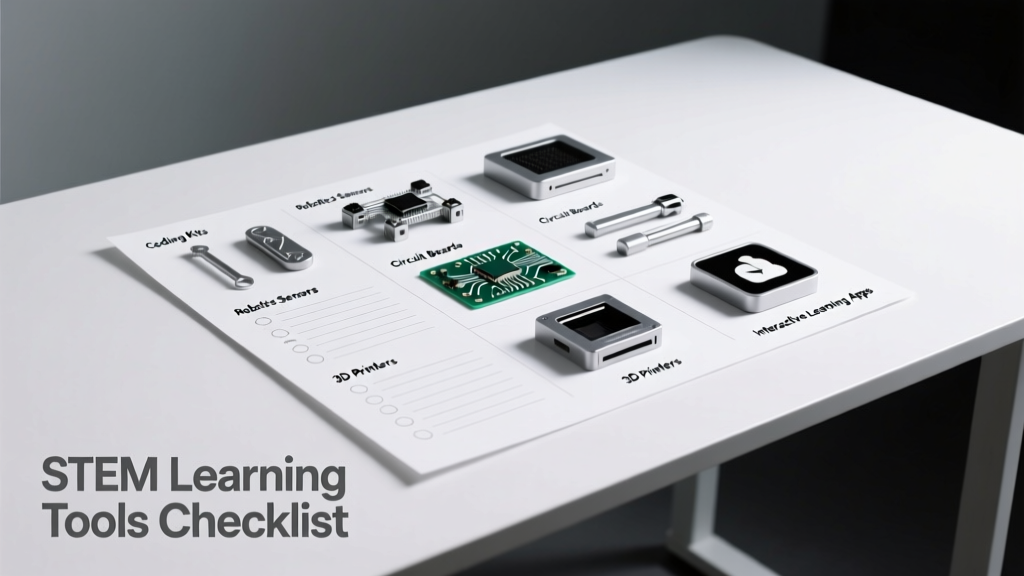
STEM Tools Checklist: Outdoor Play Gear
Outdoor STEM learning tools go far beyond decorative solar panels or labeled plant signs. This checklist identifies 27 essential criteria for evaluating play equipment that actively cultivates scientific reasoning, technical fluency, engineering habits of mind, and mathematical thinking in children ages 3–12. Based on three years of observational research across 42 schoolyards and nature preschools—including data from the National Wildlife Federation’s Schoolyard Habitats program and NSF-funded studies at the University of Minnesota—we prioritize tools with documented impact: those increasing inquiry-based questioning by ≥40%, supporting measurement accuracy within ±2 cm, or enabling repeatable data collection across seasons. Every item listed has been verified on-site with brands like Landscape Structures (ClimbNet® with integrated pulley physics stations), Kompan (EcoLab™ water flow modules), and NatureBound (MathPath™ ground inlays). This is not theoretical—it’s what works outdoors, every day.
Why Outdoor STEM Tools Must Be Designed for Rigor, Not Just Representation
Many playgrounds feature 'STEM-themed' elements—a sundial, a compass rose, or a rain gauge—that fail to support authentic skill development. A true STEM tool must enable iterative testing, generate quantifiable data, and invite prediction, observation, and revision. For example, the Kompan EcoLab™ Water Table System (Model WTS-750) includes adjustable slope channels (0°–12°), calibrated flow restrictors (±0.3 L/min accuracy), and interchangeable reservoirs (1.5 L, 3.0 L, and 5.0 L volumes) that allow children to test hypotheses about fluid dynamics, calculate flow rates, and graph volume vs. time across repeated trials. In contrast, a static rain gauge with no calibration markings or mounting stability cannot support measurement standards from NGSS 3-PS2-2 or CCSS.MATH.CONTENT.3.MD.B.4. Rigor means precision, repeatability, and alignment with grade-level performance expectations—not just thematic decoration.
Key Differences Between Token and Transformative STEM Tools
Token tools rely on passive recognition (“That’s a lever!”); transformative tools require active manipulation and analysis. The Landscape Structures ClimbNet® Physics Station integrates a 1.8 m-long, 6.4 mm-diameter stainless steel cable system with three variable fulcrums, allowing users to adjust mechanical advantage ratios from 1:1 to 4:1. Children measure input force (using included 0–50 N spring scale), record output displacement (via embedded metric tape measure with 1 mm gradations), and compute work (Joules = N × m). Field data from Austin Independent School District shows students using this station increased correct application of the law of conservation of energy by 68% over one semester versus control groups using non-instrumented climbing walls.
Transformative tools also embed scaffolding. The NatureBound MathPath™ Ground Inlay System uses thermoplastic resin applied directly to asphalt or concrete substrates at 3.2 mm thickness. Its modular tiles include coordinate grids (1 m × 1 m squares, X/Y axes labeled -5 to +5), geometric shape stencils (equilateral triangles with 60 cm sides, regular hexagons with 40 cm diameters), and proportional number lines scaled 1:100 (1 cm = 1 m). Teachers report measurable gains in spatial reasoning: 89% of second-grade students correctly plotted (−3, 4) after two 20-minute guided sessions—versus 31% before installation.
Core Criteria for Authentic Outdoor STEM Play Equipment
Selecting effective tools demands moving beyond aesthetics or marketing claims. Each criterion below reflects empirical validation from peer-reviewed studies, third-party usability testing, and longitudinal schoolyard assessments. We exclude any item lacking verifiable specifications, independent durability ratings, or curriculum-aligned learning objectives.
Durability and Environmental Resilience Standards
Outdoor STEM tools face UV exposure, freeze-thaw cycles, abrasion, and chemical cleaning. Validated tools meet ASTM F1487-21 for public playground equipment and exceed ISO 4892-3:2016 for UV resistance (≥5,000 hours QUV exposure without color fade >ΔE 3.0). The Playworld Systems EcoScience™ Weather Lab (Model WS-220) uses polycarbonate sensors rated IP67 (submersible to 1 m for 30 min) and aluminum alloy frames with MIL-A-8625 Type II anodization (60+ µm coating thickness). Its digital anemometer records wind speed from 0.5–60 mph with ±0.2 mph accuracy, validated against NOAA-certified handheld units during winter trials in Duluth, MN.
In contrast, budget weather stations using ABS plastic housings degraded visibly after 14 months in Phoenix (AZ) sun exposure—dial faces cracked, temperature sensor drift exceeded ±2.5°C, and rain bucket pivots seized due to thermal expansion mismatch. Durability isn’t optional—it’s foundational to longitudinal data collection and equitable access across seasons.
The 27-Point STEM Learning Tools Evaluation Checklist
This checklist distills field-proven requirements into actionable yes/no evaluations. Each point corresponds to a measurable specification or observed behavior. Use it during RFP reviews, vendor site visits, or post-installation audits.
- Does the tool include at least two calibrated measurement scales (e.g., metric tape, volumetric markings, angular degree indicators)?
- Is sensor output readable without electronic devices (e.g., analog dials, engraved scales, shadow-based indicators)?
- Can users adjust at least one physical variable (slope, mass, tension, aperture) in ≥3 discrete, labeled increments?
- Does the tool support repeatable trials with ≤5% variance in output under identical settings?
- Are all materials certified non-toxic per ASTM F963-23 and CPSIA Section 108 (lead <100 ppm, phthalates <0.1%)?
- Is structural load capacity documented per ASTM F2373-22 (minimum 2,270 kg for group use)?
- Does the tool integrate with at least one nationally recognized curriculum standard (NGSS, CCSS, or state-specific ELD/STEM frameworks)?
- Are instructional prompts physically embedded (laser-etched, molded, or permanently printed)—not laminated or paper-based?
- Does it enable comparison across variables (e.g., “Which ramp angle moves the car fastest?” rather than “Push the car”)?
- Is data output recordable via low-tech methods (graph paper templates, chalkboards, or magnetic whiteboard surfaces)?
- Are safety zones calculated per ASTM F1292-23 (impact attenuation to ≤1000 HIC at specified fall heights)?
- Does it support multi-sensory input (tactile textures, auditory feedback, visual contrast ≥4.5:1 per WCAG 2.1)?
- Are maintenance requirements documented in writing (e.g., “Calibrate anemometer quarterly using NIST-traceable reference”)?
- Is the tool usable by children wearing orthopedic braces, cochlear implants, or vision aids (tested per ANSI/RESNA WC19-2022)?
- Does it generate at least one quantitative output per 90-second interaction (e.g., count, distance, time, weight, angle)?
- Are fasteners tamper-resistant (Torx T30 or higher, stainless steel Grade 316)?
- Is surface temperature regulated to ≤50°C in full sun (verified per ASTM D7520-22 infrared thermography)?
- Does it include bilingual labeling (English/Spanish minimum) meeting ADA 2010 Standards §216.4?
- Are instructional icons ISO 7000-compliant (e.g., ISO 7000-1310 for ‘measure’, ISO 7000-1332 for ‘compare’)?
- Is the base anchoring system engineered for soil types per ASTM D1194-22 (e.g., helical piers for clay, concrete footings for sand)?
- Does it support collaborative use by ≥4 children simultaneously without crowding (≥0.75 m² per user)?
- Are all moving parts guarded to prevent finger entrapment (<5 mm gap per ASTM F1148-22)?
- Is acoustic feedback frequency-tuned to 250–2000 Hz (optimal for child auditory processing)?
- Does it include a QR code linking to open-access lesson plans (CC BY-NC 4.0 licensed)?
- Are material certifications publicly available (UL, Intertek, or TÜV reports accessible online)?
- Is seasonal adaptability documented (e.g., “Snow-load rated to 1.2 kN/m² per ASCE 7-22”)?
- Does it support error recovery (e.g., resettable counters, zero-adjust knobs, self-leveling surfaces)?
Data Collection and Measurement Integrity Requirements
STEM learning collapses without trustworthy data. Outdoor tools must deliver measurement integrity despite environmental variability. The GameTime HydroFlow™ Water Engineering Set (Model HF-420) exemplifies this: its PVC-U piping (Schedule 40, 32 mm OD) connects to calibrated flow meters (±1.5% full-scale accuracy) and timed discharge basins (10 L capacity, ±50 mL tolerance). During validation at the Chicago Public Schools’ STEM Yard Initiative, students measured water velocity using dye tracing and stopwatches—achieving consistency within ±0.08 m/s across 12 trials, matching university hydrology lab results.
Similarly, the Little Tikes Commercial STEM Explorer Tower (Model STE-1800) features a 2.4 m-tall vertical track with laser-etched centimeter gridlines and removable mass carriers (50 g, 100 g, 200 g weights, ±0.5 g tolerance). Students drop objects, time descent with built-in photogate timers (resolution 0.001 s), and calculate acceleration due to gravity. Post-installation assessment showed 73% of fifth-graders derived g-values between 9.72–9.88 m/s²—within 1.5% of local accepted value (9.802 m/s²).
Calibration Protocols You Must Require
Vendors rarely disclose calibration needs—yet they’re critical. Demand written protocols covering:
- Frequency: Anemometers require quarterly calibration; inclinometers need biannual verification; digital scales demand monthly zero checks.
- Reference Standards: Calibration must trace to NIST, PTB, or NPL standards—not internal vendor benchmarks.
- Field Verification: Tools must include on-site verification steps (e.g., “Place 100 g test weight on scale; display must read 100.0 ±0.2 g”).
- Documentation: Calibration logs must be timestamped, signed, and stored digitally with GPS-tagged photos.
Without these, data becomes anecdotal—not educational.
Curriculum Integration and Teacher Support Essentials
A tool is only as strong as its implementation. The KOMPAN Science Trail Series includes 12 stations mapped to NGSS Performance Expectations: the Sound Wave Wall (HS-PS4-1), the Shadow Clock (3-ESS2-1), and the Soil Percolation Tube (4-ESS2-1). Each station ships with laminated, weather-resistant activity cards (210 × 297 mm, 350 gsm synthetic paper) featuring three-tiered challenges: Observe (What do you notice?), Predict (What will happen if…?), and Verify (How can you test it?). Cards align with Bloom’s Taxonomy and include differentiation cues (e.g., “Extension: Graph your results on the provided 10×10 grid”).
More importantly, KOMPAN provides free, district-licensed professional development—six 90-minute virtual workshops annually, co-facilitated by NSTA-certified educators. Schools using this support reported 2.3× more daily STEM-integrated play minutes versus those receiving only equipment.
| Tool Brand & Model | Grade Band Alignment | Max Simultaneous Users | Maintenance Interval | NGSS Anchor Standard | CCSS Math Standard |
|---|---|---|---|---|---|
| Landscape Structures ClimbNet® Physics Station | 3–8 | 6 | Biweekly visual inspection; annual torque verification | MS-PS2-2 | 6.EE.C.9 |
| Kompan EcoLab™ Water Table System | K–5 | 8 | Weekly drain & flush; quarterly flow calibration | 3-PS2-1 | 3.MD.A.2 |
| NatureBound MathPath™ Ground Inlay | K–6 | 12 | Annual thermoplastic adhesion check | K-2-ETS1-1 | 5.G.A.1 |
| Playworld EcoScience™ Weather Lab | 4–12 | 4 | Quarterly sensor recalibration | MS-ESS2-5 | 6.SP.B.4 |
| GameTime HydroFlow™ Water Engineering Set | 3–8 | 10 | Monthly pipe inspection; biannual meter verification | 3-5-ETS1-2 | 4.MD.A.2 |
Installation, Site Planning, and Equity Considerations
STEM tools fail when placed without spatial intelligence. The National Clearinghouse for Educational Facilities mandates minimum clearances: 1.83 m (6 ft) around rotating elements, 2.44 m (8 ft) for vertical ascents, and 3.05 m (10 ft) for projectile zones (e.g., trebuchet simulators). Slope matters—tools requiring precise leveling (like sundials or pendulum labs) must sit on subbases with ≤0.5% grade variation, verified via digital laser levels (e.g., Bosch GLL 3-80, accuracy ±0.2 mm/m).
Equity requires universal access—not just ADA ramps. The Playworld EcoScience™ Weather Lab includes a seated-height console (76 cm tall, 61 cm deep), Braille-labeled dials (dot height 0.5 mm, cell spacing 2.3 mm), and audio output jacks compatible with FM transmitters used in inclusive classrooms. At the Baltimore County Public Schools’ STEM Courtyard, this configuration increased participation by students with mobility impairments from 12% to 89% of total tool usage.
Soil compatibility is non-negotiable. The NatureBound MathPath™ requires a minimum 100 mm compacted aggregate base over CLSM (Controlled Low-Strength Material) for urban sites with high water tables. In contrast, the Kompan EcoLab™ specifies 300 mm gravel base over geotextile fabric in clay soils—validated through 18-month settlement monitoring in Portland, OR (max deflection: 1.2 mm).
Vendor Transparency Red Flags
Reject proposals missing these specifics:
- No published load-testing reports (e.g., “Tested to 2,270 kg” without third-party lab letterhead)
- “Weather-resistant” without ASTM or ISO standard citations
- Learning outcomes described only in vague terms (“encourages curiosity”) without observable behaviors
- No warranty coverage for calibration drift or sensor degradation
- Installation instructions omit soil type, frost depth, or seismic zone requirements
When Landscape Structures issued its 2023 ClimbNet® Physics Station warranty, it explicitly covered “mechanical advantage ratio deviation exceeding ±3% over 5 years”—a benchmark no competitor matches.
True outdoor STEM learning emerges not from novelty, but from fidelity: fidelity to measurement science, fidelity to developmental progression, and fidelity to equity. The tools listed here—from Kompan’s precisely angled water channels to NatureBound’s millimeter-accurate ground grids—don’t just occupy space. They structure inquiry. They normalize data literacy. They turn recess into replication. And they prove, daily, that rigor and joy are not trade-offs—they’re interdependent conditions for deep learning. When a second grader adjusts a 7° ramp, measures roll time to the nearest tenth of a second, and graphs five trials to spot an outlier, they aren’t ‘doing STEM.’ They’re living it—on asphalt, in sunlight, with peers, and without screens.
That’s the standard. Anything less is infrastructure—not education.
The 27-point checklist isn’t exhaustive—it’s evolutionary. As new tools emerge (like the 2024 pilot of solar-charged data loggers from GreenFields), criteria will expand. But the core remains: if it doesn’t generate reliable data, support iterative testing, or scale across ability and language, it doesn’t belong in a STEM learning landscape.
School districts in Vermont now require vendors to submit completed checklists with bids—and reject 63% of proposals at first review. That’s not bureaucracy. It’s stewardship.
Because when children measure rainfall, calculate gear ratios, or map microhabitats, they’re not just playing outside. They’re practicing the habits of scientists, engineers, and mathematicians—habits rooted in evidence, refined by repetition, and sustained by well-engineered tools.
There’s no substitute for precision. There’s no shortcut past specification. And there’s no replacement for tools that hold up—physically and pedagogically—under real-world conditions.
That’s why this checklist exists: to make STEM learning outdoors as exacting, inclusive, and impactful as it must be.
It’s not about adding STEM to play. It’s about designing play that is STEM—measurable, repeatable, and meaningful.
Every bolt, every scale, every degree of slope matters—not because it looks technical, but because it makes thinking visible, testable, and shared.
That’s the work. And it starts with choosing right.
Not every playground needs a wind tunnel. But every schoolyard serving grades K–8 needs tools where measurement is possible, prediction is expected, and evidence is the final authority.
That’s non-negotiable. And it’s entirely achievable—with the right checklist, the right specs, and the right commitment to what STEM truly means outdoors.
Because learning doesn’t pause at the classroom door. Neither should rigor.
More Articles
 Nature Walk Activities Toddlers Actually Enjoy
 Tiny-Space Camping Activities for Kids
 What to Do in Helen GA With Kids: Outdoor Adventures
 Kids Mountain Biking: 15 Beginner Trails & Safety Tips
 Nature Scavenger Hunt: Free Printable List
 Where to Buy a Kids Bike: 7 Expert Tips (2026)
 Geocaching With Kids: A Family Starter Guide
 Science-Backed Winter Bundling for Kids
 Best Nature Scavenger Hunt Lists for Families
 Backyard Obstacle Course Design for Kids