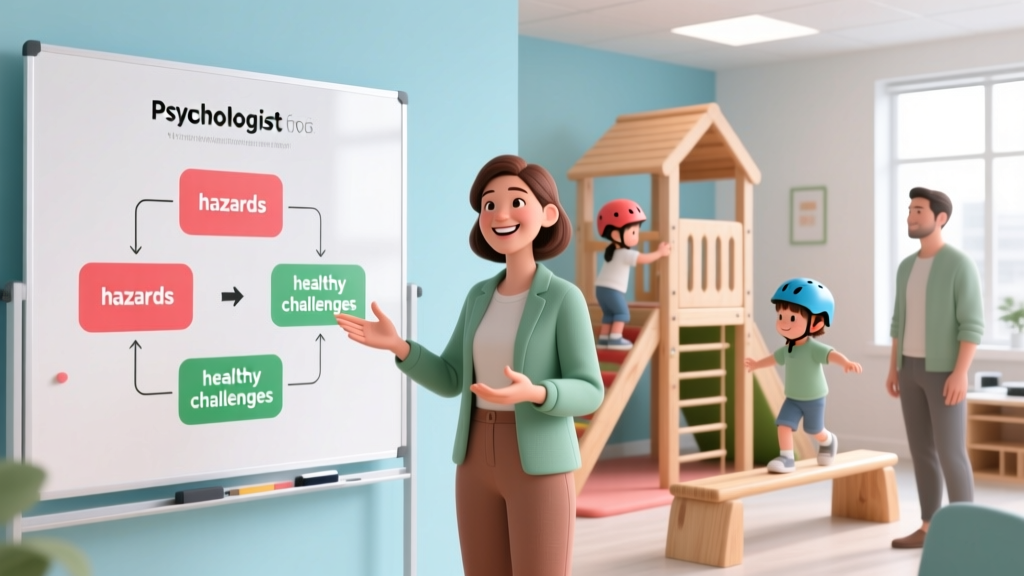
Encouraging Risky Play Without Compromising Safety
🎯 The Big Idea: "Risky play" doesn't mean dangerous play. It means play where children test their limits — climbing higher, going faster, using tools — in environments where the consequences of failure are manageable. Research shows it builds resilience, confidence, and better risk judgment.
What Is Risky Play?
Professor Ellen Sandseter identified six categories of risky play that children universally seek:
- Great heights: Climbing, hanging, balancing above the ground
- High speed: Running fast, swinging, biking downhill
- Dangerous tools: Using knives, saws, hammers, fire
- Dangerous elements: Water, fire, cliffs, ice
- Rough-and-tumble: Wrestling, play-fighting, fencing with sticks
- Disappearing/getting lost: Exploring alone, hiding, wandering
Each category serves a developmental purpose. Children who are denied these experiences often seek them in less controlled ways later.
Hazard vs. Challenge: The Critical Distinction
| Hazard (Remove) | Challenge (Support) |
|---|---|
| Rotted branch that could snap | Strong branch that requires effort to reach |
| Sharp glass in a play area | Child-safe knife for whittling with supervision |
| Traffic near play area | Hill that's steep but ends on grass |
| Deep water without supervision | Creek with shallow areas to wade and explore |
The rule: Remove hazards children can't see or assess. Leave challenges they can evaluate and choose to attempt.
The "As Safe As Necessary" Framework
Instead of "as safe as possible," aim for "as safe as necessary." This means:
- Prepare the environment: Remove hidden hazards, soft landing surfaces under climbing areas
- Teach skills: Show children HOW to climb, use tools, assess water depth
- Be present, not hovering: Stay close enough to help if needed, far enough that they feel autonomous
- Use coaching language: "Where will you put your foot next?" instead of "Be careful!"
Language Swap Guide
| Instead of... | Try... |
|---|---|
| "Be careful!" | "Notice how slippery that rock is." |
| "Get down from there!" | "Do you feel stable? Can you get down the same way you went up?" |
| "That's too high!" | "How high do you want to go? What's your plan for getting down?" |
| "Don't run!" | "The ground is uneven here — how will you keep your balance?" |
Age-Appropriate Risky Play
Ages 2-4: Introduction
- Low climbing structures (2-3 feet)
- Running on uneven terrain (grass, sand)
- Using child-safe scissors and play dough tools
- Playing in puddles and shallow streams
Ages 5-8: Building Competence
- Tree climbing with the three-point rule
- Biking on gentle hills
- Using real hammers and nails (with soft wood)
- Exploring a fenced yard independently
Ages 9-12: Expanding Boundaries
- Higher climbing with proper technique
- Fire-building with supervision
- Walking to a friend's house alone (safe neighborhood)
- Cooking with real knives and stovetops
When Your Instinct Says "Stop"
It's normal to feel anxious watching your child climb or go fast. Before intervening, pause and ask:
- Is there a hazard they can't see?
- Do they have the skills for this challenge?
- Is the worst-case outcome manageable (scraped knee vs. broken bone)?
If all three answers are "no hazard, yes skilled, manageable outcome" — step back and let them try.
More Articles
 Best Outdoor Games for Kids With ADHD (2026)
 How to Build a Sensory Garden for Kids
 Playgrounds vs Montessori Outdoors
 Best Kids Bike Trails: 12 Beginner Routes Across US
 How to Build an Igloo for Kids (2026)
 Backyard Obstacle Course Ideas Kids Love (2026)
 Why Kids Need Recess: Brain Benefits Backed by Science
 Adult Playgrounds: Stress Reduction Science (2026)
Backyard Obstacle Course Ideas Kids Love (2026)
Adult Playgrounds: Stress Reduction Science (2026)
Backyard Obstacle Course Ideas Kids Love (2026)
 Kids Bike Safety: A Parent's Quick Guide