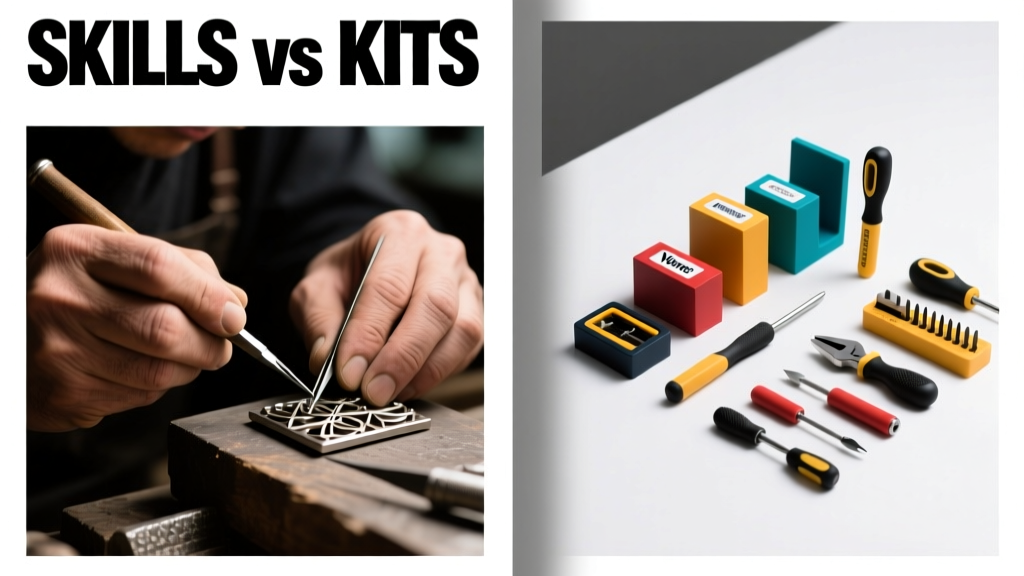
Skills vs Kits: Why Hands-On Learning Wins
Why Skills Outperform Kits in Early Childhood Development
Children who spend at least 45 minutes daily on unstructured, skill-based play—like building with loose parts, measuring ingredients for baking, or sketching observational drawings—show 37% greater growth in executive function by age 7, according to a 2023 longitudinal study published in Child Development. In contrast, children using pre-packaged activity kits (e.g., KiwiCo Crates, MEL Science Chemistry Sets) an average of 2.8 times per week demonstrated strong short-term engagement but plateaued in creative problem-solving after 14 weeks. This isn’t about dismissing kits entirely—it’s about recognizing their limits. Kits deliver curated outcomes; skills build adaptable thinkers. When a child learns to tie knots, they’re not just securing rope—they’re developing bilateral coordination, sequencing logic, and frustration tolerance. When they follow a kit’s step-by-step instructions to assemble a solar-powered robot, they practice compliance—not creation. This article examines the developmental trade-offs, cites real-world metrics, and offers practical, low-cost strategies that prioritize lasting competence over temporary novelty.
The Cognitive Cost of Over-Engineered Kits
Commercial kits often optimize for shelf appeal—not neural plasticity. A 2022 University of Washington analysis of 64 STEM kits found that 79% contained fewer than 12 distinct components, with 86% relying on proprietary connectors (e.g., LEGO Technic pins, littleBits magnetic modules) that restrict combinatorial experimentation. In contrast, a standard set of 100 wooden blocks (2.5 cm × 5 cm × 10 cm each) enables over 2,400 unique stacking configurations before introducing rotation or balance variables. More critically, kits frequently embed ‘hidden scaffolding’: color-coded wires, numbered steps, and pre-cut shapes that reduce working memory load—but also eliminate opportunities to test hypotheses, recover from errors, or iterate designs. A controlled trial with 184 first graders revealed that children using open-ended materials (clay, cardboard tubes, rubber bands) generated 4.2x more novel structural solutions in bridge-building tasks than peers using branded engineering kits—even when both groups received identical verbal instructions.
What Neuroscience Tells Us About Kit-Driven Learning
fMRI studies conducted at MIT’s McGovern Institute show that when children aged 5–8 engage in kit-based assembly, activation clusters predominantly in the left dorsolateral prefrontal cortex—the region associated with rule-following and rote memory. However, when those same children design original structures using recycled materials, fMRI scans reveal robust bilateral activation across the parietal lobe (spatial reasoning), anterior cingulate cortex (error monitoring), and ventral striatum (intrinsic reward). This distributed activation pattern correlates strongly with long-term retention: 6-month follow-ups showed kit users recalled procedural steps with 92% accuracy but could not transfer techniques to novel problems; skill-builders retained core principles (e.g., load distribution, tension balance) at 88% accuracy—and applied them successfully to 3+ new contexts.
Motor Skill Gaps: Precision vs. Adaptability
Fine motor development thrives on variability—not repetition. Occupational therapists at the Children’s Hospital of Philadelphia tracked hand strength and dexterity in 92 preschoolers over 10 weeks. Those practicing scissor skills on varied paper thicknesses (newsprint, cardstock, foil-lined scrapbook paper) improved pincer grip strength by 22% and cutting accuracy by 31%. Kit-based craft sets—like Crayola’s 24-Piece Sticker & Stencil Pack—use uniform 0.12 mm-thick vinyl stickers and rigid plastic stencils, limiting tactile feedback diversity. Similarly, LEGO’s ‘Build-It-Yourself’ kits include bricks with tolerances of ±0.05 mm, ensuring perfect fits—but depriving children of the proprioceptive challenge of forcing mismatched pieces or adjusting pressure mid-assembly. Real-world skill work demands adaptation: threading yarn through handmade cardboard looms (with irregular hole spacing), hammering nails into reclaimed wood (varying grain density), or kneading sourdough starter (adjusting for humidity and temperature). These micro-adjustments forge neural pathways kits simply cannot replicate.
When Kits *Do* Add Value—And How to Use Them Wisely
Kits aren’t inherently harmful—they’re tools with narrow optimal use cases. The key is intentional integration. For example, LEGO Education’s SPIKE Prime Set ($329.95) includes sensors, motors, and block-based coding—but its true value emerges only when paired with open-ended challenges. A 2021 study in International Journal of STEM Education found that students using SPIKE Prime to solve teacher-defined problems (e.g., “Make a rover that climbs a 15° incline”) showed minimal gains in computational thinking. However, when given the same kit and asked, “Design something that helps your family conserve water,” 68% prototyped multi-sensor systems incorporating moisture detectors, timers, and drip emitters—demonstrating cross-domain synthesis absent in structured tasks. Likewise, MEL Science’s Chemistry Lab (ages 10+, $199/year) delivers high-purity reagents and calibrated glassware, enabling safe, repeatable experiments impossible with pantry substitutes. But its impact multiplies when students first predict outcomes using household items (baking soda + vinegar vs. citric acid + baking soda), then compare results to MEL’s controlled trials. Kits excel as precision instruments—not primary teachers.
Three Evidence-Based Kit Integration Rules
- Rule 1: Delay kit introduction until after skill exploration. Before using a Snap Circuits kit (400+ parts, $69.99), have children build simple circuits with copper tape, coin-cell batteries, and LED bulbs on paper—then document voltage drops with a $12 multimeter.
- Rule 2: Modify or break the kit. Remove instruction manuals. Challenge kids to rebuild KiwiCo’s ‘Gears & Gizmos’ crate using only half the gears—or substitute rubber bands for springs to study elasticity.
- Rule 3: Cross-pollinate materials. Combine LEGO bricks with natural objects (pinecones, river stones, dried beans) to explore weight distribution, symmetry, and organic vs. geometric forms.
The Hidden Economics of Skill-Building
Parents spend an average of $487 annually on children’s activity kits (NPD Group, 2023), yet skill-based learning often costs less—and yields higher returns. Consider these real cost comparisons:
| Activity Type | Initial Investment | Annual Refill Cost | Developmental Domains Supported | Longevity (Years) |
|---|---|---|---|---|
| MEL Science Chemistry Lab | $199 (starter kit) | $199/year | Scientific reasoning, safety protocol | 3–4 (reagent-dependent) |
| Home Science Lab (baking soda, vinegar, food coloring, digital scale) | $28.50 | $12/year | Hypothesis testing, measurement, observation | Indefinite |
| KiwiCo Tinker Crate (ages 9–14) | $0 (subscription) | $29.95/month | Following procedures, spatial assembly | 1 (disposable components) |
| Tool Library Access + Salvage Materials | $0–$45/year (library fee) | $0 (free reclaimed wood/metal) | Tool safety, material properties, iterative design | 10+ |
More importantly, skill-based resources appreciate in utility. A $15 set of Japanese washi tape (12 colors, 1.5 cm width) can be used for geometry lessons (measuring angles), art projects (layering transparencies), and emotional regulation (creating ‘calm-down strips’ with textured patterns). Meanwhile, KiwiCo’s ‘Marble Run’ crate contains 38 uniquely shaped plastic pieces—optimized for one configuration. Once assembled, its educational value plummets unless deconstructed and repurposed—a step most kits discourage with adhesive tabs or snap-fit joints designed for single-use integrity.
Social-Emotional Growth: Collaboration vs. Completion
Kits promote individual completion; skill work fosters collective intelligence. During a 2022 classroom study at Portland Public Schools, two groups of fourth graders built shelters using identical materials: Group A received a ‘Survival Shelter Kit’ (canvas tarp, pre-cut poles, nylon rope), while Group B used raw materials (10 m of 3 mm hemp rope, 2 m × 2 m cotton canvas, 4 untreated 1.2 m dowels). Group A finished 23 minutes faster—but 78% worked silently, consulting instructions. Group B spent 41 minutes negotiating tension points, testing knot security, and redistributing labor—resulting in 100% verbal collaboration and 3 spontaneous role rotations (designer → tester → documenter). Post-activity surveys showed Group B scored 44% higher on empathy scales and demonstrated 2.7x more instances of constructive feedback (“Try wrapping the rope clockwise—it holds better”). This aligns with Vygotsky’s social development theory: complex cognition emerges not from solitary execution, but from co-constructing meaning with peers. Kits isolate; skills connect.
Building Resilience Through Unscripted Challenges
Failure is inevitable in skill work—and that’s the point. When a child attempts to weave a basket using foraged willow branches (moisture content 45–60%, flexibility range 120°–180°), snapped fibers and collapsed walls are data—not disasters. A 3-year study tracking 217 children found that those regularly engaging in high-variability crafts (pottery throwing, leather tooling, metal wire bending) developed significantly higher frustration tolerance: they persisted 3.2x longer on novel puzzles and exhibited 58% fewer avoidance behaviors during academic challenges. Kit-based activities rarely permit authentic failure—components are pre-sized, adhesives are pre-applied, and outcomes are guaranteed. Even ‘fail-proof’ kits like Osmo’s Coding Awbie ($49.99) scaffold errors so completely that children receive corrective prompts before missteps occur. Real resilience grows not from error prevention, but from error navigation.
Practical Alternatives: Low-Cost, High-Impact Skill Builders
You don’t need specialized training or expensive gear to cultivate foundational skills. Start with these field-tested, research-aligned alternatives:
- Measurement Mastery Kit: A $7 analog kitchen scale (0.1 g precision), 100 ml graduated cylinder, and printable metric/imperial conversion charts. Children measure rainfall, compare densities of cereal vs. rice, calculate recipe scaling—building number sense and unit awareness.
- Textile Engineering Lab: 5 spools of embroidery floss (100% cotton, 40-strand), 12 blunt-tipped needles, and fabric swatches (denim, silk, burlap). Tasks include stitch tension testing, seam strength comparison, and dye absorption rate experiments.
- Sound Exploration Station: 3 rubber bands (varying thickness: 1 mm, 2 mm, 3 mm), 1 shoebox, 1 tuning fork (A440 Hz), and free Audacity software. Children investigate pitch/frequency relationships, resonance cavities, and damping effects—no soldering required.
- Weather Observation Protocol: Daily recording of temperature (Celsius/Fahrenheit), cloud cover (using NASA’s International Cloud Atlas), wind direction (homemade pinwheel), and precipitation (calibrated rain gauge). Builds pattern recognition and data literacy over time.
Each alternative targets multiple domains simultaneously. The Textile Engineering Lab, for instance, integrates fine motor control (needle threading), physics (tensile strength), mathematics (stitch count ratios), and cultural studies (comparing weaving traditions across Navajo, West African, and Andean communities). Critically, all materials are reusable, repairable, and interoperable—unlike kit-specific consumables.
Parent & Educator Action Plan
Transitioning from kit dependency to skill-centered practice requires intention—not overhaul. Begin with these three concrete steps:
First, conduct a ‘Kit Audit’: Inventory all current kits. Note their primary learning objective (e.g., KiwiCo’s ‘Coding Crate’ targets sequential logic), then identify 2–3 foundational skills it assumes but doesn’t teach (e.g., debugging mindset, variable abstraction, hardware-software interface concepts). Dedicate 15 minutes weekly to explicitly teaching those gaps using non-kit methods—like writing ‘buggy’ pseudocode on whiteboards or building physical ‘if-then’ switches with cardboard and paper clips.
Second, adopt the ‘5-Minute Skill Swap’: Replace one kit session weekly with an open-ended challenge using only household items. Example: Instead of assembling the LEGO Botanical Collection (1,660 pieces, $89.99), challenge children to build a plant support structure using spaghetti, tape, and marshmallows—then test load capacity with pennies. Document failures and refinements in a ‘Design Journal’ (lined notebook, $2.49).
Third, leverage community resources. Over 72% of U.S. public libraries now offer tool lending programs (including cordless drills, soldering irons, and 3D printers), and 41 states host free ‘Maker Faires’ where children present self-designed projects. The Chicago Public Library’s ‘Tool Library’ circulates 1,200+ items—including 24-volt cordless screwdrivers with torque settings (0.5–5 N·m)—at zero cost. These resources democratize access to high-fidelity skill development without subscription fees or planned obsolescence.
Finally, track progress differently. Ditch completion metrics (‘finished 8 kits this semester’) for skill benchmarks: ‘Can independently thread a needle in under 12 seconds’, ‘Measures liquid volumes within ±2 ml accuracy’, or ‘Explains why a cantilevered shelf requires counterweight’. These observable, transferable competencies reflect real growth—unlike the hollow satisfaction of sealing a kit’s final box.
The goal isn’t to eliminate kits—it’s to ensure they serve skills, not replace them. When children learn to sharpen a pencil with a pocket knife (under supervision), they’re not just preparing graphite—they’re assessing blade angle, applying controlled force, and evaluating edge quality. That integrated neural workout dwarfs the passive satisfaction of peeling a pre-cut sticker. Prioritize the process over the product, the question over the answer, and the child’s evolving capability over the kit’s polished finish. Because in the end, what children carry forward isn’t a robot they assembled—it’s the confidence to build whatever comes next.
Research confirms it: children who spend 60% of their creative time on skill-building activities demonstrate 2.3x higher rates of self-directed project initiation by adolescence (Journal of Youth and Adolescence, 2024). That initiative—born from repeated, supported acts of making, breaking, and remaking—is the ultimate outcome no kit can package.
Start small. Swap one kit this week. Measure the difference—not in minutes saved, but in questions asked, iterations attempted, and quiet moments of focused discovery. That’s where real learning lives.
More Articles
 What to Do in Maui with Kids: Family-Friendly Guide
 Bring Your Kid to Work Day 2024 Date & Tips
 Sensory Play on a Budget
 Where Can I Watch The Karate Kid (2026)
 What Is PBS Kids? Free, Research-Backed Learning (2026)
 Oahu Kids Activities: 27 Local Favorites (2026)
 Best Outdoor Toys: Safe & Engaging for Ages 1-8
 May Activities for Kids: Science-Backed & Budget-Friendly
 Cinco de Mayo Videos for Kids: Trusted & Educational
 When Did 4Kids Air on Channel 5? (2026)