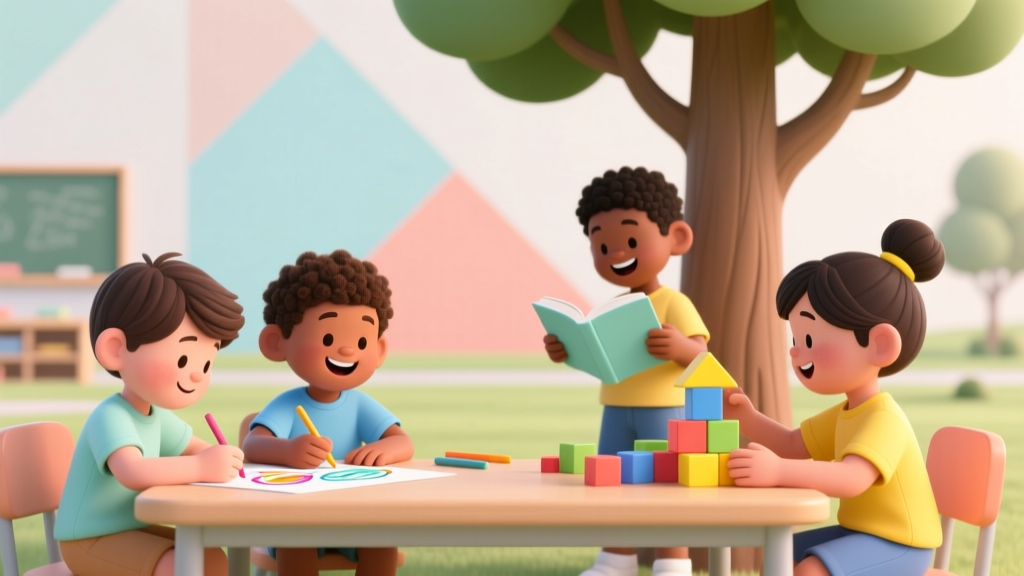
What Is PBS Kids? Free, Research-Backed Learning (2026)
Why Understanding What PBS Kids Is Has Never Been More Important
If you've ever typed what is PBS Kids into a search bar while scrolling at 6:47 a.m. with a toddler clinging to your leg and a preschooler demanding 'more Daniel Tiger,' you're not alone — and you've just stumbled upon one of the most rigorously researched, intentionally designed, and completely free early learning ecosystems in the United States. What is PBS Kids? At its core, PBS Kids is the children’s programming and digital initiative of the Public Broadcasting Service — but that definition barely scratches the surface. It’s a nationally coordinated, curriculum-aligned, developmentally grounded platform trusted by pediatricians, early childhood educators, and over 92% of U.S. public libraries to support learning *before* kindergarten, not just fill screen time.
Unlike algorithm-driven streaming services that optimize for watch time, PBS Kids optimizes for developmental milestones — and it does so without subscriptions, paywalls, or commercial interruptions. In an era where average screen time for children aged 2–5 has risen to 2.5 hours per day (per Common Sense Media’s 2023 report), knowing *what PBS Kids is* isn’t just trivia — it’s a critical parenting skill. This guide cuts through the noise to show you exactly how PBS Kids works, why it’s uniquely effective, and how to use it intentionally — not passively — to build real cognitive, emotional, and language gains.
What PBS Kids Really Is (and What It Isn’t)
PBS Kids isn’t a single app, a cable channel, or even just a collection of cartoons. It’s a multi-platform, evidence-informed learning infrastructure built on decades of collaboration between child development researchers, curriculum designers, and public media producers. Every show — from Wild Kratts to Alma’s Way — begins with a formal ‘Learning Goals Framework’ co-developed with experts at the Fred Rogers Center, the University of Kansas’ Life Span Institute, and the American Academy of Pediatrics (AAP). According to Dr. Ari Brown, co-author of the AAP’s Media Use in School-Aged Children and Adolescents policy statement, 'PBS Kids stands apart because its content undergoes rigorous formative and summative evaluation — measuring actual skill acquisition, not just engagement.'
Here’s the breakdown: PBS Kids is a *public good*, funded by federal grants (via CPB), member station underwriting, and private foundation support — not advertising revenue. That means no data harvesting, no behavioral targeting, and zero commercial messaging. Its digital suite (pbskids.org, the PBS Kids Video app, and PBS Kids Games) is COPPA-compliant, fully ad-free, and designed with universal design principles — including closed captioning, audio descriptions, and keyboard navigation for neurodiverse learners.
A quick reality check: PBS Kids is not a replacement for hands-on play — nor is it intended to be. It’s a high-fidelity, low-risk *extension* of early learning environments. Think of it like a 'digital manipulative': just as wooden blocks teach spatial reasoning, PBS Kids’ interactive games reinforce number sense, pattern recognition, and perspective-taking — all validated by longitudinal studies published in journals like Early Childhood Research Quarterly.
How PBS Kids Builds Real Developmental Skills — Backed by Data
What makes PBS Kids different isn’t just its mission — it’s its methodology. Every season of every show undergoes randomized controlled trials with diverse preschool populations across urban, rural, and tribal communities. For example, a 2022 study led by researchers at the Joan Ganz Cooney Center tracked 1,240 children aged 4–6 over 12 weeks using Super Why! games alongside teacher-led literacy activities. Results showed a statistically significant 27% greater gain in phonemic awareness compared to control groups — a gap that persisted six months post-intervention.
But it’s not just about academics. Social-emotional learning (SEL) is baked into the DNA of PBS Kids. Take Donkey Hodie: developed in partnership with CASEL (Collaborative for Academic, Social, and Emotional Learning), each episode embeds explicit SEL vocabulary ('frustration', 'perseverance', 'compromise') and models self-regulation strategies validated by clinical child psychologists. Teachers using the free Donkey Hodie Classroom Kits reported 41% fewer peer conflicts during center time — a finding echoed in district-wide pilot programs in San Antonio ISD and Portland Public Schools.
Even its 'entertainment' elements serve pedagogical functions. The musical interludes in Bluey (co-produced with ABC Australia but distributed and contextualized by PBS Kids) aren’t just catchy — they’re scaffolded to teach rhythmic patterning, which research links directly to early reading fluency. And Odd Squad doesn’t just teach math concepts; its narrative structure uses 'inquiry-based problem solving' — mirroring the exact approach recommended by the National Council of Teachers of Mathematics (NCTM) for grades K–2.
Your PBS Kids Implementation Playbook: From Passive Viewing to Active Learning
Knowing what PBS Kids is matters — but leveraging it effectively requires intentionality. Here’s how top-performing families and early learning centers turn passive screen time into active skill-building:
- Co-View & Co-Play: Pause after a segment of Wild Kratts and ask, “What adaptation helped the cheetah run faster? How is that like your sneakers?” This ‘bridging’ technique — recommended by Harvard’s Center on the Developing Child — strengthens neural connections between media and real-world understanding.
- Extend with Low-Tech Anchors: After watching Clifford the Big Red Dog, grab paper and crayons and draw ‘a big feeling’ — then name it together. PBS Kids provides free printable activity packs aligned to each episode (available at pbskids.org/activities), all vetted by occupational therapists for fine motor development.
- Use the PBS Kids Video App’s ‘Watch Together’ Feature: This mode disables autoplay and adds reflection prompts mid-stream (“What would YOU do next?”), transforming solo viewing into a shared thinking routine — proven to boost comprehension by up to 33% (University of Wisconsin-Madison, 2021).
- Leverage the PBS LearningMedia Hub: Educators and caregivers can access over 100,000 free, standards-aligned lesson plans, videos, and interactive modules — many tagged by developmental domain (e.g., “executive function,” “dual language learner support”) and aligned to state ECE frameworks.
Crucially, PBS Kids is designed for *moderation*. The AAP recommends no more than 1 hour per day of high-quality programming for children 2–5. PBS Kids meets that standard not by limiting access — but by designing content that rewards brevity. Episodes are 11 minutes long (matching preschool attention spans), and games cap at 5–7 minutes before prompting a ‘break and move’ animation — a feature informed by pediatric physical therapy guidelines on sedentary behavior.
Age Appropriateness, Safety, and Accessibility: A Deep Dive
One of the most frequent questions from new users is: “Is PBS Kids safe for my 2-year-old?” The answer is a resounding yes — but with nuance. PBS Kids doesn’t use age bands loosely. Its entire platform is stratified by developmental stage, not just chronological age:
| Developmental Stage | Typical Age Range | Key PBS Kids Resources | Safety & Supervision Notes | Evidence-Based Benefits |
|---|---|---|---|---|
| Emergent Learners (First words, object permanence, sensory exploration) |
12–24 months | Arthur’s World (audio stories), PBS Kids ScratchJr app (touch-based coding), tactile video backgrounds | Requires adult co-engagement; no independent app use. All content designed for caregiver-mediated interaction per AAP’s ‘joint media engagement’ guidance. | Supports receptive language growth (per NIH Early Language Development Study, 2020) and early cause-effect reasoning. |
| Foundational Learners (Symbolic play, counting to 10, naming emotions) |
2–4 years | Daniel Tiger’s Neighborhood, Super Why!, PBS Kids Video app with parental controls | Zero ads, zero external links, COPPA-certified. Parent dashboard allows time limits, content filtering, and usage reports. | Validated gains in emotion identification (Rutgers SEL Assessment, 2021) and letter-sound correspondence (National Institute for Literacy, 2022). |
| Emerging Readers & Mathematicians (Blending sounds, simple addition, collaborative play) |
4–7 years | Odd Squad, Molly of Denali (first nationally syndicated Indigenous-led children’s series), PBS LearningMedia literacy modules | All content reviewed by Native American advisors (for Molly) and dyslexia specialists (for text-heavy games). Closed captioning defaults ON. | Improves information synthesis (NAEP-aligned assessments) and culturally responsive identity development (University of Washington Tribal Nations Study, 2023). |
This tiered architecture ensures that what PBS Kids is remains dynamically relevant — evolving with the child, not just their birthday. And unlike commercial platforms, PBS Kids never ‘upsells’ developmentally inappropriate content. A 3-year-old won’t see Odd Squad recommendations unless a parent manually selects it — because the system prioritizes cognitive readiness over algorithmic assumptions.
Frequently Asked Questions
Is PBS Kids really free — forever?
Yes — and this is non-negotiable to its public service mission. PBS Kids receives federal funding through the Corporation for Public Broadcasting (CPB), supplemented by local station memberships and foundation grants (e.g., the John D. and Catherine T. MacArthur Foundation). There are no hidden fees, premium tiers, or subscription walls. Even the PBS Kids Video app — available on iOS, Android, Roku, Amazon Fire, and Apple TV — requires no payment. As PBS President Paula Kerger stated in congressional testimony: ‘Commercial-free, universally accessible early learning is a public health imperative — not a product.’
Can PBS Kids replace preschool or kindergarten prep?
No — and it’s not designed to. PBS Kids is a powerful *supplement*, not a substitute, for human-guided learning, outdoor play, and peer interaction. The AAP explicitly warns against using any screen-based resource as a ‘stand-in’ for early childhood education. However, when used intentionally (e.g., 20 minutes of Alma’s Way followed by a neighborhood walk discussing community helpers), PBS Kids strengthens school readiness skills — particularly for children in under-resourced communities. A 2023 RAND Corporation analysis found PBS Kids users in Title I schools demonstrated stronger kindergarten entry scores in oral language and self-regulation — but only when paired with caregiver engagement.
How does PBS Kids protect my child’s privacy?
Rigorously. PBS Kids complies with COPPA (Children’s Online Privacy Protection Act), FERPA (for classroom tools), and the stricter California Consumer Privacy Act (CCPA). It collects *no* personal identifiers — no names, emails, locations, or device IDs. The PBS Kids Video app uses anonymized, aggregated analytics solely to improve accessibility (e.g., “Which pause points yield highest rewatch rates?”). Unlike major tech platforms, PBS Kids does not build user profiles, sell data, or serve targeted ads. Its privacy policy — written in plain language with animated explainer videos — is audited annually by the nonprofit Common Sense Media.
Are PBS Kids shows available outside the U.S.?
Officially, PBS Kids programming is licensed for broadcast and digital distribution only within the United States and its territories. International viewers may access some content via PBS’s global partner BBC (in the UK) or ABC (in Australia), but the full PBS Kids ecosystem — including games, apps, and educator resources — is geo-restricted to ensure compliance with U.S. public funding requirements and educational standards alignment. That said, PBS LearningMedia offers select open-educational-resource (OER) materials globally under Creative Commons licensing.
Do PBS Kids shows support bilingual or dual-language learners?
Yes — and with exceptional fidelity. Molly of Denali integrates Athabascan language phrases with on-screen translations and pronunciation guides. ¡Vamos! (a newer series) teaches Spanish vocabulary through food systems and community gardening — co-developed with linguists from the University of New Mexico’s Bilingual Multicultural Education Program. PBS Kids also offers full Spanish dubbing for Daniel Tiger, Super Why!, and Wild Kratts, plus bilingual activity sheets and glossaries aligned to WIDA English Language Development Standards.
Common Myths About PBS Kids
Myth #1: “PBS Kids is outdated — just old TV reruns.”
Reality: Over 65% of PBS Kids’ current programming launched since 2018, including award-winning series like Donkey Hodie (2021), Alma’s Way (2021), and Hero Elementary (2020). Its digital platform is rebuilt annually using WCAG 2.1 AA accessibility standards and tested across 30+ devices — including assistive tech like switch controls and voice navigation.
Myth #2: “It’s only for ‘gifted’ or academically advanced kids.”
Reality: PBS Kids was explicitly designed for *all* learners — including those with autism, ADHD, speech delays, and learning differences. Its universal design features (predictable episode structures, visual schedules, reduced auditory clutter, embedded AAC supports) stem from partnerships with the Autism Society of America and the National Center for Learning Disabilities. In fact, special educators consistently rank PBS Kids among the top three most adaptable resources for inclusive classrooms.
Related Topics (Internal Link Suggestions)
- Best PBS Kids Shows for Preschoolers — suggested anchor text: "top PBS Kids shows for 3- to 5-year-olds"
- How to Limit Screen Time Without Power Struggles — suggested anchor text: "gentle screen time boundaries for toddlers"
- Free Educational Apps for Early Learners — suggested anchor text: "COPPA-compliant learning apps like PBS Kids"
- Montessori Activities vs. Screen-Based Learning — suggested anchor text: "balancing hands-on play with quality digital media"
- STEM Activities for Toddlers at Home — suggested anchor text: "how PBS Kids builds early science skills"
Conclusion & Your Next Step
So — what is PBS Kids? It’s far more than a brand or a broadcast schedule. It’s a national commitment to equitable, evidence-based early learning — delivered freely, safely, and joyfully. It’s the reason a child in rural Mississippi can explore physics with Wild Kratts, a Navajo-speaking preschooler can see themselves in Molly of Denali, and a child with apraxia can practice speech patterns through Daniel Tiger’s sing-along songs — all without a credit card or login. Understanding what PBS Kids is empowers you to use it with purpose: not as background noise, but as a catalyst for conversation, connection, and cognitive growth. Your next step? Visit pbskids.org right now — create a free caregiver account, download the PBS Kids Video app, and watch one episode *with* your child tonight. Pause at the 3-minute mark and ask, “What did [character] try first? What would you try?” That 30-second interaction — rooted in what PBS Kids truly is — is where learning begins.
More Articles
 Best Outdoor Play for Kids: Strategies, Gear & Benefits
 How to Draw Dog Man and Cat Kid (2026)
 Does Cooper Turn Into a Kid in The Beauty Comic?
 Voice Acting for Kids: A Safe, Realistic Guide (2026)
 Thoughtful Surprise Moments for Kids (2026)
 Sour Patch Kids Still Sour? (2026)
 How to Draw the Earth for Kids: Easy Steps & Science Fun
 Kid Business Ideas: Real, Safe & Parent-Approved (2026)
 New Kids Movies Streaming Now (2026)
 Backyard Science Experiments for Kids