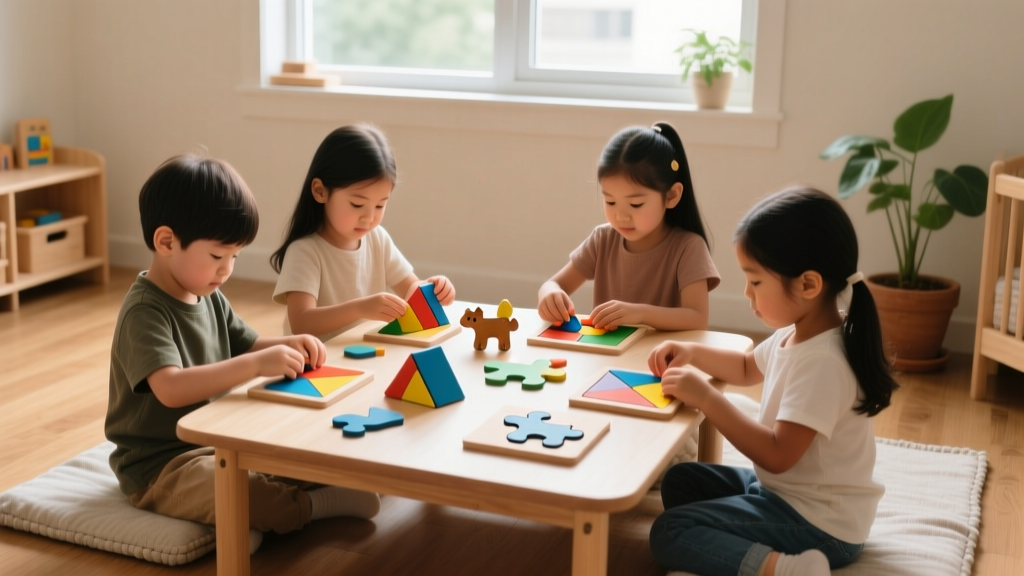
Puzzle Toys That Boost Problem-Solving (Ages 3–8)
The Power of Puzzles for Cognitive Development
Puzzle toys are among the most effective tools for developing problem-solving skills, logical thinking, and persistence in children. Working through puzzles teaches children to analyze problems, test solutions, learn from failures, and experience the deep satisfaction of finding answers through their own effort.
Types of Puzzle Toys by Development Stage
Ages 3-4: Knob and Chunky Puzzles
Large wooden pieces with knobs or chunky shapes that fit into corresponding cutouts. These develop shape recognition, fine motor skills, and the fundamental concept that problems have solutions. Look for puzzles with 4-12 pieces featuring familiar objects or animals.
Ages 4-5: Jigsaw Puzzles (12-48 pieces)
Floor puzzles with large pieces are perfect for this age. Children learn to sort by color, match edges, and work from the outside in. This develops systematic thinking and visual-spatial skills. Choose themes that match their interests — dinosaurs, space, or ocean life.
Ages 5-6: Logic and Pattern Puzzles
Introduce tangrams, pattern blocks, and simple Sudoku-style puzzles. These require children to manipulate shapes mentally and follow logical rules. Wooden brain teasers and metal wire puzzles add a tactile dimension to problem-solving.
Ages 6-8: Complex Puzzles and Strategy Games
100-300 piece jigsaws, Rubik's cubes, Rush Hour sliding puzzles, and introductory strategy board games. These develop patience, planning ahead, and the ability to hold multiple possibilities in mind simultaneously.
How Puzzles Build Executive Function
Puzzle play directly strengthens executive function skills:
- Working Memory: Remembering piece shapes and where they might fit
- Cognitive Flexibility: Trying different approaches when one doesn't work
- Inhibitory Control: Resisting the urge to force pieces that don't fit
- Planning: Developing a strategy before diving in
- Self-Monitoring: Checking progress and adjusting approach
Creating a Puzzle-Friendly Environment
Designate a flat surface where puzzles can remain in progress over multiple days. Provide good lighting and comfortable seating. Store puzzles in labeled containers with all pieces accounted for. Rotate puzzles regularly to maintain challenge and interest.
Social Puzzle Play
Puzzles become social learning opportunities when done together. Assign sections to different family members. Take turns adding pieces. Discuss strategies aloud. Celebrate completion as a team achievement. This builds communication and collaboration skills alongside cognitive abilities.
Digital vs. Physical Puzzles
While digital puzzle apps offer convenience, physical puzzles provide superior developmental benefits through tactile feedback, three-dimensional manipulation, and social interaction. Use digital puzzles as supplements, not replacements, for hands-on puzzle play.
More Articles
 Piece by Piece for Kids: Best Building Toys (2026)
 Who Played Kid Ray in Lean on Me? Why It Matters
 Best Evidence-Based Educational Toys for Early Learning
 Learning Tablets vs. Traditional Toys: What Research Shows
 Is PolyBuzz Safe for Kids? A Safety Audit (2026)
 Did Diddy Blow Up Kid Cudi’s Car? (2026)
 Montessori Toys for 2-Year-Olds
 Who Shot Billy the Kid? Truth, Teaching Tools & Myths
 Who Is the Blonde Kid in Happy Gilmore? (2026)
 i-Ready for Kids: 7 Evidence-Based Truths (2026)