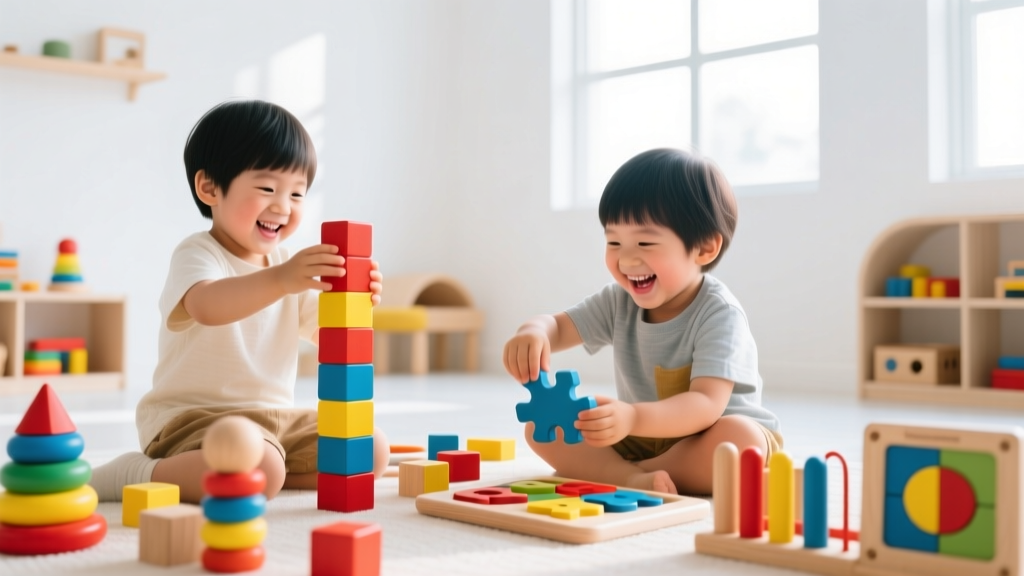
Best Puzzle Toys for Problem Solving
Why Puzzle Toys Are Powerhouses for Cognitive Growth
Puzzle toys are far more than quiet-time distractions—they’re dynamic tools that shape how children think, reason, and persevere. Research from the American Academy of Pediatrics shows that early exposure to structured problem-solving play strengthens neural pathways linked to executive function, spatial reasoning, and working memory. Unlike passive screen time, puzzles require active engagement: testing hypotheses, learning from mistakes, and adjusting strategies in real time. The best ones don’t just entertain—they scaffold thinking. And the magic? They meet kids where they are: a 2-year-old stacking rings builds foundational sequencing skills; a 10-year-old tackling a 3D metal brain teaser practices deductive logic and patience. In this guide, we spotlight puzzle toys proven to nurture problem solving—and give you clear, actionable ways to maximize their impact.
Top Puzzle Toys by Age & Skill Level
Toddlers (2–4 Years): Building Foundations
At this stage, success is measured in focus time—not completion. Prioritize chunky, tactile puzzles with clear visual cues and minimal pieces.
- Shape Sorters with Multiple Holes: Look for ones with varied textures or colors (e.g., Melissa & Doug Shape Sorting Cube). These teach categorization, hand-eye coordination, and cause-and-effect.
- Simple Wooden Peg Puzzles: Choose puzzles with thick, easy-grip knobs and realistic images (animals, vehicles). Avoid overly abstract themes—concrete visuals help toddlers connect symbols to real-world objects.
- Stacking & Nesting Sets: Oball Stack & Nest Cups or Tegu Magnetic Blocks (with large, safe magnets) encourage trial-and-error while developing spatial vocabulary (“inside,” “on top,” “next to”).
Parent Tip: Sit beside your child—not across the table—and narrate your thinking aloud: *“Hmm, this circle doesn’t fit in the star hole. Let’s try the round one instead!”* This models flexible thinking without taking over.
Preschoolers (4–6 Years): Introducing Logic & Sequencing
Now kids can follow multi-step instructions and begin recognizing patterns. Introduce puzzles that layer complexity gradually.
- Progressive Jigsaw Puzzles: Start with 12–24 pieces featuring familiar themes (community helpers, nature). Ravensburger’s My First Puzzles series uses soft-click technology so kids hear success—and learn self-correction.
- Logic Path Games: ThinkFun’s Robot Turtles (board game format) teaches sequencing and debugging using cards and a turtle pawn—no reading required. Kids “code” moves step-by-step, building computational thinking before screens.
- Interlocking Construction Sets: LEGO DUPLO or Magformers allow open-ended building with guided challenges (e.g., “Build a bridge that holds a toy car”). This blends creativity with structural problem solving.
Parent Tip: Use the “Two-Try Rule”: After two attempts at a tricky piece or step, ask, *“What’s one thing we haven’t tried yet?”* Then pause for 5 seconds—giving your child space to generate ideas, not just wait for your answer.
School-Age Kids (7–12 Years): Deepening Strategy & Resilience
This age craves challenge—and benefits most from puzzles that demand sustained attention, hypothesis testing, and metacognition (“thinking about thinking”).
- Multi-Layered Mechanical Puzzles: Hanayama Cast Puzzles (Level 3–5) offer elegant, frustration-resistant designs. Each requires observing movement patterns, testing rotations, and backtracking—a physical metaphor for scientific method.
- Escape Room–Style Kits: Exit: The Game or ThinkFun’s Code Master combine storytelling with logic grids, pattern recognition, and sequential deduction. Kids work through clues like real investigators.
- Algorithmic Coding Toys: Osmo Coding Starter Kit or Botley 2.0 introduce loops, conditionals, and debugging through tangible programming blocks—turning abstract coding concepts into visible, solvable puzzles.
Parent Tip: Normalize struggle. Say, *“Your brain is growing right now—that ‘stuck’ feeling means new connections are forming.”* Then suggest a 90-second “brain break” (stretch, sip water) before returning—not to solve it for them, but to reinforce that persistence is a skill, not an innate trait.
How to Maximize Learning—Beyond Just Buying Toys
Even the best puzzle won’t build problem-solving muscles if used passively. Here’s how to turn play into powerful practice:
- Create a “Puzzle Station,” Not a Toy Bin: Dedicate a low shelf or small tray with 3–4 curated puzzles (rotated weekly). Limit choices to reduce decision fatigue and increase depth of engagement.
- Ask Open-Ended Questions, Not “What’s the Answer?”: Try: *“How did you figure out which piece went first?”*, *“What would happen if we flipped this piece?”*, or *“What’s a different way to start?”* These prompt reflection—not just result-oriented thinking.
- Play *With* Them—Then Step Back Strategically: For the first 2–3 minutes, co-solve to model curiosity and calm frustration. Then say, *“I’ll be nearby—I’d love to hear your next idea when you’re ready.”* This builds autonomy while keeping support accessible.
- Celebrate Process, Not Perfection: Praise specific actions: *“You kept trying different angles—that’s how engineers solve hard problems!”* or *“I noticed you wrote down your clues. That’s brilliant note-taking!”*
Also, resist the urge to “fix” mismatched pieces or interrupt mid-struggle. A 2022 study in Child Development found that children who experienced brief, supported frustration during puzzle play showed 23% greater persistence on novel tasks 2 weeks later—proof that productive struggle is developmental gold.
Final Thoughts
Choosing puzzle toys isn’t about finding the flashiest item—it’s about matching challenge to readiness, honoring effort over outcome, and staying present in the process. When you engage thoughtfully, every puzzle becomes a micro-lab for resilience, logic, and creative confidence. Start small: pick one puzzle your child hasn’t mastered yet, set a 10-minute timer, and try one tip from this article today. You’re not just building a tower or solving a maze—you’re wiring their brain for lifelong problem solving.
More Articles
 How Many Kids Did Anne Boleyn Have? (2026)
 Choosing Educational Toys: A Research-Based Guide
 Poseidon’s Kids: Myth & Teaching Guide for Kids
 How Many Kids Does Zeus Have? Mythology Learning Kit
 Is Ellaola Good for Kids? (2026)
 How Old Was Ralph Macchio in Karate Kid? (2026)
 How Many Kids Does Aphrodite Have? Myth & Teaching Tips
 Who Do You Think You Are Kidding, Mr. Hitler? (2026)
 Who Made PBS Kids? A Public Media Partnership
 Learning Safety Tips for Play & Study Environments