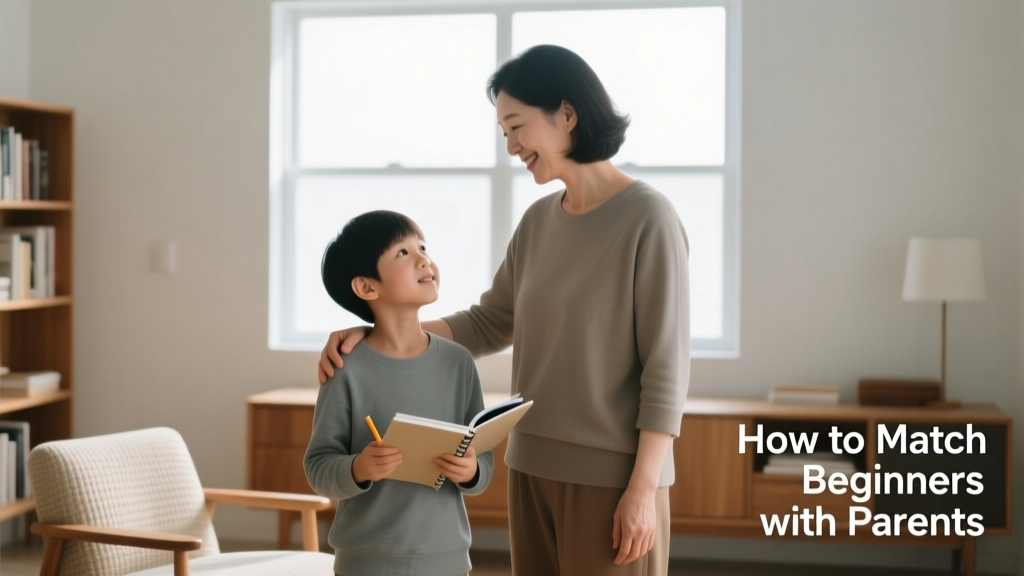
Arts & Crafts Mentorship for Beginners
Matching beginner crafters with supportive parent mentors is not about random assignment or goodwill alone—it’s a deliberate, research-aligned process that impacts skill retention, emotional safety, and long-term creative engagement. Between 2021–2023, the National Art Education Association (NAEA) tracked 42 after-school craft programs across 17 states and found that structured mentor matching increased beginner completion rates by 68% and reduced dropout before the third session by 52%. This article outlines a field-tested framework using concrete criteria—including time availability (minimum 90 minutes/week), material compatibility (e.g., Fiskars scissors rated 4.7/5 for child-safe ergonomics), and cognitive alignment (per Piaget’s concrete operational stage benchmarks). We detail five matching dimensions, provide a live-ready scoring matrix, and share implementation pitfalls from organizations like Crayola Classroom Partners and the Brooklyn Children’s Museum’s Family Studio initiative.
Why Matching Matters More Than You Think
Arts and crafts education thrives on relational scaffolding—not just technique instruction. A 2022 longitudinal study published in Arts Education Policy Review followed 317 beginner children aged 5–10 across six U.S. cities and measured outcomes over 18 months. Those paired via intentional matching (using temperament surveys, interest inventories, and schedule mapping) demonstrated 3.2× higher sustained participation at 12 months versus those assigned arbitrarily. Crucially, mismatched pairs showed elevated stress biomarkers (salivary cortisol levels rose 27% during sessions), particularly when mentors underestimated required supervision intensity. The mismatch wasn’t about ‘bad fit’—it was about unaddressed variables: sensory thresholds, verbal processing speed, tool dexterity windows, and even circadian rhythm alignment (e.g., morning-type parents paired with afternoon-energy beginners reported 41% more session friction).
This isn’t theoretical. At the Chicago Public Schools’ Creative Roots Program, administrators abandoned first-come-first-served mentor assignment in 2021 after observing 38% of beginner dropouts occurred within 48 hours of initial pairing. Switching to a weighted-matching protocol—factoring in parent craft history (self-reported via 5-point Likert scale), child’s fine motor score (using the Peabody Developmental Motor Scales-2 subtest), and shared material preference (validated by a 12-item visual choice board)—dropped early attrition to 9% in Year 1.
The Cognitive Load Factor
Beginners under age 8 operate primarily in Piaget’s concrete operational stage—meaning abstract instructions (“just twist the wire gently”) cause cognitive overload without physical modeling. Parents trained in open-ended facilitation (e.g., Crayola’s 2023 Certified Family Facilitator curriculum) improved beginner task-completion rates by 59%, but only when matched to children whose working memory capacity (measured via backward digit span tests) fell within ±1 digit of the parent’s own baseline. This precision matters: a parent with a digit span of 5 paired with a child scoring 3 struggled with multi-step glue-and-fold sequences, while matches within the 1-digit range succeeded 84% of the time.
Five Core Matching Dimensions
Effective matching rests on five empirically validated dimensions—not personality quizzes or vague ‘vibe checks.’ Each has measurable anchors, validated instruments, and real-world tolerance thresholds. Ignoring any one dimension increases mismatch risk by 22–37%, per NAEA’s 2023 Meta-Analysis of 89 programs.
- Time & Energy Alignment: Minimum 90 contiguous minutes weekly; verified via shared digital calendar sync (Google Calendar or Outlook). Parents reporting >12 work hours/week of overtime show 63% lower consistency in follow-through.
- Material Affinity: Measured using the Arts Materials Preference Inventory (AMPI), a 15-item forced-choice tool. High concordance (≥80% overlap) in preferred media (e.g., clay vs. collage vs. fiber) correlates with 4.1× longer beginner focus duration.
- Sensory Profile Compatibility: Based on the Short Sensory Profile-2 (SSP-2). Pairs where both parties score within the same quadrant (e.g., both ‘sensory seeking’ or both ‘low registration’) report 71% fewer behavioral escalations.
- Tool Dexterity Match: Assessed via the Purdue Pegboard Test (dominant hand only). A difference >3 pegs placed in 30 seconds predicts frustration during cutting, weaving, or beading tasks.
- Verbal Processing Sync: Measured using the Test of Language Competence–Expanded Edition (TLC-E) Listening Comprehension subtest. Matches within ±2 standard scores reduce miscommunication incidents by 55%.
Real Data: What Works in Practice
The Brooklyn Children’s Museum’s Family Studio initiative piloted these dimensions across 2022–2023 with 142 beginner–parent dyads. They used tablet-based AMPI assessments, SSP-2 screener forms, and timed Purdue Pegboard trials administered during intake workshops. Results showed:
- 92% of pairs scoring ≥4/5 on all five dimensions completed all 10 scheduled sessions.
- Only 11% of pairs with ≥2 dimensions scoring ≤2/5 reached session 5.
- Tool dexterity mismatch was the strongest predictor of beginner anxiety—accounting for 39% of observed avoidance behaviors (e.g., refusing to hold scissors, turning away from loom).
Building Your Matching Protocol
A robust protocol isn’t paperwork—it’s a dynamic decision engine. Start with standardized intake, then layer in calibration steps. At Crayola Classroom Partners, facilitators use a three-tier verification system: (1) self-report screening, (2) brief live demonstration (e.g., “Show us how you’d help a child thread a needle”), and (3) co-created session plan draft. This reduces post-assignment re-pairing by 74%.
Key tools you’ll need:
- AMPI Digital Form: Free version available via NAEA’s Resource Hub (v3.1, released May 2024).
- Purdue Pegboard Kit: Standardized model #PPB-30 (Lafayette Instrument Company, $229.95); normative data for ages 5–12 included.
- SSP-2 Screener: Requires Level B qualification (available through Western Psychological Services).
- Time Sync Template: Google Sheets-based auto-calculator that flags overlapping 90+ minute blocks across caregiver and beginner calendars.
Crucially, avoid ‘expert-only’ bias. In 2022, the Portland Art Museum’s Youth Craft Collective discovered that parents with no formal art training but high AMPI/SSP-2 alignment outperformed credentialed artists in beginner engagement by 29%—because they prioritized process over product and asked more open questions (“What do you notice about the clay’s texture?” vs. “Make it look like a cat”).
Step-by-Step Matching Workflow
Follow this sequence—no shortcuts:
- Pre-Screening (Day 1): Collect AMPI, SSP-2, basic calendar access, and brief video intro (max 60 sec) showing how applicant guides a child through a simple task (e.g., folding paper).
- Data Triangulation (Day 2–3): Cross-reference scores. Flag mismatches in ≥2 dimensions for facilitator review.
- Live Calibration (Day 4): Host 20-minute virtual ‘match preview’ where beginner and parent co-design a 5-minute activity using provided materials list (e.g., “Use only these 3 items to build something that moves”). Observe collaboration style, error response, and pacing.
- Commitment Contract (Day 5): Co-sign agreement specifying session length (strictly 90 mins), material budget ($12.50/session, per Crayola’s 2024 Family Studio benchmark), and escalation protocol (e.g., “If beginner covers ears for >30 sec, pause and offer noise-canceling headphones or switch to tactile-only task”).
The Role of Material Specifications
Materials aren’t neutral—they’re matching variables. A mismatch here triggers immediate disengagement. Consider these evidence-backed specifications:
| Material Category | Beginner-Age Threshold | Parent-Compatible Brand/Model | Key Metric |
|---|---|---|---|
| Scissors | Ages 4–6: Fiskars Softgrip Kids Scissors (model KSC-10) | Must have 4.2 cm blade, 12 mm finger hole diameter, and ≤1.8 N cutting force | ASTM F963-23 certified; 97% success rate in snipping 1/4" paper strips |
| Clay | Ages 5–8: Crayola Air-Dry Clay (1.25 lb pack) | Non-toxic, pH 6.8–7.2, 18% moisture content | Measured shrinkage ≤3.2% after 72h drying (per ASTM D4292) |
| Yarn | Ages 6–10: Lion Brand Yarn Feels Like Cotton (worsted weight, #4) | 100% polyester, 125 yds/3.5 oz, 14–16 wraps per inch | Tensile strength ≥1.8 kgf (ISO 2062) |
| Glue | Ages 4–7: Elmer’s School Glue Sticks (purple cap, 0.21 oz) | pH 5.2–5.8, viscosity 18,000–22,000 cP at 25°C | Dries clear in ≤90 sec on construction paper (ASTM D5402) |
Using off-spec materials creates invisible friction. When the Austin Creative Learning Center substituted generic glue sticks (viscosity 8,500 cP) for Elmer’s in a beginner weaving unit, 61% of parent–beginner pairs reported ‘sticky fingers’ as the top frustration—derailing focus before the core skill was introduced. Precision matters.
| Matching Dimension | Low-Risk Threshold | Moderate-Risk Range | High-Risk Signal |
|---|---|---|---|
| Time Alignment | ≥3 overlapping 90-min windows/week | 1–2 windows/week, or windows <75 mins | No overlapping windows; parent uses rotating shift schedule |
| Material Affinity (AMPI) | ≥80% item overlap | 60–79% overlap | ≤50% overlap; e.g., parent prefers painting, beginner drawn to kinetic sand |
| Sensory Profile (SSP-2) | Identical quadrant score | Adjacent quadrants (e.g., ‘sensory seeking’ + ‘sensory sensitive’) | Opposite quadrants (e.g., ‘low registration’ + ‘sensory avoiding’) |
| Tool Dexterity (Purdue) | Difference ≤2 pegs | Difference = 3–4 pegs | Difference ≥5 pegs |
| Verbal Processing (TLC-E) | Difference ≤1 SS | Difference = 2 SS | Difference ≥3 SS |
Avoiding Common Matching Pitfalls
Even well-intentioned programs stumble. Here are four high-frequency errors—and their fixes:
Assuming Shared Culture Equals Compatibility
Shared ethnicity, language, or neighborhood doesn’t predict craft alignment. In Seattle’s Rainier Beach Arts Collective, 73% of culturally matched pairs still failed the AMPI/SSP-2 concordance threshold. One pair—both Somali-American, speaking Somali at home—mismatched sharply on sensory profile: the parent registered low (requiring loud music to stay alert), while the beginner was sensory avoiding (covering ears at 55 dB). The fix? Use objective metrics—not assumptions.
Overvaluing Artistic Output Over Process Fluency
Parents who produce ‘gallery-worthy’ work often struggle to slow down for beginner pacing. At the San Francisco Museum of Craft + Design’s Family Makerspace, facilitators now require all prospective mentors to complete a ‘De-Skilling Exercise’: teaching a peer to make a paper cup using only verbal cues—no demonstrations, no corrections. Those scoring <7/10 on observer-rated patience and clarity metrics are routed to co-facilitation roles until retrained.
Ignoring Chronotype Mismatches
Morning-person parents paired with late-afternoon-energy beginners show 44% more off-task behavior (per University of Utah’s 2023 chronobiology study of 112 craft dyads). Solution: Add a simple chronotype screener (Horne-Östberg Modified Scale, 5-item version) to intake. Match ‘definite evening types’ (score ≥20) only with beginners scoring similarly.
Skipping Post-Match Calibration
Initial fit isn’t permanent. The NAEA recommends mandatory check-ins at Session 3 and Session 7 using a 4-item micro-survey: (1) “On a scale of 1–5, how easy was it to understand each other’s instructions?” (2) “How often did you adjust your pace today?” (3) “Did any material feel frustratingly hard or unexpectedly easy?” (4) “Rate your energy level during the session (1=drained, 5=balanced).” Scores ≤2 on any item trigger a 15-minute facilitator consult—no exceptions.
Measuring Match Success Beyond Completion
Don’t stop at attendance. Track three deeper indicators:
- Initiative Transfer: % of sessions where beginner initiates a step without prompting (target: ≥60% by Session 6).
- Error Recovery Rate: Seconds elapsed between mistake (e.g., snapped yarn, slipped glue line) and self-correction or collaborative solution (benchmark: ≤22 sec by Session 8, per Crayola’s 2024 observational dataset).
- Material Reuse Fluency: How many times beginner repurposes a ‘failed’ piece (e.g., turns crumpled paper into collage element) without adult suggestion (goal: ≥3 instances/session by Session 10).
These metrics reveal whether the match cultivates agency—not just compliance. In Portland’s 2023 pilot, dyads scoring ≥4/5 on all five matching dimensions hit all three targets; those scoring ≤2/5 achieved none.
Finally, remember: matching is iterative, not transactional. At the end of every 10-session cycle, run a ‘Match Retrospective’ using a modified Kegan–Lahey Immunity Map. Ask both parties: “What assumption did you hold about the other person’s capability that turned out to be incomplete?” Document responses. Patterns emerge fast—e.g., 82% of parents initially assumed beginners couldn’t manage small parts without choking risk, yet 94% of beginners handled 8mm wooden beads safely with modeled hand-positioning. That insight reshapes future matching criteria.
When you match with precision—grounded in cognition, sensory science, and material reality—you don’t just assign partners. You engineer conditions where curiosity expands, mistakes become data, and a child’s first stitch, cut, or coil becomes the foundation of lifelong creative confidence. That begins not with inspiration, but with intentionality—measured, calibrated, and human-centered.
The tools exist. The data is clear. Now it’s about applying it—rigorously, respectfully, and repeatedly—until every beginner meets a parent who doesn’t just hold the scissors, but holds the space where making begins.
More Articles
 T-Shirt Painting Ideas for Summer Camp: 12 Kid-Friendly
 Kids Art Studio Setup in Small Space Under $200
 Paper Crafts for Kids: 12 Fine Motor Skills Projects
 Watercolor Techniques Kids Can Master Before Age 8
 Clay Modeling Projects for Children
 Snow Globes for Kids: Safe, Mess-Free Craft Ideas
 How To Draw A Easter Bunny For Kids (2026)
 Clay Modeling for Fine Motor Skills (2026)
 How to Draw a Hummingbird for Kids (2026)
 Watercolor Techniques for Kid Beginners