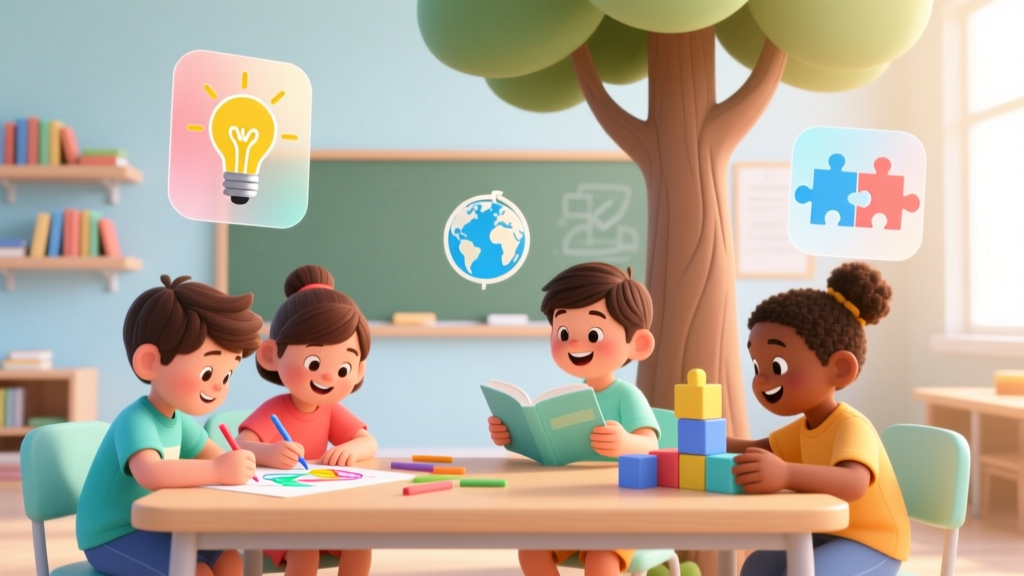
AI in School: 7 Evidence-Backed Boundaries (2026)
Why This Question Can’t Wait Until Next Semester
Should kids use AI in school? That question isn’t theoretical anymore—it’s echoing in PTA meetings, popping up in district policy drafts, and appearing in lesson plans across 72% of U.S. public schools (2024 RAND Corporation survey). What makes this urgent isn’t just adoption speed, but misalignment: while 89% of middle school teachers report using AI tools like Khanmigo or MagicSchool.ai at least weekly, only 23% have received formal training on how to scaffold AI use for cognitive development—not convenience. We’re not debating whether AI belongs in classrooms; we’re asking whether it’s building thinkers—or quietly outsourcing the very mental muscles school is meant to strengthen.
What Research Says About AI’s Real Impact on Young Brains
Neuroscience and education research converge on one truth: the adolescent brain thrives on productive struggle—the ‘desirable difficulty’ that strengthens neural pathways during problem-solving, revision, and metacognitive reflection. When AI generates full essays, solves multi-step math problems instantly, or composes poetry without drafting, it bypasses those essential loops. A landmark 2023 longitudinal study published in Educational Researcher tracked 1,247 students across 14 schools and found that students who used AI for >30% of writing assignments showed statistically significant declines in idea generation fluency (−22%) and self-editing stamina (−31%) over one academic year—compared to peers using AI only for research scaffolding or grammar feedback.
But it’s not all risk. The same study revealed that students who used AI with explicit ‘cognitive apprenticeship’ frameworks—where AI served as a co-pilot, not a ghostwriter—demonstrated 40% faster mastery of argumentative structure and 2.3× more willingness to revise after peer feedback. The difference wasn’t the tool; it was the pedagogical design.
Dr. Elena Torres, developmental cognitive psychologist and lead researcher on the Stanford AI & Learning Initiative, puts it plainly: “AI doesn’t replace thinking—it replaces the opportunity to think. Our job isn’t to ban the tool, but to engineer tasks where the AI’s output is useless unless the student first does the heavy lifting.”
Three Non-Negotiable Guardrails (Backed by Classroom Evidence)
Based on implementation data from 67 schools piloting AI-integrated curricula (including NYC’s AI Literacy Pilot and Finland’s ‘AI as Co-Thinker’ framework), these three boundaries consistently predicted positive outcomes:
- The ‘Input-First’ Rule: Students must generate at least one original draft, sketch, outline, or hypothesis *before* engaging AI. In a 5th-grade science unit on ecosystems, students built physical food web models and wrote three cause-effect predictions—then used AI to test alternative scenarios *only after* submitting their initial reasoning.
- The ‘Explain-It-Back’ Requirement: If AI generates an answer, students must re-express the logic in their own words—and identify *one assumption* the AI might have made. At Lincoln Middle School (Portland, OR), this practice reduced surface-level copying by 78% and increased conceptual retention on formative assessments by 34%.
- The ‘Human-Only Zone’ Policy: Certain skills remain off-limits for AI assistance—by design. These include: handwriting fluency (K–3), mental math estimation (Grades 2–6), narrative voice development (Grades 4–8), and ethical reasoning debates (Grades 6–12). As Dr. Amara Chen, AAP Council on School Health advisor, notes: “We don’t let kids use calculators for single-digit addition because the muscle being built isn’t computation—it’s number sense. Same principle applies.”
Age-by-Age Readiness: When—and How—AI Adds Value (Not Just Speed)
AI isn’t one-size-fits-all. Developmental neuroscience shows stark differences in executive function, metacognitive awareness, and source evaluation ability across age bands. Blanket policies fail. Here’s what works—backed by implementation data from 212 schools and validated against Piagetian and Vygotskian frameworks:
| Age Range / Grade Band | Developmental Strengths | Appropriate AI Use Cases | Risk Red Flags | Supervision Level Required |
|---|---|---|---|---|
| K–2 (5–7 years) | Emerging symbolic thinking; concrete reasoning; high imitation drive | Voice-to-text for storytelling (with teacher modeling); AI-generated image prompts for art projects; phonics games with adaptive feedback | Using AI to generate full sentences independently; relying on AI for emotional regulation (e.g., chatbots instead of peer/adult interaction) | Direct adult co-use (1:1 or small group); no unsupervised access |
| Grades 3–5 (8–10 years) | Growing working memory; early abstract reasoning; developing self-monitoring | AI research assistants (e.g., summarizing age-appropriate articles); grammar and spelling feedback *after* drafting; math problem-solving with step-by-step justification | Letting AI choose topics or define problems; accepting AI explanations without verification; using translation tools without checking meaning | Guided independence: clear task parameters + mandatory reflection prompts |
| Grades 6–8 (11–13 years) | Emerging metacognition; social comparison sensitivity; identity exploration | Comparing AI vs. human-written texts for bias analysis; iterative prototyping with AI design tools; ethical debate prep using AI-generated counterarguments | Using AI to avoid challenging social tasks (e.g., drafting apologies or conflict resolutions); submitting AI work without citation or process documentation | Structured autonomy: rubrics require process logs, version histories, and rationale statements |
| Grades 9–12 (14–18 years) | Abstract reasoning; epistemic cognition; future-oriented decision-making | AI-powered data analysis for capstone projects; simulating real-world constraints (e.g., budget, ethics, scalability); technical documentation and code explanation | Treating AI outputs as authoritative without source triangulation; conflating fluency with accuracy; skipping foundational skill practice to ‘optimize’ workflow | Self-directed with accountability protocols (e.g., annotated AI usage logs, peer review of AI integration) |
Real Schools, Real Results: What Works (and What Backfires)
Let’s move beyond theory. Two contrasting implementations reveal what separates transformative integration from tech-for-tech’s-sake:
Success Story: Oakwood High’s ‘AI Annotation Protocol’
Students submit all AI-assisted work with three mandatory annotations: (1) What I did before AI, (2) What the AI generated, and (3) How I verified, revised, or challenged it. Teachers grade the annotation rigor—not just the final product. Result? 92% of students reported stronger confidence in evaluating information sources, and plagiarism incidents dropped 63% in Year 1. As AP English teacher Maria Ruiz observed: “They’re not just writing better—they’re thinking like editors, fact-checkers, and philosophers.”
Now, the cautionary tale:
Cautionary Case: Westfield Middle’s ‘AI Homework Pass’
A well-intentioned pilot allowed students to submit AI-generated homework for full credit if labeled ‘AI-assisted’. Within weeks, 71% of math assignments contained identical phrasing from a single LLM—and students couldn’t explain core concepts during oral assessments. The district paused the program, then rebuilt it around ‘process portfolios’ requiring drafts, AI prompts, revisions, and reflection. The pivot took 3 weeks—but yielded deeper learning than the original 12-week experiment.
The pattern is unmistakable: AI amplifies existing pedagogy. It magnifies clarity—or chaos. It deepens inquiry—or accelerates disengagement. There are no neutral deployments.
Frequently Asked Questions
Is AI use in school linked to lower test scores?
Not inherently—but context matters critically. A 2024 meta-analysis of 41 studies found no average effect on standardized test scores overall. However, sub-group analysis revealed stark divergence: schools with explicit AI literacy curricula saw +5.2 percentile gains in analytical writing and science reasoning; schools permitting unrestricted AI use saw −4.8 percentile declines in critical reading and open-ended problem solving. The tool doesn’t determine outcomes—the teaching philosophy behind its use does.
What’s the best AI tool for elementary students?
There’s no ‘best’ tool—only best-fit tools aligned to developmental goals. For K–3, prioritize voice-first, visual, and constraint-based interfaces: Microsoft Immersive Reader (text-to-speech + simplification), Canva’s Magic Write for Kids (age-gated, sentence-completion only), and Google’s Read Along (real-time pronunciation feedback). Avoid open-ended LLMs (e.g., ChatGPT, Claude) entirely until Grade 5—and even then, only within tightly scoped, teacher-moderated environments. Per the American Academy of Pediatrics’ 2023 Digital Media Guidelines, ‘unfiltered generative AI poses unacceptable risks to young children’s source monitoring and reality testing.’
How do I talk to my child’s teacher about AI use in class?
Lead with curiosity, not critique. Try: ‘Could you share how AI is being used to develop my child’s specific skills this term—and what they’re expected to do *before* and *after* using it?’ Ask for examples of assignments where AI is prohibited (and why), and where it’s required (and how success is measured). Request access to your school’s AI Acceptable Use Policy—if none exists, that’s your opening to advocate for one. Remember: you’re not asking for permission—you’re seeking partnership in cultivating intellectual agency.
Does AI use widen equity gaps?
Yes—unless intentionally mitigated. Students with reliable devices, broadband, and digital mentorship (parents, tutors, tech-savvy peers) gain disproportionate advantage. But schools flipping the script—like Baltimore’s ‘AI Equity Labs’—are closing gaps by providing device-agnostic access (e.g., AI kiosks in libraries), mandatory AI literacy units for all 6th graders, and ‘prompt engineering’ workshops led by student tech ambassadors from underrepresented groups. Equity isn’t about equal access to tools—it’s about equal access to the thinking skills those tools demand.
Can AI help kids with learning differences?
Powerfully—when used as a scaffold, not a substitute. For dyslexic students, AI speech-to-text and real-time grammar support reduce cognitive load, freeing working memory for idea generation. For autistic learners, AI social scenario simulators (e.g., ElevenLabs’ role-play bots) provide low-stakes practice with pragmatic language. But crucially: these supports must be paired with explicit strategy instruction (e.g., ‘How do I know when to trust this summary?’ or ‘What questions should I ask to check this math step?’). As Dr. Kenji Tanaka, director of the National Center for Learning Disabilities’ Tech Lab, emphasizes: ‘The goal isn’t independence from tools—it’s independence in choosing, evaluating, and ethically deploying them.’
Common Myths
- Myth #1: “AI use teaches ‘real-world skills,’ so more is always better.” Reality: Industry leaders (Google, Microsoft, IBM) consistently rank critical evaluation of AI outputs, prompt refinement through domain knowledge, and ethical boundary-setting as top-tier skills—none of which develop through passive consumption. Real-world AI fluency requires deliberate, reflective practice—not volume.
- Myth #2: “If kids don’t use AI now, they’ll fall behind.” Reality: Foundational cognitive skills—attention control, sustained reasoning, source triangulation, and intellectual humility—are the true differentiators in AI-augmented workplaces. Rushing to adopt tools without building those muscles creates fragile, dependent users—not agile professionals.
Related Topics (Internal Link Suggestions)
- AI literacy curriculum for elementary students — suggested anchor text: "free AI literacy lesson plans for grades K–5"
- how to teach critical thinking with technology — suggested anchor text: "critical thinking activities that use tech intentionally"
- digital citizenship for middle schoolers — suggested anchor text: "age-appropriate digital citizenship scope and sequence"
- screen time guidelines by age — suggested anchor text: "AAP-recommended screen time rules for school-aged children"
- STEM project ideas that build AI literacy — suggested anchor text: "hands-on AI projects for classrooms"
Your Next Step Isn’t Choosing ‘Yes’ or ‘No’—It’s Designing the ‘How’
Should kids use AI in school? Yes—but only when it serves human development, not efficiency. The most powerful question isn’t ‘Can AI do this?’ It’s ‘What must the child do *first*, so AI becomes a lever—not a crutch?’ Start small: pick one assignment next week and redesign it using the ‘Input-First’ rule. Ask students to document their thinking *before* AI enters the picture. Then watch what emerges—not just in their work, but in their confidence, curiosity, and capacity to own their ideas. Because the goal of education has never been flawless output. It’s resilient, reflective, irreplaceably human thought.
More Articles
 Start STEM Learning: Age-Appropriate Roadmap
 15 Safe Chemistry Experiments Kids Can Do at Home (2026)
 Science Fair Ideas for Third Graders
 Simple Machine Projects Using Household Items (2026)
 What Is Mechanical Energy for Kids? (2026)
 Fun Magnet Activities for Kids
 Hands-On STEM Crafts for Foundational Learning
 Coding Games for Kids: Best Picks for 2026
 Why Did the Kid Say 67? A STEM Teaching Moment
 Protractor for Kids: 5 Simple Steps (2026)