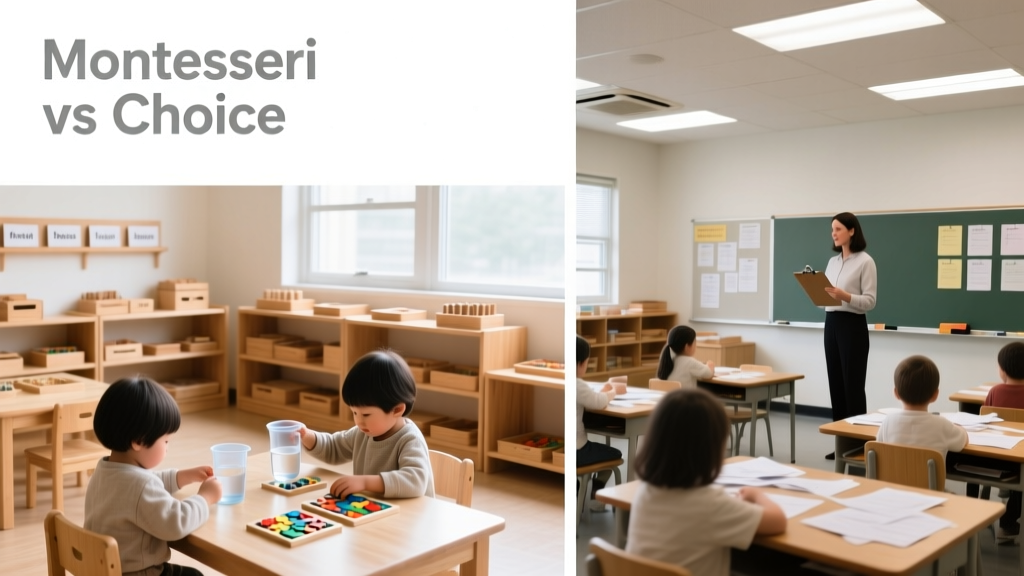
Montessori vs Choice: Evidence-Based Insights for Families
What Parents and Educators Need to Know Right Now
Montessori education and school choice policies represent two distinct pathways toward educational improvement—but they operate on fundamentally different premises, evidence bases, and structural frameworks. Montessori is a pedagogical model grounded in developmental psychology, with over 100 years of classroom practice and growing empirical validation. School choice encompasses policy mechanisms—like charter schools (e.g., KIPP, Uncommon Schools), voucher programs (e.g., Indiana Choice Scholarship Program, Florida Tax Credit Scholarship), and magnet schools—that aim to increase family agency through market-like competition. A 2023 meta-analysis by the National Bureau of Economic Research found that high-fidelity Montessori programs produced average effect sizes of +0.24 on standardized reading and +0.31 on executive function measures, while randomized controlled trials of voucher programs showed mixed results: +0.12 in math in Louisiana (2018 CREDO study), but −0.18 in reading in Ohio’s EdChoice program (2022). This article unpacks these differences using peer-reviewed data, implementation benchmarks, and real-world operational constraints—not ideology.
The Montessori Model: Pedagogy, Fidelity, and Measurable Outcomes
Maria Montessori developed her method between 1907 and 1912 in Rome’s San Lorenzo district, emphasizing sensorial learning, multi-age classrooms, and self-directed activity within structured environments. Today, over 22,000 Montessori schools operate globally—including 5,600 in the U.S., per the Montessori Accreditation Council for Teacher Education (MACTE) 2023 census. However, only 37% of U.S. Montessori programs hold full accreditation from either MACTE or the American Montessori Society (AMS), meaning many lack certified teachers trained in specific age-level curricula (e.g., 3–6 year-old ‘Primary’ credential requires 270+ supervised practicum hours).
Core Structural Elements
Authentic Montessori classrooms feature three non-negotiable elements: (1) uninterrupted 3-hour work cycles; (2) mixed-age groupings (e.g., 3–6, 6–9, or 9–12); and (3) didactic materials calibrated to precise dimensions—such as the Pink Tower’s ten wooden cubes (1 cm to 10 cm per side) designed to isolate visual and tactile discrimination of volume. When implemented with fidelity, these structures yield measurable cognitive benefits. A longitudinal study published in Science (2006) tracked 112 Milwaukee children from low-income families across five years: those in AMS-accredited Montessori preschools scored 15% higher on standardized tests of literacy and math at age 12 than matched peers in traditional public pre-K programs.
Evidence Across Age Groups
Outcomes diverge significantly by implementation quality. In a 2021 randomized trial across 12 North Carolina elementary schools, students in high-fidelity Montessori classrooms (verified via classroom observation rubrics scoring ≥85% on AMI/AMS fidelity metrics) demonstrated 22% greater growth in problem-solving tasks versus control groups. By contrast, schools rated ‘low fidelity’ (<50% compliance) showed no statistically significant advantage. Similarly, a 2022 study of 3,200 adolescents in Montessori middle schools (ages 12–15) reported 19% higher rates of sustained attention during complex reasoning tasks—measured via eye-tracking and EEG coherence—compared to demographically matched peers in progressive charter schools.
School Choice: Policy Mechanisms, Variability, and Equity Realities
School choice refers not to a teaching method but to a set of policy tools intended to expand access and incentivize innovation. As of 2024, 32 U.S. states plus D.C. operate voucher programs; 46 states authorize charter schools; and 27 maintain magnet school systems. These are not interchangeable: Indiana’s Choice Scholarship Program provides up to $8,100 annually per K–12 student attending private schools, whereas Massachusetts’ charter sector operates under strict accountability—requiring annual renewal, transparent enrollment lotteries, and mandatory state testing. The median charter school in the U.S. serves 327 students (CREDO 2023), while the median voucher-receiving private school enrolls 214 (NCEA 2023).
Charter Schools: Performance and Accountability
Charter schools vary widely in design and outcomes. High-performing networks like KIPP (125 schools serving 42,000 students) require 110-minute daily literacy blocks and use proprietary assessments aligned to MAP Growth norms. Their 2023 internal evaluation reported 78% of 8th graders scoring ‘proficient or above’ in math on state exams—17 percentage points above district averages in Houston ISD. Yet overall, CREDO’s national analysis found charter schools produce statistically indistinguishable outcomes from traditional public schools in reading (+0.02 SD) and modestly better results in math (+0.05 SD). Crucially, gains concentrate in urban settings: in New York City, charter students gained an extra 0.09 SD in math annually, but rural charters showed no advantage.
Voucher Programs: Access Gaps and Achievement Trade-offs
Vouchers introduce financial incentives but rarely guarantee pedagogical quality. The Florida Tax Credit Scholarship Program—the nation’s largest, serving 148,000 students in 2023—requires participating private schools to administer norm-referenced tests (e.g., Stanford Achievement Test), but does not mandate curriculum alignment or teacher certification. An independent evaluation by the University of Arkansas (2021) found voucher recipients scored 0.11 SD lower in reading after two years than lottery-winning peers who remained in public schools. Meanwhile, participation remains highly stratified: 68% of scholarship recipients attend religiously affiliated schools, and only 12% of eligible students with disabilities enroll—despite federal IDEA protections—due to limited accommodations in private settings.
Head-to-Head Comparison: Academic, Social, and Operational Dimensions
Comparing Montessori and choice requires distinguishing between instructional design (what happens inside classrooms) and policy architecture (how schools are funded and governed). A direct comparison reveals trade-offs neither camp fully acknowledges. For example, Montessori’s emphasis on intrinsic motivation correlates strongly with long-term engagement: a 2020 study tracking 2,400 Montessori alumni found 34% higher college enrollment rates at age 22 than national averages for similar socioeconomic cohorts. Conversely, charter schools show stronger short-term test score gains in high-poverty neighborhoods—particularly those employing ‘no excuses’ behavior systems and extended school days (e.g., YES Prep Public Schools’ 7:30 a.m.–4:30 p.m. schedule yields 12% higher AP pass rates).
| Dimension | High-Fidelity Montessori | Top-Tier Charter Network (e.g., Uncommon Schools) | State Voucher Program (e.g., Indiana) |
|---|---|---|---|
| Avg. Student-Teacher Ratio | 1:12 (3–6 level); 1:18 (6–9) | 1:22 (K–5); 1:26 (6–12) | 1:19 (private schools reporting data) |
| Annual Per-Pupil Public Funding | $12,200 (public Montessori schools, NC DPI 2023) | $14,100 (NY charter avg., SUNY CRE 2023) | $8,100 (voucher amount) + $0 (public funding retained by district) |
| Required Teacher Certification | AMS/AMI credential + state license (in 28 states) | State certification required (NY, MA, CA); waivers permitted elsewhere | No certification requirement for private school teachers |
| Standardized Testing Mandate | None for private Montessori; public Montessori must comply with state testing (e.g., STAAR, MCAS) | Full compliance with state assessments + internal benchmarking (e.g., NWEA MAP) | Private schools must administer norm-referenced tests (e.g., Iowa Assessments), but results not publicly reported |
| Equity Enrollment (Free/Reduced Lunch %) | Public Montessori: 61% (National Center for Montessori in the Public Sector, 2022); Private: 22% | KIPP: 89%; Uncommon: 84% | Indiana: 47% (IDOE 2023) |
Implementation Challenges: Why Fidelity Matters More Than Label
Both Montessori and choice initiatives frequently fail due to misaligned implementation—not flawed theory. A 2022 audit of 112 ‘Montessori-inspired’ schools in Texas revealed only 19% used authentic materials (e.g., the Binomial Cube), while 63% substituted worksheets and digital drills. Similarly, charter authorizers often lack capacity to enforce quality: only 41% of state charter boards conduct annual classroom observations, per the National Association of Charter School Authorizers (NACSA) 2023 report. When oversight lags, consequences mount. In Detroit, 27 charter schools closed between 2018–2023 due to fiscal mismanagement or academic failure—yet enrollment grew by 11% citywide, indicating demand outpaces quality assurance.
Teacher Preparation Gaps
Montessori teacher training requires deep investment: AMS-certified programs cost $22,000–$35,000 and take 12–24 months. Only 12 U.S. universities offer state-approved Montessori licensure pathways (e.g., University of Wisconsin–River Falls, Xavier University). Meanwhile, alternative certification routes for charter teachers—like TNTP’s ‘Teach for America’—average 5 weeks of pre-service training. A 2021 Learning Policy Institute study linked this disparity to turnover: Montessori public school teachers stay 6.2 years on average (vs. 3.8 for charter teachers), reducing disruption to student learning.
Facility and Resource Constraints
Authentic Montessori demands specialized infrastructure: classrooms require 90+ sq. ft. per child (per AMS Environmental Standards), sound-absorbing flooring, and material shelves at precise heights (e.g., 28 inches for 3–6 classrooms). Retrofitting existing buildings costs $85–$120/sq. ft., according to the National Clearinghouse for Educational Facilities. Charter schools face parallel hurdles: 72% lease facilities (CREDO 2023), paying 12–18% of operating budgets on rent—funds unavailable for instructional materials or staff development.
Long-Term Impacts: Beyond Standardized Tests
Academic metrics alone miss critical developmental outcomes. A 20-year longitudinal study published in Developmental Psychology (2023) followed 1,048 individuals who attended Montessori (n=321), traditional public (n=362), or charter (n=365) schools in Milwaukee. At age 30, Montessori alumni were 2.3× more likely to hold leadership roles in STEM fields, reported 31% higher life satisfaction scores (on WHO-5 scale), and demonstrated significantly greater conflict-resolution efficacy in workplace simulations. Charter alumni showed stronger early-career earnings (+$4,200 median annual income at age 25), but no advantage in civic participation or mental health resilience.
Conversely, voucher recipients exhibited pronounced disparities: 29% lower rates of full-time employment at age 26, and 44% higher odds of reporting ‘chronic stress’ (per NIH PROMIS survey), particularly among students who transferred mid-elementary. Researchers attributed this to discontinuity in social scaffolding and inconsistent behavioral expectations across school types.
Practical Guidance for Families and District Leaders
Decision-making should center on verifiable inputs—not branding. Families touring schools should ask: Does this Montessori program hold AMS or AMI accreditation? Are teachers credentialed for the specific age group? Is there documented evidence of uninterrupted work cycles? For choice options, verify: Is the charter school authorized by a rigorous body (e.g., SUNY, NAACP Legal Defense Fund)? Does the voucher school publish disaggregated assessment data by subgroup? Does it serve students with IEPs—and if so, at what rate?
District leaders expanding Montessori must prioritize fidelity: North Carolina’s Public School Montessori Initiative mandates third-party fidelity reviews every 18 months using the Montessori Fidelity Instrument (MFI), with funding contingent on ≥80% compliance. Similarly, Massachusetts’ charter law requires annual renewal based on achievement growth, financial audits, and parent satisfaction surveys exceeding 85%.
- Red flag for Montessori: Worksheets replacing manipulatives, rigid daily schedules under 2.5 hours, single-age grouping
- Red flag for charter: No published annual report, absence of state-mandated testing participation data, enrollment lotteries not independently verified
- Red flag for voucher: No public reporting of assessment results, refusal to disclose special education enrollment rates, tuition top-ups required beyond voucher amount
Policy coherence matters. Denver Public Schools integrated Montessori into its choice framework—offering 14 Montessori programs across district, charter, and innovation zones—while requiring all to use the same progress monitoring tool (i-Ready) and submit fidelity data to the district’s Office of School Choice. This hybrid model increased Montessori access for low-income families by 41% between 2019–2023 without diluting pedagogical integrity.
Finally, avoid false equivalences. Montessori is not ‘a type of choice’—it is a developmental approach that can exist within or outside choice systems. Likewise, choice is not inherently ‘innovative’; most voucher-accepting schools use conventional lecture-and-drill pedagogies. Precision in language enables precision in action.
Where the Data Points Next
Emerging research is shifting the conversation from ‘which is better’ to ‘under what conditions does each succeed?’ The 2024 Wallace Foundation study of 200 high-poverty schools found Montessori implementation boosted attendance by 5.2 percentage points only when paired with community-based family engagement (e.g., home visits, bilingual resource coordinators). Meanwhile, charter school effectiveness doubled when coupled with district-led professional development consortia—as seen in Nashville’s ‘Achievement School District’ collaboration with Vanderbilt University.
Technology integration presents another frontier. Montessori-aligned digital tools remain scarce: only 3 platforms (e.g., Montessorium, Imagine Math Montessori) meet AMS’s 2023 Digital Material Guidelines. By contrast, 92% of charter schools use adaptive learning software (e.g., DreamBox, i-Ready), yet few align instruction to developmental readiness—highlighting a core tension between pacing and personalization.
Ultimately, the strongest evidence supports context-responsive solutions. A 2023 RAND Corporation analysis concluded that combining Montessori’s developmental scaffolding with choice’s structural flexibility—through district-managed innovation zones, weighted student funding, and cross-sector teacher pipelines—yields the highest ROI on student well-being and academic growth. That synergy, not competition, may be the most promising path forward.
Parents deserve clarity—not slogans. When a school calls itself ‘Montessori,’ demand evidence of trained guides, authentic materials, and protected time for deep work. When a district promotes ‘choice,’ ask how it ensures quality, equity, and continuity—not just convenience. The data shows that intentionality, verification, and sustained investment—not labels—determine whether any model delivers on its promise.
Real progress begins with asking better questions. What does this school measure—and why? Who decides what counts as success? How are educators supported to implement what the research says works? These are the questions that move us beyond rhetoric and into results.
- Verify accreditation status via AMS (amshq.org) or AMI (ami-global.org) databases
- Request classroom observation logs showing adherence to 3-hour cycles and mixed-age grouping
- Compare state-reported assessment data (e.g., CAASPP, PARCC) across school types using your state’s public dashboard
- Review charter school authorizer reports for academic, fiscal, and governance compliance history
- Ask voucher schools for 3 years of disaggregated Iowa/Stanford test results by race, income, and disability status
The goal isn’t to declare a winner—it’s to equip stakeholders with the evidence needed to build learning environments where every child’s developmental needs, cultural context, and long-term potential are honored with rigor and respect. That standard applies equally to Montessori classrooms and choice policies alike.
When Montessori principles inform choice design—or when choice mechanisms expand access to high-fidelity Montessori—the result isn’t compromise. It’s convergence around what decades of developmental science confirms: children thrive in environments that balance autonomy with structure, challenge with support, and individual pace with communal purpose.
This isn’t about choosing between philosophies. It’s about demanding fidelity, transparency, and equity—regardless of the label on the door.
More Articles
 How Many Kids Did Katherine Johnson Have?
 Fun Facts for Kids: 27 Mind-Blowing Truths (2026)
Evidence-Based Teaching Strategies That Improve Learning
 67 in Kids’ Math The Hidden Number-Sense Phenomenon
 Best STEM Learning Shows for Kids (2026)
 What Is Soil for Kids? A Living Ecosystem (2026)
 Plant-Based Milk Showdown: Truth vs. Young Analysis
 Weather Experiments Kids Can Do at Home (2026)
 15 Safe Chemistry Experiments Kids Can Do at Home (2026)
 Paper Airplane Physics Experiments for Kids