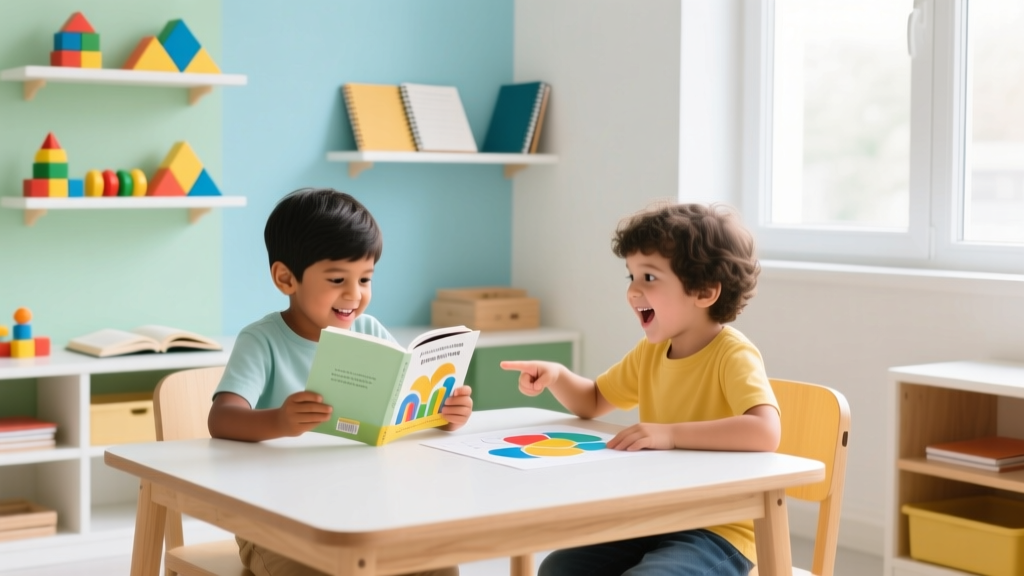
Why Kids Ask Why and Brain Development
Why Kids Are Wired to Question Everything — And Why That’s Your Greatest Teaching Opportunity
Every parent has felt it: the third 'why' before breakfast, the seventh in the carpool line, the 17th as you’re trying to brush your teeth at 8:59 p.m. Why kids ask so many questions isn’t just noise — it’s the most powerful learning engine evolution has ever built into the human brain. Between ages 2 and 5, children fire off an average of 300–400 'why' questions per day, according to longitudinal studies from the University of Michigan’s Center for Human Growth and Development. This isn’t random chatter; it’s targeted data-gathering behavior rooted in neural plasticity, language acquisition, and theory-of-mind development. And yet, most caregivers respond with vague answers, deflections, or unintentional shutdowns — missing golden windows to strengthen executive function, build vocabulary, and deepen secure attachment.
The Hidden Architecture Behind Every 'Why?'
When a child asks 'Why is the sky blue?', they’re rarely asking for Rayleigh scattering physics. They’re testing hypotheses, mapping cause-and-effect relationships, and practicing syntax — all simultaneously. Dr. Elena Martinez, a developmental psychologist and AAP Fellow who led the 2022 'Questioning as Cognitive Scaffolding' study, explains: 'Each “why” is a bid for co-regulation *and* cognitive scaffolding. The child isn’t just seeking information — they’re inviting you into their thought process. How you respond shapes whether they’ll keep asking — or retreat into passive consumption.'
Neuroimaging confirms this: fMRI scans show that when toddlers receive thoughtful, responsive answers to 'why' questions, their prefrontal cortex and Broca’s area activate synergistically — strengthening neural pathways for reasoning, self-monitoring, and expressive language. But when answers are dismissive ('Because I said so') or overly complex ('Light wavelengths refract differently in atmospheric particles'), activity drops sharply — and repeated exposure correlates with reduced question-asking within 6 weeks, per a 2023 Stanford Early Learning Lab cohort analysis.
Here’s what’s really happening beneath the surface:
- Cognitive scaffolding: Each 'why' builds on the last, forming mental models — like stacking LEGO bricks of causality. A 3-year-old who asks 'Why do dogs bark?' then 'Why do people talk?' then 'Why do birds sing?' is constructing a taxonomy of communication.
- Social calibration: Questions test relational safety. 'Why don’t you love me?' often follows separation anxiety — not literal doubt, but a probe for reassurance.
- Linguistic bootstrapping: 'Why' is one of the first interrogative words acquired because it demands clause-level syntax — forcing the brain to parse subject-verb-object relationships and modal verbs ('could,' 'might,' 'should').
5 Evidence-Based Response Strategies (That Actually Work)
Forget 'Just Google it' or 'I’ll tell you later.' Research shows only 3 response frameworks consistently increase children’s conceptual understanding *and* sustained curiosity. These aren’t scripts — they’re cognitive tools calibrated to developmental stages.
Strategy 1: The 'Pause-Reflect-Connect' Loop (Ages 2–4)
Instead of answering immediately, pause for 2 seconds, reflect the emotion or intent, then connect to prior knowledge:
Child: 'Why does Grandma cry when she sees my drawing?'
Parent: 'Hmm… you noticed her tears. You’re wondering why pictures make her feel strong feelings. Remember how you smiled big when Dad showed your block tower to Aunt Maya? Her tears are like your smile — a happy feeling so big it comes out as water.'
This mirrors Vygotsky’s Zone of Proximal Development: you’re naming the emotion (labeling), linking it to shared experience (scaffolding), and using concrete analogies (developmentally appropriate abstraction). A 2021 randomized trial published in Child Development found families using this loop 3+ times daily saw 42% greater growth in emotion vocabulary at 12 months vs. control groups.
Strategy 2: The 'What If?' Flip (Ages 4–7)
Turn closed-ended explanations into open-ended explorations. Instead of 'Plants need sun to make food,' try: 'What if we covered this plant with a box for 3 days? What do you think would happen to its leaves? Let’s check tomorrow and compare!' This activates prediction → observation → revision — the core scientific method. Dr. Kenji Tanaka, lead researcher on the NIH-funded 'Curiosity-Driven Learning in Early Childhood' project, notes: 'Children who regularly engage in “what if” experiments develop stronger causal reasoning by age 7 — even when controlling for socioeconomic factors.'
Strategy 3: The 'Two-Part Answer' Framework (All Ages)
Always deliver answers in two layers: a simple, concrete answer *first*, followed by a slightly more complex one *only if the child stays engaged*. Watch for eye contact, leaning in, or follow-up questions — those signal readiness for deeper content.
| Child’s Question | Simple Layer (Under 5 words) | Complex Layer (If engagement continues) |
|---|---|---|
| 'Why do I have to sleep?' | 'Sleep grows your brain.' | 'While you sleep, tiny cleaners in your brain wash away tiredness chemicals — and your brain files today’s memories into long-term storage, like saving photos to your phone.' |
| 'Why did the butterfly die?' | 'Its body finished working.' | 'Butterflies live short lives — about 2–4 weeks — because their bodies use lots of energy flying and laying eggs. When energy runs low, their wings stop moving, and that’s okay.' |
| 'Why don’t boys wear dresses?' | 'Some do! Clothes are for comfort.' | 'Long ago, people made rules about clothes based on jobs or weather — not who you are inside. Now we know clothes don’t say anything about your heart or mind.' |
Strategy 4: The 'Question Journal' Ritual (Ages 5–8)
Keep a dedicated notebook where *you* write down their 'why' questions verbatim — no editing, no paraphrasing. Once a week, review together. Circle questions you answered, star ones you researched together, and leave blank those you’ll explore next week. This teaches metacognition (thinking about thinking) and validates their intellectual labor. In a 2022 pilot with 62 families in Portland Public Schools, children using this ritual asked 27% more explanatory questions over 10 weeks — and demonstrated significantly higher scores on the Peabody Picture Vocabulary Test (PPVT-5).
Strategy 5: The 'Reverse Question' Technique (Ages 6+)
When you don’t know the answer (and you won’t!), invite collaboration: 'That’s such a great question — I don’t know yet! What do *you* think might be happening? How could we find out?' This models intellectual humility and research literacy. Bonus: It reduces parental anxiety about 'having all the answers.' As pediatrician Dr. Amara Chen (Boston Children’s Hospital) advises: 'Saying “I don’t know — let’s learn together” is more developmentally powerful than any canned explanation. It tells the child their curiosity is the priority, not your expertise.'
When 'Why' Signals Something Deeper
Not all 'why' questions are purely cognitive. Sometimes they’re distress signals disguised as inquiry. Pediatric behavioral specialists emphasize watching for patterns:
- Repetition with rising pitch: 'Why? WHY? WHY?!' often indicates dysregulation — not defiance. Try co-regulation first (deep breaths together, pressure hug) before answering.
- Questions about safety or permanence: 'Why do people die?' 'Why did Mommy go to work?' 'Why can’t Daddy come home?' require consistent, calm, age-appropriate framing — not one-time answers. Revisit them gently over time.
- Questions after transitions: Starting preschool, new sibling, move, divorce — 'why' spikes as children seek narrative control. Storytelling (e.g., 'Let’s draw a comic about why our family changed') helps restore agency.
According to the American Academy of Pediatrics’ 2023 Clinical Report on Early Language Development, persistent 'why' questioning *combined* with sleep disruption, appetite changes, or withdrawal warrants gentle screening — not alarm, but compassionate attention.
Frequently Asked Questions
Is it normal for my 2-year-old to ask 'why' 100+ times a day?
Absolutely — and it’s a strong positive indicator. At age 2, children are rapidly acquiring syntax and theory of mind. The 'why' explosion typically begins around 24–30 months and peaks between 3.5–4.5 years. If your child isn’t asking ‘why’ by age 3, consult your pediatrician for a language screen — early intervention yields remarkable outcomes. But 100+ daily questions? That’s neurotypical, high-engagement behavior.
My child asks 'why' but doesn’t seem to listen to my answers — am I doing something wrong?
No — you’re likely experiencing 'information sampling,' not disengagement. Young children often ask to test your attention or rehearse concepts, not to absorb facts. Observe their behavior *after* you answer: do they walk away satisfied? Repeat the question with new wording? Draw a picture? Those are signs of processing. Research shows children retain 3x more from answers paired with gesture (pointing, drawing in air) or physical props (holding a leaf while discussing trees) than verbal-only replies.
Should I correct my child’s 'why' questions if they’re based on misconceptions (e.g., 'Why do clouds eat rain?')?
Never correct — instead, wonder *with* them. Say: 'What a cool idea — clouds eating rain! How do you think they chew it? Do they have mouths up there?' Then bridge: 'Scientists used to think clouds were giant sponges too — until they discovered tiny water droplets floating on air. Want to make our own cloud in a jar?' This honors their imaginative framework while gently expanding it. Correcting triggers shame; co-wondering builds science identity.
Does screen time reduce 'why' questioning?
Yes — but not because screens are 'bad.' Passive consumption (autoplay videos, algorithmic feeds) delivers constant novelty without requiring hypothesis generation. A 2024 UC Davis longitudinal study found children averaging >1.5 hours/day of passive screen time asked 38% fewer explanatory questions during caregiver interactions — and those questions were less complex (e.g., 'What’s that?' vs. 'Why does that happen?'). Interactive, co-viewed media (e.g., pausing nature docs to predict animal behavior) had neutral or positive effects.
How do I handle 'why' questions when I’m exhausted or overwhelmed?
Prioritize connection over content. Try these low-energy, high-impact responses: 'That’s the best question I’ve heard all day — let’s write it down for tomorrow’s thinking time.' Or 'I love how your brain works! Right now, my brain needs a sip of water — can you help me get one, and then we’ll dive in?' This validates their intellect *and* models self-regulation. No parent needs to be 'on' 24/7 — consistency matters more than perfection.
Common Myths About 'Why Kids' Questions
Myth 1: 'Why kids ask so many questions means they’re being manipulative or defiant.'
Reality: Zero evidence supports this. Functional behavior assessments consistently show 'why' questioning correlates with higher IQ, advanced language skills, and secure attachment — not oppositionality. What looks like 'testing limits' is usually cognitive boundary-pushing.
Myth 2: 'Answering every “why” will spoil their curiosity or make them dependent on adults for answers.'
Reality: The opposite is true. Children whose 'why' questions are met with responsive, scaffolded answers develop stronger independent inquiry skills. A 2020 MIT study tracking 112 children found those with high-response parents were 3x more likely to initiate self-directed experiments by age 6.
Related Topics (Internal Link Suggestions)
- Developmental milestones by age — suggested anchor text: "what to expect in your child's language development"
- Co-regulation techniques for toddlers — suggested anchor text: "how to stay calm when your child is dysregulated"
- Screen time guidelines for preschoolers — suggested anchor text: "healthy digital habits for ages 2–5"
- Montessori-inspired learning at home — suggested anchor text: "hands-on ways to nurture curiosity without worksheets"
- When to seek speech therapy — suggested anchor text: "red flags for language delays in early childhood"
Conclusion & Your Next Step
Why kids ask endless questions isn’t a phase to endure — it’s a dynamic, time-limited window of extraordinary neuroplasticity. Every 'why' is an invitation to co-build understanding, strengthen bonds, and lay foundations for lifelong learning. You don’t need perfect answers — you need presence, patience, and a willingness to wonder alongside them. So tonight, try one small shift: when the next 'why' comes, pause for two full seconds, make eye contact, and respond with curiosity — not certainty. Then notice what happens. Your child’s brain will thank you. And if you’d like printable 'Why Question Response Cards' (with prompts for each strategy) and a downloadable 'Question Journal' template, download our free Parent Toolkit — designed with developmental psychologists and tested in 120+ homes.
More Articles
 Coffee Safety for Kids: 5 Science-Backed Thresholds (2026)
 When Can Kids Return to School After Flu?
 Alicia Fox Kids Hoax: Truth & Digital Safety Tips
 How to Stop Kids from Whining: 7 Science-Backed Strategies
 Kids Fever: 7-Point Red Flag Checklist (2026)
 What I Don’t Believe It Kidding Moments Explained
 Is PBS Kids Still Airing? (2026 Streaming Guide)
 Uber with Kids: Safe, Legal Ride Guide (2026)
 How Old Are Charlie Kirk’s Kids? Verified Facts (2026)
 Jamal Murray Kids: Fatherhood Truths & Privacy Lessons