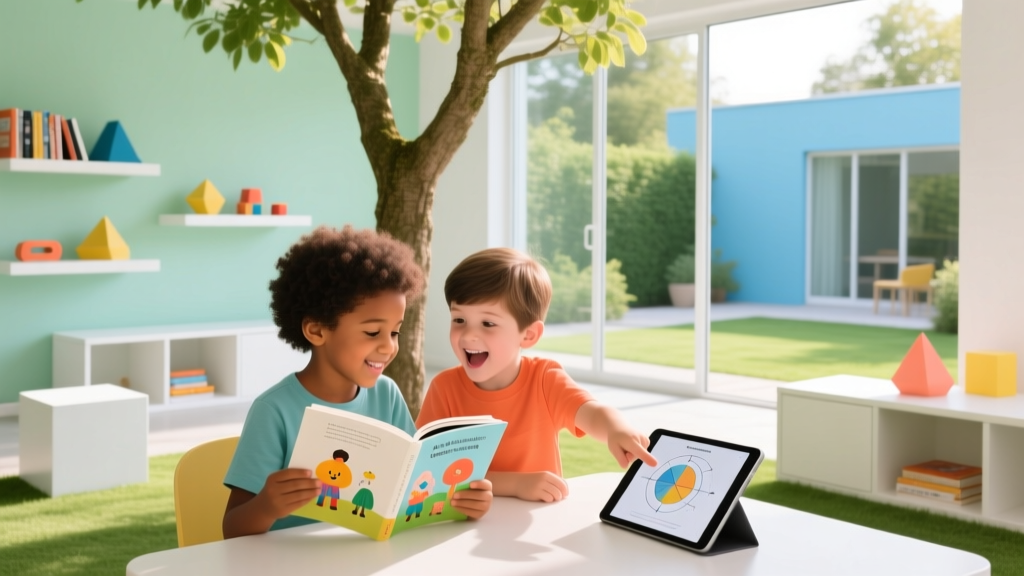
Why Is Homework Good for Kids? Research-Backed Benefits
Why Is Homework Good for Kids? More Than Just Busywork — It’s Brain-Building
When you ask why is homework good for kids, you're not just seeking justification for another after-school task — you're asking whether this daily ritual truly serves your child's development. In an era where screen time competes fiercely with quiet study, and parental skepticism about 'more worksheets' is at an all-time high, the answer isn’t 'because teachers assign it.' It’s because, when thoughtfully designed and appropriately calibrated, homework actively strengthens neural pathways, cultivates self-regulation, and builds academic resilience — benefits confirmed across decades of longitudinal research and validated by the American Academy of Pediatrics (AAP) and the National Education Association (NEA). This isn’t about rote repetition; it’s about scaffolding independence in a low-stakes environment where mistakes become data, not disasters.
The Real Cognitive Payoff: Beyond Memorization
Homework isn’t simply a reinforcement tool — it’s a deliberate cognitive workout. Dr. Angela Duckworth, psychologist and author of Grit, emphasizes that consistent, manageable academic challenges like homework help children develop 'deliberate practice' habits: focused effort over time that rewires the prefrontal cortex for sustained attention and working memory. A landmark 2018 meta-analysis published in Educational Psychology Review examined 195 studies involving over 2 million students and found that quality homework (defined as purposeful, individualized, and feedback-rich) correlated with a 12–15% average gain in standardized test scores — but only when duration matched developmental capacity. For elementary students, even 10–15 minutes of targeted math fluency practice or reading reflection builds automaticity, freeing up mental bandwidth for higher-order thinking later. Consider Maya, a second grader in Portland: her teacher assigned 'Math Journal Prompts' — not timed drills, but open-ended questions like 'Draw two ways to make 14 using addition.' After six weeks, Maya’s problem-solving flexibility improved measurably on district assessments, and she began applying similar visual strategies during science experiments. That’s not busywork — that’s executive function training disguised as pencil-and-paper work.
Social-Emotional Growth You Can’t Measure on a Report Card
Here’s what most parents miss: homework teaches emotional regulation long before college applications. When a fourth grader wrestles with a tricky paragraph summary, they’re not just practicing comprehension — they’re learning how to tolerate frustration, self-soothe, and pivot strategies. According to Dr. Lisa Damour, clinical psychologist and author of The Emotional Lives of Teenagers, 'The small-scale stressors of homework — deadlines, uncertainty, revision — are developmental inoculations. They let kids practice coping in safe, contained doses.' In fact, a 2022 University of Michigan longitudinal study tracked 1,247 children from ages 8–16 and found that students who regularly completed moderate homework showed significantly stronger self-efficacy and lower anxiety around academic challenges by adolescence — especially those with ADHD or learning differences. Why? Because homework provides repeated, low-risk opportunities to experience 'productive struggle,' then succeed. One parent in Austin shared how her son with dyslexia started using a color-coded planner after his IEP team introduced 'homework micro-routines': 5 minutes of previewing assignments, 10 minutes of focused work, then 2 minutes of self-check. Within eight weeks, he initiated planning independently — a skill that transferred directly to organizing his soccer gear and managing weekend chores.
The Independence Accelerator: From Supervised to Self-Directed Learning
Homework is the first formal apprenticeship in autonomy. Think of it as 'guided flight time' — the teacher sets the destination and checks the instruments, but the student pilots the plane. Montessori educators call this 'preparation of the environment'; developmental psychologists label it 'scaffolding withdrawal.' The goal isn’t perfection — it’s increasing ownership. A 2023 RAND Corporation study observed over 400 classrooms and discovered that students whose homework included choice elements (e.g., 'Pick one of three essay prompts' or 'Choose how to present your science findings: poster, video, or model') demonstrated 28% higher engagement and 22% greater retention than peers with uniform assignments. But autonomy requires structure: the most effective homework includes clear 'success criteria' (not just 'complete page 32'), built-in reflection prompts ('What part was easiest? Hardest? Why?'), and timely, specific feedback — not just a red checkmark. Take Liam, a seventh grader in Denver: his history teacher replaced weekly quizzes with 'Learning Logs' — short reflections on primary source analysis. He began noticing patterns in his own reasoning, catching his own assumptions, and even volunteering corrections during class debates. That metacognitive awareness — knowing *how* he learns — didn’t come from lectures. It came from writing three sentences, twice a week, about his thinking process.
When Homework Stops Helping — And What to Do Instead
Let’s be unequivocal: homework isn’t universally beneficial. Poorly designed, excessive, or misaligned assignments harm more than help. The AAP explicitly warns against homework for children under age 6, citing zero academic benefit and documented increases in family conflict and sleep deprivation. For older kids, the '10-minute rule' (10 minutes per grade level per night) remains the gold standard — but only if assignments are meaningful. A 2021 study in Pediatrics found that students assigned >2 hours of nightly homework showed diminishing returns, increased cortisol levels (a stress biomarker), and no academic gains beyond peers doing 45–60 minutes. So what distinguishes high-value homework? Three non-negotiable traits: (1) It connects to real-world relevance (e.g., calculating grocery costs instead of abstract decimals), (2) It allows for voice and choice, and (3) It’s calibrated to individual readiness — not grade-level benchmarks alone. If your child consistently melts down over spelling lists but thrives when recording vocabulary words as audio clips, that’s data. Not defiance — neurodiversity in action.
| Developmental Domain | How Homework Builds It | Age-Appropriate Examples | Red Flags (When It’s Not Working) |
|---|---|---|---|
| Cognitive | Strengthens working memory, processing speed, and conceptual transfer through spaced repetition and application. | K–2: Sorting household items by attribute; 3–5: Creating graphs from family survey data; 6+: Designing a budget for a mock business. | Child memorizes answers without understanding; avoids explaining reasoning; needs constant adult prompting to begin. |
| Executive Function | Practices planning, task initiation, time estimation, and self-monitoring in authentic contexts. | K–2: Using a visual checklist for packing backpack; 3–5: Estimating and tracking time spent on a project; 6+: Breaking multi-step research into phases with self-set deadlines. | Relies entirely on adult reminders; chronically misjudges time needed; abandons tasks mid-way without strategy shift. |
| Social-Emotional | Fosters resilience, self-advocacy, and emotional labeling through low-stakes challenge and reflection. | K–2: Drawing 'feelings faces' after completing a puzzle; 3–5: Writing one sentence about a frustration and one solution; 6+: Peer-reviewing drafts with structured feedback prompts. | Shuts down emotionally at first sign of difficulty; refuses help or feedback; expresses shame or worthlessness tied to performance. |
| Academic Identity | Builds 'I am a learner' identity through ownership, revision, and visible progress over time. | K–2: Keeping a 'My Learning Book' with photos of projects; 3–5: Maintaining a portfolio with 'Before/After' writing samples; 6+: Curating a digital showcase of best work with personal commentary. | Asks 'Is this right?' before attempting; compares work obsessively to peers; avoids sharing work even when praised. |
Frequently Asked Questions
Does homework improve grades — or just test scores?
Research shows homework correlates more strongly with improved *academic habits* than immediate grade bumps. A 2020 Stanford study tracking 3,200 middle schoolers found that students with consistent, moderate homework developed stronger study routines, better note-taking skills, and more proactive help-seeking behaviors — all of which predicted higher GPAs in high school, even when controlling for IQ and socioeconomic status. Grades reflect consistency and process; test scores reflect recall. Homework builds the former — which ultimately lifts the latter.
My child has ADHD. Is homework still beneficial — and how do we adapt it?
Absolutely — but traditional models often fail neurodiverse learners. According to Dr. Russell Barkley, leading ADHD researcher, 'Homework must serve as a scaffold for self-regulation, not a test of it.' Effective adaptations include: chunking assignments into 12-minute segments with movement breaks; using audio instructions paired with visual checklists; allowing oral responses or video summaries instead of written ones; and building in 'error analysis' time (reviewing mistakes together) rather than just grading correctness. Many schools now incorporate 'homework contracts' co-created with students — specifying supports, timelines, and success metrics — which reduce power struggles and increase follow-through.
What’s the ideal amount of homework for different ages?
The NEA and National PTA jointly endorse the '10-minute rule': 10 minutes per grade level per night (e.g., 30 minutes for third grade, 60 for sixth). However, this is a ceiling — not a target. A 2023 Johns Hopkins review emphasized that quality trumps quantity: 20 minutes of deep reading reflection yields more growth than 45 minutes of disconnected worksheets. For K–2, focus shifts to literacy routines (shared reading, journaling) and math talk (counting objects, estimating quantities) — not formal assignments. Preschoolers need zero homework; their 'learning work' is play, conversation, and exploration.
Can too much homework damage family relationships?
Yes — and it’s more common than many realize. A 2022 APA survey found that 68% of parents reported frequent homework-related conflicts, with 41% saying it negatively impacted sibling dynamics. The key isn’t eliminating homework — it’s redefining its role. Experts recommend designating 'homework time' as collaborative, not corrective: 15 minutes of shared reading, 10 minutes of math games, or co-creating a family timeline for history class. When homework becomes relational (not transactional), stress drops and learning deepens. As pediatrician Dr. Perri Klass advises: 'If homework consistently triggers tears, yelling, or avoidance, it’s not the child who needs fixing — it’s the assignment.'
Are digital homework platforms better than paper-based ones?
Not inherently — but they offer unique affordances when used intentionally. Adaptive platforms like Khan Academy provide instant, personalized feedback that reinforces growth mindset. However, research from the Joan Ganz Cooney Center shows that screen-based homework increases cognitive load for younger children and reduces retention compared to handwriting. The sweet spot? Hybrid approaches: use apps for drill-and-practice (spelling, math facts) and paper for reflective, creative, or analytical tasks. Always prioritize 'deep work' — uninterrupted focus — over convenience. If an app encourages multitasking or constant notifications, it undermines the very skills homework should build.
Debunking Common Myths
Myth #1: 'Homework builds discipline and work ethic.' — While true in moderation, excessive or meaningless homework actually erodes intrinsic motivation. Deci & Ryan’s Self-Determination Theory shows that when tasks feel coercive or irrelevant, children disengage — reducing long-term perseverance. Discipline grows from autonomy-supportive environments, not compliance-driven ones.
Myth #2: 'More homework = better college readiness.' — College success hinges on research skills, time management, and intellectual curiosity — none of which are cultivated by volume. A 2019 UCLA study found that students entering elite universities reported spending less time on high school homework than peers at less selective schools — but engaged in far more self-initiated projects, internships, and deep reading.
Related Topics
- Homework alternatives for young learners — suggested anchor text: "play-based learning activities that build early literacy and numeracy"
- How to help with homework without doing it — suggested anchor text: "supportive homework coaching strategies for parents"
- Signs your child is overwhelmed by schoolwork — suggested anchor text: "subtle stress signals in elementary and middle schoolers"
- IEP accommodations for homework — suggested anchor text: "practical homework modifications for ADHD, dyslexia, and anxiety"
- Screen-free homework ideas — suggested anchor text: "hands-on, offline assignments that deepen understanding"
Your Next Step: Audit One Week of Homework
You don’t need to overhaul your routine overnight — start with observation. For the next five school nights, jot down: (1) What was assigned? (2) How long did your child actually spend? (3) What emotions surfaced? (4) Where did they get stuck — and what helped them unstuck? Then compare notes with your child: 'What made today’s work feel doable? What felt pointless?' That conversation — not the assignment itself — is where real learning begins. If you notice consistent friction, reach out to your child’s teacher with specific observations (not complaints): 'We’ve noticed [X behavior] during [Y task]. Could we explore alternatives that achieve the same learning goal?' Most educators welcome collaboration — especially when it’s grounded in your child’s actual experience. Remember: homework isn’t about proving competence. It’s about cultivating capability — one thoughtful, supported step at a time.
More Articles
 Obama Kids in Cages: Truth About Child Detention (2026)
 Is the New Superman OK for Kids? (2026)
 Minecraft Movie 2026: Age-Appropriate for Kids?
 Does Lindsay Shiver See Her Kids? (2026)
 Gordon Ramsay Parenting Style: What Research Shows
 Rainy-Day & Hunt-Ready Outerwear for Parents
 What Can You Give Kids For Upset Stomach (2026)
 Jordan Love Kids: NFL QB Fatherhood Truth (2026)
 Does Dominic Fike Have a Kid? (2026)
 Is Protein Powder Safe for Kids? (2026)