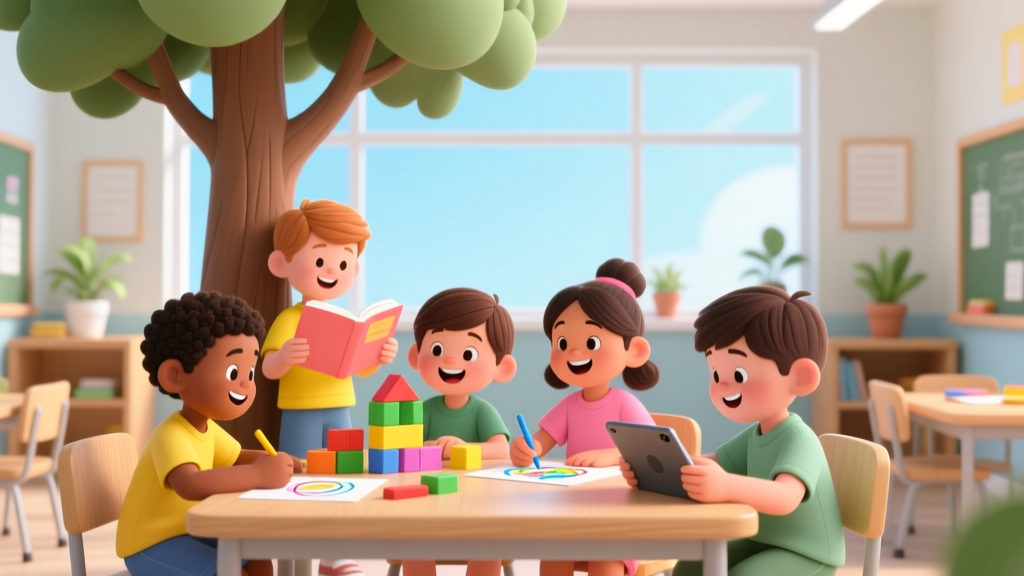
Why Are Kids Drawn to Me? 7 Science-Backed Reasons
Why Are Kids Drawn to Me? It’s Not Magic — It’s Neurobiology, Noticing, and Quiet Confidence
If you’ve ever found yourself surrounded by toddlers tugging your sleeves, preschoolers offering you their favorite toy unprompted, or shy kindergarteners choosing your lap over their parent’s during story time — you’ve likely asked yourself: why are kids drawn to me? This isn’t vanity or coincidence. It’s a quiet signal that your presence aligns with deeply wired childhood needs for safety, predictability, and emotional resonance. In an era where many adults report feeling disconnected from children — whether due to screen saturation, generational communication gaps, or rising anxiety — this natural magnetism is both rare and profoundly meaningful. And more importantly: it’s learnable, deepen-able, and ethically significant.
The 3 Core Foundations: Safety, Synchrony, and Subtle Signals
Children don’t assess adults cognitively — they scan neurologically. Long before language develops, infants use autonomic nervous system cues to determine who is ‘safe enough’ to approach. According to Dr. Stephen Porges’ Polyvagal Theory — widely cited in pediatric psychology and trauma-informed care — children detect safety through three primary nonverbal channels: facial expression (especially eye warmth and brow relaxation), vocal prosody (pitch, rhythm, and warmth — not just words), and postural openness (uncrossed arms, forward-leaning posture, relaxed shoulders). When these signals align, the child’s vagus nerve downregulates stress responses and activates social engagement circuits.
A landmark 2022 study published in Child Development observed 147 children aged 18–48 months across daycare settings and found that 83% initiated proximity-seeking behaviors (e.g., touching, lingering nearby, handing objects) first with adults whose resting facial expression showed mild levator labii superioris activation — a subtle, unconscious ‘soft smile’ around the eyes and upper lip, distinct from forced grins. These adults weren’t necessarily the most talkative or animated; they were the calmest, slowest-paced, and most consistently responsive.
Here’s what this means in practice:
- You’re likely a ‘low-arousal anchor’ — Your energy doesn’t spike easily. Kids sense this as a refuge from overstimulation (common in classrooms, playgrounds, or chaotic homes).
- You mirror without mimicking — When a child stomps, you might gently tap your foot once — not copying, but validating rhythm. This is called attuned mirroring, a cornerstone of secure attachment formation (Beebe & Lachmann, 2014).
- You pause — and mean it — You wait 3–5 seconds after a child speaks or gestures before responding. That micro-pause signals deep listening, which children register as respect — even before they have words for it.
The Hidden Role of Your Voice: Why Tone Trumps Vocabulary Every Time
Most adults assume kids respond to content: ‘Be gentle,’ ‘Share your toys,’ ‘Use your words.’ But neuroscience shows otherwise. fMRI studies at the Yale Child Study Center reveal that children under age 7 process adult speech primarily in the right hemisphere — the region governing emotion, melody, and bodily sensation — not the left hemisphere (language centers). What registers first isn’t ‘clean up your blocks’ — it’s the warmth, steadiness, and rhythmic consistency in how those words land.
This explains why some teachers manage 25 energetic kindergartners with near-silent hand signals and low-volume directives — while others shout clear instructions and get escalating chaos. It’s not about volume or vocabulary. It’s about vocal anchoring: using consistent pitch contours (e.g., slightly rising at pauses, falling gently at endings), moderate tempo (120–140 syllables/minute), and breath-supported resonance (not throat-tight or airy).
Try this experiment next time you’re with a child: Say ‘Let’s go outside’ in three ways — (1) flat monotone, (2) rushed and high-pitched, (3) warm, unhurried, with a soft ‘uh-huh’ hum at the end. Watch where their body leans. Their nervous system will answer before their brain does.
What You’re Doing Right (Even If You Don’t Realize It)
Many people who wonder why are kids drawn to me assume they must be doing something extraordinary — telling amazing stories, building epic forts, or knowing every dinosaur name. In reality, the strongest draw is often what’s absent: judgment, urgency, or agenda. Consider these evidence-backed traits commonly observed in ‘child-magnet’ adults:
- You follow, don’t lead — You let the child set the pace and topic (‘You’re stacking the red block on top… interesting!’), resisting the urge to redirect or ‘teach’ mid-play. This builds agency — a core need identified in Self-Determination Theory (Ryan & Deci, 2000).
- You name feelings without fixing — ‘That made you frustrated when the tower fell’ lands differently than ‘It’s okay — I’ll build it again!’ The former validates neural wiring; the latter bypasses emotional processing.
- You maintain ‘relational availability’ — Even when busy, you offer micro-connections: a 2-second eye hold while passing a snack, a hand-on-shoulder while walking, a whispered ‘I see you trying’ during struggle. Pediatrician Dr. Claudia Gold notes in The Power of Discord that these ‘rupture-and-repair’ micro-moments — especially when repair is immediate and embodied — are where trust crystallizes.
One powerful case study comes from Oakland Unified School District’s ‘Calm Corner’ pilot program (2021–2023). Teachers trained in nonverbal attunement saw a 68% reduction in classroom escalation incidents — not because they changed curriculum, but because they learned to ‘drop their shoulders, soften their gaze, and breathe with the child’ before speaking. Students didn’t just calm down faster — they sought out those teachers for help before meltdowns occurred.
When the Draw Feels Overwhelming — Setting Boundaries with Kindness
Being a safe harbor is a gift — but it’s not permission for limitless access. Children drawn to you may test boundaries more intensely, precisely because they trust you’ll hold them. That’s healthy — if you respond with clarity and consistency. The American Academy of Pediatrics (AAP) emphasizes that secure attachment requires both warmth and structure: ‘Children thrive when love has edges.’
Boundaries aren’t walls — they’re bridges built with predictable language and embodied calm. Instead of ‘Stop climbing on me!’ try: ‘My body needs rest right now. Let’s sit side-by-side and watch the ants instead.’ Notice the shift: from prohibition to invitation, from ‘no’ to ‘here’s what’s possible.’
Three research-backed boundary practices:
- Use ‘and’, not ‘but’ — ‘I love having you close and I need two minutes to tie my shoe’ preserves connection while stating need.
- Offer limited, concrete choices — ‘Would you like to hold my hand or walk beside me?’ gives autonomy within safety.
- Pair words with gentle, non-withdrawing touch — A palm-down hand placed softly on a child’s back during redirection signals ‘I’m still here’ neurologically.
| Child Behavior You Observe | What It Signals Developmentally | How to Respond Supportively | What to Avoid |
|---|---|---|---|
| Child brings you every drawing, even scribbles | Seeking co-regulation + identity validation (‘I exist, and you see me’) | Point to one detail: ‘You used so much blue here — tell me about this part’ | Saying ‘That’s beautiful!’ generically or asking ‘What is it?’ (forces labeling) |
| Child hides behind you with new adults | Using you as secure base (classic attachment behavior — not shyness) | Whisper: ‘I’m right here. You can look when you’re ready’ + gentle hand on back | Pulling them forward, saying ‘Don’t be shy,’ or speaking for them |
| Child repeats your phrases or mannerisms | Neurological mirroring — early stage of empathy & self-concept formation | Playfully echo back: ‘You said “all done!” — yes, we’re all done eating!’ | Correcting pronunciation or saying ‘Say it properly’ |
| Child touches your hair, clothes, or hands repeatedly | Sensory seeking + tactile regulation (especially if they’re fidgety or avoidant elsewhere) | Offer alternatives: ‘Would you like this smooth stone to hold while we talk?’ | Withdrawing abruptly or saying ‘Don’t touch me’ (triggers shame) |
Frequently Asked Questions
Is it normal for kids to prefer me over their own parents sometimes?
Yes — and it’s usually a sign of healthy attachment dynamics, not rejection. Children develop multiple secure attachments, and may seek specific adults for different needs: one for comfort, another for play, another for calm. The AAP confirms that having 2–3 trusted adults strengthens resilience. However, if a child consistently avoids or resists their primary caregivers *only* when you’re present, gently observe timing and context — it may signal unmet needs at home (e.g., fatigue, inconsistency, or stress) rather than anything about you.
Could this mean I’m unconsciously encouraging dependency?
Not if your interactions foster competence. Ask yourself: Do children leave your presence feeling more capable — able to try a new puzzle, name their feeling, or initiate play with peers? Or do they seem ‘stuck’ needing your presence to act? True security empowers independence. As Dr. Becky Kennedy says: ‘Connection is the vehicle — not the destination.’ Your role isn’t to be needed forever, but to help them internalize your calm, curiosity, and kindness as inner resources.
I’m not a parent or teacher — why do neighborhood kids always follow me?
This highlights how rare authentic presence has become. In communities where adults are often distracted (phones, work stress, social performance), your grounded, unhurried attention becomes magnetic. It’s not about you being ‘special’ — it’s about you being available. That said, always prioritize consent and transparency: greet parents warmly, explain your role (‘I love talking with kids — is it okay if I sit with Maya for a bit?’), and honor cultural norms around adult-child interaction.
Does this mean I’d be a good foster or adoptive parent?
Your natural attunement is a strong asset — but formal caregiving requires rigorous training, emotional stamina, and systemic support. Many ‘child-magnets’ excel in therapeutic roles (play therapists, special education aides, pediatric nurses) where their gifts serve without carrying full parental responsibility. Consider volunteering with organizations like Big Brothers Big Sisters or attending AAP-endorsed courses on trauma-informed care before pursuing licensure.
Common Myths
Myth #1: ‘Kids only like adults who are super playful or silly.’
Reality: While playfulness helps, research shows children prioritize predictability over exuberance. A calm, steady adult who laughs genuinely at a child’s joke is more magnetizing than a hyperactive one who performs constantly. Overstimulation exhausts young nervous systems.
Myth #2: ‘If kids cling to me, I must be enabling bad behavior.’
Reality: Clinging is a biological stress response — not manipulation. When children feel unsafe, tired, or overwhelmed, proximity to a regulated adult literally lowers cortisol. What looks like ‘clinginess’ is often their nervous system asking, ‘Are you still here? Can I borrow your calm?’
Related Topics (Internal Link Suggestions)
- How to Build Secure Attachment With Toddlers — suggested anchor text: "secure attachment with toddlers"
- Nonverbal Communication Skills for Adults Around Children — suggested anchor text: "nonverbal communication with kids"
- Setting Gentle Boundaries With Young Children — suggested anchor text: "gentle boundaries for toddlers"
- Signs of Healthy Child-Adult Relationships — suggested anchor text: "healthy adult-child relationships"
- Understanding Separation Anxiety in Preschoolers — suggested anchor text: "separation anxiety preschool"
Conclusion & CTA: Your Gift Is a Practice — Not a Personality Trait
Learning why are kids drawn to me isn’t about unlocking a secret code — it’s about recognizing that your presence already holds value. That draw is evidence of your capacity for presence, patience, and embodied empathy. But like any strength, it deepens with intention. This week, choose one micro-practice: pause for 3 seconds before responding to a child’s gesture, notice your resting facial expression in a mirror, or replace one ‘good job’ with a specific observation (‘You kept trying even when it wobbled’). Track what shifts — not in the child, but in your own sense of grounded confidence. Then, share your insight: What’s one small thing you noticed about how children respond to your calm? Drop it in the comments — your reflection might be the exact reassurance another adult needs to trust their own quiet power.
More Articles
 Dolly Parton’s Choice: Why She Didn’t Have Kids (2026)
 Do Leighton and Adam Have Kids? (2026)
 Charlie Kirk Shooting: Facts, Safety & Talking to Kids
 How to Get Kids to Try New Foods (2026)
 How Many Kids Does Chris Perez Have? (2026)
 Solo Mio for Kids: 7 Safety Checks (2026)
 Jingle Bell Heist Appropriate for Kids? (2026)
 Autistic Kids Sleep Problems: Causes & Solutions
 What Causes Autism in Kids? Science-Backed Answers
 Positive Discipline for Kids: 7 Evidence-Based Strategies