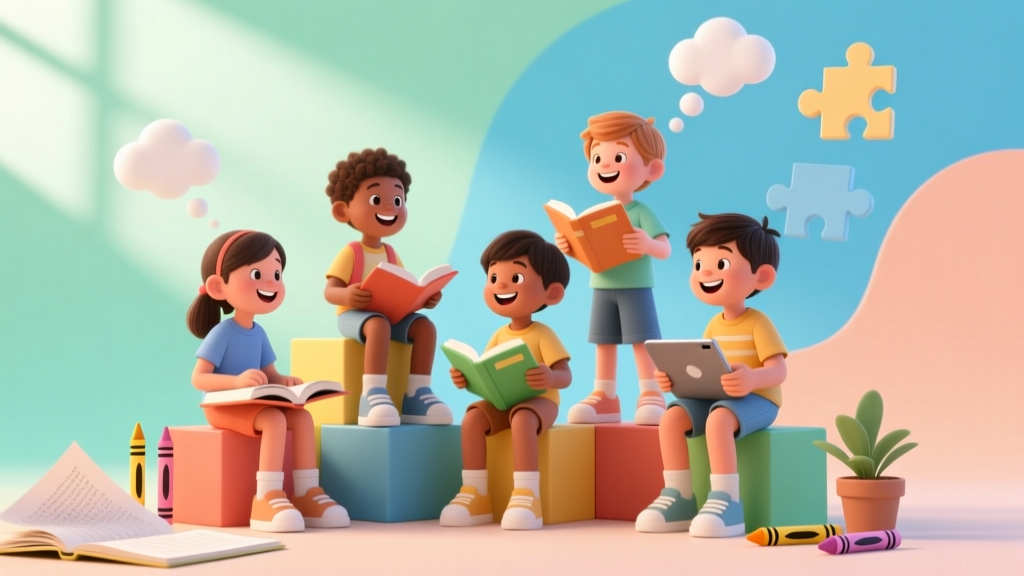
When Should Kids Read? Evidence-Based Readiness Signs
Why 'When Should Kids Read?' Isn’t a One-Size-Fits-All Question—And Why Getting It Wrong Can Reshape a Child’s Relationship with Learning
The question when should kids read echoes in pediatric waiting rooms, preschool parent-teacher conferences, and late-night Google searches—often laced with quiet anxiety. Is your 4-year-old ‘behind’ if they don’t recognize letters? Should you enroll your kindergartner in phonics tutoring because their classmate is reading chapter books? Here’s what decades of longitudinal research and clinical observation confirm: reading is not a switch that flips at age 5 or 6—it’s a biological, neurological, and emotional cascade that unfolds uniquely for every child. And misreading the signs—either by rushing or delaying—carries real consequences: early frustration can trigger avoidance behaviors that persist into adolescence; conversely, waiting too long without targeted support may widen gaps in language processing and executive function. This isn’t about benchmarks alone—it’s about listening to your child’s nervous system, observing their play, and aligning instruction with brain development—not school calendars.
What Reading Readiness *Really* Looks Like (Spoiler: It’s Not Alphabet Flashcards)
According to Dr. Susan B. Neuman, former U.S. Assistant Secretary of Education and literacy researcher at NYU, reading readiness is a constellation of interlocking skills—not one isolated ability. Her landmark 2019 longitudinal study tracking 1,247 children from age 3 to grade 3 found that children who demonstrated strong oral language comprehension, sustained attention during shared book reading, and symbolic play (e.g., pretending a block is a phone while narrating a ‘call’) were 3.2x more likely to achieve fluent decoding by second grade than peers who scored high on letter-naming drills but low on narrative retelling. In other words: the ability to tell a coherent story matters more than reciting the ABCs backward.
Here’s what to watch for—not just what your child knows, but how they engage:
- Phonological awareness: Not just rhyming (‘cat/hat’), but syllable clapping, identifying beginning sounds in familiar words (‘What sound does ‘butterfly’ start with?’), and blending sounds orally (‘/c/ /a/ /t/ → ?’). Emerges naturally between ages 3–5, often through songs and nonsense word games—not worksheets.
- Print concepts: Understanding that text moves left-to-right, that words carry meaning (not just pictures), and that letters represent sounds. Observed when a child tracks print with their finger during read-alouds—even if they can’t ‘read’ yet.
- Oral language depth: Using rich vocabulary (e.g., ‘enormous’ instead of ‘big’), asking ‘why’ and ‘how’ questions, retelling events with sequence (‘First we baked, then we waited, then we ate!’). Strongly predictive of later reading comprehension, per American Academy of Pediatrics (AAP) 2022 literacy guidelines.
- Executive function cues: Sitting through a 10-minute picture book without distraction, remembering character names across sessions, self-correcting when mispronouncing a word (“That doesn’t sound right…”). These reflect prefrontal cortex maturation—not just ‘focus.’
Crucially, readiness isn’t binary. As Dr. Maryanne Wolf, cognitive neuroscientist and author of Proust and the Squid, explains: “The brain doesn’t develop reading circuitry on a fixed timeline—it co-opts existing neural pathways for spoken language, vision, and attention. Forcing it before those pathways are sufficiently wired is like trying to stream HD video on dial-up—it overwhelms the system and creates negative associations.”
The Hidden Cost of ‘Early Reader’ Pressure—and What to Do Instead
A 2023 national survey by the National Association for the Education of Young Children (NAEYC) revealed that 68% of kindergarten teachers observed increased anxiety-related behaviors (nail-biting, stomachaches, school refusal) in students subjected to intensive, worksheet-driven phonics programs before age 5.5. Worse: follow-up assessments showed no long-term advantage in reading fluency by third grade—and significantly lower intrinsic motivation scores. Why? Because drilling isolated skills without meaningful context teaches children that reading is a chore, not a tool for connection or discovery.
Instead, build the foundation invisibly—through daily, joyful interactions:
- Co-create stories: While looking at wordless picture books, ask open-ended questions: “What’s happening in this panel? What might she say next?” This builds narrative syntax and inference—the bedrock of comprehension.
- Embed phonology in movement: Clap syllables while jumping rope (“el-e-phant”), stretch rubber bands while stretching out sounds (“ssssss-un”), or use hand gestures for phonemes (‘sh’ = finger to lips). Kinesthetic learning activates motor cortex pathways that reinforce sound-symbol mapping.
- Label the world—not flashcards: Narrate routines with rich language (“We’re pouring the thick, cool milk into the blue cup”) and invite your child to describe textures, temperatures, and sequences. This builds semantic networks that make decoding meaningful.
- Read aloud with dramatic pause: Stop before the last word of a rhyming line (“The cat sat on the ___”) and wait. Let them supply it—even if it’s wrong. This builds prediction, metacognition, and risk-taking.
Real-world example: Maya, a speech-language pathologist in Portland, worked with Leo, age 5, who’d been labeled ‘resistant’ after six months of failed phonics apps. His assessment revealed strong oral storytelling but weak phonemic segmentation. Instead of worksheets, they played ‘Sound Detective’—listening for initial sounds in environmental noises (door creak = /k/, kettle whistle = /w/). Within 8 weeks, Leo segmented words spontaneously—and began pointing to letters in his favorite comic books. His breakthrough wasn’t speed—it was agency.
Neurodiversity-Aware Timelines: When ‘Typical’ Doesn’t Apply
For children with dyslexia, ADHD, language processing disorders, or autism, the ‘when should kids read’ question requires re-framing entirely. According to Dr. Sally Shaywitz, co-director of the Yale Center for Dyslexia & Creativity, 1 in 5 children has dyslexia—but only 20% receive formal diagnosis before age 9. Early signs aren’t ‘laziness’ or ‘not trying’—they’re subtle: difficulty remembering nursery rhymes, confusing similar-sounding words (‘pen’/’pan’), slow naming of colors or objects, or exceptional oral storytelling paired with extreme frustration over written tasks.
Timing shifts dramatically here. Research published in Pediatrics (2021) shows children with dyslexia often develop fluent reading 1–3 years later than peers—but with structured literacy intervention (Orton-Gillingham or Wilson Reading System), 89% achieve grade-level proficiency by fifth grade. The critical factor? Starting intervention early—not starting reading early. That means prioritizing phonemic awareness, explicit phonics, and multisensory encoding before expecting independent decoding.
For autistic learners, readiness may manifest differently: intense focus on letters/numbers (hyperlexia), exceptional visual memory for logos or signs, or resistance to traditional books but deep engagement with interactive e-books or tactile alphabet materials. As occupational therapist and autism specialist Dr. Temple Grandin advises: “Meet the child where their brain seeks input—visual, auditory, or kinesthetic—and build bridges from there.”
Age-Appropriate Guide to Reading Milestones (Backed by AAP, NAEYC & Literacy Research)
This table synthesizes consensus guidelines from the American Academy of Pediatrics, National Association for the Education of Young Children, and the National Institute for Literacy—translated into observable, parent-friendly behaviors. Note: These are ranges, not deadlines. A child hitting 70% of markers in their age band is on track—even if they miss one or two.
| Age Range | Key Observable Behaviors | Supportive Actions (Not Interventions) | Risk Flags Requiring Professional Consultation |
|---|---|---|---|
| 2–3 years | Points to pictures when named; repeats rhymes/songs; uses 2–3 word phrases; follows simple 2-step directions (“Get your shoes and put them by the door”) | Read aloud daily (10+ minutes); sing nursery rhymes with exaggerated rhythm; play ‘I Spy’ with beginning sounds (“I spy something that starts with /b/”) | Doesn’t respond to name; uses fewer than 50 words by age 2; no pretend play; avoids eye contact during shared reading |
| 4–5 years | Names most letters; matches letters to sounds (/b/ says ‘buh’); recognizes own name in print; tells simple stories with beginning/middle/end; blends 2–3 sounds orally (“/c/ /a/ /t/” → “cat”) | Play sound-matching games (‘Which word starts like ‘sun’—sock or hat?’); write stories together (you scribe, they dictate); point to words as you read aloud | No interest in books/stories; cannot rhyme by age 4.5; confuses all letters/sounds; struggles to remember 3-item instructions |
| 5–6 years (Kindergarten) | Decodes CVC words (cat, sun); reads familiar words by sight (‘the’, ‘and’); writes letters/numbers legibly; understands that print carries meaning; asks ‘How do you spell…?’ | Let them ‘read’ favorite books from memory; play word-building games with magnetic letters; encourage invented spelling without correction (“You wrote ‘hors’—that’s a great guess! It’s spelled h-o-r-s-e.”) | Cannot blend sounds after 6+ months of kindergarten instruction; reverses letters consistently past age 6.5; avoids reading aloud; expresses shame about reading attempts |
| 6–7 years (Grade 1) | Reads simple sentences fluently; self-corrects errors; uses context + phonics to decode new words; comprehends main ideas of short texts; writes simple sentences with spaces/punctuation | Listen to them read aloud daily (even 5 minutes); discuss characters’ feelings/motivations; introduce chapter books with audio support; celebrate effort, not just accuracy | Still relying solely on picture clues to ‘guess’ words; reads word-by-word with no expression; cannot retell basic plot; significant spelling/grammar gaps compared to peers |
Frequently Asked Questions
My child is 4 and already reading simple books—is this advanced, or could it be hyperlexia?
Early reading can reflect advanced development—or be a sign of hyperlexia, a profile often seen in autistic children where decoding skills far exceed comprehension or social communication. Key differentiators: Does your child understand what they read? Can they answer ‘why’ or ‘how’ questions about the story? Do they use reading to connect (e.g., ‘Look, Mommy—this says “ice cream!”’), or primarily for self-soothing/repetition? If comprehension lags significantly behind decoding, consult a developmental pediatrician or speech-language pathologist for holistic assessment—not just reading level.
Should I hold my child back from kindergarten if they’re not reading yet?
No—holding back is rarely beneficial for reading development. Research from the University of California, Berkeley (2020) tracked 2,100 children and found no academic advantage for ‘redshirted’ kindergartners by fourth grade—and higher rates of social-emotional challenges. Kindergarten curricula are designed to teach foundational literacy skills explicitly. What matters more is whether your child receives responsive, differentiated instruction—not their entry-level skill. Advocate for screening and support within the classroom instead.
Are digital reading apps effective for early readers?
Some are—but most are not. A 2022 meta-analysis in JAMA Pediatrics reviewed 127 apps marketed for early literacy and found only 12% promoted evidence-based practices (e.g., explicit phonics, multimodal feedback). Top performers: Endless Alphabet (kinesthetic letter formation + phoneme blending), Headsprout Early Reading (adaptive, research-backed sequence). Avoid apps that reward speed over accuracy, use excessive animation, or replace human interaction. Rule of thumb: If your child engages more with the app than with you, it’s time to pause.
My bilingual child isn’t reading in English yet—should I focus only on our home language first?
Yes—strong foundation in the home language accelerates English literacy. The National Literacy Panel’s 2006 report confirmed that oral language proficiency in any language predicts reading success in a second language. Prioritize rich, complex conversations and storytelling in your home language. Code-switching (mixing languages) is normal and cognitively beneficial—not a barrier. Introduce English print gradually through shared bilingual books, not isolated vocabulary drills.
What’s the biggest myth about teaching kids to read?
That phonics alone is sufficient. While phonics is essential, reading is a ‘three-cueing system’ (meaning, structure, visual)—and over-reliance on sounding out undermines comprehension. The Science of Reading movement now emphasizes ‘structured literacy,’ which integrates phonics with vocabulary, morphology (word parts), syntax, and background knowledge. As literacy expert Dr. Timothy Shanahan states: ‘Decoding without understanding is like having a key to a door but no idea what’s inside.’
Common Myths Debunked
- Myth #1: “If they’re not reading by first grade, they’ll never catch up.” False. Longitudinal studies show children who begin reading at age 7–8 (with appropriate support) reach average fluency and comprehension by middle school. What predicts long-term outcomes is consistent access to rich language, responsive adults, and reduced shame—not calendar age.
- Myth #2: “Learning sight words first makes reading easier.” Partially true—but dangerous if overdone. High-frequency words like ‘the’ and ‘said’ are irregular and must be memorized, but teaching 100+ ‘sight words’ before phonics leads to guessing habits. Best practice: Teach 10–15 core irregular words alongside systematic phonics—so children learn when to sound out and when to recall.
Related Topics (Internal Link Suggestions)
- Signs of Dyslexia in Preschoolers — suggested anchor text: "early dyslexia indicators"
- Best Phonics Programs for Struggling Readers — suggested anchor text: "evidence-based phonics curriculum"
- How to Choose Age-Appropriate Chapter Books — suggested anchor text: "chapter books by reading level"
- Screen Time Guidelines for Early Literacy Development — suggested anchor text: "educational screen time limits"
- Bilingual Literacy Development Timeline — suggested anchor text: "supporting bilingual readers"
Final Thought: Reading Begins Long Before the First Word Is Decoded
When should kids read? Not when the calendar says so—but when their curiosity, their neural wiring, and your attuned presence align. That moment might arrive at 4.5, 6.2, or 7.8—and each is valid. What transforms ‘when should kids read’ from a source of stress into a journey of discovery is shifting focus from output (words on a page) to input (language-rich interactions), from performance to partnership. So tonight, skip the flashcards. Pick up a beloved book. Pause at the funniest page. Ask, ‘What would YOU do if you were the dragon?’ Then listen—not to assess, but to connect. Because the first real act of reading isn’t decoding ‘cat’—it’s understanding that stories hold power, that words can change feelings, and that your voice is the original, irreplaceable textbook. Ready to build that foundation? Download our free Reading Readiness Observation Checklist—a printable, research-backed tool to track your child’s unique literacy journey, month by month.
More Articles
 How Many Kids Does Beckham Have? (2026)
 Charlie Kirk Family Safety: Real-Time Coordination Tips
 Bill Belichick Kids: The Truth Behind His Private Parenting
 Do Kids Fly Free on Southwest? (2026)
 When to Take Kid to DR for Fever: Pediatrician Guide
 Nick Cannon’s Kids Names: Full Verified List (2026)
 How Many Kids Does Jep Robertson Have? (2026)
 How Old Are Charlie Kith’s Kids? Privacy & Safety Facts
 How Many Kids Does Michael Landon Have? (2026)
 What Causes Kids to Be Nonverbal? 7 Evidence-Based Reasons