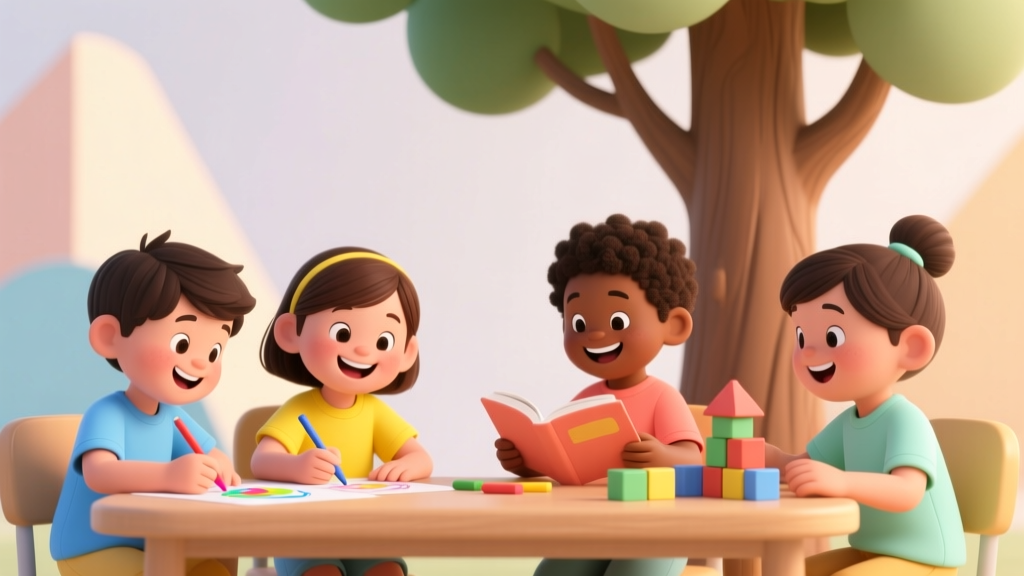
When Should Kids Be Reading? Readiness Over Age
Why 'When Should Kids Be Reading?' Isn’t Just About Age—It’s About Readiness, Relationship, and Resilience
The question when should kids be reading echoes in pediatric waiting rooms, preschool parent-teacher conferences, and late-night scrolling sessions—often laced with quiet worry: "Is my child behind? Did I miss something? Are flashcards the answer—or am I pushing too hard?" Here’s the truth most well-meaning advice overlooks: reading isn’t a switch that flips at age 6. It’s a layered, neurologically intricate skill built over years through oral language, phonemic awareness, print exposure, and emotional safety—not timed drills or app-based quizzes. According to the American Academy of Pediatrics (AAP), foundational literacy begins at birth—not kindergarten—and children who experience rich, responsive language interactions from infancy are up to 3x more likely to enter school with strong decoding and comprehension readiness. Yet, 34% of U.S. fourth graders still read below grade level (NAEP, 2023), not because they’re ‘late,’ but because early support was fragmented, mismatched to their learning profile, or derailed by unrecognized challenges like auditory processing differences or vision tracking delays. This article cuts through the noise with actionable, stage-specific guidance grounded in developmental science—not trends.
What ‘Reading’ Really Means at Each Stage (and Why Labeling Too Early Backfires)
Many parents equate ‘reading’ with fluent, silent, independent decoding—but that’s just one endpoint on a 7-year continuum. Developmental psychologist Dr. Susan Neuman, former U.S. Assistant Secretary for Elementary and Secondary Education, emphasizes that early literacy is not a race—it’s a scaffolded apprenticeship. Let’s unpack what’s typical—and what’s meaningful—at each phase:
- Birth–2 years: ‘Reading’ means joint attention with board books, pointing to pictures, babbling along with rhymes, and recognizing familiar logos (e.g., cereal boxes). This builds vocabulary, narrative sense, and sound discrimination—the bedrock of later decoding.
- 3–4 years: Children begin ‘pretend reading’ (recalling stories from memory), identify beginning sounds (‘/b/ for ball’), and match letters to names (not yet sounds). A 2022 longitudinal study in Early Childhood Research Quarterly found toddlers who engaged in daily dialogic reading (where adults ask open-ended questions like “What do you think happens next?”) developed 40% stronger phonological awareness by age 5.
- 5–6 years (Kindergarten–1st Grade): This is when formal instruction typically begins—but readiness varies widely. True ‘reading’ here means blending CVC words (cat, sit), recognizing high-frequency words (the, and, go), and self-correcting errors (“That says ‘dog’—but the picture shows a cat!”). Crucially, it’s not about speed; it’s about comprehension monitoring.
- 7–9 years: Fluency emerges—not just accuracy, but expression, pacing, and inference. Children move from ‘learning to read’ to ‘reading to learn.’ Struggling readers at this stage often mask difficulties with memorization or avoidance—a red flag requiring targeted intervention, not more worksheets.
A key insight from speech-language pathologist Dr. Elena Plante (University of Arizona) is that labeling a child as ‘not reading yet’ before age 7 often confuses developmental variation with disorder. In fact, the AAP states that reading delays diagnosed before age 7 have a 60% spontaneous resolution rate—meaning many children catch up naturally with enriched environments, not remediation. The real risk isn’t starting ‘late’—it’s missing subtle signs of dyslexia, language impairment, or vision deficits that *do* benefit from early screening.
The 4 Non-Negotiable Foundations (Before Sight Words or Phonics Apps)
Forget flashcards for a moment. Before any formal instruction, four evidence-backed pillars must be in place—each supported by decades of research in cognitive science and early childhood education:
- Oral Language Richness: Children need 21,000+ words of conversational exposure weekly to build vocabulary depth (Hart & Risley, 1995). But it’s not volume—it’s quality. Use descriptive language (“Look at the glistening raindrops on the slippery leaf”), ask ‘how’ and ‘why’ questions, and expand their utterances (“You said ‘dog run’—yes! The golden retriever is sprinting across the grass.”).
- Phonemic Awareness (Not Phonics): This is the ability to hear, isolate, and manipulate sounds in spoken words—*before* connecting them to letters. Try clapping syllables in names (“Em-ma”), deleting sounds (“Say ‘cat’ without /k/…” → “at”), or blending (“/m/ /a/ /n/…” → “man”). A meta-analysis in Reading Research Quarterly (2021) showed phonemic awareness training boosted reading outcomes more than phonics instruction alone—especially for at-risk learners.
- Print Awareness & Environmental Literacy: Knowing books have front/back, text flows left-to-right, and symbols carry meaning. Point out letters on street signs, let kids ‘write’ grocery lists, and notice fonts (“This cereal logo uses curly letters—like your name!”). Children who recognize 10+ environmental print items by age 4 are 3x more likely to decode early (National Center for Family Literacy).
- Executive Function Scaffolding: Reading requires working memory (holding sounds in mind), inhibition (ignoring distractions), and cognitive flexibility (switching between letter-sound rules). Simple games like ‘Red Light, Green Light,’ storytelling with sequenced pictures, or building routines with visual schedules strengthen these skills far more effectively than isolated letter drills.
Here’s what *doesn’t* belong in this foundation: screen-based phonics apps before age 5 (AAP recommends zero educational screen time under 18 months), pressure to ‘perform’ reading aloud in front of peers, or comparing progress to siblings or classmates. As Dr. G. Reid Lyon, former NIH reading research chief, warns: “We’ve medicalized normal variation. A child who doesn’t read fluently at 6 isn’t broken—they may just need more time, different input, or a quieter space to process.”
Decoding the Data: When Milestones *Actually* Signal Concern (and What to Do Next)
While variation is normal, certain patterns warrant professional evaluation—not panic, but proactive partnership. Below is a clinically validated timeline based on AAP, ASHA (American Speech-Language-Hearing Association), and IDA (International Dyslexia Association) guidelines:
| Age Range | Expected Literacy Behaviors | Green Light (Typical Variation) | Yellow Flag (Monitor Closely) | Red Flag (Seek Evaluation) |
|---|---|---|---|---|
| 3–4 years | Enjoys rhyming games; points to pictures when named; repeats simple nursery rhymes | Occasional difficulty with rhyming or sound blending | Rarely attempts rhyming; cannot identify beginning sounds in 3+ words; avoids book sharing | No response to verbal directions; limited expressive vocabulary (<50 words); no pretend play with books |
| 5–6 years | Recognizes some letters; matches letters to sounds; writes own name; ‘reads’ familiar books from memory | Knows 10–15 letters; confuses similar letters (b/d, p/q) | Cannot identify >5 letter names; struggles to segment 3-sound words (e.g., ‘cat’ → /c/ /a/ /t/); reverses letters consistently | No letter-sound knowledge; cannot blend sounds to make words; avoids all print activities |
| 7–8 years | Reads simple chapter books aloud with expression; self-corrects errors; answers inferential questions | Slow, effortful reading; occasional word substitutions (‘house’ for ‘home’) | Frequent guessing from context/pictures; omits small words (‘the,’ ‘and’); poor spelling despite instruction | Cannot decode unfamiliar CVC words; reads 2+ grades below level; fatigue or frustration during reading tasks |
Note: A single red flag isn’t diagnostic—but two or more across domains warrants consultation with a pediatrician, school psychologist, or certified reading specialist. Importantly, dyslexia is not linked to intelligence: 20% of the population has dyslexia, including Nobel laureates and engineers. Early identification (by age 7) leads to 85% of children reaching grade-level proficiency with structured literacy intervention (IDA, 2023).
What Works (and What Doesn’t) in Real Homes—Case Studies from Diverse Families
Let’s ground this in reality. Meet three families navigating the ‘when should kids be reading’ question—each with distinct needs, resources, and outcomes:
“Maya, age 5, spoke late and struggled with rhyming. Her preschool teacher suggested ‘more phonics practice.’ Instead, her mom started daily ‘sound scavenger hunts’—finding things that start with /s/, singing silly songs with exaggerated consonants, and using clay to form letters while saying sounds. By 6, Maya was blending confidently—not because she ‘caught up,’ but because her brain needed tactile-auditory pairing, not drill sheets.”
Maya’s story reflects research from the University of Washington’s Haskins Labs: multisensory approaches (touch + sound + movement) activate broader neural networks for struggling decoders, especially those with auditory processing differences.
“Liam, age 7, read fluently but couldn’t retell a story or answer ‘why’ questions. His teacher labeled him ‘advanced.’ His parents discovered he’d memorized patterns—not comprehended meaning. They shifted to ‘thinking aloud’ while reading: pausing to predict, connect to his life (“This character feels nervous—remember when you waited for your first soccer game?”), and sketch scenes. Within 10 weeks, his comprehension scores jumped 2 grade levels.”
Liam’s case highlights a critical gap: fluency ≠ comprehension. A 2023 study in Journal of Educational Psychology found 42% of ‘fluent’ second graders scored below benchmark on inferential reasoning—proving that decoding mastery without metacognitive strategy instruction leaves comprehension vulnerable.
“Aisha, age 8, was held back in 2nd grade for reading. Her family spoke Somali at home and English at school. Standard assessments missed her bilingual advantage—she had rich vocabulary in Somali and strong narrative skills, but English phonology was new. With a bilingual speech therapist, she learned English sound patterns through Somali cognates (‘salaam’/‘salmon’) and used dual-language books. She’s now thriving in 4th grade.”
Aisha’s journey underscores a vital equity point: standardized milestones assume monolingual English exposure. Bilingual children often show ‘temporary lag’ in English-only assessments but demonstrate superior executive function and metalinguistic awareness long-term (Center for Applied Linguistics).
Frequently Asked Questions
My child is 6 and still mixing up b/d/p/q—should I be worried?
Mixing similar-looking letters is extremely common through age 7 and often resolves naturally as visual processing matures. What matters more is whether they’re applying phonics knowledge consistently (e.g., using /b/ sound for ‘b’ in multiple words) and showing growth in letter-sound accuracy over time. If confusion persists beyond age 7 *and* co-occurs with trouble rhyming, slow naming speed, or poor spelling, consult a reading specialist for dyslexia screening.
Is it harmful to teach reading before kindergarten?
Not if it’s playful, child-led, and embedded in daily life (e.g., reading recipes together, writing notes to grandparents). However, formal, worksheet-driven instruction before age 5–6 can backfire—leading to burnout, negative associations with reading, or superficial ‘memorization’ without understanding. The AAP explicitly advises against academic pressure in preschool, citing increased anxiety and decreased intrinsic motivation.
My child reads well but hates it—what’s going on?
This is incredibly common and rarely about ‘laziness.’ Often, it signals a mismatch between their interests and available material (e.g., forced classics instead of graphic novels or nonfiction about dinosaurs), fatigue from decoding effort, or social-emotional factors (fear of making mistakes, comparison to peers). Try ‘interest-based immersion’: let them choose *any* text (comics, instructions, menus), read aloud *to them* daily (modeling joy), and focus on connection—not correction.
Does screen time help or hurt early reading?
Passive screen time (videos, autoplay) displaces crucial language interaction and harms attention regulation—linked to poorer vocabulary and narrative skills (JAMA Pediatrics, 2022). Interactive apps *can* support specific skills (e.g., phoneme manipulation games) but only for 10–15 mins/day, with adult co-engagement. Nothing replaces human dialogue, shared book exploration, and real-world print experiences.
How do I advocate for my child if their school says ‘they’ll catch up’ but I’m concerned?
Calmly request data: Ask for specific assessment results (not just teacher opinion), sample work showing error patterns, and documentation of interventions tried. Cite AAP and IDA guidelines on early screening. In public schools, you have the right to request a formal evaluation under IDEA—even before retention is considered. Document everything in writing. Most importantly: trust your instinct. You know your child’s baseline better than any snapshot assessment.
Common Myths About When Kids Should Be Reading
- Myth #1: “If they’re not reading by 6, they’re behind for life.” Reality: The largest longitudinal study on literacy (NICHD, 2005) followed 1,000+ children and found that 30% of ‘late bloomers’ (reading by age 8–9) achieved above-average comprehension and fluency by adolescence—especially when provided with supportive, shame-free instruction.
- Myth #2: “More practice = faster progress.” Reality: Over-practice without addressing underlying gaps (e.g., weak phonemic awareness) reinforces inefficient strategies. Neuroscientist Dr. Maryanne Wolf notes that ‘massed practice’ (long, repetitive drills) activates stress pathways that inhibit learning, while spaced, varied, joyful practice builds durable neural connections.
Related Topics (Internal Link Suggestions)
- Signs of Dyslexia in Preschoolers — suggested anchor text: "early dyslexia indicators before kindergarten"
- Best Multisensory Reading Programs for Struggling Learners — suggested anchor text: "structured literacy programs backed by research"
- How to Choose Books That Match Your Child’s Reading Level — suggested anchor text: "finding just-right books using the five-finger rule"
- Building Vocabulary at Home: Simple Daily Habits That Work — suggested anchor text: "everyday vocabulary boosters for toddlers and preschoolers"
- Screen Time Guidelines for Early Literacy Development — suggested anchor text: "what the AAP says about tablets and reading readiness"
Your Next Step Isn’t Timing—It’s Tuning In
So—when should kids be reading? The most empowering answer isn’t an age. It’s this: when they feel safe enough to try, curious enough to wonder, and supported enough to stumble. Forget the calendar. Start today by noticing what captivates your child’s attention (trucks? bugs? weather patterns?), follow their lead into stories about it, and celebrate every tiny step—not just the ‘first sentence.’ If you’ve been carrying worry, pause and ask yourself: What’s one small, joyful literacy moment I can create this week? Maybe it’s tracing letters in sand, acting out a favorite story, or simply listening—without correcting—as they ‘read’ a beloved book from memory. That’s where real reading begins: not on a page, but in the space between your voice and theirs. Ready to build that space? Download our free Readiness Reflection Guide—a 5-minute journal tool to observe your child’s unique literacy sparks and track organic growth, no pressure required.
More Articles
 Booster Seat Age Rules: AAP-Approved Safety Guide
 How Much Protein Should Kids Eat? (2026)
 Adopt a Kid: 7 Steps, Costs, Timeline & #1 Mistake (2026)
 Phil Robertson’s Kids: How Many & What It Reveals (2026)
 How to Donate to Kids Cancer: 7 Impact-First Steps
Skills Trends 2026: What Parents Must Know for Kids' Future
How to Donate to Kids Cancer: 7 Impact-First Steps
Skills Trends 2026: What Parents Must Know for Kids' Future
 IHOP Free Kid Meals 2026: Truth & Workarounds
 Unvaccinated Kids in School: Exemptions & 2026 Rules
 Chickenpox Vaccine Age: AAP Schedule & Catch-Up Rules (2026)
 Kids Feel Like Strangers: 7 Evidence-Based Reconnection Tips