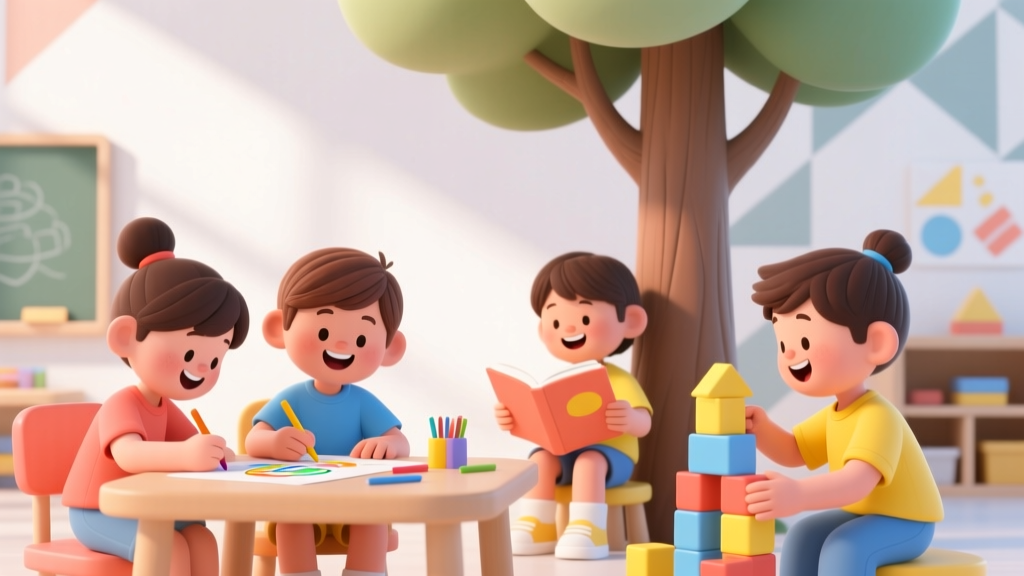
When Do Kids Write Their Name (2026)
Why This Milestone Matters More Than You Think
When do kids write their name? It’s one of the most frequently asked questions in preschool parent groups, pediatric waiting rooms, and kindergarten orientation sessions—and for good reason. A child’s first attempts at writing their own name often serve as an unofficial barometer of school readiness, fine motor development, visual-motor integration, and even self-concept. Yet many parents unknowingly misinterpret silence, scribbles, or letter reversals as ‘delay,’ when in fact, the typical window spans nearly three full years—from age 3 to age 6—with wide, healthy variation rooted in neurodevelopmental science. What matters isn’t just when, but how they get there: with joy, agency, and scaffolding that honors their unique pace.
What the Research Says: It’s Not a Deadline—It’s a Spectrum
According to the American Academy of Pediatrics (AAP) and longitudinal studies from the National Institute of Child Health and Human Development (NICHD), name-writing emerges gradually through four overlapping phases—not as a sudden ‘switch’ that flips on a birthday. These stages reflect brain maturation in the parietal lobe (spatial awareness), prefrontal cortex (planning and inhibition), and cerebellum (fine motor coordination). By age 3, about 20% of children can copy or trace their name; by age 4, roughly half produce recognizable letters—even if jumbled or oversized; by age 5, 75% write their name legibly with consistent letter order and directionality; and by age 6, over 90% do so independently and with appropriate spacing.
But here’s what rarely makes headlines: gender, handedness, bilingualism, sensory processing differences, and even birth month significantly influence timing. A 2022 study published in Early Childhood Research Quarterly tracked 1,247 children across 12 U.S. states and found that children born in August (the youngest in their kindergarten cohort) were 2.3x more likely to be labeled ‘delayed’ in name-writing by teachers—even though their performance caught up completely by second grade. This ‘relative age effect’ underscores why rigid benchmarks harm more than help.
Consider Maya, a bright, left-handed 4-year-old who loved drawing animals but avoided pencils for months. Her parents worried until her occupational therapist explained that Maya was still building hand strength via play-dough sculpting and vertical chalkboard drawing—both critical precursors to pencil control. Within eight weeks of targeted sensory-motor play, she began tracing her name on laminated cards with a dry-erase marker. Her path wasn’t behind—it was different, and deeply effective.
The 4 Foundational Pillars (Not Just Pencil Practice)
Most well-intentioned parents jump straight to worksheets—but handwriting is the output, not the skill itself. Before a child writes their name, they must master four interdependent foundations. Skip or rush any one, and frustration mounts while progress stalls.
- Core & Shoulder Stability: Writing begins in the trunk and shoulder girdle—not the fingers. Children need strong postural control to stabilize their arm while moving their hand. Try this: Have your child draw on a vertical surface (easel, fridge, wall-mounted whiteboard) for 5–10 minutes daily. This activates upper-body muscles far more effectively than tabletop work.
- Hand Strength & Dexterity: Squeeze, pinch, twist, and release—these micro-movements build the intrinsic hand muscles needed for pencil grip. Swap plastic scissors for safety scissors that require real resistance. Use tweezers to pick up pom-poms. String large beads onto shoelaces. Even tearing paper into strips strengthens the web space between thumb and index finger.
- Visual-Motor Integration: This is the brain’s ability to translate what the eyes see into coordinated hand movement. It’s why tracing doesn’t always transfer to independent writing. Instead, pair visual input with full-body movement: ‘Draw your name in the air with your whole arm,’ ‘Walk your fingers up the wall spelling M-A-Y-A,’ or use a flashlight to ‘write’ letters on the ceiling in a darkened room.
- Name Recognition & Letter-Sound Awareness: A child cannot write what they don’t know. Before expecting production, ensure they can point to their name among others, identify the first letter, and connect it to its sound (e.g., ‘M says /m/ like ‘monkey’). Sing name songs, make name puzzles, and label belongings with clear, consistent print.
Red Flags vs. Reassuring Variations: What to Watch For
Developmental variation is normal—but some patterns warrant gentle professional input. Pediatric occupational therapists emphasize distinguishing between expected variation and signs that may indicate underlying needs. Key differentiators include consistency, effort, and response to support.
For example, occasional letter reversals (‘b’ for ‘d’) are typical through age 7 and reflect ongoing visual-perceptual development—not dyslexia. But persistent mirror writing across all contexts (not just names), avoidance of all fine motor tasks (buttoning, using utensils), or inability to copy simple shapes (circle, cross, square) by age 4 signals a need for further observation.
Here’s a clinically validated guide used by early intervention teams:
| Age Range | Typical Name-Writing Behaviors | Green Light (Expected) | Yellow Light (Monitor) | Red Flag (Seek Input) |
|---|---|---|---|---|
| 3–3.5 years | Random marks, scribbles, or copying single letters; may ‘sign’ with a unique symbol | Enjoys mark-making with varied tools (crayons, chalk, finger paint) | Refuses all writing tools; only draws circles or lines with no variation | No interest in any symbolic play (no pretend writing, drawing, or storytelling) |
| 3.5–4.5 years | Attempts first letter of name; may string random letters; uses invented spelling | Names letters in own name; points to matching letters in books or signs | Cannot identify first letter of name after repeated exposure | No response to letter names or sounds; avoids looking at printed text entirely |
| 4.5–5.5 years | Writes name with some correct letters; inconsistent sizing/direction; may omit letters | Can copy short words; shows preference for dominant hand; draws recognizable people | Still uses fist grip at age 5; tires quickly during 2-minute drawing task | Consistently reverses >3 letters; cannot copy a triangle or diamond shape |
| 5.5–6.5 years | Writes name legibly, left-to-right, with proper capitalization; may add surname | Uses tripod grip; writes first name without visual model; spells phonetically | Still requires verbal prompting for every letter; cannot write own first name from memory | Unable to hold pencil for 1 minute without fatigue; complains of hand pain or shakes |
Practical, Play-Based Strategies That Actually Work
Forget drills. The most effective name-writing practice feels like play—and leverages neuroplasticity through multisensory repetition. Here’s what top early childhood specialists recommend, backed by classroom implementation data:
- Sandpaper Letter Tracing: Cut out the letters of your child’s name from sandpaper and glue them onto cardstock. Let your child trace each letter with their index finger while saying the letter name and sound. The tactile feedback builds muscle memory faster than visual-only tracing. (Used successfully in Montessori classrooms since 1912.)
- Name Collages: Collect magazine cutouts of letters matching your child’s name. Glue them in order on poster board. Then, add photos, fabric swatches, or natural items (feathers, leaves) that start with each letter—‘M’ for ‘maple leaf,’ ‘A’ for ‘apple.’ This embeds phonemic awareness and personal meaning.
- Chalk Obstacle Course: Draw giant letters of the name on the driveway. Call out one letter: ‘Hop to your ‘M’! Now crawl to your ‘A’!’ This links motor planning, spatial awareness, and letter recognition—all while burning energy.
- Shaving Cream Writing: Spread a thin layer on a tray. Let your child ‘write’ their name with their finger. The resistance and scent engage multiple senses—and cleanup is instant with a damp cloth. Occupational therapists report 40% faster letter retention with this method versus paper-and-pencil alone.
Crucially, avoid correcting errors mid-process. Instead, narrate positively: ‘I see you made a strong ‘S’ curve—let’s make another one together!’ Research from Vanderbilt University’s Peabody College shows that error-focused feedback reduces writing attempts by 37% in preschoolers, while descriptive praise increases persistence and experimentation.
Frequently Asked Questions
My child is 5 and still writes their name backward—should I be concerned?
Not necessarily. Reversals (like ‘b’/‘d’, ‘p’/‘q’, or mirror writing) are common and typically resolve by age 7 as the brain’s visual processing centers mature. What matters more is whether your child recognizes the correct orientation when shown examples, can self-correct with gentle guidance, and demonstrates other age-appropriate visual skills (matching shapes, completing puzzles, recognizing familiar logos). If reversals persist alongside difficulty distinguishing left/right, trouble with directional words (‘up/down’, ‘first/last’), or avoidance of reading-related tasks, consult a pediatric occupational therapist for vision-motor screening.
Does typing their name count as ‘writing’ for school readiness?
No—typing engages different neural pathways and motor skills than handwriting. While keyboarding builds digital literacy, it does not develop the fine motor control, hand-eye coordination, or letter-form memory essential for early academic tasks. The AAP explicitly recommends limiting screen-based letter practice before age 6 and prioritizing tactile, kinesthetic experiences instead. That said, pairing typing with handwriting—e.g., type the name, then write it—can reinforce letter recognition through dual coding.
My child refuses to hold a pencil—what should I do instead?
Respect the refusal. It’s often a sign of underdeveloped hand strength or tactile sensitivity—not defiance. Shift focus to foundational play: tear construction paper into strips, roll play-dough ‘snakes’ and cut them with safety scissors, squeeze water droppers onto cotton balls, or dig for buried ‘treasure’ (buttons, beads) in dried beans. These activities build the exact muscles needed for pencil control—without pressure. Most children spontaneously reach for pencils once their hands feel capable and confident, usually within 4–8 weeks of consistent sensory-rich play.
Is handwriting still important in the digital age?
Absolutely—and neuroscience confirms why. fMRI studies show that handwriting activates unique regions of the brain associated with memory encoding, idea generation, and reading fluency—regions not engaged during typing or tracing. A landmark 2021 study in Frontiers in Psychology found that elementary students who wrote notes by hand retained 28% more conceptual information than peers who typed the same content. Handwriting isn’t obsolete—it’s irreplaceable cognitive infrastructure.
Should I teach cursive first to avoid reversals?
No. Current evidence strongly supports starting with manuscript (print) letters. Cursive introduces complex motor sequences, slant, and connected strokes before foundational stability and letter discrimination are secure. The International Dyslexia Association advises delaying cursive instruction until at least second grade—and only after manuscript fluency is established. Premature cursive often increases confusion, especially for children with visual-spatial challenges.
Common Myths
Myth #1: “If they’re not writing their name by age 4, they’ll fall behind in kindergarten.”
Reality: Kindergarten curricula are designed for a wide developmental range. In fact, the National Association for the Education of Young Children (NAEYC) emphasizes that play-based, process-oriented learning—not early output—is the strongest predictor of long-term academic success. Many high-achieving students didn’t write their names independently until late in kindergarten—and thrived.
Myth #2: “More practice = faster progress.”
Reality: Forced, repetitive practice without foundational readiness leads to avoidance, anxiety, and negative associations with writing. Neuroscientist Dr. Maryanne Wolf, author of Proust and the Squid, explains that ‘stress inhibits the neural pathways required for automatic letter retrieval.’ Ten joyful, 2-minute multisensory sessions per week yield better outcomes than daily 20-minute worksheets.
Related Topics
- Fine Motor Skills Activities for Preschoolers — suggested anchor text: "preschool fine motor activities"
- When Do Kids Hold a Pencil Correctly? — suggested anchor text: "correct pencil grip age"
- Early Signs of Dysgraphia in Children — suggested anchor text: "dysgraphia symptoms preschool"
- Best Pencils and Tools for Beginning Writers — suggested anchor text: "best pencils for preschoolers"
- How to Teach Letter Formation Step-by-Step — suggested anchor text: "teaching letter formation"
Next Steps: Trust the Process, Not the Calendar
When do kids write their name? The answer isn’t a date—it’s a story written in scribbles, smudges, and proud, lopsided capitals. Your role isn’t to rush the timeline, but to enrich the soil: provide tools, celebrate effort, observe closely, and advocate gently when something feels consistently off. Keep a ‘name-writing journal’—snap weekly photos of attempts, note what tools they choose, and track non-writing wins (‘used scissors independently,’ ‘built a tower of 10 blocks’). In six months, you’ll see growth far richer than any checklist. Ready to take action? Start today with one playful, no-pressure strategy from this article—and watch what unfolds when you replace expectation with invitation.
More Articles
 Is SpongeBob Movie for Kids? Research-Backed Guide
 Booster Seat Age, Weight & Maturity Rules (2026)
 PBS Kids App Going Away? Truth & 2026 Updates
 Worst Baby Names: Risks Backed by Research
 52 Kids Escape Gilead? Urgent Safety Steps (2026)
 How Many Kids Does Brittney Griner Have? (2026)
 When Can Kids Start Lifting Weights? (2026)
 Do Kids Sail Free on Norwegian? (2026 Truth)
 How Many Kids Does Ronaldo Have? (2026)
 How Many Kids Does Elon Musk Have in 2026?