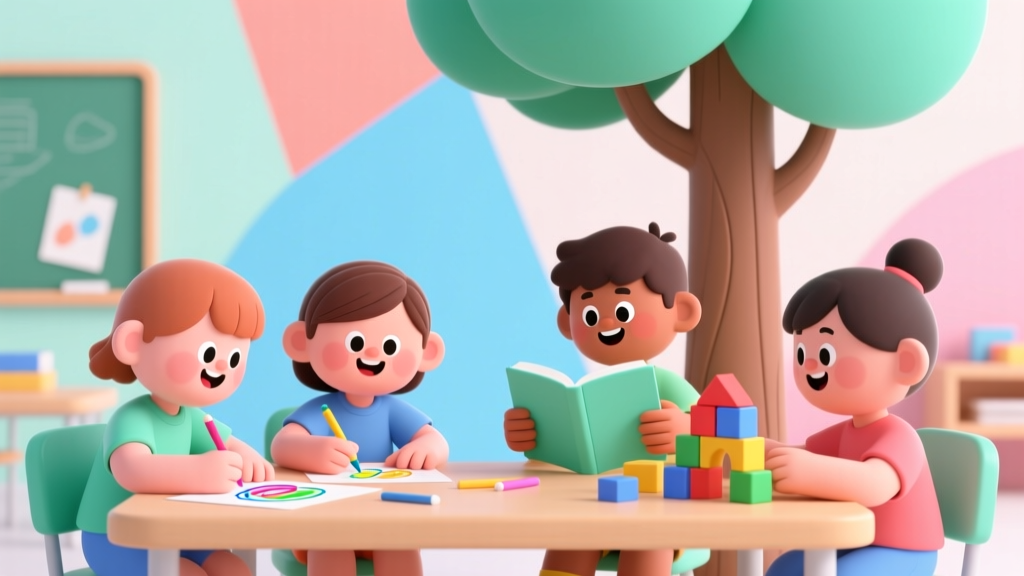
When Do Kids Start Pretend Play? (12–36 Months)
Why This Moment Matters More Than You Think
When do kids start pretend play? Most parents assume it begins around age 2—but research from the American Academy of Pediatrics (AAP) and longitudinal studies at the University of Washington show that the foundations emerge as early as 12 to 15 months, often overlooked because they look nothing like 'playing house' or 'feeding a doll.' These subtle, fleeting moments—like pretending to drink from an empty cup or holding a block to their ear like a phone—are not just cute; they’re critical neural milestones signaling rapid growth in symbolic thinking, theory of mind, and executive function. In today’s screen-saturated world, where passive digital engagement often replaces open-ended imaginative interaction, recognizing and supporting authentic pretend play isn’t nostalgic—it’s neuroprotective.
What Pretend Play Really Looks Like—By Age Band
Pretend play doesn’t arrive overnight like a birthday gift. It unfolds in distinct, observable phases tied directly to brain development—not calendar age. Pediatric neuropsychologist Dr. Laura Jana, co-author of The Toddler Brain, emphasizes: 'Symbolic representation—the ability to use one thing to stand for another—is the cognitive engine behind all higher learning. If a child can’t pretend a banana is a phone at 18 months, we need to ask why—not wait until age 3.'
Phase 1: Symbolic Gestures (12–18 months)
These aren’t ‘play’ in the traditional sense—but they are the neurological starting line. Watch for:
- Holding a toy car to their ear and saying “vroom” while moving it across the floor
- Bringing an empty cup to their mouth and tilting it, eyes closed, as if drinking
- Pushing a block along the floor while making engine sounds
- Offering you an invisible snack with open palm and eye contact
At this stage, children rarely sustain the action beyond 2–3 seconds—and almost never invite others into the scenario. That’s normal. What matters is intentionality: Does the gesture appear deliberate, not reflexive? Does it recur across days? According to AAP’s 2022 developmental screening guidelines, consistent symbolic gestures by 18 months are stronger predictors of later language and social-emotional outcomes than vocabulary count alone.
Phase 2: Object Substitution (18–24 months)
This is where most parents finally say, 'Ah—they’re pretending!' A toddler uses one object to represent another: a wooden spoon becomes a microphone; a stuffed animal ‘sleeps’ when covered with a blanket; a shoe is fed like a baby. Crucially, this phase includes self-directed actions—not yet shared narratives. They may hand you a block and say 'cookie,' but won’t wait for your response or adjust behavior based on your reaction. This reflects emerging working memory and mental flexibility—but not yet joint attention mastery.
Phase 3: Role Enactment & Simple Scripts (24–36 months)
Now pretend becomes relational and narrative-driven. Children assign roles ('You be the doctor, I’ll be sick'), initiate scenarios ('Let’s go to the zoo!'), and maintain consistency—even correcting others who break character. They begin using props symbolically *and* verbally: 'This is my stethoscope' while tapping a ruler on your chest. By age 3, over 85% of neurotypical children engage in multi-step sequences—e.g., 'First we pack lunch, then drive the car, then find the tiger.' As Dr. Megan McClelland, director of Oregon State’s Hallie Ford Center for Healthy Children, notes: 'This isn’t just fun—it’s rehearsal for real-world problem solving, emotional regulation, and perspective-taking.'
How to Nurture Pretend Play—Without Over-Engineering It
Contrary to popular 'enrichment' marketing, high-cost themed toys aren’t required—and sometimes hinder development. Research published in Child Development (2023) found toddlers exposed to open-ended, low-detail materials (blankets, cardboard boxes, wooden spoons) engaged in significantly longer, more complex pretend sequences than those given realistic plastic kitchens or dollhouses. Why? Realistic toys prescribe meaning; ambiguous ones demand imagination.
Here’s what works—backed by Montessori-trained early childhood educators and pediatric occupational therapists:
- Follow, don’t lead. If your child holds a block to their ear, mirror it—say, 'Oh! You’re calling Grandma!'—then pause. Let them decide if Grandma answers. Never insert your own script unless invited.
- Create 'invitation spaces,' not playrooms. Designate one small, uncluttered corner with 3–5 rotating items: a basket of fabric scraps, a muffin tin with wooden pegs, a large scarf, a smooth stone, and a single wooden spoon. Rotate monthly. Clutter overwhelms working memory; scarcity sparks creativity.
- Model 'thinking aloud' during daily routines. While washing dishes, say, 'Hmm—I’m pretending this sponge is a fluffy cloud that soaks up rain.' Narrate your own low-stakes pretend without expectation of imitation. Children absorb far more from ambient modeling than direct instruction.
- Embrace 'messy' symbolism. Let them smear yogurt like paint, crumple paper into 'snowballs,' or drape towels like capes—even if it defies function. Cognitive scientist Dr. Alison Gopnik calls this 'the messy middle of learning': where rules are bent to test boundaries of meaning.
A real-world example: Maya, a speech-language pathologist in Austin, worked with twin boys—one diagnosed with mild expressive language delay. She advised the parents to stop using flashcards and instead spend 10 minutes daily doing 'nothing but pretend tea parties' with mismatched cups and no script. Within 8 weeks, both boys initiated 3x more symbolic gestures and used 22% more novel two-word combinations—because play lowered anxiety and activated reward pathways linked to language acquisition.
Red Flags vs. Normal Variation—What Deserves a Conversation With Your Pediatrician?
Every child develops at their own pace—but certain patterns warrant professional input. The AAP’s Developmental Surveillance and Screening Toolkit identifies these evidence-based indicators for referral:
- No symbolic gestures (e.g., pretending to sleep, eat, talk on phone) by 18 months
- No object substitution (using one item to represent another) by 24 months
- Consistent avoidance of eye contact *during* attempts to share pretend (e.g., offering you an imaginary cookie but looking away when you reach)
- Repetitive, non-symbolic manipulation only (e.g., spinning wheels, lining up toys) with zero variation or narrative intent by 30 months
Importantly: Late onset ≠ deficit. Many bilingual children, gifted children, or those with sensory processing differences begin pretend play later—but with richer complexity once it emerges. What matters is trajectory, not timing. As Dr. Rebecca Landa, founding director of the Kennedy Krieger Institute’s Center for Autism and Related Disorders, stresses: 'We don’t diagnose delay on a single snapshot. We track whether new layers of abstraction—like adding emotion ('The baby is sad') or causality ('She fell because the slide was slippery')—appear consistently over 3–4 months.'
If concerns arise, request a developmental evaluation—not just a hearing or speech screen. True pretend play integrates motor planning, language, social cognition, and emotional regulation. A comprehensive assessment uncovers root causes, whether related to auditory processing, executive function lag, or social motivation differences.
Developmental Benefits of Pretend Play—Backed by Neuroscience
It’s tempting to view pretend play as ‘just play.’ But fMRI studies at Harvard’s Center on the Developing Child reveal that when children engage in sustained role-play, multiple brain networks activate simultaneously: the default mode network (self-referential thought), the salience network (emotional relevance), and the frontoparietal control network (goal management). This cross-network synchronization is rare outside of advanced problem-solving—and it strengthens with repetition.
| Developmental Domain | How Pretend Play Builds It | Evidence Snapshot |
|---|---|---|
| Language & Communication | Children use 3x more complex sentence structures and novel vocabulary during pretend play vs. free play (University of Texas, 2021) | 72% of toddlers who engaged in daily 15-min pretend sessions showed accelerated vocabulary growth over 6 months vs. control group |
| Executive Function | Role-switching requires inhibitory control; maintaining a story demands working memory and cognitive flexibility | Preschoolers with high pretend play scores scored 40% higher on standardized EF tasks (Head-Toes-Knees-Shoulders test) |
| Social-Emotional Intelligence | Assigning emotions to dolls/characters builds theory of mind; negotiating roles practices conflict resolution | Longitudinal study: Strong pretend play at age 3 predicted lower aggression and higher empathy scores at age 8 (Journal of Abnormal Child Psychology) |
| Early Literacy Foundations | Creating narratives mirrors story grammar (beginning-middle-end); assigning voices builds phonological awareness | Kindergarteners with rich pretend histories were 2.3x more likely to recognize story structure in read-alouds |
Frequently Asked Questions
Can too much screen time delay pretend play?
Yes—especially passive viewing. A landmark 2022 JAMA Pediatrics study followed 2,400 toddlers and found that each additional hour of background TV per day correlated with a 9% reduction in symbolic gestures by 18 months. Why? Screens deliver pre-packaged meaning; pretend play requires generating meaning. Active co-viewing (talking about characters’ feelings) has neutral effects—but doesn’t substitute for hands-on symbolic practice.
My child only pretends with me—not peers. Is that normal?
Absolutely—and developmentally appropriate until age 3. Parallel play (playing alongside, not with) dominates toddler years. Joint pretend (co-constructing stories) typically emerges between 30–36 months and solidifies by age 4. If your 3.5-year-old still avoids peer pretend entirely—or becomes distressed when others join—discuss with your pediatrician.
Do girls start pretend play earlier than boys?
No significant sex-based difference exists in onset timing. However, research from the University of Michigan shows girls tend toward nurturing themes (caregiving, family) earlier, while boys lean toward action-based scripts (rescuing, building, battling)—but both reflect equal cognitive sophistication. Avoid steering children toward 'gendered' play; follow their symbolic interests.
Is it okay to correct my child’s pretend logic? (“That’s not how phones work!”)
No—this undermines the core purpose of pretend: exploring possibilities, not accuracy. Correcting breaks flow and signals that imagination must conform to reality. Instead, join the fiction: 'Oh wow—your magic phone works even without batteries! How does it charge?' This validates their thinking while gently expanding it.
What if my child pretends about scary things—monsters, accidents, separation?
This is often therapeutic. Children use pretend to process big emotions they can’t articulate. Unless it’s repetitive, rigid, or accompanied by sleep disruption/anxiety, it’s healthy. Respond with calm curiosity: 'That monster seems really loud. What helps him feel quieter?' Never dismiss or shame the theme.
Common Myths About Pretend Play
Myth #1: “Pretend play only matters for creativity—not academics.”
False. As Dr. Kathy Hirsh-Pasek, Temple University developmental psychologist and author of Becoming Brilliant, states: 'Symbolic thinking is the bedrock of algebra, coding, and scientific hypothesis testing. When a child pretends a stick is a bridge, they’re practicing abstraction—the same skill needed to understand x + 2 = 5.'
Myth #2: “If my child doesn’t love dress-up or dolls, they’re missing out.”
Not true. Pretend manifests uniquely: building intricate block cities with assigned functions (‘This tower is the hospital’), narrating elaborate car races with sound effects, or arranging stuffed animals in courtroom formations. Look for intentionality and symbolism—not just props.
Related Topics (Internal Link Suggestions)
- Signs of autism in toddlers — suggested anchor text: "early signs of autism spectrum disorder"
- Best open-ended toys for toddlers — suggested anchor text: "top Montessori-inspired toys for 12–36 month olds"
- Speech milestones by age — suggested anchor text: "what speech and language skills to expect at each age"
- How to encourage imaginative play — suggested anchor text: "simple, no-toy ways to spark creativity"
- When do kids start sharing toys? — suggested anchor text: "the real timeline for cooperative play development"
Your Next Step Starts Today—No Special Tools Required
You don’t need a Pinterest-perfect playroom, expensive kits, or hours of structured time. The most powerful catalyst for pretend play is your curious, unhurried presence. Tonight, try this: Put your phone away for 12 minutes. Sit on the floor with your child and one ordinary object—a spoon, a sock, a leaf. When they interact with it, name the action without judgment: 'You’re holding it high!' or 'It’s rolling down your arm!' Then wait. Breathe. Watch. You’re not teaching pretend—you’re bearing witness to the quiet, miraculous birth of abstract thought. And if you notice your first symbolic gesture this week? Celebrate it—not as a milestone reached, but as a door cracked open to everything your child will one day imagine, build, and become.
More Articles
 How to Sign Up as an Angel Tree Kid (2026)
 How Old Were the Kids in Stranger Things Season 5 (2026)
 How to Explain Easter to Kids (2026)
 How Many Kids Does Bruce Jenner Have? (2026)
 Kids Size 90 Explained: Why Sizes Change Fast (2026)
 Trisha Paytas’ Kids Reincarnated? Experts Weigh In
 Does Chili’s Have Kids Eat Free in 2026?
 GH Custody Drama: Real Parenting Lessons (2026)
 How Often Should Kids See a Dentist? (2026)
 Shiba Inus and Kids: Safety & Bonding Guide (2026)