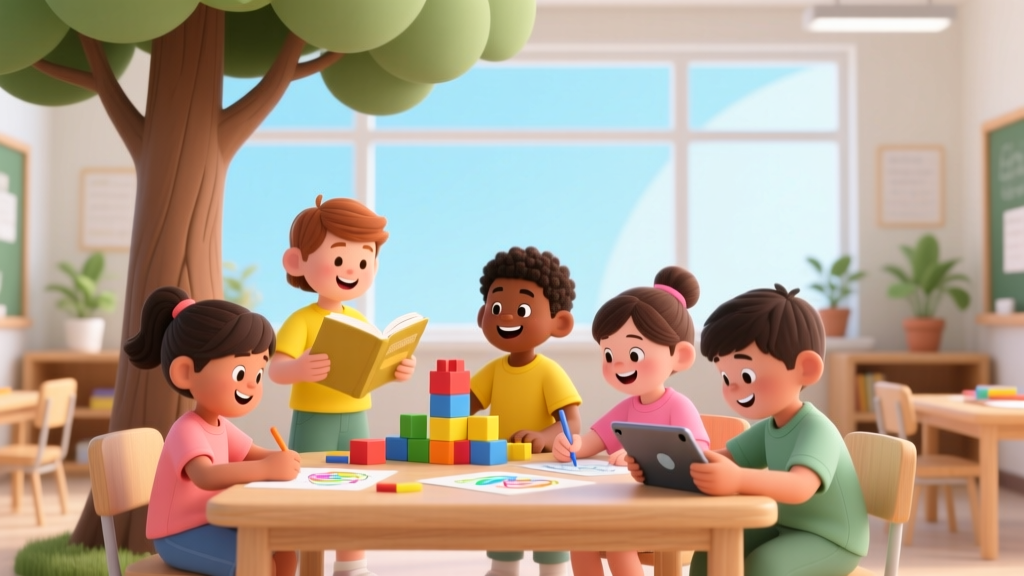
When Do Kids Start Counting to 10? (2026)
Why This Milestone Matters More Than You Think—And Why Timing Varies Wildly
When do kids start counting to 10 is one of the most frequently searched questions among parents of toddlers—and for good reason. It’s often the first visible sign that a child is developing foundational number sense, a critical predictor of later math confidence and academic success. But here’s what most search results get wrong: counting to 10 isn’t a single ‘switch’ that flips at age 3. It’s a layered progression spanning nearly two years—from babbling number words like nursery rhymes to understanding that '7' means seven distinct objects. According to the American Academy of Pediatrics (AAP), this unfolding happens across three interlocking stages: rote counting, one-to-one correspondence, and cardinality. And crucially, variation within this timeline is not just normal—it’s neurologically expected. In fact, a landmark 2022 longitudinal study published in Early Childhood Research Quarterly tracked 1,247 children and found that only 12% achieved full cardinal understanding of numbers 1–10 by their third birthday—yet over 94% reached it solidly by age 4 years, 8 months. So if your 3-year-old confidently rattles off '1-2-3-4-5-6-7-8-9-10' while pointing to six blocks? That’s fantastic rote skill—but it doesn’t yet mean they grasp quantity. Let’s unpack what’s really happening beneath the surface—and how to support it with warmth, not worksheets.
Rote Recitation: The ‘Song Stage’ (Ages 2–3)
This is the stage most parents notice first—and often misinterpret as ‘real’ counting. Between ages 24 and 36 months, many children begin chanting number words in sequence, much like singing the alphabet. They may do it while stacking blocks, climbing stairs, or even mid-tantrum. Dr. Laura J. Niles, developmental psychologist and co-author of Math in the Early Years, explains: 'Rote counting is primarily a linguistic and memory feat—it relies on auditory pattern recognition, not numerical understanding. Think of it like learning the chorus of a pop song: catchy, repetitive, and emotionally rewarding—but not yet meaningful.' Key markers of this phase include:
- Reciting numbers in order—but skipping or repeating digits ('1-2-3-5-5-6-7-9-10')
- Counting faster or slower depending on mood or context (e.g., rushing through '7-8-9-10' when excited)
- No consistent pointing or touching of objects while saying numbers
- Difficulty starting from numbers other than '1' (e.g., can’t count '5-6-7-8-9-10' on request)
At this stage, your role isn’t correction—it’s joyful reinforcement. Sing number songs (Five Little Monkeys, 10 in the Bed), label steps aloud ('One step… two steps… three!'), and celebrate attempts—even if the sequence is imperfect. Avoid drilling or testing. As Dr. Niles emphasizes: 'Pressure before readiness creates math anxiety that can persist into elementary school. Play is the curriculum.'
One-to-One Correspondence: The ‘Pointing Phase’ (Ages 3–4)
This is where counting transforms from performance to cognition. Somewhere between 36 and 48 months, children begin matching each spoken number word to exactly one object—touching, tapping, or looking at items deliberately as they say 'one', 'two', 'three'. This is the bedrock of quantification. A classic sign? Your child lines up toy cars and says 'one' while tapping the first, 'two' while tapping the second—and stops when they run out of objects, even if they haven’t reached 10 yet. This phase requires fine motor coordination, attentional control, and working memory—all still maturing rapidly.
Here’s how to nurture it without pressure:
- Use everyday objects: Count grapes at snack time, spoons while setting the table, or shoes while getting dressed. Keep it embedded—not isolated.
- Model ‘slow counting’: Say each number slowly and deliberately while making clear physical contact: 'One… *tap*… Two… *tap*… Three… *tap*…' Then pause and invite them to continue.
- Introduce intentional errors: Count five buttons but say 'one, two, three, four, six'—then ask, 'Did I say something strange?' This builds metacognition and error detection.
- Limit sets to 5–7 items initially: Research shows young children reliably track only 4–5 objects without losing count. Gradually increase as accuracy improves.
A powerful real-world example: Maya, a preschool teacher in Portland, noticed her 3-year-old student Leo could chant to 10 flawlessly—but consistently pointed to only three blocks when asked to 'give me four'. She began using 'count-and-move' games: placing plastic bears in a line and asking him to slide one bear into a cup for each number he said. Within three weeks, his one-to-one accuracy jumped from 42% to 89%—not because she taught numbers, but because she made the connection between word and action tangible and kinesthetic.
Cardinality & Beyond: When ‘10’ Actually Means Something (Ages 4–5)
The final—and most profound—leap is cardinality: understanding that the last number said represents the total quantity in the set. If a child counts seven crayons and answers 'How many?' with 'seven', they’ve grasped cardinality. This typically consolidates between ages 4 and 4½—and it’s the gateway to all future arithmetic. Without it, addition is just verbal ritual; with it, '2 + 3' becomes a mental model of combining quantities.
Three evidence-backed activities that accelerate cardinal understanding:
- Hide-and-Count: Place 6 toys under a cloth, count them aloud together, then ask, 'How many are hiding?' If they answer 'six' without recounting, cardinality is emerging.
- Change-the-Set: Count 5 buttons, then add one more. Ask, 'Now how many?' Children who must recount lack stable cardinal knowledge; those who say 'six' immediately demonstrate it.
- Subitizing Practice: Show dot patterns (like dice faces) for 1–2 seconds and ask 'How many?' Subitizing—the instant recognition of small quantities—strengthens neural pathways linked to cardinal reasoning. Use dominoes, ten-frames, or apps like Number Frames (free from The Math Learning Center).
Importantly, don’t rush past 10. Many curricula push 'counting to 20' prematurely—but mastery of 1–10 with deep conceptual grounding predicts stronger long-term outcomes than superficial fluency to 100. As Dr. Douglas H. Clements, founding director of the Marsico Institute for Early Learning, states: 'Depth before breadth. Ten isn’t a finish line—it’s a foundation stone.'
What the Data Really Shows: Age Ranges, Variability, and Red Flags
While developmental milestones offer helpful benchmarks, individual variation is vast—and influenced by language exposure, socioeconomic factors, home numeracy practices, and even birth season (studies show summer-born children often lag slightly in early numeracy due to cutoff-based school entry). Below is a research-synthesized timeline based on meta-analyses from the National Center for Education Statistics (NCES), AAP clinical reports, and longitudinal data from the Early Childhood Longitudinal Study (ECLS-K).
| Developmental Stage | Typical Age Range | Key Behaviors | Supportive Strategies | When to Consult a Specialist |
|---|---|---|---|---|
| Rote Counting | 24–36 months | Sings numbers 1–10 in sequence; may skip or repeat; no object matching | Sing number songs; count stairs/steps; use rhythmic clapping | Not speaking any number words by 36 months |
| One-to-One Correspondence | 36–48 months | Points/touches one item per number; may lose track beyond 5–6 items | Count manipulatives (beans, buttons); use finger-counting; play 'count and move' | Cannot match 1:1 for sets of 3+ objects by age 4 |
| Cardinality Mastery | 48–60 months | Answers 'How many?' correctly after counting; understands 'more'/'less'; begins subitizing 1–5 | Play board games with dice; compare groups ('Which pile has more?'); introduce simple addition stories | No cardinal understanding by age 5, or persistent reversal of numbers (e.g., writing 15 as '51') |
| Counting On & Skip-Counting | 5–6 years | Counts on from a given number (e.g., 'Start at 7… 7, 8, 9, 10'); counts by 2s/5s with support | Use number lines; play 'what comes next?'; count money coins; sing skip-counting chants | Unable to count on from any number above 5 by age 6, or significant difficulty recognizing numerals 1–20 |
Frequently Asked Questions
My 3-year-old counts to 10 perfectly—but can’t count 5 toys correctly. Is that normal?
Absolutely normal—and very common. This is textbook rote vs. conceptual disconnect. Rote counting develops earlier because it’s linguistic and rhythmic; connecting number words to quantity requires executive function and visual-motor integration, which mature later. Continue modeling one-to-one counting during daily routines (e.g., 'Let’s count these crackers: one… two… three…') without quizzing. Most children bridge this gap naturally between ages 3½ and 4.
Should I use flashcards or apps to teach counting faster?
Evidence strongly advises against it—at this age. A 2023 University of Cambridge study found toddlers exposed to digital counting apps showed lower gains in number sense than peers using hands-on materials. Why? Screens reduce tactile feedback, limit social interaction (a key driver of learning), and encourage passive reception over active construction. Stick to physical objects, movement, and conversation. As Dr. Kathy Hirsh-Pasek, Temple University child development expert, puts it: 'Children don’t learn math from pixels—they learn it from pebbles, peas, and people.'
My child mixes up 6 and 9, or writes numbers backward. Should I correct them?
Not yet—and definitely not with frustration. Reversals and confusions are neurodevelopmentally typical until age 7. The brain’s visual processing centers are still refining spatial orientation. Instead of correction, provide multi-sensory reinforcement: trace numbers in sand, form them with pipe cleaners, or find them in environmental print (street signs, books, packaging). Focus on numeral recognition in context ('Which number says “bus 7”?' rather than isolated drills). Persistent reversals beyond age 7 warrant evaluation—but at age 4? It’s just part of the beautiful, messy work of wiring a mathematician’s brain.
Is bilingualism delaying my child’s counting skills?
No—bilingualism does not delay numeracy development. In fact, numerous studies (including a 2021 NIH-funded cohort study) show bilingual children often develop stronger executive function, which supports mathematical reasoning. They may code-switch ('uno, dos, three, four') or learn number words in both languages sequentially—but their underlying number concepts develop on par with monolingual peers. Celebrate both languages: count in Spanish at dinner, English at bath time. Dual-language exposure enriches cognitive flexibility—the very skill needed for advanced math.
What if my child seems behind compared to siblings or classmates?
Comparison is the enemy of developmental understanding. Siblings differ genetically, environmentally, and temperamentally—just as no two trees grow at identical rates. Focus on your child’s growth: Can they count 3 objects accurately today when they couldn’t last month? Do they now recognize '5' on a die without counting dots? Progress—not peer alignment—is the metric that matters. If you’re concerned, consult your pediatrician or a licensed early intervention specialist (available free in most U.S. states via IDEA Part C). But remember: late bloomers in early math often become deep, thoughtful problem-solvers later—because they build understanding, not speed.
Common Myths
Myth #1: “If they can’t count to 10 by age 3, they’ll struggle with math forever.”
False. Counting to 10 by age 3 is not predictive of long-term math achievement. Research from Stanford’s Graduate School of Education shows that early number sense—understanding relationships between numbers, not recitation speed—is the true predictor. A child who deeply understands '4' and '5' at age 4 outperforms a child who chants to 20 at age 3 but can’t compare quantities.
Myth #2: “More practice = faster mastery.”
Counterproductive. Forced repetition without conceptual grounding creates frustration and disengagement. The National Association for the Education of Young Children (NAEYC) explicitly warns against drill-based approaches for children under 5, citing evidence that play-based, meaning-centered experiences yield superior and longer-lasting learning outcomes.
Related Topics (Internal Link Suggestions)
- When do kids understand addition — suggested anchor text: "early addition readiness signs"
- Best counting toys for toddlers — suggested anchor text: "Montessori-inspired counting tools"
- Number sense activities for preschoolers — suggested anchor text: "play-based number sense games"
- Signs of dyscalculia in preschool — suggested anchor text: "early math learning differences"
- How to teach counting with fingers — suggested anchor text: "finger counting benefits and best practices"
Wrap-Up: Trust the Process, Not the Timeline
When do kids start counting to 10 isn’t about hitting a date on the calendar—it’s about witnessing the quiet miracle of neural architecture being built: synapses firing as your child connects sound, symbol, gesture, and meaning. There will be days they count flawlessly, and days they forget 'seven' entirely. Both are essential. Your calm presence, playful curiosity, and refusal to equate speed with intelligence are the most powerful teaching tools you own. So put down the checklist. Pick up a handful of raisins. Sit on the floor. Count them slowly—together. And when your child grins and says 'ten!' while holding exactly eight? Celebrate the attempt, name the quantity, and keep going. Because the goal isn’t just reaching 10—it’s building a lifelong relationship with numbers that feels safe, joyful, and deeply human. Ready to go deeper? Download our free Number Sense Play Kit—12 screen-free, research-backed games you can start tonight.
More Articles
 Is Superman Kid Friendly? A Parent’s Media Guide
 Diddy’s Kids: How Many Children Does He Have? (2026)
 Home Alone Age Rules: State Laws & Readiness Signs
 Jeffrey Manchester Kids’ Access: Rights & Emotional Care
 What Age Kids Start Reading: Truth & Tips
 Is Santa Real? A Pediatrician-Backed Guide (2026)
 Did Dolly Parton Ever Have Kids? The Truth (2026)
 How Much Are Braces for Kids? (2026)
 Walton Goggins Kids: Privacy, Parenting & Values
 Elon’s Kid Viral Clip: How to Respond (2026)