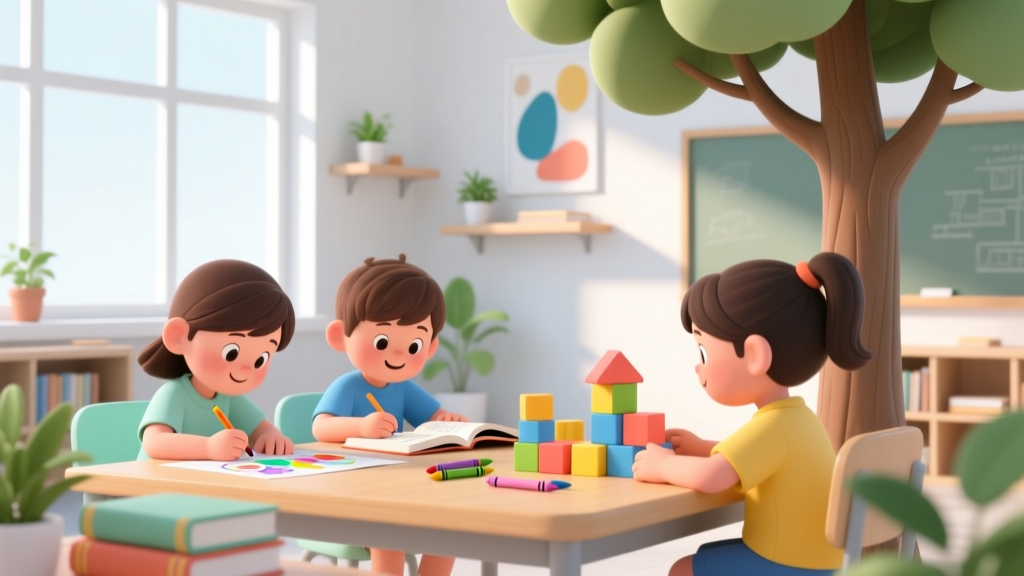
When Do Kids Start Counting? Evidence-Based Milestones
Why This Question Matters More Than You Think Right Now
When do kids start counting isn’t just curiosity—it’s often the first quiet pulse of parental worry: Is my child on track? Am I missing something important? Should I be doing more—or less? In an era where early academic pressure creeps into preschools and social media feeds overflow with ‘genius toddler’ clips, parents are left second-guessing natural development. But here’s what leading child development experts emphasize: counting isn’t about memorization—it’s the visible tip of a deep cognitive iceberg involving number sense, working memory, language integration, and executive function. Getting this right—supporting without rushing, observing without comparing—can shape not just math confidence, but lifelong learning attitudes.
The Real Timeline: From Babbling Numbers to True Understanding
Contrary to viral checklists that treat counting like a switch to flip, developmental science reveals it as a layered, nonlinear progression. According to the American Academy of Pediatrics (AAP) and research published in Child Development, children move through five distinct phases—each building on the last—and most don’t achieve full conceptual mastery until age 5–6. Let’s unpack them:
- Rote Counting (Ages 2–3): Reciting numbers in order—often up to 10 or 20—like a nursery rhyme. No connection yet to quantity. A child may say “1, 2, 3, 4, 5…” while pointing to five toys—but count only three of them correctly.
- One-to-One Correspondence (Ages 3–4): Matching each number word to exactly one object while counting. This is the critical bridge from recitation to meaning. A child who taps each block once while saying “one, two, three” demonstrates this skill—even if they miscount the total.
- Cardinality (Age 4+): Understanding that the last number said represents the total quantity. Ask “How many?” after counting five buttons—they should answer “five,” not repeat the sequence.
- Order Irrelevance (Age 4–5): Knowing objects can be counted in any order and still yield the same total. This signals flexible thinking beyond rigid routines.
- Abstraction & Subitizing (Age 5+): Recognizing small quantities (1–4) instantly without counting (subitizing) and applying counting to non-physical things (“How many times did you jump?”).
Dr. Laura Jana, pediatrician and co-author of The Toddler Brain, stresses: “Counting fluency before age 4 is not predictive of future math success. But consistent difficulty with one-to-one correspondence or cardinality after age 4 warrants gentle screening—not panic.”
What’s Normal vs. When to Pause and Observe
Every child’s pace varies—and variation is healthy. But certain patterns deserve thoughtful attention, not dismissal. Consider these benchmarks, drawn from longitudinal studies at the University of Chicago’s Early Math Collaborative and AAP clinical guidelines:
- A child who consistently skips numbers (“1, 2, 4, 5”) or repeats them (“1, 2, 3, 3, 4”) between ages 3.5–4.5 may need language or auditory processing support.
- If your 4-year-old cannot reliably count 5 objects with one-to-one correspondence—even with modeling—this may signal emerging challenges in visual-motor integration or working memory.
- Children who count accurately but never use numbers functionally (“I want 3 crackers”) or respond to simple quantitative questions (“Which group has more?”) may benefit from enriched number-language exposure.
Importantly: bilingual children often hit milestones slightly later in each language—but their combined conceptual understanding is typically on par or advanced. As Dr. Ellen Bialystok, cognitive psychologist and bilingualism researcher, notes: “Dual-language learners aren’t delayed—they’re managing two symbolic systems. Their number sense develops robustly across both languages when supported with rich, contextual input.”
7 Play-Based, Evidence-Informed Strategies That Actually Work
Forget flashcards and timed drills. Research from the National Council of Teachers of Mathematics (NCTM) and the Erikson Institute confirms: the most effective counting support happens in joyful, embedded, low-stakes moments. Here’s how to weave it in—without turning snack time into a test:
- Count Everything—But Never Correct Mid-Flow: Narrate your actions aloud: “I’m putting *one* spoon in the drawer… *two* spoons… *three*.” If your child says “four” when you place the fifth, smile and continue: “Yes! Four—and now *five* spoons!” This models accuracy without shaming.
- Use ‘Touch & Say’ Before ‘Point & Say’: For toddlers struggling with one-to-one correspondence, have them gently *touch* each object as they say the number. Tactile feedback strengthens neural pathways far more than pointing alone.
- Introduce ‘How Many?’ Only After They Count: Wait until your child finishes counting before asking “How many?” This reinforces cardinality. Jumping to the question too soon teaches them to stop at “five” instead of internalizing that “five” means the whole set.
- Play ‘Same or Different?’ With Small Quantities: Show two groups of 2–4 items (e.g., 3 grapes vs. 4 blueberries). Ask “Are there the same number?” before counting. This builds comparative reasoning—the foundation for addition and subtraction.
- Count Backward During Transitions: “We have 5 steps to the car… 5, 4, 3, 2, 1—car time!” Backward counting strengthens number flexibility and prepares the brain for subtraction concepts.
- Use Non-Standard Units for Measurement: “How many blocks long is your train?” or “How many hand-spans wide is the book?” This links counting to real-world application and spatial reasoning.
- Read Number-Rich Books—Then Pause to Predict: In Five Little Monkeys, pause before “four little monkeys”—ask “What comes next?” This builds ordinal awareness and anticipation, key for pattern recognition.
A real-world example: Maya, a speech-language pathologist and mom of twins, noticed her daughter Lila (age 3.8) could recite to 20 but rarely matched words to objects. Instead of drilling, she started a “Counting Jar”: each day, they added one item (a button, a pebble, a pasta shell) and counted the total together—always ending with “So today we have *X* things!” Within 6 weeks, Lila began spontaneously counting snacks and blocks, using cardinality correctly 80% of the time. No worksheets. Just consistency, warmth, and zero pressure.
Developmental Milestones & Support Guide: Age-by-Age Breakdown
| Age Range | Typical Counting Behaviors | Key Cognitive Skills Developing | Supportive Actions (What to Do) | When to Gently Observe Further |
|---|---|---|---|---|
| 2–2.5 years | Says “one,” “two,” sometimes “three”; may point randomly while naming numbers | Emerging number-word vocabulary; early auditory sequencing | Label quantities in daily life (“one shoe,” “two eyes”); sing counting songs with gestures | Doesn’t imitate number words by 2.5 years despite frequent exposure |
| 2.5–3.5 years | Rote counts to 10+; may skip or repeat numbers; attempts to count objects but loses track | Working memory growth; improving attention span; early one-to-one mapping | Count stairs, utensils, animal pictures in books; use finger plays (“Five Little Ducks”) | Cannot match 3 objects to 3 number words even with modeling by age 3.5 |
| 3.5–4.5 years | Counts 5–10 objects accurately with one-to-one correspondence; answers “How many?” correctly ~70% of the time | Cardinality understanding; improved inhibitory control; symbolic representation | Play board games with dice (count dots); sort objects then count each group; compare sets (“Which has more?”) | Consistently miscounts sets of 5+ objects or cannot identify “how many” after counting by age 4.5 |
| 4.5–6 years | Counts to 20+; understands order irrelevance; counts backward from 10; begins simple addition/subtraction | Abstract thinking; mental number line formation; early arithmetic reasoning | Estimate then count (“How many crackers do you think are in the box?”); solve story problems with props (“You had 3 apples, ate 1—how many left?”) | Cannot count 10 objects accurately or apply counting to simple problems by age 5.5 |
Frequently Asked Questions
My 3-year-old counts to 30 but can’t count 5 toys correctly—why?
This is extremely common—and completely normal. Rote counting (memorizing the sequence) develops earlier and separately from conceptual counting (understanding quantity). Think of it like singing the alphabet: a child can recite A–Z before knowing what “B” stands for. Focus on playful one-to-one practice (touching each toy while saying a number) rather than extending the rote range. The AAP advises prioritizing meaning over length.
Should I teach my toddler to write numbers while they’re learning to count?
Not yet—and not as a priority. Writing numbers requires fine motor control, visual-motor integration, and symbol recognition that typically lags behind counting comprehension by 12–18 months. Pushing writing too early can create frustration and negative associations with math. Instead, build number sense through movement, song, and manipulation. When writing emerges naturally (usually around age 4.5–5), keep it playful: trace numbers in sand, form them with playdough, or draw them in condiment on a plate.
My child is bilingual—does that delay counting development?
No—bilingualism does not cause delays in counting or overall cognitive development. Research from the Max Planck Institute shows bilingual children develop number concepts at the same rate as monolingual peers, though they may initially distribute vocabulary across languages (e.g., know “three” in English and “tres” in Spanish but not both terms for “three”). Consistent, rich exposure to number words in both languages actually strengthens executive function. Focus on quality interactions—not language dominance.
Are educational apps helpful for teaching counting?
Most are not—and some may hinder. A landmark 2023 study in JAMA Pediatrics found toddlers who used number-learning apps for >15 mins/day showed slower growth in real-world counting skills than peers who engaged in hands-on play. Why? Screens lack tactile feedback, social contingency (the back-and-forth of shared attention), and physical manipulation. If used, choose apps requiring active touch (not passive watching) and co-view with your child—narrating what’s happening and connecting it to real objects (“That’s 3 fish—let’s count our 3 crackers!”).
My pediatrician said ‘wait and see’—but I’m still worried. What’s a respectful next step?
Trust your instinct—and advocate kindly. Request a referral to your school district’s early childhood special education team (available free under IDEA for children 3–5) or a developmental pediatrician. Frame it as proactive support: “I’d love to better understand her learning profile so I can support her most effectively.” Document specific observations (e.g., “She counts 4 blocks but says ‘5’ every time”)—not comparisons to siblings or peers. As Dr. Barry Zuckerman, founding director of Boston Medical Center’s Grow Clinic, reminds parents: “Early support isn’t about fixing a problem—it’s about matching opportunities to a child’s unique rhythm.”
Common Myths About Early Counting
- Myth #1: “If they’re not counting by age 3, they’ll fall behind in math forever.”
False. Longitudinal data from the NICHD Study of Early Child Care shows no correlation between rote counting age and later math achievement. What *does* predict success is conceptual understanding—built through play, conversation, and exploration—not speed of acquisition.
- Myth #2: “More practice = faster mastery.”
Also false—and potentially counterproductive. Forced repetition without meaning creates anxiety and disengagement. The NCTM emphasizes “mathematical joy” as a predictor of persistence. One 5-minute, joyful counting moment daily is vastly more effective than 20 minutes of stressed drill.
Related Topics (Internal Link Suggestions)
- How to Teach Number Recognition — suggested anchor text: "number recognition activities for toddlers"
- When Do Kids Understand Addition and Subtraction? — suggested anchor text: "early addition concepts preschool"
- Best Counting Toys That Are Actually Developmentally Appropriate — suggested anchor text: "Montessori counting materials"
- Signs of Dyscalculia in Preschoolers — suggested anchor text: "early math learning difficulties"
- Math Talk: How Parents Can Build Number Sense Daily — suggested anchor text: "everyday math talk tips"
Final Thought: Counting Is Connection, Not Competition
When do kids start counting isn’t a race—it’s a relationship. It’s the shared focus as you count raindrops on the window, the laughter when you miscount and giggle, the pride in their voice saying “I did it!” after lining up six cars. Your calm presence, your curiosity about their thinking (“How did you figure that out?”), and your willingness to follow their lead—not your ability to accelerate the timeline—is what truly builds mathematical confidence. So take a breath. Put down the checklist. Pick up a handful of Cheerios—and count them together, slowly, joyfully, without an end goal. That’s where real numeracy begins. Ready to go deeper? Download our free Playful Number Sense Starter Kit—with 12 screen-free, research-backed counting games you can start tonight.
More Articles
 Does Katy Perry Have Kids? The Truth (2026)
 Jason Aldean’s Kids: How Many & Family Details (2026)
 Aphmau’s Kids: How Many & Why Parents Love Her Honesty
 Twin Peaks for Kids? Honest Family Visit Facts (2026)
 Does Chris Kattan Have Kids? The Privacy Truth
 Kids Kindle Account Setup Guide (2026)
 How to Screen Lock iPhone for Kids (2026)
 Epstein Myth: Calmly Debunk with Kids (2026)
 Why Kids Say 6 7 Instead of Six Seven
 When Do Kids Learn to Jump? (2026)