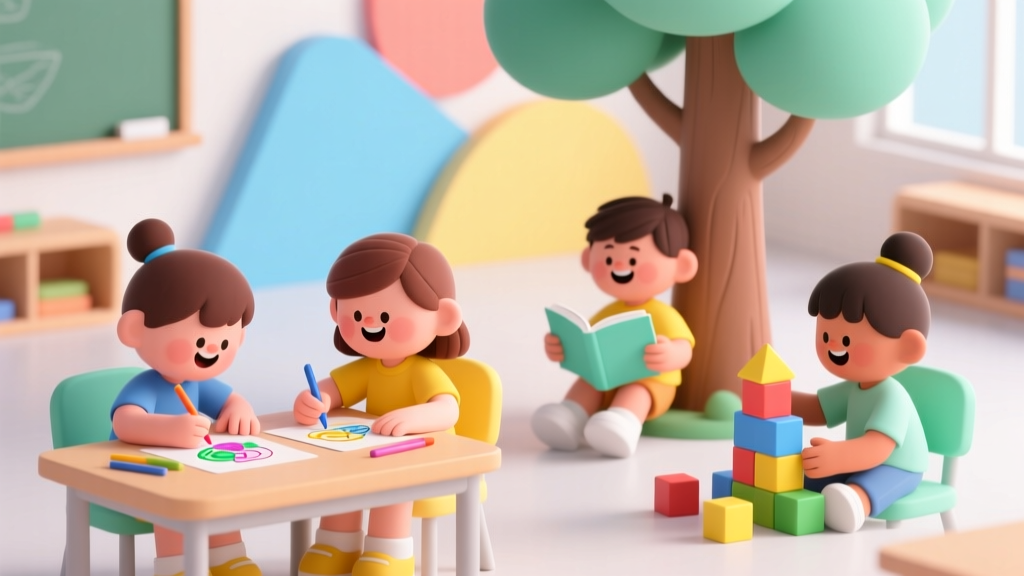
When Do Kids Learn to Share? Science-Backed Truths
Why 'When Do Kids Learn to Share?' Isn’t Just a Question—It’s a Parenting Crossroads
When do kids learn to share? This deceptively simple question lands like a quiet thunderclap in the middle of a toddler meltdown over a plastic dump truck—or during the third consecutive playdate where your 3-year-old clutches a stuffed unicorn like Excalibur while peers cry. You’re not just asking about a behavior; you’re wrestling with a core tension in modern parenting: how to raise kind, cooperative humans without sacrificing emotional safety or developmental integrity. And here’s what the latest child development research confirms—what most parents assume is ‘normal’ sharing pressure is often misaligned with brain science, leading to guilt, frustration, and ironically, *less* generosity long-term.
The Real Timeline: Sharing Isn’t a Switch—It’s a Symphony of Brain Development
Forget the myth that children ‘should’ share by age 2 or 3. Neuroscientists at the University of Washington’s Institute for Learning & Brain Sciences (I-LABS) have mapped sharing as an emergent skill requiring three distinct neural systems to mature and coordinate: inhibitory control (stopping the impulse to grab/keep), theory of mind (understanding others have different desires), and empathic resonance (feeling motivated to act on that understanding). These don’t fully integrate until ages 5–7—and even then, context matters immensely.
Consider Maya, a bright 4-year-old observed in Dr. Stephanie Carlson’s longitudinal study at UC Berkeley. In a lab setting with structured turn-taking games, Maya shared stickers 68% of the time. But during unstructured free play with her younger brother? She guarded her favorite dinosaur figurines fiercely—even after being prompted. Why? Because real-world sharing isn’t about abstract rules; it’s about emotional regulation under stress, attachment security, and perceived fairness. As Dr. Carlson notes: ‘Sharing isn’t a moral failing when it doesn’t happen—it’s data about a child’s current regulatory capacity.’
So what *does* the developmental arc actually look like? Not as a rigid checklist—but as overlapping waves of capability:
- 12–24 months: Early ‘proto-sharing’ emerges—passing objects to caregivers during peek-a-boo or handing a toy to a parent unprompted. This reflects sensorimotor exploration, not social intention.
- 24–36 months: Children begin parallel play with occasional object exchange—but almost always initiated by adults or driven by imitation, not internal motivation. They may say ‘mine’ up to 10x/hour (per Yale Child Study Center observational data) because they’re solidifying self-concept, not being selfish.
- 3–4 years: Turn-taking appears in highly scaffolded contexts (e.g., board games with adult mediation), but spontaneous sharing remains rare. A landmark 2022 study in Child Development found only 12% of 3.5-year-olds shared a desired toy without prompting—even when told it would make a peer happy.
- 5–7 years: Genuine, internally motivated sharing increases significantly—but still depends on relationship quality, perceived fairness, and emotional state. Children are far more likely to share with a friend than a stranger, and less likely when tired or overwhelmed.
Why ‘Just Share!’ Backfires—And What to Do Instead
Most well-intentioned parents default to directives: ‘Share the blocks!’ ‘Give it to Sam!’ ‘Be nice!’ But developmental psychologist Dr. Laura Markham, author of Peaceful Parents, Happy Kids, warns this approach triggers the amygdala—the brain’s threat center—before the prefrontal cortex (responsible for reasoning) can engage. When a child hears ‘share now,’ their nervous system interprets it as: ‘My safety is at risk. My autonomy is being erased.’ The result? Power struggles, shame loops, and learned helplessness around generosity.
Instead, evidence-based alternatives focus on co-regulation and scaffolding:
- Name the feeling, not the flaw: ‘You really love that fire truck—and it’s hard to let someone else hold it right now. That’s okay.’ This validates emotion while separating identity from behavior.
- Offer concrete, limited choices: ‘Would you like to hand it to Leo yourself, or should I help you pass it?’ Autonomy + support = reduced resistance.
- Model generosity *without commentary*: ‘I’m going to pour some juice for you and me.’ Then do it—no ‘see, I’m sharing!’ narration. Children absorb behavior through observation, not lectures.
- Create ‘sharing infrastructure’: Use visual timers for turns, designate ‘special toys’ that stay in a ‘my space’ bin during playdates, and rotate ‘community toys’ (like playdough or building sets) that belong to everyone equally.
- Reframe ‘not sharing’ as information: If your child hides toys before guests arrive, ask gently: ‘What feels scary about sharing today?’ Their answer reveals unmet needs—often safety, predictability, or attention—not character deficits.
A powerful case study comes from Seattle’s Rainier Valley Montessori School, where teachers replaced ‘sharing circles’ with ‘care circles’ for ages 3–5. Children brought one personal item to show (not give), described its meaning, and practiced active listening. Over 8 months, spontaneous sharing increased 41%—and teacher-reported conflicts dropped 63%. Why? Because generosity grew from relational security, not compliance.
The Hidden Role of Temperament, Culture, and Environment
Assuming all children follow the same sharing trajectory ignores critical variables. A child with high sensory sensitivity may guard toys to maintain control over overwhelming stimuli. A child raised in a collectivist culture (e.g., many East Asian or Indigenous communities) may demonstrate sharing earlier—but through communal ownership norms rather than individual turn-taking. Meanwhile, a child experiencing food insecurity or housing instability may cling to possessions as anchors of safety—a survival strategy, not defiance.
Environmental factors matter deeply too. A 2023 meta-analysis in Developmental Psychology found children in classrooms with ≥15% adult-to-child ratio showed 2.3x higher spontaneous sharing rates than those in high-stress, understaffed settings. Why? Adults who aren’t stretched thin can offer calm, consistent scaffolding instead of reactive demands.
Even language shapes perception. In bilingual households, children exposed to languages with strong collective pronouns (e.g., Mandarin’s ‘we’-focused constructions) demonstrated earlier prosocial behaviors in lab tasks—but only when caregivers consistently used those linguistic frames in daily interactions. As Dr. Elena Llamas, a bilingual development researcher at UT Austin, explains: ‘It’s not the language itself—it’s how language carries values. “Let’s take turns” embeds cooperation differently than “You must share.”’
Age-Appropriate Sharing Support: A Practical Guide
Below is a research-informed, pediatrician-vetted guide to supporting sharing development—organized by age band, grounded in AAP (American Academy of Pediatrics) milestones and Montessori principles of respectful independence. Unlike generic advice, this table maps specific actions to underlying neurodevelopmental needs.
| Age Range | Key Developmental Needs | Practical Support Strategies | What to Avoid |
|---|---|---|---|
| 12–24 months | Sensory-motor exploration; emerging sense of self; limited theory of mind | • Narrate exchanges warmly: ‘You gave Mommy the spoon! Thank you!’ • Offer identical toys during parallel play to reduce scarcity stress • Use simple sign language (e.g., ‘give’, ‘more’) to build communication before verbal skills mature |
• Labeling behavior as ‘selfish’ or ‘greedy’ • Forcing physical handover of objects |
| 24–36 months | Strong ‘mine’ identification; early empathy glimmers; poor impulse control | • Introduce turn timers (visual sand timers work best) • Practice ‘sharing’ with stuffed animals: ‘Bear wants a turn with the ball—can we pass it?’ • Read books highlighting feelings (e.g., Hands Are Not for Hitting)—not just sharing |
• Public shaming: ‘Why won’t you share? Sam is crying!’ • Using rewards/punishments tied to sharing behavior |
| 3–5 years | Growing theory of mind; desire for peer connection; inconsistent emotional regulation | • Co-create simple ‘playdate agreements’: ‘We’ll take turns with the swing—3 pushes each!’ • Use ‘I-statements’ to model: ‘I feel happy when we both get to paint’ • Designate 1–2 ‘special toys’ kept away during visits—reducing anxiety-driven guarding |
• Comparing to siblings/peers: ‘Your sister shares so nicely’ • Withholding affection or attention after ‘non-sharing’ moments |
| 5–7 years | Developing moral reasoning; stronger empathy; ability to negotiate | • Involve child in creating fair solutions: ‘How could we make sure everyone gets a turn?’ • Discuss fairness vs. equality: ‘Sometimes fairness means giving extra help—not equal time’ • Highlight generosity in everyday life: ‘Did you see how Maya helped carry groceries? That was caring.’ |
• Assuming moral understanding equals consistent behavior • Ignoring context (e.g., fatigue, hunger, prior conflict) |
Frequently Asked Questions
Is it normal for my 4-year-old to never share—even with close cousins?
Yes—and it’s developmentally appropriate. At age 4, sharing remains highly context-dependent. Children are more likely to share with secure attachments (parents, siblings) than extended family, especially if visits are infrequent. Focus on scaffolding: ‘Would you like to show Lily how the train works first? Then maybe she can try?’ This honors autonomy while inviting connection. According to Dr. Rebecca Schrag Hershberg, clinical psychologist and author of The Tantrum Survival Guide, ‘Consistent non-sharing with peers often signals unmet needs—not opposition. Look for patterns: Does it happen more when tired? After transitions? That’s your clue.’
Should I force my child to share their birthday gifts?
No—this undermines trust and conflates generosity with coercion. Birthday gifts represent a child’s first major experience of ownership and personal agency. Pediatricians at Boston Children’s Hospital advise designating ‘birthday bins’ for new items, allowing children to choose when and how to introduce them to others. One parent reported success using a ‘gift museum’ approach: new toys stay in a special display case for 3 days, then the child decides which ones join ‘community play.’ Result? 70% increase in voluntary sharing within 6 weeks—because ownership felt safe.
My child shares at preschool but hoards at home. Why?
This is extremely common—and revealing. Preschool environments provide predictable structures (timers, clear routines, adult mediators) that reduce anxiety. Home often lacks those supports—and may involve siblings competing for attention. It’s not hypocrisy; it’s adaptation. Try adding ‘home sharing scaffolds’: a visual schedule showing ‘your turn / sibling turn’ for shared spaces, or a ‘sharing jar’ where kids deposit tokens earned for cooperative moments (used later for small privileges). Consistency—not correction—is the key.
Does screen time affect sharing development?
Indirectly—but significantly. A 2024 JAMA Pediatrics study linked >1 hour/day of solo tablet use in toddlers to delayed theory-of-mind development at age 4—directly impacting sharing readiness. Why? Screen time displaces face-to-face interaction, where children learn to read micro-expressions, negotiate turn-taking in real-time, and practice impulse control. The fix isn’t banning screens—it’s co-viewing with rich dialogue: ‘Look how the character shared her snack. How do you think her friend felt?’
Are there red flags that suggest a deeper issue?
Occasional non-sharing is universal. Concern arises when combined with: persistent difficulty reading emotions in others, extreme distress over minor transitions, inability to engage in reciprocal play by age 4, or aggression (hitting, biting) instead of verbal protest. These may signal underlying challenges like language delays, sensory processing differences, or early signs of autism spectrum traits. Consult a pediatrician or developmental specialist—not for diagnosis, but for tailored support. As the AAP emphasizes: ‘Early intervention isn’t about fixing a child—it’s about adapting the environment to their neurology.’
Common Myths About Sharing
- Myth #1: ‘Sharing teaches kindness.’ Truth: Forced sharing teaches compliance—or resentment. Authentic kindness grows from secure attachment and modeled empathy, not external pressure. Research shows children who experience unconditional acceptance (even during ‘non-sharing’) develop stronger moral reasoning by age 7.
- Myth #2: ‘If I don’t enforce sharing, my child will become selfish.’ Truth: Selfishness is a trait; guarding resources is a developmental stage. Longitudinal studies confirm children raised with respectful boundaries—not punitive enforcement—show higher empathy scores in adolescence.
Related Topics (Internal Link Suggestions)
- Toddler emotional regulation techniques — suggested anchor text: "how to help a toddler manage big feelings"
- Montessori-inspired playroom setup — suggested anchor text: "Montessori toys for sharing and cooperation"
- Positive discipline for preschoolers — suggested anchor text: "gentle discipline strategies that build empathy"
- Playdate preparation for sensitive kids — suggested anchor text: "how to host playdates without meltdowns"
- When do kids understand fairness? — suggested anchor text: "the developmental timeline of fairness awareness"
Conclusion & Your Next Step
When do kids learn to share? Not on a calendar—and not through our demands. They learn through thousands of tiny, supported moments where their feelings are honored, their autonomy respected, and their growing capacity for connection gently nurtured. The goal isn’t perfect generosity by kindergarten—it’s raising a child who knows their worth *and* values others, who shares from abundance—not obligation. So this week, try one shift: replace ‘share’ with ‘let’s figure this out together.’ Notice what happens when you pause, breathe, and ask: ‘What does my child need right now to feel safe enough to connect?’ That’s where true generosity begins—and it starts with you.
More Articles
 Who Is Olivia Rodrigo for Kids? (2026)
 Does Kodak Black Have Kids? Verified Facts (2026)
 Hot Tub Safety for Kids: AAP Age Rules & Temp Limits
 Is Anaconda Okay for Kids? Safety Facts & Alternatives
 Does Hilary Musser Have Kids? Rethinking Family Success
 Epstein Misinfo: Protect Kids & Teach Critical Thinking
 Preschool Age: When to Start (2026 Pediatrician Timeline)
 Why W-Sitting Is Bad for Kids: Risks & Fixes
 How.Many Kids Does Cardi B Have (2026)
 Amanda Knox Kids? Her Privacy, Trauma, and Motherhood (2026)