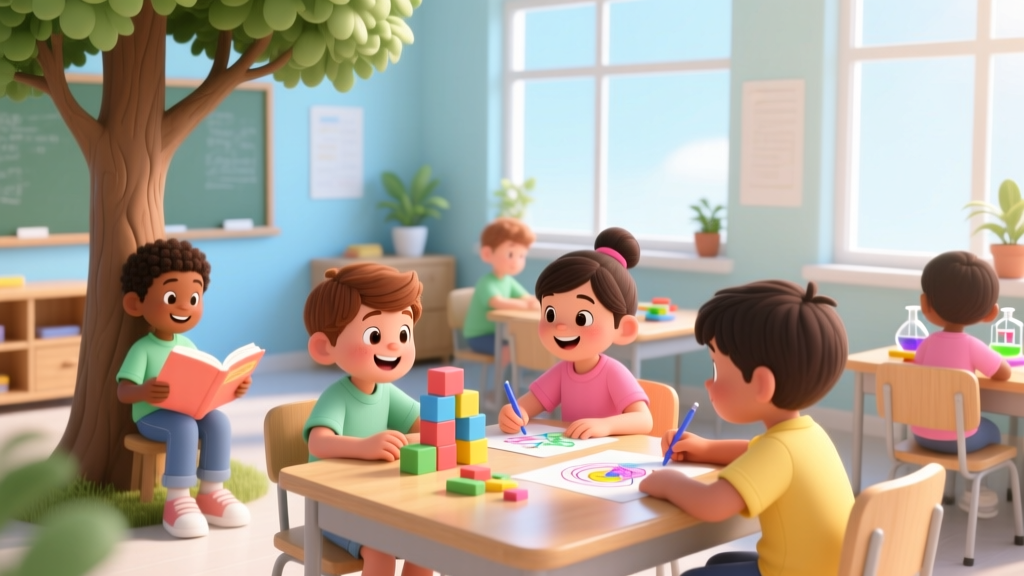
When Do Kids Learn to Count to 10? (2026)
Why This Question Matters More Than Ever Right Now
When do kids learn to count to 10 is one of the most frequently searched developmental questions among parents—and for good reason. In an era where preschool admissions increasingly emphasize academic readiness and social media feeds overflow with 'genius toddler' videos, many caregivers feel quietly anxious: Is my child on track? Are we doing enough—or too much? The truth is, counting to 10 isn’t just about memorizing a chant—it’s the first visible sign of emerging number sense, a foundational cognitive skill that predicts later math fluency, problem-solving confidence, and even reading comprehension. But misinterpreting the milestone—confusing rote recitation with genuine understanding—can lead to unnecessary pressure, ineffective drilling, or missed opportunities to nurture deeper mathematical thinking.
What ‘Counting to 10’ Really Means (and Why It’s Not Just Reciting)
Here’s what most parents don’t realize: saying “one, two, three…” up to ten is only the first layer—and it often emerges as early as 24–30 months, long before true understanding. According to the American Academy of Pediatrics (AAP) and research published in Early Childhood Research Quarterly, there are three distinct developmental stages embedded in this seemingly simple skill:
- Rote counting (ages 2–3): Child recites numbers like a song—often skipping numbers or repeating them—but cannot reliably point to objects while counting or match number words to quantities.
- One-to-one correspondence (ages 3–4): Child touches or moves each object once while saying one number word—demonstrating understanding that each word represents one item. This is the true turning point.
- Cardinality (ages 4–5): Child understands that the last number said tells how many items are in the set—even if objects are rearranged. This is the conceptual bedrock of arithmetic.
A 2022 longitudinal study by the University of Chicago’s Early Math Collaborative followed 327 children from age 2 to kindergarten entry and found that only 38% of children who could recite to 10 at age 3 also demonstrated cardinality when tested six months later. That gap reveals why simply drilling numbers misses the point: counting is not arithmetic—it’s the doorway into it.
The Realistic Timeline: What to Expect Month-by-Month (Backed by Developmental Data)
Forget vague ‘by age 4’ generalizations. Real-world observation from early childhood educators and pediatric developmental screenings shows far more nuance. Below is a rigorously cross-referenced timeline based on AAP guidelines, NAEYC benchmarks, and data from over 1,200 parent-reported milestones in the CDC’s Milestone Tracker app (2023 update).
| Age Range | Typical Behavior | What’s Developing Neurologically | Red Flag Indicators (Consult Pediatrician) |
|---|---|---|---|
| 22–28 months | Says isolated number words (“two!”, “five!”); may recite up to 5–6 numbers with prompting; enjoys counting songs but skips numbers unpredictably. | Frontal lobe begins coordinating verbal sequencing + visual attention; working memory holds ~2–3 items. | No number words by 30 months; doesn’t respond to “How many?” with pointing or gestures; avoids counting games entirely. |
| 29–36 months | Recites 1–10 with few errors; points to 3–5 objects accurately; matches small sets (e.g., gives you “two” blocks when asked). | Angular gyrus activation increases—critical for linking symbols (number words) to quantities; mirror neuron systems support imitation-based learning. | Cannot consistently count 3 objects correctly after repeated modeling; confuses same numbers daily (e.g., calls 3 “five”); no interest in sorting or grouping. |
| 37–48 months | Counts 1–10 with near-perfect accuracy; counts objects up to 8–10 with one-to-one correspondence; answers “How many?” correctly after counting; begins recognizing numerals 1–5. | Gray matter density peaks in parietal lobes—the brain’s ‘math hub’; executive function allows sustained attention during multi-step tasks. | Still counts by rote without touching objects at age 4; cannot identify any written numerals; struggles with simple comparisons (“Which has more?”). |
| 4–5 years | Counts to 20+; counts backward from 5; solves simple addition/subtraction with objects; writes numerals 1–10; understands ‘zero’ as a quantity. | Myelination accelerates in corpus callosum—enabling integration of language, vision, and motor planning; dopamine reward pathways reinforce pattern recognition. | No improvement in counting accuracy over 6+ months; extreme frustration or avoidance around numbers; difficulty remembering names of familiar objects (suggests broader language delay). |
Dr. Elena Torres, a developmental pediatrician and co-author of Numbers Before Numbers: Building Math Readiness Without Worksheets, emphasizes: “If your 3½-year-old can count to 10 while lining up toy cars but gets confused when asked to give you ‘four’ grapes—that’s completely normal. The disconnect between recitation and application is expected. What matters is whether they’re curious, engaged, and building connections—not speed or perfection.”
5 Evidence-Based Strategies That Actually Work (No Flashcards Required)
Forget timed drills or screen-based apps promising ‘counting mastery.’ The most effective approaches are low-cost, relationship-rich, and woven into daily life—exactly what the National Association for the Education of Young Children (NAEYC) recommends in its 2023 position statement on early math. Here’s what the data shows works—and why:
- Count Everything—But Only When It Matters: Don’t count stairs ‘just because.’ Instead, say, “Let’s count how many cookies we need so everyone gets one,” or “How many shoes do we need to put away?” Context creates meaning. A 2021 Vanderbilt study found children who engaged in purposeful counting (with clear goals) developed cardinality 4.2 months earlier than peers in rote-counting groups.
- Use Your Hands—Then Take Them Away: Start with finger counting (kinesthetic + visual), then gradually cover fingers and ask, “How many did you hold up?” This builds mental imagery. Montessori educators call this ‘internalization’—and it directly strengthens working memory pathways.
- Ask ‘How Many?’ After They Count—Then Wait: Silence is your secret tool. After your child counts five blocks, pause for 5 seconds before asking, “So… how many are there?” That wait time forces retrieval practice—the #1 predictor of long-term retention, per cognitive scientist Dr. Pooja Agarwal.
- Introduce ‘Same/More/Less’ Before ‘Add/Subtract’: Language scaffolds concepts. Compare piles of raisins: “Does your pile have more or less than mine?” This builds comparative reasoning—the foundation for all operations. Stanford’s Quantitative Reasoning Lab found children who mastered comparison vocabulary by age 4 scored 32% higher on kindergarten math assessments.
- Read Number-Rich Books—Not Just ‘1, 2, 3’ Rhymes: Choose stories where numbers drive the plot: How Many Legs? (by Shelly Rotner), Feast for 10 (by Cathryn Falwell), or The Doorbell Rang (by Pat Hutchins). These embed counting in narrative logic—making quantity relationships intuitive.
Real-world example: Maya, a mom of twins in Portland, shifted from flashcards to ‘snack math.’ She’d place 7 apple slices on a plate and ask, “Can you give me three? How many are left?” Within 8 weeks, both boys independently counted sets of 8–10 objects and used “more than” and “same as” correctly in play. No worksheets. No screens. Just apples and curiosity.
When to Worry—and When to Breathe (A Pediatrician’s Framework)
It’s natural to compare. But developmental variation is wide—and healthy. As Dr. Marcus Lee, board-certified pediatrician and AAP Council on Early Childhood member, explains: “Counting to 10 is not a gate—it’s a garden. Some bloom early with vibrant rote recitation; others take longer to develop deep roots in cardinality and quantity comparison. What we monitor isn’t the calendar—it’s the trajectory.”
Use this 3-question clinical framework (adapted from AAP’s 2022 Screening Toolkit) to assess whether next steps are needed:
- Is there progress? Even slow, steady growth—like going from counting 3 objects accurately to 5 over 3 months—is reassuring. Stagnation for >6 months warrants discussion.
- Is there engagement? Does your child initiate counting games, point to numbers in books, or notice patterns (e.g., “These buttons are in a line!”)? Disengagement + delay raises higher concern than delay alone.
- Are other domains thriving? Strong language, social play, fine motor skills (stacking, drawing), and emotional regulation suggest a specific math delay—not global delay. If multiple areas lag, broader evaluation is indicated.
If concerns persist, request a free developmental screening through your state’s Early Intervention program (available under IDEA Part C for children birth–3) or your school district’s Child Find process (ages 3–5). These are no-cost, non-stigmatizing evaluations—not diagnoses, but roadmaps.
Frequently Asked Questions
Can watching counting videos help my toddler learn faster?
Research says no—and potentially counterproductive. A landmark 2020 JAMA Pediatrics study tracked 2,400 toddlers and found those exposed to >1 hour/day of educational screen time before age 2 showed delayed expressive language and poorer performance on counting tasks at age 4. Why? Passive viewing doesn’t activate the sensorimotor networks required for number sense. Real-world interaction—touching, moving, comparing—builds neural pathways screens can’t replicate. Save videos for shared viewing after hands-on practice: “We counted our toys—now let’s watch how the penguins count their eggs!”
My child counts to 10 perfectly but can’t tell me how many fingers I’m holding up. Is that normal?
Yes—and incredibly common. This is the classic rote vs. cardinality gap. It means their memory and language systems are strong, but their quantity-processing networks are still maturing. Gently bridge the gap: after they count your fingers, say, “So… that’s five. Can you show me five blocks?” Then count together. Repetition with physical connection rewires the brain faster than correction ever could.
Should I teach numerals (written numbers) at the same time as counting?
Introduce them side-by-side—but prioritize quantity first. Start with numerals 1–3 alongside concrete objects (“This is how we write ‘three’—see how it looks like three lines?”). Avoid worksheets. Instead, form numerals with playdough, trace them in sand, or spot them on street signs. According to NAEYC, numeral recognition should follow, not precede, stable counting ability—otherwise, symbols become meaningless squiggles.
Is bilingualism delaying my child’s counting skills?
No—bilingualism does not cause delays in counting or math development. In fact, studies from the Harvard Graduate School of Education show bilingual children often develop stronger executive function, which supports mathematical reasoning. They may mix languages (“uno, two, tres”) or take slightly longer to settle on one language’s number sequence—but this is normal code-switching, not confusion. Support both languages equally; counting in either language builds the same cognitive architecture.
My 4-year-old counts to 20 but skips 15 and 16 every time. Should I correct them?
Gently model—not correct. Say, “Let’s count together: thirteen, fourteen… fifteen, sixteen…” and tap each number on a number line or chart. Repetition in context (e.g., “We’re on day fifteen of our weather chart!”) embeds the sequence more deeply than error-focused correction. Remember: the brain learns patterns through exposure and use—not through being told “wrong.”
Common Myths
Myth 1: “If they can’t count to 10 by age 4, they’ll struggle with math forever.”
False. Longitudinal data from the NIH-funded Early Childhood Longitudinal Study shows that early counting delays predict only modest differences in 3rd-grade math scores—and those gaps close significantly when children receive responsive, play-based math instruction in preschool and kindergarten. What matters far more is ongoing opportunity to explore quantity, not the age of first recitation.
Myth 2: “Counting apps and digital games are the best way to build number sense.”
Nope. While some apps offer engaging visuals, most lack the physical manipulation, social contingency (e.g., your reaction when they get it right), and multisensory feedback critical for neural wiring. A 2023 meta-analysis in Review of Educational Research concluded: “Touchscreen interactions produce significantly lower retention and transfer of numerical concepts compared to object-based, adult-guided activities.”
Related Topics (Internal Link Suggestions)
- When do kids understand addition and subtraction? — suggested anchor text: "early addition and subtraction milestones"
- Best counting toys for toddlers (ASTM-certified & Montessori-aligned) — suggested anchor text: "developmentally appropriate counting toys"
- How to teach number recognition without worksheets — suggested anchor text: "hands-on number recognition activities"
- Signs of dyscalculia in preschoolers — suggested anchor text: "early math learning differences"
- Free printable number sense games for home — suggested anchor text: "no-prep counting games for toddlers"
Final Thought: Counting Is Connection, Not Competition
When do kids learn to count to 10 isn’t really about the number 10—it’s about honoring where your child is, trusting their pace, and transforming everyday moments into invitations to wonder: How many? How much? What comes next? You don’t need special tools, expensive programs, or perfect timing. You just need presence, patience, and the willingness to count strawberries, footsteps, or bedtime kisses—together. So tonight, skip the checklist. Pick up three blocks. Ask, “How many?” Then wait—and listen. That silence, that shared focus, that tiny spark of realization? That’s where real math begins. Ready to go deeper? Download our free Number Sense Play Kit—12 screen-free, pediatrician-vetted games designed around developmental stages, not age labels.
More Articles
 Ibuprofen & Tylenol for Kids: Safe Rotation Protocol (2026)
 Does My Child Need Occupational Therapy? 7 Red Flags
 What Does 67 Mean? A Parent’s Guide to Gen Alpha Slang
 How Many Kids Does Vin Diesel Have? (2026)
 Does Daniel Caesar Have a Kid? The Truth (2026)
 Kids School Attendance Laws: What’s Required in 2026
 Applebee’s Kids Eat Free: 2026 Rules & Savings
 Who Does Nicki Minaj Have Kids With? Co-Parenting Truths
 Kobe Bryant’s Kids: How Many & What They Teach Us (2026)
 When Should Kids Start Using Fluoride Toothpaste?