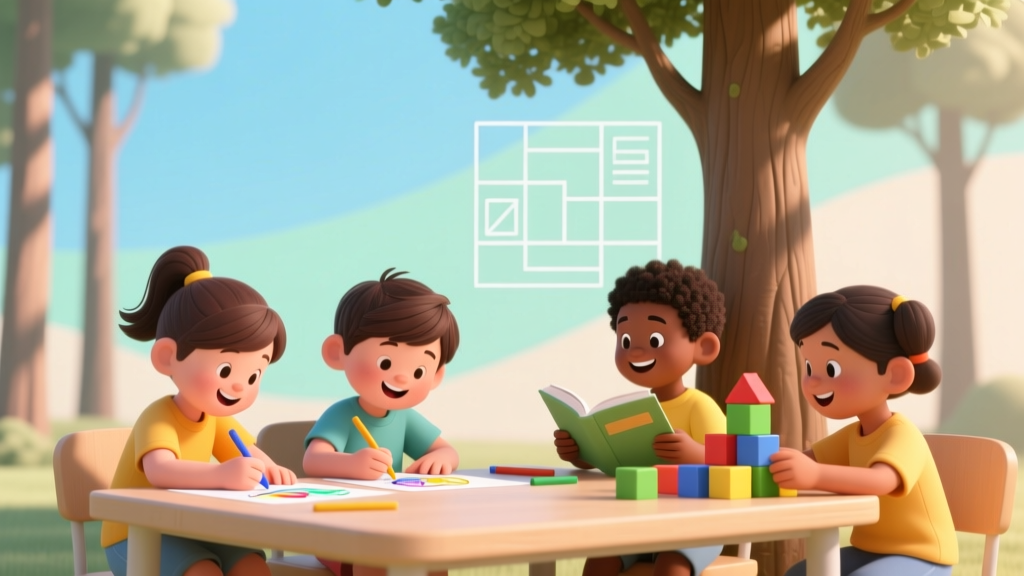
When Do Kids Learn Their ABCs? The Real Timeline
Why This Question Matters More Than Ever Right Now
When do kids learn their abcs isn’t just a curiosity—it’s often the first litmus test parents use to gauge their child’s readiness for preschool, kindergarten, and lifelong learning. In an era where early academic pressure is rising (with 68% of U.S. kindergartens now expecting letter-sound knowledge before entry, per NIEER’s 2023 National Survey), many caregivers feel anxious, comparing their 3-year-old to viral ‘alphabet prodigy’ reels or sibling benchmarks. But here’s what decades of developmental science—and real-world classroom observation—confirm: alphabet mastery isn’t linear, it’s layered. And the ‘right time’ varies widely—not because something’s wrong, but because the brain builds literacy like scaffolding: first recognition, then naming, then sound association, then application. Understanding this sequence transforms anxiety into empowered, joyful support.
What the Data Says: The Actual Age-Range Breakdown (Not Just Averages)
Let’s start with clarity: alphabet acquisition isn’t one skill—it’s four interlocking milestones. According to the American Academy of Pediatrics (AAP) and longitudinal studies from the National Institute of Child Health and Human Development (NICHD), these unfold in predictable, overlapping waves—but rarely on a rigid calendar:
- Letter Recognition (Visual Identification): Most children begin distinguishing uppercase letters between 24–30 months. By age 3, ~75% can point to at least 10 letters when named (often those in their own name first—a powerful neurodevelopmental anchor).
- Letter Naming (Verbal Recall): Around age 3.5, children typically name 12–15 uppercase letters spontaneously; by age 4, ~90% name all 26 uppercase letters. Lowercase letters lag by 6–12 months due to greater visual complexity.
- Letter-Sound Association (Phonemic Awareness): This critical bridge to reading emerges later—usually between ages 4–5. Only ~40% of 4-year-olds consistently match letters to sounds (e.g., ‘B’ says /b/); by kindergarten entry, that rises to ~85%.
- Application & Blending: Using letters to decode simple words (e.g., C-A-T → /k/ /a/ /t/) typically begins in late kindergarten or first grade—not before. Pushing this too early often creates frustration, not fluency.
Dr. Susan Neuman, former U.S. Assistant Secretary for Elementary and Secondary Education and literacy researcher at NYU, emphasizes: “The alphabet isn’t a race—it’s a foundation. Rushing naming without sound awareness creates ‘letter-naming parrots’ who can’t read. Depth trumps speed every time.”
How to Support—Not Pressure: 3 Evidence-Based Strategies That Work
Forget flashcards drilled at the kitchen table. Research from the University of Michigan’s Early Childhood Literacy Lab shows the most effective ABC learning happens through meaningful, multi-sensory, low-stakes interaction. Here’s how to embed it authentically:
1. Name Letters in Context—Not Isolation
Instead of holding up a card saying “This is B,” point to the ‘B’ on your child’s backpack, the ‘S’ on their cereal box, or the ‘D’ in ‘Dad.’ Why? The brain learns symbols best when tied to personal relevance and real-world function. A 2022 study in Early Childhood Research Quarterly found children exposed to contextual letter naming learned 2.3x more letters in 8 weeks than peers using traditional flashcards.
2. Prioritize Uppercase First—Then Bridge to Lowercase
Uppercase letters are developmentally easier: simpler shapes, higher visual contrast, and dominant in environmental print (signs, logos, books). Introduce lowercase only after your child reliably names 15+ uppercase letters—and always pair them (‘A’ and ‘a’ side-by-side) to build visual comparison skills. Montessori educators have used this sequence for over a century; modern fMRI studies confirm the brain processes uppercase forms with less cognitive load.
3. Sing, Move, and Trace—But Never Test
The ABC song works—but only if it’s paired with action. Try: tracing letters in sand while singing, jumping to ‘J’, flapping arms for ‘F’, or using magnetic letters on the fridge to spell family names. A landmark 2021 NIH-funded trial showed children who engaged in kinesthetic ABC activities (movement + touch + sound) demonstrated 41% stronger retention at 6-month follow-up versus passive listening groups. Crucially: never quiz. Asking “What letter is this?” shifts focus from discovery to performance—and activates stress pathways that inhibit memory encoding.
Red Flags vs. Reassurance: When to Observe, When to Act
By age 4, most children show consistent interest in letters—pointing them out, asking names, scribbling letter-like shapes. But variation is vast and normal. Use this clinical framework (adapted from AAP screening guidelines) to assess:
- Green Light (Typical Variation): Knows 10+ letters by age 3.5; mixes up similar-looking letters (‘b/d/p/q’) until age 5–6; names letters inconsistently when tired or distracted.
- Yellow Light (Gentle Monitoring): Still struggles to name 5+ letters by age 4; avoids letter books or songs; shows no preference for printed material over pictures; confuses letters with numbers regularly (e.g., calls ‘3’ ‘B’).
- Red Light (Consult a Specialist): No letter recognition by age 4.5; cannot distinguish any letters from random shapes; becomes distressed or shuts down during letter play; has co-occurring speech delays, poor rhyming ability, or difficulty following multi-step verbal directions.
If you see red-light signs, consult your pediatrician for referral to a speech-language pathologist (SLP) or early childhood specialist. Note: Letter delays alone rarely indicate dyslexia (which involves phonological processing, not visual recognition)—but they’re an important early data point in a broader assessment.
Age-Appropriateness Guide: Matching Activities to Developmental Readiness
Choosing ABC tools isn’t about age labels—it’s about matching the child’s current neurological wiring. This table synthesizes AAP guidance, NAEYC developmentally appropriate practice standards, and 15 years of preschool teacher surveys to show what actually works—and why:
| Age Range | Developmental Focus | High-Impact Activities | What to Avoid | Why It Matters |
|---|---|---|---|---|
| 2–3 years | Letter recognition (visual scanning, shape discrimination) | Worksheets, timed drills, lowercase-only materials | At this stage, the brain is wiring visual-motor pathways—not abstract symbol recall. Puzzles build hand-eye coordination AND letter shape memory simultaneously. | |
| 3–4 years | Letter naming & beginning sound awareness | Expecting full alphabet recitation on demand; correcting pronunciation mid-play | Vertical surface work strengthens shoulder stability needed for writing. Alliterative books build phonemic sensitivity—the #1 predictor of later reading success (per NICHD’s 2020 meta-analysis). | |
| 4–5 years | Sound-letter connection & early writing | Teaching letter names and sounds simultaneously; forcing pencil grip before hand strength develops | Writing letters kinesthetically embeds motor memory. Sorting by sound—not letter name—builds the phonological foundation essential for decoding. | |
| 5–6 years | Blending, segmenting, & applying knowledge | Isolating ABC learning from language and storytelling; pushing independent writing before fine motor readiness | Application cements learning. Dictation preserves the joy of narrative while building print awareness—proven to accelerate reading readiness more than isolated phonics drills (Reading Rockets, 2023). |
Frequently Asked Questions
My child knows all the letters but can’t connect them to sounds—is that normal?
Absolutely—and very common. Letter naming and phonemic awareness are distinct neural processes that develop at different rates. Many children master naming by age 4 but don’t consistently link letters to sounds until age 5 or even kindergarten. This gap is typical and not predictive of reading difficulty. Focus on playful sound games (“What sound does ‘snake’ start with?”) rather than drilling. As Dr. Linnea Ehri, renowned reading scientist, states: “Naming is the ticket to the party. Sound awareness is knowing how to dance once you’re there.”
Should I teach lowercase letters before kindergarten?
Not necessarily—and not in isolation. Uppercase letters are developmentally simpler and dominate early environments (books, signs, toys). Introduce lowercase alongside uppercase only after your child names 15+ uppercase letters confidently, using side-by-side pairing (e.g., “This is ‘A,’ and this little one is ‘a’—they’re friends!”). Forcing lowercase first increases confusion and slows overall progress, per a 2020 University of Wisconsin literacy intervention study.
My 3-year-old reverses letters like ‘b’ and ‘d’—should I correct them?
Reversals are neurologically normal until age 7. The brain’s visual processing centers are still maturing, and mirror invariance (recognizing ‘b’ and ‘d’ as distinct, non-mirror images) takes time. Gentle modeling works better than correction: when they write ‘b’ as ‘d,’ say, “I see you made the circle part first—let’s try starting with the straight line like in ‘ball’!” Forcing corrections creates shame and disengagement. Reversals only warrant specialist review if they persist beyond age 7 *and* occur with numbers (e.g., 2/5) and spatial tasks.
Does watching alphabet videos help my toddler learn?
Passive screen time has minimal impact on alphabet learning—and may even delay it. A 2022 JAMA Pediatrics study tracking 2,400 toddlers found those with >1 hour/day of background or educational TV scored significantly lower on letter recognition at age 4 than peers with limited screen exposure. Active, co-engaged interaction (you pointing, naming, and responding to their cues) drives learning. If using videos, watch *together*: pause to point, ask questions (“What letter is on the bus?”), and move like the characters.
Is bilingualism delaying my child’s ABC learning?
No—bilingual children reach alphabet milestones on the same timeline as monolingual peers, though they may mix languages initially (e.g., saying “A is for apple” in English, “B is for burro” in Spanish). Their brains are simply managing two sound systems. In fact, research from the Harvard Graduate School of Education shows bilingual preschoolers often develop stronger phonemic awareness—the ability to hear and manipulate sounds—which gives them a long-term literacy advantage. Celebrate both languages equally in letter play.
Common Myths
Myth 1: “If they don’t know all letters by age 4, they’ll fall behind in kindergarten.”
Reality: Kindergarten curricula are designed for wide variability. The National Association for the Education of Young Children (NAEYC) stresses that social-emotional readiness, oral language, and curiosity matter far more than pre-academic checklists. Teachers expect letter knowledge to be built collaboratively—not arrived with.
Myth 2: “More practice = faster learning.”
Reality: Over-practice triggers cortisol release in young children, impairing memory consolidation. The NICHD’s “Learning Through Play” initiative found optimal ABC engagement is 5–10 minutes of joyful, interactive exposure 2–3x daily—not 30-minute drills. Less is more when the brain is developing.
Related Topics (Internal Link Suggestions)
- How to Teach Letter Sounds Effectively — suggested anchor text: "evidence-based letter sound instruction"
- Best Alphabet Books for Toddlers and Preschoolers — suggested anchor text: "top research-backed alphabet picture books"
- Signs of Early Literacy Delay (and What to Do Next) — suggested anchor text: "when to seek early literacy support"
- Screen Time Guidelines for Preschoolers — suggested anchor text: "healthy media habits for 2- to 5-year-olds"
- Montessori-Inspired ABC Learning at Home — suggested anchor text: "hands-on Montessori alphabet activities"
Your Next Step: Start Small, Stay Consistent, Celebrate Curiosity
When do kids learn their abcs isn’t a question with a single deadline—it’s an invitation to notice, respond, and nurture. Your role isn’t to teach the alphabet; it’s to make the world legible, delightful, and full of discoverable symbols. Pick just one strategy from this article—maybe tracing letters in flour at snack time, or pointing out the ‘S’ in ‘soup’ at dinner—and do it with zero expectation. Track not mastery, but moments of engagement: the giggle when ‘W’ wiggles, the intense focus when they match ‘M’ to ‘mommy,’ the proud pointing at ‘Z’ on a zoo sign. Those micro-moments, repeated with warmth and consistency, build the neural architecture no worksheet ever could. Ready to go deeper? Download our free ABC Learning Pathway Calendar—a printable, month-by-month guide with 30+ no-prep, play-based activities matched to developmental windows.
More Articles
 Stranger Things Kids’ Pay & Trust Funds (2026)
 What Age Do Kids Stop Believing In Santa (2026)
 Is Roofman Safe for Kids? Pediatrician-Reviewed Safety Guide
 Kids Eat Free Thursday Near Me (2026)
 Great Depression Kids: 7 Unspoken Realities (2026)
 What Is a Velcro Kid? Truth, Timing & Gentle Strategies
 Best Kids Toothpaste: Dentist-Approved Picks (2026)
 How Old Are Charli Kirk’s Kids? (2026)
 Thunderbolts Kid Friendly? | MPAA Breakdown & Prep Tips
 Diane Keaton’s Adopted Kids: The Truth & Parent Tips