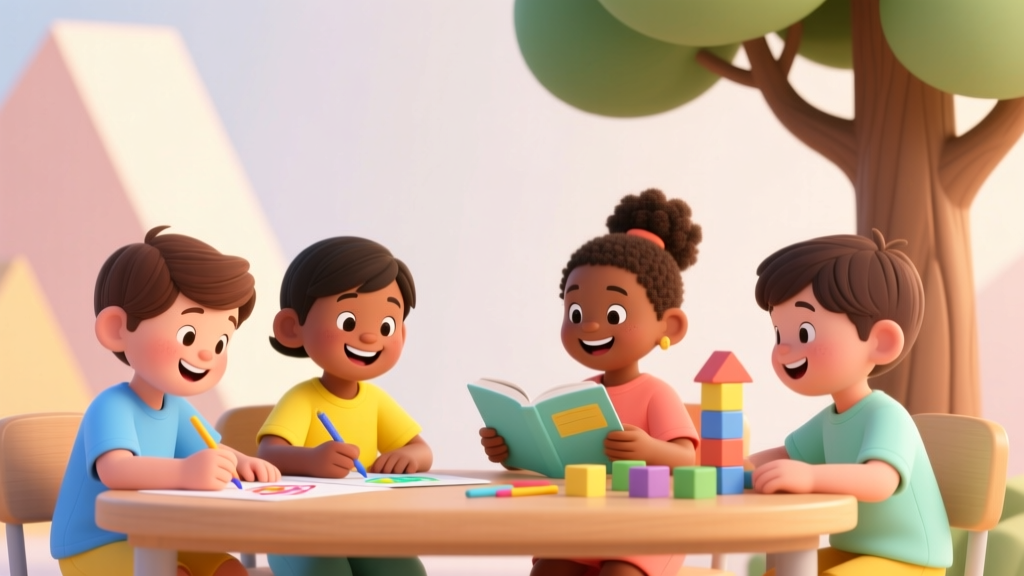
When Do Kids Learn Numbers? (2026)
Why This Question Matters More Than Ever Right Now
When do kids learn numbers isn’t just academic curiosity—it’s the quiet hum beneath bedtime questions, preschool enrollment decisions, and that sinking feeling when your 4-year-old still points to ‘5’ and says ‘six.’ In an era where kindergarten now expects fluency with quantities up to 20—and social media feeds overflow with ‘genius toddler’ videos—parents are more anxious than ever about timing, pace, and what ‘normal’ really means. The truth? Number learning isn’t a single event like losing a tooth; it’s a layered, five-year developmental cascade rooted in brain wiring, sensory experience, and responsive caregiving. And the most critical factor isn’t flashcards or apps—it’s how you talk about quantity in the kitchen, at the park, and during laundry day.
The 5-Stage Number Learning Journey (Age-by-Age Breakdown)
According to the American Academy of Pediatrics (AAP) and longitudinal research from the National Center for Education Statistics, number understanding unfolds in predictable, overlapping stages—not rigid grade-level boxes. These stages reflect neurological maturation in the intraparietal sulcus (the brain’s ‘number hub’) and depend heavily on language exposure, motor engagement, and real-world repetition.
Stage 1: Quantity Awareness (12–24 months)
Before saying any number words, babies notice ‘more’ vs. ‘less’—reaching for the bigger pile of crackers, showing distress when a toy is taken from a group of three but not one. This is subitizing: instantly recognizing small quantities (1–3) without counting. It’s innate, observable in infants as young as 6 months, and forms the bedrock of later math cognition.
Stage 2: Rote Counting Without Meaning (2–3 years)
Your child sings “one-two-three-four-five…” like a nursery rhyme—but can’t reliably point to five objects or tell you which group has more. This is normal and essential practice. Dr. Kathy Hirsh-Pasek, developmental psychologist and co-author of Becoming Brilliant, calls this ‘counting ritual’: the brain is building phonological memory and sequencing skills long before attaching meaning.
Stage 3: One-to-One Correspondence & Cardinality (3–4 years)
This is the breakthrough moment: your child touches each block while saying ‘one, two, three…’ and then answers ‘How many?’ with ‘Three!’—not just repeating the last word. Cardinality—the understanding that the final number word names the whole set—is the single strongest predictor of future math success (National Council of Teachers of Mathematics, 2022).
Stage 4: Number Conservation & Decomposition (4–6 years)
Can your child recognize that five pennies spread out hold the same value as five stacked? That’s conservation—a Piagetian milestone emerging around age 5. Simultaneously, they begin decomposing: ‘Five is two and three’ or ‘Seven is five and two more.’ This flexibility predicts algebra readiness far more than rote memorization.
Stage 5: Symbolic Fluency & Mental Operations (6–7 years)
Now digits on paper connect to mental images of quantity. Children add and subtract without fingers, estimate, compare fractions using pizza slices, and grasp place value. As Dr. Douglas Clements, early math researcher at the University at Buffalo, emphasizes: ‘Fluency isn’t speed—it’s flexibility, accuracy, and deep conceptual anchoring.’
What Actually Works (and What Doesn’t) in Everyday Practice
Forget worksheets before age 5. Research from the Erikson Institute’s Early Math Collaborative shows that children who engage in intentional, playful number talk daily develop stronger number sense than peers using digital drills—even when controlling for socioeconomic status. Here’s what evidence-based practice looks like:
- Label quantity—not just count. Instead of ‘Let’s count these grapes,’ try ‘You have four grapes. I have two. Do you have more or less than me?’ This embeds comparison, magnitude, and relational thinking.
- Use ‘how many’ only after counting. Asking ‘How many?’ before they’ve counted teaches guessing, not cardinality. Wait until they finish pointing and saying numbers—then ask.
- Integrate math into motor play. A 2023 study in Early Childhood Research Quarterly found toddlers who built towers with numbered blocks (‘Put the ‘3’ block on top of the ‘2’ block’) showed 40% faster cardinality acquisition than control groups doing identical fine-motor tasks without number labels.
- Embrace ‘mistakes’ as data. If your child says ‘five’ after counting four objects, don’t correct—ask: ‘Let’s check together. Can you touch each one again?’ This preserves agency and turns error into inquiry.
Conversely, avoid: timed quizzes before age 6 (triggers math anxiety linked to lifelong avoidance), over-reliance on screens (passive watching ≠ active number construction), and comparing siblings or classmates (neurodiversity means timelines vary widely—even among twins).
Red Flags vs. Normal Variation: When to Pause and When to Proceed
Development isn’t linear—but certain patterns warrant gentle observation. The AAP recommends consulting a pediatrician or early intervention specialist if, by age 4, your child consistently:
- Cannot match sets of 3+ identical objects (e.g., give you ‘three spoons’ when asked);
- Shows no interest in counting games or number books despite repeated, joyful exposure;
- Confuses numbers beyond simple reversals (e.g., says ‘13’ for ‘31’ repeatedly past age 5);
- Struggles with basic spatial language (‘in,’ ‘on,’ ‘under’) alongside number concepts—suggesting broader processing differences.
Crucially, late talkers aren’t automatically ‘behind’ in number sense—many catch up rapidly once language scaffolds are in place. And advanced counters (e.g., a 3-year-old reciting to 100) aren’t necessarily ‘ahead’ cognitively; rote memory ≠ understanding. As speech-language pathologist Dr. Sarah K. H. Lee notes: ‘Counting is a linguistic skill first. Number sense is a cognitive one. They develop on parallel tracks—and converge around age 4.5.’
Age-Appropriateness Guide: Number Activities That Match Brain Development
| Age Range | Key Milestones | High-Impact Activities | Safety & Supervision Notes |
|---|---|---|---|
| 12–24 months | Notices ‘more/less’; recognizes 1–3 items instantly (subitizing) | Sorting socks by color/size; filling cups with rice or water; singing counting songs with gestures (‘five little monkeys’) | Supervise all small-item play; avoid choking hazards (use large pom-poms, not beads); prioritize sensory-rich materials over plastic toys |
| 2–3 years | Rote counts to 10+; points randomly at objects; may skip numbers | Counting steps while walking; matching lids to containers; ‘find three red things’ scavenger hunts | No small parts; use durable board books with textured numbers; keep sessions under 5 minutes—follow child’s lead |
| 3–4 years | Counts with one-to-one correspondence; identifies numerals 1–5; understands ‘same number’ | Setting the table (‘we need 4 plates’); baking with measuring cups (‘pour two scoops’); dot-to-dot with 1–10 | Child-safe knives for cutting soft foods; non-toxic playdough for numeral tracing; always supervise cooking activities |
| 4–5 years | Counts to 20 accurately; writes numerals 1–10; compares groups up to 10; understands ‘zero’ | Board games with dice (Snakes & Ladders, First Orchard); making simple graphs (‘How many pets do we have?’); counting money with large coins | Choose games with large, chunky pieces; avoid competitive win/lose framing—focus on shared goals; check ASTM F963 certification on all toys |
| 5–7 years | Adds/subtracts within 10 mentally; understands place value; uses number lines; solves simple word problems | Creating shopping lists with prices; measuring garden rows; coding basics (Scratch Jr. number blocks); budgeting allowance | Digital screen time limited to 30 mins/day per AAP; ensure online tools are COPPA-compliant; co-play all tech activities |
Frequently Asked Questions
My 3-year-old counts to 20 but can’t tell me how many blocks are in a pile of 5. Is that normal?
Absolutely normal—and actually a sign of healthy development. Rote counting (memorized sequence) and cardinality (understanding ‘how many’) are separate neural pathways that mature at different rates. Most children master rote counting 6–12 months before cardinality. Keep playing ‘how many?’ games after counting, and celebrate every time they pause to think—not just when they get it right.
Should I teach my child to write numbers before they understand what they mean?
No—prioritize meaning over symbols. Writing numerals before grasping quantity often leads to frustration and superficial learning. Start with gross-motor numeral formation (drawing big ‘3’s in sand, tracing in shaving cream) alongside concrete counting. Formal pencil-and-paper numeral writing is best introduced alongside cardinality mastery—typically around age 4.5–5, when hand-eye coordination and working memory support symbolic representation.
My child is bilingual. Does that delay number learning?
Research shows bilingual children often develop number concepts faster due to enhanced executive function and metalinguistic awareness. However, they may mix languages (‘dos apples’) or take slightly longer to retrieve number words in one language. This is not delay—it’s code-switching. Support by using consistent number words in each language during relevant activities (e.g., ‘cuatro’ when setting four places at Spanish meals, ‘four’ during English storytime).
Are Montessori number rods or Waldorf counting stones worth the investment?
Yes—if used intentionally. Montessori number rods (red-blue segmented bars) build sensorimotor links between length and quantity. Waldorf wooden counting stones encourage tactile discrimination and open-ended play. But their value lies in adult-guided interaction—not passive display. A $2 set of painted rocks works just as well if you narrate quantity, compare lengths, and invite sorting. The magic isn’t in the material—it’s in the dialogue you create around it.
What’s the biggest mistake parents make when teaching numbers?
Assuming ‘more input = more learning.’ Bombarding kids with flashcards, apps, or drills before age 4–5 often backfires—triggering resistance, anxiety, and disengagement. The brain learns numbers through embodied, joyful, repeated experience—not isolated instruction. As Dr. Lisa Guernsey of the New America Foundation states: ‘The most powerful math tool in your home isn’t an app—it’s your voice, asking ‘How many?’ while folding laundry.’
Common Myths
Myth 1: “If they’re not counting by age 3, they’ll fall behind in school.”
False. The average child achieves reliable one-to-one correspondence around 3.5–4 years—but the range is wide (2.5–5 years) and perfectly normal. Kindergarten curricula are designed for this variability, and early intervention is highly effective when needed. Rushing creates stress, not advantage.
Myth 2: “Learning numbers is mostly about memorization.”
Deeply misleading. Memorizing sequences is just the entry point. Real number sense requires understanding magnitude, relationships, decomposition, and application. A child who can recite 1–100 but can’t share 6 cookies fairly hasn’t learned numbers—they’ve learned a song.
Related Topics (Internal Link Suggestions)
- When do kids learn letters — suggested anchor text: "when do kids learn letters"
- Best counting books for toddlers — suggested anchor text: "best counting books for toddlers"
- Signs of dyscalculia in preschoolers — suggested anchor text: "early signs of dyscalculia"
- Montessori math activities at home — suggested anchor text: "simple Montessori math activities"
- Screen time guidelines for preschoolers — suggested anchor text: "healthy screen time for 3-year-olds"
Conclusion & CTA
When do kids learn numbers isn’t a question with a single answer—it’s an invitation to observe, wonder, and participate in your child’s unfolding mathematical mind. From the baby who stares intently at two raisins versus one, to the kindergartener who proudly explains why 7 + 5 equals 12 using finger strategies, number learning is woven into the fabric of daily life. Your role isn’t to accelerate, but to illuminate: name quantities, pose genuine questions, follow their curiosity, and trust the process. So tonight, skip the worksheet. Count the stairs together. Ask, ‘How many peas are on your fork?’ And when they pause, smile, and wait—that silence is where understanding grows. Ready to bring number talk into your routine? Download our free 7-Day Number Talk Challenge—with daily prompts, real parent examples, and printable conversation starters designed by early childhood educators.
More Articles
 Potty Training Readiness Signs—Not Age (2026)
 Dan Campbell Kids: Parenting Strategies for Coaches
 Does Ross Duffer Have Kids? Creative Parenting Truths
 Does Juice WRLD Have Kids? A Parent’s Guide (2026)
 How Many Kids Does Georgina Rodriguez Have?
 Denny’s Kids Eat Free Rules (2026)
 Pepto Kids for Diarrhea: Pediatrician Advice & Alternatives
 Who Has Ashley Schwalm Kids? The Truth (2026)
 iPad Setup for Kids: Pediatrician-Approved Guide
 Shielding Kids from Traumatic Media (2026)