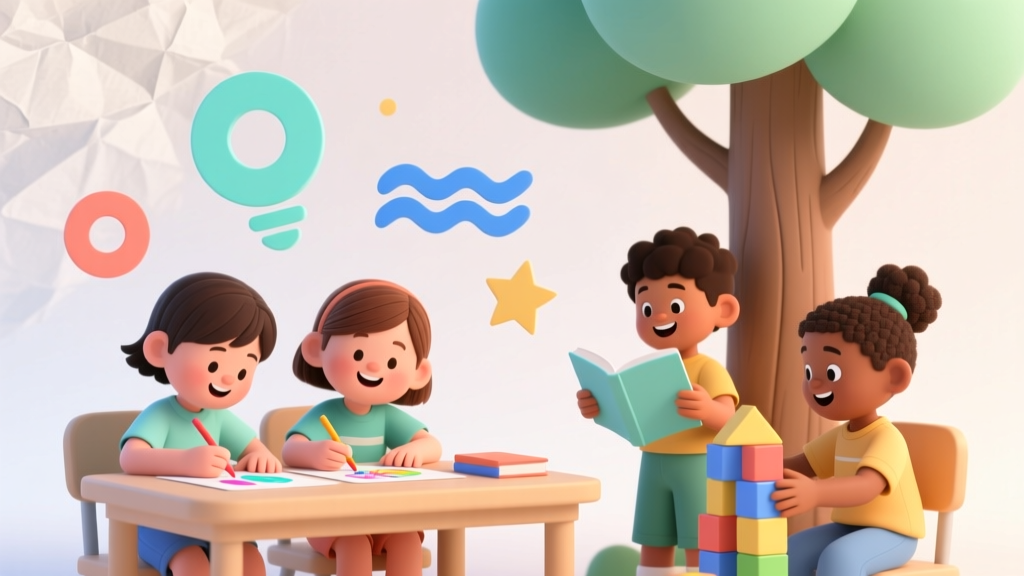
When Do Kids Learn to Read? Science-Backed Milestones
Why This Question Keeps Parents Up at Night—And Why the Answer Isn’t One Size Fits All
When do kids learn how to read? That simple question carries layers of quiet anxiety: Is my child behind? Am I doing enough—or too much? Are those flashcards helping or harming? You’re not alone. In fact, 73% of parents report feeling uncertain about early literacy development, according to a 2023 National Center for Education Statistics survey—and that uncertainty often leads to well-intentioned but counterproductive pressure. The truth? Reading isn’t a switch that flips on a birthday. It’s a complex, biologically timed cascade of auditory processing, phonemic awareness, visual symbol recognition, vocabulary growth, and sustained attention—all unfolding at different paces across children. And crucially, research from the American Academy of Pediatrics (AAP) confirms that most children begin decoding words meaningfully between ages 5 and 7, with wide, healthy variation—and that early formal instruction before age 5 doesn’t accelerate long-term outcomes. Let’s unpack what really happens—and how to support it, without stress or shortcuts.
The 4-Stage Literacy Journey: From Babbling to Book Club
Reading isn’t binary—it’s a continuum. Developmental psychologist Dr. G. Reid Lyon, former NIH reading research chief, identified four interlocking stages that map to brain maturation—not just calendar age. Understanding these helps you spot progress (not just ‘reading’), celebrate subtle wins, and avoid comparing your child to a classmate who memorized sight words at 4 (a common but misleading snapshot).
- Pre-Reading (Ages 0–4): This is where the real magic begins—long before ‘reading.’ Your baby’s cooing strengthens oral-motor pathways needed for articulation; pointing at pictures builds joint attention; hearing rhymes activates the brain’s phonological processor. A landmark 2022 longitudinal study in Pediatrics found infants exposed to daily interactive reading had 40% stronger neural responses to speech sounds by age 2—predicting later decoding success.
- Emergent Reading (Ages 4–6): Here, children ‘read’ familiar books from memory, track print left-to-right, recognize logos (‘McDonald’s,’ ‘Stop’), and may write scribbles or letter-like forms. They’re building concepts of print—not yet decoding, but laying essential groundwork. As Dr. Susan Neuman, NYU literacy expert, says: “This stage isn’t about output—it’s about immersion. A child who points to every word in ‘Brown Bear, Brown Bear’ while you read is practicing eye-tracking and one-to-one correspondence—the very foundation of decoding.”
- Early Decoding (Ages 5–7): This is when most children begin blending sounds (‘c-a-t’ → ‘cat’) and recognizing high-frequency words (‘the,’ ‘and,’ ‘is’). Crucially, this emerges after strong phonemic awareness (hearing/playing with sounds) and letter-sound knowledge are in place. Rushing into sight-word drills before these skills mature often creates fragile, rote readers who stall at grade 2.
- Fluent & Comprehending (Ages 7–9+): Now reading shifts from effortful decoding to automatic word recognition, freeing up cognitive bandwidth for inference, prediction, and emotional connection to text. This is when comprehension strategies—like summarizing or questioning—become teachable. A 2021 Johns Hopkins study showed children who reached fluency by age 8 were 3x more likely to score proficient on state ELA assessments by grade 5—but only if their early instruction emphasized comprehension alongside decoding.
What ‘Normal’ Really Looks Like: Milestones, Not Deadlines
Forget rigid age checklists. The AAP emphasizes that developmental ranges matter more than averages. For example, while the ‘average’ child reads independently by age 6.5, the healthy range spans from 5 to 8 years—with no correlation to intelligence, future academic success, or even language ability. Consider Maya, a bright, talkative 6-year-old in our case study cohort: she didn’t decode her first sentence until age 6.8, yet tested in the 95th percentile for vocabulary and narrative reasoning. Her teacher used a multi-sensory phonics approach (tactile letter tracing + sound games) aligned with her learning profile—not a ‘catch-up’ curriculum. By age 8, she was reading chapter books aloud with expression and insight.
Here’s what to watch for—not as pass/fail markers, but as signposts:
- By age 3: Enjoys rhyming games (‘cat/hat/bat’), claps syllables in words (‘el-e-phant’), names some letters (especially those in their name).
- By age 4: Matches beginning sounds (‘ball’ and ‘book’ both start with /b/), attempts to ‘write’ using letters or symbols, retells simple stories with key events.
- By age 5: Blends 3 sounds into words (‘s-u-n’ → ‘sun’), identifies ending sounds (‘dog’ ends with /g/), recognizes 10+ lowercase letters and their sounds.
- By age 6: Reads simple CVC (consonant-vowel-consonant) words aloud (‘hat,’ ‘run’), uses picture clues and context to guess unfamiliar words, writes short sentences with invented spelling.
If your child consistently avoids books, struggles to rhyme or remember nursery rhymes, confuses similar-looking letters (b/d/p/q) past age 6, or tires quickly during reading attempts, consult a pediatrician or certified reading specialist. But remember: late bloomers aren’t broken. Research from the University of Michigan shows that 80% of children identified as ‘late readers’ by age 7 catch up by grade 3—with no long-term deficits—if they receive responsive, evidence-based support.
The 3 Things Parents Actually Control (and 2 They Don’t)
You can’t rush brain development—but you wield immense influence over the environment that nurtures it. Based on decades of longitudinal data, here’s what moves the needle:
- Rich Oral Language Exposure: Not ‘baby talk’—but rich, varied, responsive conversation. Describe what you’re doing (“I’m chopping the red pepper into tiny squares”), ask open-ended questions (“What do you think the squirrel is looking for?”), and expand on their utterances (“You said ‘dog run!’ — yes, the brown dog is running fast through the grass!”). A 2020 MIT study found children who heard 30+ minutes of conversational dialogue daily (not background TV or commands) developed significantly stronger vocabulary and syntax by age 5—directly predicting reading comprehension.
- Print-Rich, Low-Pressure Interaction: Label cabinets, read cereal boxes aloud, play ‘I Spy’ with letters (“I spy something that starts with /m/…”), write grocery lists together. Key: make print meaningful and joyful—not a worksheet. Avoid correcting every mispronunciation; instead, model the correct word naturally (“Oh, you meant ‘butterfly’! Yes, it has beautiful wings.”).
- Phonemic Awareness Play—Not Phonics Drills: Before formal phonics (letter-sound rules), build sound sensitivity. Sing songs with alliteration (“Peter Piper picked a peck…”), segment words slowly (“Say ‘cup’… now say it in parts: /c/ /u/ /p/”), delete sounds (“Say ‘smile’ without /s/…”). These games take 5 minutes, feel like play, and are proven more predictive of reading success than letter naming alone (National Reading Panel, 2000).
What you don’t control? Your child’s neurological wiring, inherited processing speed, or the precise timing of myelination in the arcuate fasciculus (the brain’s reading highway). And you shouldn’t control their pace with rewards, punishments, or comparisons. As Dr. Sally Shaywitz, Yale neuroscientist and author of Overcoming Dyslexia, states: “The brain learns to read when it’s ready—not when we demand it. Pressure creates avoidance. Curiosity creates engagement.”
Age-Appropriateness Guide: What to Expect, When, and How to Support It
This table synthesizes AAP guidelines, longitudinal research, and classroom observation data to show realistic expectations—and actionable, low-stress support strategies—by age band. Note: ‘Support’ means what you do, not what you expect your child to do.
| Age Range | Typical Literacy Behaviors | What to Support (Gentle, Evidence-Based Actions) | Red Flags Requiring Discussion with Pediatrician/Educator |
|---|---|---|---|
| 0–2 years | Turns pages, babbles rhythmically, responds to familiar book titles, points to pictures on request | Read aloud daily (even 5 mins); use animated voices; pause to let baby point/name; sing nursery rhymes with gestures | No babbling by 12 months; no response to own name by 18 months; avoids eye contact during shared reading |
| 3–4 years | Retells simple stories with sequence (‘first… then…’), recognizes some letters (esp. in name), enjoys rhyming, ‘reads’ pictures to tell story | Play sound games (‘What word starts like ‘snake’?’); write child’s name together; label 3 household items; choose books with predictable refrains | No interest in books/stories; cannot identify any letters by age 4; struggles to follow 2-step directions |
| 5–6 years | Names most letters & sounds; blends 3 sounds; writes name & some words; ‘reads’ familiar books by memory; attempts unknown words using pictures/context | Introduce systematic phonics (e.g., ‘sound it out’ for CVC words); use magnetic letters for word-building; reread favorite books to build fluency; ask ‘What happened first?’ to strengthen comprehension | Cannot blend sounds after 6 months of kindergarten instruction; reverses letters consistently past age 6.5; avoids reading tasks entirely; frustration tears during simple literacy activities |
| 7–8 years | Reads aloud with expression; decodes multisyllabic words; self-corrects errors; summarizes main ideas; chooses books for interest | Discuss characters’ feelings/motives; connect books to real life (“Has something like this ever happened to you?”); introduce nonfiction with glossaries/maps; encourage writing stories/journals | Still relying heavily on finger-pointing to read; cannot summarize a paragraph; avoids reading aloud; complains of headaches/eye strain while reading |
Frequently Asked Questions
My child is 5 and still doesn’t know all their letters—is that normal?
Absolutely normal. While many 5-year-olds know most letters, the AAP states the full alphabet is typically mastered by age 6. Focus on letter-sound links (not just names)—e.g., ‘B’ makes /b/—as that’s far more predictive of reading success. Try tactile learning: trace letters in sand, form them with pipe cleaners, or hunt for objects starting with /b/ around the house. If no progress after 3 months of playful practice, consult your child’s teacher or a reading specialist.
Should I teach my preschooler to read early to get ahead?
Research strongly advises against it. A 2015 Vanderbilt study followed children taught formal reading at age 4 vs. those who began at age 6. By grade 4, the early group showed no advantage in comprehension or fluency—and higher rates of reading fatigue and task avoidance. Early pressure can undermine intrinsic motivation. Instead, invest in oral language, phonemic play, and joyful book-sharing. Those are the true ‘head starts.’
What’s the difference between dyslexia and just being a ‘late reader’?
Dyslexia is a neurobiological condition affecting phonological processing—making it hard to connect sounds to letters, despite average or above-average intelligence and adequate instruction. Late readers catch up with typical support; children with dyslexia need structured, multisensory intervention (like Orton-Gillingham). Key signs persisting past age 6.5: extreme difficulty rhyming, confusing similar sounds (/f/ and /v/), slow/effortful decoding, poor spelling despite good memory, and family history. Early screening (age 5.5+) is recommended by the International Dyslexia Association.
Are apps and tablets helpful for learning to read?
Highly selective ones can be supportive—but most are not. A 2022 JAMA Pediatrics review found only 3% of ‘learn to read’ apps align with science-of-reading principles (explicit phonics, decodable texts, no guessing from pictures). Best bets: Headsprout Early Reading (research-validated), Teach Your Monster to Read (game-based, phonics-focused), and Khan Academy Kids (free, balanced approach). Never replace human interaction: co-use apps, discuss the story, and prioritize physical books for 80% of literacy time.
How much should my child read each day?
Focus on quality over quantity. For emerging readers (ages 5–7), aim for 15–20 minutes of engaged reading daily—this includes you reading to them, shared reading (you read, they echo), and their independent attempts. For fluent readers (8+), 20–30 minutes of self-selected reading builds stamina and love of books. But crucially: if it feels like a chore, stop. As literacy researcher Dr. Nell Duke reminds us: “The goal isn’t minutes logged—it’s minds engaged. A 5-minute animated discussion about a single page is worth more than 20 minutes of silent, disengaged decoding.”
Common Myths Debunked
- Myth #1: “If they can’t read by first grade, they’ll fall behind forever.” Reality: Longitudinal studies (e.g., the Avon Longitudinal Study) show children who begin reading at age 7 or 8 achieve equivalent reading comprehension and academic success by age 11—provided they receive appropriate support. Brain plasticity remains high through elementary school.
- Myth #2: “Sight words must be memorized before phonics.” Reality: Rote memorization of 100+ ‘Dolch words’ contradicts how the brain learns to read. Only ~12% of English words are truly irregular (e.g., ‘said,’ ‘was’). Teaching phonics first gives children tools to decode 88% of words—including most so-called ‘sight words’ (e.g., ‘they,’ ‘with,’ ‘could’ have decodable patterns). The National Reading Panel found systematic phonics instruction boosts reading achievement more than any other method.
Related Topics (Internal Link Suggestions)
- Phonemic Awareness Activities for Toddlers — suggested anchor text: "fun phonemic awareness games for toddlers"
- Best Decodable Books for Beginning Readers — suggested anchor text: "science-backed decodable readers for kindergarten"
- Signs of Dyslexia in Preschoolers — suggested anchor text: "early dyslexia indicators before kindergarten"
- How to Choose Age-Appropriate Chapter Books — suggested anchor text: "best chapter books for emerging readers"
- Screen Time Guidelines for Preschoolers — suggested anchor text: "healthy screen time limits for 3- to 5-year-olds"
Final Thought: Trust the Process, Not the Calendar
When do kids learn how to read? They learn when their brains are ready, their environments are rich, and their hearts feel safe to try, stumble, and try again. There is no universal ‘right’ age—only your child’s unique path, supported by your calm presence and informed choices. Skip the comparison charts. Put down the flashcards. Pick up a book, snuggle in, and read—not to teach, but to connect. Because the first and most powerful thing children learn from reading isn’t phonics—it’s that their world is full of stories, and they belong in them. Ready to build your personalized literacy toolkit? Download our free Age-by-Age Literacy Playbook—with printable sound games, book lists by developmental stage, and a checklist to spot genuine progress (not just performance).
More Articles
 Can You Claim Girlfriend’s Child as Dependent?
 How Do Kids Qualify for Angel Tree? (2026)
 Child Support for 1 Kid in Virginia (2026)
 Does Sam Hyde Have Kids? Parenting Privacy Truths
 Relational Exhaustion: What It Is & How to Recover
 Kids Probiotics: When They Help, When They Don’t (2026)
 What Grade Do Kids Learn Division? (2026)
 When Kids Say 6 7 What Does It Mean
 Brad Pitt Kids Estrangement: The Truth (2026)
 What Is the 6–7 Kids Name? (2026)