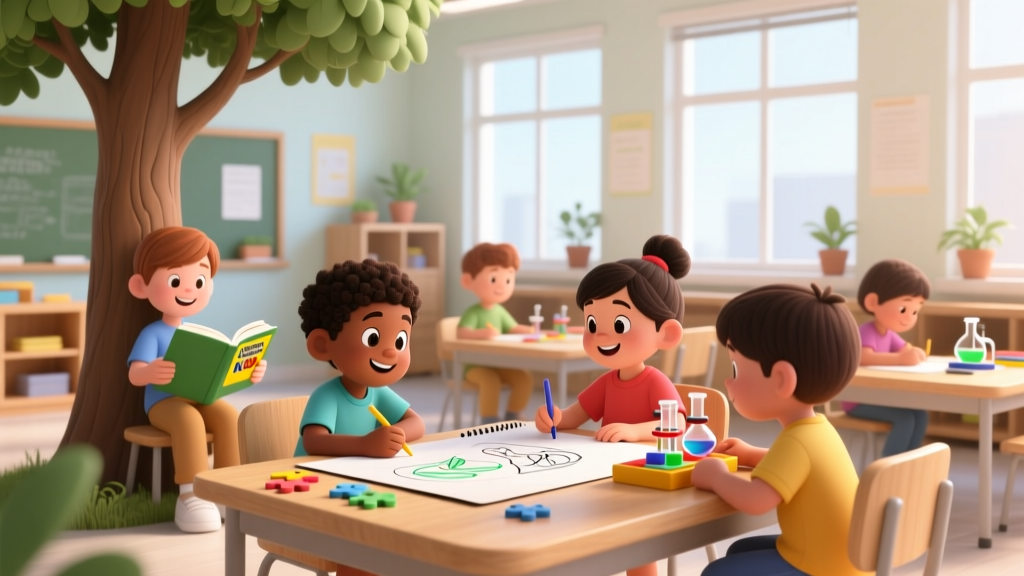
When Do Kids Go to Preschool? The Real Readiness Guide
Why 'When Do Kids Go to Preschool?' Is One of the Most Stressful Questions New Parents Ask — And Why There’s No Universal Answer
When do kids go to preschool? That simple question carries enormous weight for parents navigating the first major educational decision of their child’s life — and yet, most online advice reduces it to a single age (‘3 years old’) or a vague ‘whenever they’re ready.’ In reality, the answer hinges on a dynamic interplay of cognitive, emotional, linguistic, physical, and even socioeconomic factors — not just a birthday. According to the American Academy of Pediatrics (AAP), preschool entry timing should be viewed as a *developmental milestone decision*, not an administrative deadline. With over 60% of U.S. children enrolled in center-based preschool by age 4 — and nearly half starting before age 3 — the stakes are high: entering too early may strain self-regulation systems still under construction; delaying too long can widen opportunity gaps in language exposure and peer interaction, especially for children from low-income households where home literacy environments vary widely.
What ‘Readiness’ Really Means — And Why It’s Not About Knowing the Alphabet
Preschool readiness isn’t about academic precocity — it’s about foundational regulatory and relational capacities. Dr. Claire Lerner, child development specialist and former director of parenting resources at ZERO TO THREE, emphasizes that 'readiness is built on three pillars: self-regulation (managing big feelings and impulses), co-regulation (using adults to help calm and refocus), and relational stamina (engaging meaningfully with peers and teachers for 15+ minutes without frequent adult rescue).'
These skills emerge unevenly — and often lag behind vocabulary or motor milestones. For example, a 3-year-old who counts to 20 and draws circles may still struggle to wait for a turn or transition between activities without meltdowns — a strong signal that full-day preschool may be premature. Conversely, a 2-year, 10-month-old who consistently uses words to express frustration, follows two-step directions, and plays alongside peers for sustained stretches may thrive in a high-quality, play-based program — even if they haven’t hit the ‘typical’ age threshold.
Here’s what research shows matters most:
- Language comprehension: Can your child understand and act on phrases like 'Put the red block in the basket' or 'Wash your hands before snack' — not just isolated words?
- Bladder control: Most programs require daytime dryness for at least 2–3 hours — but this doesn’t mean perfect potty independence. Many quality preschools support gentle, non-shaming toileting routines for children still mastering this skill.
- Separation tolerance: Can your child stay calmly engaged with another trusted adult (grandparent, babysitter) for 45+ minutes without prolonged distress? This predicts adjustment more accurately than age alone.
- Motor coordination: Not fine-motor perfection — but ability to hold a crayon, stack blocks, push/pull toys, and navigate stairs safely indicates neurological readiness for group movement activities.
A real-world case study: Maya, a parent in Portland, delayed her daughter’s preschool entry from age 3 to 3.5 after noticing persistent difficulty with transitions and sensory overload during playgroup. At 3.5, after working with an occupational therapist on co-regulation strategies, her daughter entered a nature-based preschool — and within six weeks, demonstrated marked improvement in attention span and peer imitation. As Dr. Sarah Lytle, developmental cognitive scientist at the University of Washington, notes: 'Neuroplasticity peaks in early childhood — but optimal learning occurs when challenge meets capacity. Pushing before readiness doesn’t accelerate development; it can create avoidance patterns.'
State Laws, District Policies, and the Hidden Cutoff Trap
While federal law doesn’t mandate preschool, every state sets kindergarten entry cutoffs — and these directly influence preschool timing. But here’s what most parents miss: state cutoff dates apply to kindergarten, not preschool. Yet many districts use them as de facto preschool benchmarks — leading families to believe their child ‘must’ start at age 3 to ‘get ahead’ for kindergarten eligibility.
In fact, only 12 states require public preschool programs — and eligibility rules vary wildly. For example:
- Oklahoma offers universal pre-K for all 4-year-olds, regardless of income — but enrollment opens in August for children turning 4 by September 1.
- New York requires districts to provide free pre-K for 4-year-olds, with some offering limited slots for 3-year-olds based on need — but priority goes to children with IEPs or those in foster care.
- Texas mandates pre-K only for children meeting specific risk criteria (e.g., limited English proficiency, poverty, military family) — and eligibility is determined by August 31 cutoffs, meaning a child born September 1 misses the entire year.
This creates what early education researchers call the 'cutoff cliff' — where children born just days apart experience dramatically different educational trajectories. A landmark study published in Nature Human Behaviour (2022) tracked 12,000 children across 18 states and found that summer-born children (born June–August) were 27% more likely to be diagnosed with ADHD by age 9 — not due to biology, but because teachers interpreted normal immaturity as pathology. The same study showed summer-born children placed in preschool one year earlier had significantly higher rates of behavioral referrals.
The takeaway? Don’t assume your district’s calendar defines readiness. Instead, ask: What’s the average age range in the classroom you’re considering? Does the program group by developmental stage rather than strict birthdate? Are teachers trained in recognizing neurodiverse expressions of readiness (e.g., a highly verbal autistic child who struggles with unstructured play)?
The Financial Reality: Cost vs. ROI — When Preschool Pays Off (and When It Doesn’t)
Preschool costs average $10,200/year nationally — up 23% since 2020 — yet returns aren’t guaranteed. A 2023 meta-analysis in Early Childhood Research Quarterly reviewed 87 longitudinal studies and concluded: high-quality preschool yields measurable gains only when it meets four evidence-based criteria:
- Low student-teacher ratios (≤10:1 for 3-year-olds, ≤12:1 for 4-year-olds)
- Teachers with BA degrees + early childhood specialization
- Curriculum grounded in play-based, language-rich, responsive interactions — not worksheet-driven academics
- Strong family engagement protocols (not just newsletters — home visits, bilingual communication, cultural responsiveness)
Without these, the ROI diminishes sharply. In fact, children in low-quality programs (defined as lacking all four criteria) showed no long-term gains in literacy or math by third grade — and in some cases, exhibited higher levels of classroom behavior challenges compared to peers who stayed home or attended informal playgroups.
So how do you assess quality before enrolling? Look beyond glossy brochures:
- Observe quietly for 20 minutes: Do teachers kneel at child height? Do they narrate actions (“You’re stacking the blue blocks so tall!”) rather than direct (“Put the blue one there”)?
- Ask for staff turnover rate: High turnover (>25% annually) correlates strongly with lower emotional security and inconsistent routines.
- Review the daily schedule: Balanced programs allocate ≥60% of time to child-directed play, outdoor exploration, and small-group interactions — not circle time, worksheets, or screen-based learning.
And consider alternatives: High-quality home-based care with a nurturing provider, cooperative preschools where parents share teaching duties (cutting costs by 40–60%), or community playgroups facilitated by early childhood specialists — all offer developmental benefits at lower cost and stress.
Developmental Readiness by Age: A Nuanced Timeline (Not a Rigid Rule)
Rather than prescribing fixed ages, developmental science reveals overlapping windows of opportunity. Below is a research-informed guide to typical readiness markers — with emphasis on variability and red flags:
| Age Range | Typical Social-Emotional Signs | Typical Language & Cognitive Signs | Typical Physical & Self-Care Signs | Key Considerations |
|---|---|---|---|---|
| 2.5–3 years | Plays alongside peers (parallel play); tolerates brief separations (5–10 min); expresses basic emotions verbally ("I mad") | Follows 2-step directions; uses 3–4 word sentences; names common objects and body parts | Washes hands with help; attempts to dress/undress; climbs stairs alternating feet | May succeed in half-day, low-stimulus programs (e.g., forest preschools, Montessori toddler communities) — but full-day traditional settings often overwhelm regulatory systems. |
| 3–3.5 years | Engages in simple cooperative play (takes turns, shares toys briefly); seeks comfort from teachers when upset; shows curiosity about others’ feelings | Asks “why” and “how” questions; tells simple stories; matches shapes/colors; understands basic concepts (big/small, in/on) | Uses toilet independently (with occasional accidents); feeds self with utensils; builds towers of 8+ blocks | This is the most common entry window — but only if child demonstrates consistent regulation across settings (home, playgroup, errands). |
| 3.5–4 years | Initiates play with peers; negotiates simple conflicts (“My turn now”); manages disappointment with minimal adult support | Uses full sentences (5+ words); understands time concepts (“after snack,” “tomorrow”); recognizes some letters/sounds; engages in pretend play with narrative | Dresses/undresses with minimal help; cuts with safety scissors; draws recognizable shapes (circle, cross) | Often ideal for children who needed extra time to mature emotionally or linguistically — especially those with speech delays, sensory sensitivities, or younger siblings dominating attention at home. |
| 4+ years | Forms friendships; resolves minor conflicts with words; adapts to new routines with brief support | Tells detailed stories; understands cause-effect; identifies rhyming words; writes name or letters | Skips, hops, catches large balls; ties shoes (or attempts); uses fork/spoon proficiently | Entering preschool at this age may indicate significant delay or prior lack of structured social exposure — warrants discussion with pediatrician or early intervention specialist. |
Frequently Asked Questions
Is it better to start preschool at 3 or wait until 4?
Neither is universally 'better.' Starting at 3 works well for children with strong self-regulation, expressive language, and separation tolerance — especially in low-ratio, play-based settings. Waiting until 4 benefits children who need more time to develop emotional resilience, language processing speed, or motor coordination. A 2021 study in Pediatrics found children who started at 4 showed stronger executive function skills by kindergarten — but only when their home environment provided rich language input and responsive caregiving. The key isn’t age — it’s alignment between the child’s developmental profile and the program’s demands.
What if my child isn’t potty trained by preschool age?
Most quality preschools accept children who are still working on toilet learning — as long as they show consistent awareness (e.g., telling an adult when wet/dirty, staying dry for 2+ hours). Avoid programs that require full independence as a condition of enrollment; this contradicts AAP guidelines, which state that 'toilet learning is a developmental process, not a prerequisite for early education.' Instead, look for schools with supportive, shame-free routines — like scheduled bathroom breaks, easy-access clothing, and collaboration with families on consistency.
Does preschool really make a difference for future academic success?
Yes — but only when it’s high-quality and developmentally appropriate. Longitudinal data from the National Institute of Child Health and Human Development (NICHD) shows children in high-quality preschools scored 12–18% higher on kindergarten literacy assessments and demonstrated stronger social problem-solving skills. However, these gains fade by fourth grade unless elementary schools sustain similar relationship-rich, play-integrated practices. The real lifelong advantage? Children who attend quality preschool develop stronger 'learning identities' — seeing themselves as curious, capable contributors — which predicts motivation and persistence far more powerfully than early test scores.
How do I know if my child has separation anxiety that’s developmentally normal vs. a sign they’re not ready?
Normal separation anxiety peaks between 18 months and 3 years and typically eases within 10–15 minutes after caregiver departure. Red flags include: crying that lasts >30 minutes daily for 2+ weeks, refusal to engage with teachers or peers while crying, physical symptoms (vomiting, stomachaches) before school, or regression in skills (sleep, toileting, language) after starting. If present, consult a pediatrician or child psychologist — but also consider whether the program’s transition plan supports gradual entry (e.g., 15-minute stays building to full days over 2 weeks).
Are there alternatives to traditional preschool that still build readiness?
Absolutely. Community-based options with strong developmental outcomes include: parent-cooperative preschools (where caregivers rotate teaching roles), nature preschools (which emphasize sensory integration and risk-taking in natural settings), library storytimes with embedded early literacy coaching, and evidence-based home visiting programs like Parents as Teachers. A 2023 randomized trial found children in home-visiting programs matched preschool participants on language growth — at 1/5 the cost — when visits included joint book reading, responsive conversation practice, and caregiver coaching on scaffolding play.
Common Myths About Preschool Timing
- Myth #1: “Starting earlier gives kids a permanent academic head start.”
False. While early exposure to rich language and play boosts foundational skills, research shows any 'advantage' in letter recognition or counting fades by second grade — unless paired with ongoing, developmentally aligned instruction. What endures is social confidence and learning habits — not rote knowledge.
- Myth #2: “If your child isn’t talking in full sentences by 3, they need preschool ASAP to catch up.”
Not necessarily. Late talkers benefit more from targeted speech-language therapy and responsive home interactions than generic preschool exposure. In fact, placing a child with undiagnosed language disorder in a fast-paced, group-heavy setting can increase frustration and withdrawal. Always pursue evaluation through your state’s early intervention program (birth–3) before assuming preschool is the solution.
Related Topics (Internal Link Suggestions)
- Signs Your Child Is Ready for Preschool — suggested anchor text: "preschool readiness checklist"
- How to Choose a High-Quality Preschool Program — suggested anchor text: "what makes a good preschool"
- Alternatives to Traditional Preschool for Young Children — suggested anchor text: "preschool alternatives"
- Understanding State Preschool Programs and Eligibility — suggested anchor text: "free preschool near me"
- Sensory-Friendly Preschool Options for Neurodiverse Children — suggested anchor text: "preschool for autistic children"
Conclusion & Next Step
When do kids go to preschool isn’t a question with a calendar-based answer — it’s a personalized assessment of your child’s unique developmental journey, your family’s values and resources, and the quality of available options. Rather than asking 'Is my child old enough?', shift to 'Is this program designed to meet my child where they are — and grow with them?' Start by observing your child across multiple contexts (not just at home), reviewing your state’s early learning guidelines, and scheduling in-person visits to 2–3 programs with very different philosophies. Then, trust your intuition — backed by data. As Dr. Rebecca London, early education researcher at UC Santa Cruz, reminds us: 'The best preschool decision isn’t the one that looks most impressive on paper — it’s the one where your child walks in smiling, picks up a block, and says, “I’m going to build something amazing.”' Your next step? Download our free Preschool Readiness Observation Tracker — a printable tool used by early intervention specialists to document 12 key readiness behaviors over 10 days. It takes 5 minutes a day — and transforms guesswork into grounded insight.
More Articles
 How Many Kids Does Lynette Have in Desperate Housewives?
 Ludacris Kids: How Many & His Blended Family Approach
 Herbal Diffuser Pens Safe for Kids? (2026)
 How Many Kids Does Snoop Dog Have (2026)
 Kids Home Alone in CA: Age Guidelines & Readiness Tips
 How Many Kids Elon (2026)
 How Many Kids Does Hulk Hogan Have? (2026)
 Who Is the Kid in Bad Bunny Halftime? (2026)
 Ellen Pompeo Kids: Adoption, Surrogacy & Birth (2026)
 Do Kids Die in Welcome to Derry? Pediatrician Guide