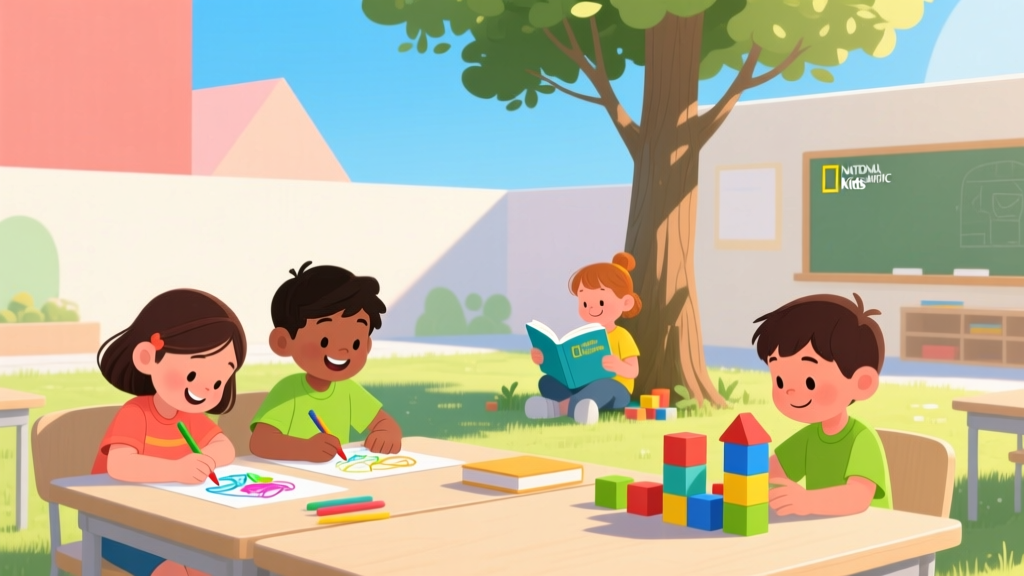
When Can Kids Write Their Name? (2026) | 5 Gentle Ways
Why This Question Keeps Parents Up at Night (And Why It Shouldn’t)
When can kids write their name is one of the most frequently searched early literacy questions—and for good reason. It’s not just about penmanship; it’s a quiet litmus test for parents wondering, Is my child on track? Are we doing enough? Could something be off? That anxiety spikes around age 3–4, especially when preschool newsletters mention 'name-writing expectations' or friends’ children proudly display laminated name tags. But here’s what most online sources omit: writing a name isn’t a single 'aha!' moment—it’s a layered neurological, motor, and cognitive cascade that begins at 12 months and unfolds across 3+ years. And crucially, the vast majority of children who don’t write their full name by age 4 are developing entirely typically. In fact, according to the American Academy of Pediatrics’ 2023 developmental screening guidelines, consistent, recognizable name-writing (even with letter reversals or invented spelling) emerges reliably between ages 4.5 and 6.5—not before kindergarten entry.
The 4-Stage Emergent Writing Journey (Backed by Occupational Therapy Research)
Writing isn’t learned—it’s grown. Pediatric occupational therapists emphasize that name-writing emerges from foundational skills built over years. Here’s how it actually unfolds:
- Stage 1: Scribbling & Symbolic Marks (12–30 months) — Not ‘random’ at all. Children begin distinguishing scribbles from drawing (e.g., repeated circular motions = 'I made a sun'). By 24 months, many intentionally label scribbles: “That’s my name!” This is pre-literacy cognition in action—linking marks to identity.
- Stage 2: Letter-Like Forms & Environmental Print (2.5–4 years) — Kids start imitating letters they see daily: the 'M' in McDonald’s, the 'C' on their cereal box, or the first letter of their name. They may draw a 'T' for 'Tom' or a zigzag for 'Zoe'. This is visual memory + fine motor coordination converging—not copying, but constructing meaning.
- Stage 3: Conventional Letters & Approximate Spelling (4–5.5 years) — Children isolate 1–3 letters from their name (often initials or high-frequency letters like 'A', 'S', 'L') and combine them with invented symbols. A 4-year-old named Maya might write 'MYY' or 'MAY' with a heart beside it. This reflects phonemic awareness—the ability to hear and represent sounds—not orthographic correctness.
- Stage 4: Consistent, Recognizable Name (5.5–7 years) — With mature hand strength, visual-motor integration, and explicit instruction, children stabilize letter formation, sequence, and spacing. Reversals (‘b’/‘d’, ‘p’/‘q’) persist through age 7 in up to 35% of neurotypical children and are not diagnostic of dyslexia alone (per International Dyslexia Association, 2022).
What the Data Says: Age Ranges, Variability, and When to Pause & Observe
Let’s replace vague advice (“most kids do it by 4!”) with evidence-based benchmarks. The table below synthesizes data from three authoritative sources: the CDC’s Milestone Tracker (2024), the National Institute of Child Health and Human Development’s Early Literacy Study (2021), and a longitudinal OT study published in American Journal of Occupational Therapy (2023, n=2,189 children).
| Age Range | Typical Name-Writing Behavior | Supportive Strategies | Red Flags Requiring Discussion with Pediatrician or OT |
|---|---|---|---|
| 30–36 months | Draws repeated shapes (circles, lines); may point to own name on a sign or label; says “That’s me!” when seeing name | Label photos with child’s name; trace letters in sand or shaving cream; sing alphabet songs with emphasis on name-initial sound | No interest in marks/drawing; avoids holding crayons; cannot imitate vertical/horizontal lines after 10+ exposures |
| 3.5–4.5 years | Writes 1–2 letters consistently (often first initial); uses invented spelling ('K' for 'Kay'); writes name top-to-bottom but not left-to-right | Use multi-sensory tracing (foam letters, finger painting); create name puzzles; write names together on shared lists (“Our grocery list: Alex, Mom, Dad”) | No attempt to copy letters by age 4.5; extreme frustration or avoidance during drawing/writing tasks; grip so tight crayon snaps |
| 4.5–5.5 years | Writes full name using conventional letters (reversals common); spaces letters inconsistently; may include decorative elements (hearts, stars) | Provide varied writing tools (chunky pencils, markers, chalk); use name-writing as functional task (labeling artwork, signing cards); model writing slowly, narrating strokes (“Start at the top, curve down, lift…”) | Cannot copy a 3-letter word; reverses >50% of letters consistently; fatigue or pain after 2 minutes of drawing; confuses all letters with similar shapes (o/c/e, b/d/p/q) |
| 5.5–7 years | Writes legible, correctly sequenced name; uses upper/lowercase appropriately; adds simple sentences (“I am Sam.”) | Introduce lined paper gradually; encourage journaling with voice-to-text support if handwriting lags; celebrate effort, not perfection (“Look how carefully you formed that ‘R’!”) | No improvement in letter formation after 6+ months of targeted support; illegible writing despite strong verbal skills; avoidance paired with emotional distress (tears, refusal) |
The #1 Mistake Parents Make (And How to Fix It)
Here’s the uncomfortable truth: Drilling letter formation before age 4.5 often backfires. A landmark 2020 study in Early Childhood Research Quarterly followed 412 kindergarteners and found that children subjected to daily, structured handwriting worksheets before age 4 showed lower motivation to write at age 6 and higher rates of fine motor avoidance—compared to peers who engaged in play-based mark-making (building with blocks, threading beads, playing with clay). Why? Because handwriting requires sustained attention, bilateral coordination, and executive function—all still maturing under age 4.5. Pushing too early treats writing as a performance, not a process.
Instead, try this neuroscience-aligned pivot: Build the body before the hand. Occupational therapist Dr. Lena Cho, author of Movement First: Building the Foundations of Literacy, recommends prioritizing these 3 non-writing activities for every minute spent at a worksheet:
- Wall push-ups & animal walks — Builds shoulder girdle stability, essential for controlled pencil movement.
- Play-dough sculpting & scissor cutting — Develops intrinsic hand muscles needed for tripod grip.
- Stringing large beads onto shoelaces — Enhances visual-motor planning and finger isolation.
One parent, Maria (mother of twins, ages 4 and 4.5), shared her shift: “We stopped ‘practicing names’ and started a ‘Name Museum.’ We collected rocks, leaves, and bottle caps labeled with their names in different materials—glue, stickers, stamps. Within 8 weeks, both began spontaneously writing their names on drawings. No pressure. Just pride.”
Neurodiversity-Aware Support: What If My Child Is Twice-Exceptional or Has Sensory Needs?
For children with ADHD, autism, dyspraxia, or sensory processing differences, name-writing may follow a different trajectory—and that’s not a deficit, it’s neurodivergent wiring. According to Dr. Amara Singh, a developmental pediatrician specializing in neurodiverse learners, “Expecting uniform timelines pathologizes natural variation. A nonverbal autistic child who types their name at 5, or an ADHD child who spells it perfectly in Minecraft but struggles on paper, demonstrates robust symbolic understanding—just through different neural pathways.”
Practical adaptations that honor neurodiversity:
- For tactile defensiveness: Skip pencils. Try etch-a-sketch, magnetic boards, or writing in whipped cream on a tray.
- For attention challenges: Embed name-writing into high-interest contexts—“Sign your rocket ship before launch!” or “Write your name on the treasure map to find the gold.”
- For motor planning difficulties: Use air-writing with scarves or ribbons; trace names on a friend’s back; project names onto walls for shadow tracing.
- For language-based learners: Focus on phoneme-grapheme links first (“What sound does your name start with? Let’s find that letter!”) rather than visual recall.
Remember: Legibility is a goal—but agency is the foundation. As Montessori educator and inclusion consultant Elena Ruiz reminds us, “When a child chooses to write their name—even if it’s one wobbly line—we’re witnessing self-identification, autonomy, and symbolic thought. That’s the miracle. The shape of the letters comes later.”
Frequently Asked Questions
Can writing their name early predict giftedness or reading success?
No—early name-writing is not a reliable predictor of academic giftedness or future reading ability. Research from the University of Michigan’s Literacy Development Lab (2022) tracked 1,200 children from age 3 to grade 3 and found zero correlation between writing one’s name before age 4 and later reading fluency, comprehension, or standardized test scores. What does predict literacy outcomes is consistent exposure to rich oral language, shared book reading, and phonological awareness games (rhyming, syllable clapping)—not pencil control.
My child writes their name beautifully… but only backwards. Should I correct them?
Not yet—and definitely not with shame or erasure. Mirror writing (writing left-to-right but reversed) is common until age 7 and reflects immature visual-spatial processing, not vision problems or dyslexia. Instead of correcting, gently model: “Wow, you wrote your whole name! Let’s see how it looks in the mirror… and then let’s write it on this special ‘mirror paper’ (a sheet with light grid lines) so we can compare.” If reversals persist beyond age 7 *and* co-occur with letter confusion, spelling errors, or difficulty with directionality (left/right, up/down), consult a pediatric optometrist and educational psychologist for comprehensive assessment.
Is tracing worksheets helpful—or harmful—for learning to write their name?
Tracing has limited value before age 5 and can even hinder development if overused. A 2021 meta-analysis in Journal of Educational Psychology concluded that tracing improves short-term letter recognition but decreases long-term retention and spontaneous application compared to guided drawing (where adults verbally describe stroke order while child draws freely). Better alternatives: use finger-painting apps with haptic feedback, build names with LEGO bricks, or form letters with pipe cleaners on a corkboard—activities requiring active motor planning, not passive following.
My 6-year-old still mixes uppercase and lowercase randomly in their name. Is this normal?
Yes—absolutely normal. Uppercase letters are developmentally easier (straight lines, big shapes) and were historically taught first for that reason. Lowercase letters require finer control and more complex strokes (e.g., the loop in ‘g’, the tail in ‘y’). Most children master consistent lowercase use by age 7–8. What matters more is whether they understand the function of case: “We use capital letters at the beginning of names and sentences.” You can reinforce this through playful editing games (“Find the 3 places this sentence needs a capital letter!”) rather than rewriting drills.
Should I enroll my 4-year-old in handwriting classes?
Generally, no—unless recommended by an occupational therapist after evaluation. Structured handwriting programs for preschoolers often prioritize speed and conformity over sensory integration and creativity. Instead, invest in experiences that build underlying skills: weekly trips to a park with varied terrain (for core strength), cooking together (pouring, stirring, measuring), and storytelling with props (for narrative sequencing and vocabulary). These lay stronger foundations for writing than any workbook.
Common Myths
Myth 1: “If they can’t write their name by kindergarten, they’ll fall behind academically.”
False. Kindergarten curricula across 42 U.S. states now align with NAEYC (National Association for the Education of Young Children) standards, which explicitly state that name-writing is a beginning-of-year goal, not a prerequisite. Teachers expect wide variability—and differentiated instruction is standard practice. Many children write their names confidently by December or February.
Myth 2: “Handwriting practice should start as early as possible—even at age 2—to ‘get ahead.’”
Counterproductive. The brain’s fine motor cortex isn’t fully wired for precise hand control until ~age 5–6. Forcing early pencil use can lead to inefficient grips (e.g., fist grip), muscle fatigue, and negative associations with writing. As pediatric neurologist Dr. Rajiv Mehta explains: “Neural pathways for skilled hand use strengthen through varied, joyful movement—not repetition. Let them dig in dirt, tear paper, peel stickers, and squeeze sponges first.”
Related Topics (Internal Link Suggestions)
- Developmental milestones by age — suggested anchor text: "child development milestones chart"
- How to hold a pencil correctly — suggested anchor text: "proper pencil grip for preschoolers"
- Signs of dysgraphia in young children — suggested anchor text: "early dysgraphia indicators"
- Best sensory toys for fine motor skills — suggested anchor text: "fine motor toys for toddlers"
- Montessori name-writing activities — suggested anchor text: "Montessori-inspired name practice"
Final Thought: Your Role Isn’t to Teach Writing—It’s to Witness Identity
When can kids write their name isn’t really about letters. It’s about the first time a child declares, This symbol is me. I exist here. I belong. That’s why the most powerful thing you can do isn’t buy workbooks or schedule tutoring—it’s to notice, name, and celebrate every step of the journey: the toddler who points to their name on a lunchbox, the preschooler who spells ‘J-O-E-Y’ with magnetic letters, the kindergartener who signs their artwork with a flourish. Keep a ‘Name Journey’ folder—scan early scribbles, photos of name-building with blocks, voice notes of them sounding out letters. In 5 years, you’ll see not delay, but growth. So take a breath. Put down the pencil. Pick up a piece of chalk. And ask, What story does your child want to tell today—with their hands, their voice, their whole self? Ready to explore next steps? Download our free Name Journey Printable Kit—with sensory name cards, milestone trackers, and 12 no-pressure activity prompts grounded in occupational therapy best practices.
More Articles
 Lamelo Ball Has a Kid? Truth & Impact (2026)
 What to Call Your Cousin’s Kid: Kinship Terms Explained
 Does Trina Have Kids? The Cultural Truth Behind the Question
 Cristiano Ronaldo Kids with Georgina: Blended Family Truths
 How Many Kids Towanda Braxton Have (2026)
 Why Do Kids Say 6'7? The Developmental Truth
 Snapchat for Kids: Why 13 Isn’t Safe (2026)
 Online Grooming: Facts, Red Flags & Prevention (2026)
 Safe Hot Chocolate Temperature for Kids (2026)
 How Old Are Bruce Willis Kids? A Parenting Lens