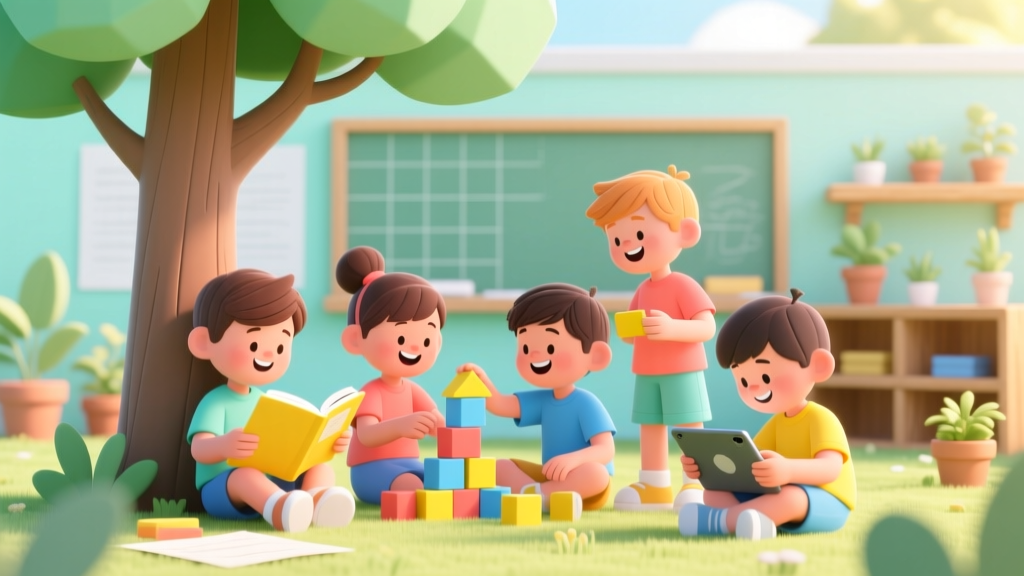
When Can Kids Learn to Read? The Science Behind It
Why 'When Can Kids Learn to Read' Is the Wrong Question — And What to Ask Instead
If you've ever found yourself scrolling at midnight wondering when can kids learn to read, comparing your 4-year-old’s letter-sound knowledge to a neighbor’s precocious 5-year-old who just finished 'Green Eggs and Ham' solo—you’re not behind. You’re human. And you’re asking a question that’s been oversimplified for decades. The truth? Reading isn’t a switch that flips on a birthday—it’s a complex neurological cascade built over years of spoken language exposure, phonological awareness, visual processing, and emotional safety. According to the American Academy of Pediatrics (AAP), only about 17% of children meet all conventional 'reading-ready' benchmarks by age 5—and yet, over 95% achieve functional literacy by age 8. So if your child isn’t sounding out CVC words by kindergarten, it doesn’t mean delay, deficit, or failure. It means their brain is developing exactly as designed—just on its own timeline. This guide cuts through the noise with actionable, research-backed insight—not rigid timelines, but responsive strategies grounded in how children *actually* learn.
What Reading Readiness Really Looks Like (Hint: It’s Not Alphabet Recitation)
Many parents equate 'reading readiness' with letter naming or memorizing ABCs—but those are surface-level skills, not predictors of decoding ability. True readiness involves four interlocking pillars, each with observable, low-pressure indicators:
- Phonological Awareness: Can your child clap syllables in 'butterfly'? Rhyme 'cat' with 'hat' and 'mat'? Hear that 'smile' starts with /sm/, not just 's'? This auditory skill—often emerging between ages 3–5—is the strongest predictor of later reading success (National Institute of Child Health and Human Development, 2022).
- Print Concepts: Does your child hold books right-side up? Track text left-to-right with a finger? Know that letters carry meaning—not just decorations? These 'book smarts' develop through shared reading, not flashcards.
- Oral Language Depth: Vocabulary size at age 4 predicts reading comprehension at age 10 more accurately than IQ scores (Hart & Risley, 1995). A child who uses 'gigantic' instead of 'big', asks 'Why do clouds float?', or retells a story with sequence ('First… then… finally…') is building the semantic scaffolding reading needs.
- Executive Function Foundations: Can your child sit for 5 minutes during storytime? Wait their turn while sounding out a word? Persist when a word feels tricky? Self-regulation—not phonics drills—is the silent engine of early literacy.
Here’s what this looks like in real life: Maya, age 4, couldn’t name all letters but could segment 'dog' into /d/ /o/ /g/ and blend /b/ /a/ /t/ into 'bat'—so her preschool teacher introduced magnetic letters to build on that strength. By age 6, she was reading leveled chapter books. Meanwhile, Leo, age 5, knew every letter and sound but struggled to hear rhymes or hold attention long enough to decode. His family focused on rhythmic games (clapping poems, singing nursery rhymes) and oral storytelling—no worksheets, no pressure. He began reading confidently at 7. Both paths were neurologically sound. Neither was 'late.'
The Real Timeline: What to Expect (and When to Pause and Observe)
Forget rigid grade-level expectations. Research from the National Center for Education Statistics shows wide natural variation: 10% of U.S. kindergarteners read simple texts independently; 40% do so by first grade; and 92% reach basic fluency by second grade—with most catching up *without intervention*. What matters isn’t speed—it’s whether your child is moving *forward* along their own continuum. Below is an evidence-based developmental guide—not a checklist, but a compass:
| Age Range | Typical Literacy Behaviors | Supportive Actions (No Pressure Needed) | When to Gently Pause & Observe |
|---|---|---|---|
| 2–3 years | Points to pictures when named; repeats rhyming words; enjoys being read to daily; scribbles with intent | Read aloud 20+ minutes/day; play 'sound games' (e.g., 'What starts with /m/? Monkey! Milk! Moon!'); label objects during routines ('This is a spoon. Ssspoon.') | Child avoids books entirely; doesn’t respond to their name or simple directions; shows no interest in sounds or symbols after 6+ months of consistent exposure |
| 4–5 years | Counts syllables; generates rhymes spontaneously; recognizes some environmental print (STOP sign, cereal box); attempts to 'write' using letters or invented spelling | Play I-Spy with sounds ('I spy something that starts with /b/'); write grocery lists together (child draws, you scribe); use magnetic letters to build names or favorite words | No rhyme awareness by age 5; inability to segment 3-sound words (e.g., 'cat' → /c/ /a/ /t/); persistent letter reversals *with confusion* (e.g., calls 'b' 'd' and can’t correct when shown) |
| 6–7 years | Decodes CVC words (cat, dog); reads familiar repetitive texts; self-corrects errors using context or pictures; spells phonetically | Choose 'just-right' books (95%+ words known); model fluent reading aloud; ask open-ended questions ('What do you think will happen next? Why?') | Relies solely on picture cues with no attempt to decode; guesses every word; avoids reading aloud even with support; frustration leads to tantrums or avoidance |
| 8+ years | Reads chapter books; comprehends main ideas and inferences; writes multi-sentence paragraphs; self-monitors for meaning | Discuss themes and character motives; introduce genre variety (biographies, poetry, graphic novels); co-write stories or emails | Persistent letter/word reversals *with no self-correction*; slow, labored reading affecting comprehension; avoidance across all literacy tasks despite targeted support |
Note: 'Gently pause and observe' ≠ panic. It means stepping back from instruction to watch patterns: Does your child misread 'was' as 'saw' consistently? That’s a visual processing cue. Do they skip small words ('the', 'and') but get big ones right? That points to weak sight-word recognition—not intelligence. As Dr. Sally Shaywitz, neuroscientist and author of Overcoming Dyslexia, emphasizes: 'Dyslexia isn’t about seeing letters backward. It’s a difficulty with the phonological component of language—and it’s highly treatable when identified early, with structured, multisensory instruction.'
What NOT to Do (Even With the Best Intentions)
Well-meaning efforts often backfire. Here’s what developmental science says to avoid—and why:
- Pushing formal phonics before age 5–6: The brain’s phonological processing network isn’t fully myelinated until around age 6. Early drill-based programs (like intensive flashcard rote) can create anxiety, erode motivation, and even impair neural pathways for joyful learning. Montessori educators observe that children taught phonics *after* robust oral language development progress faster and retain more.
- Comparing to siblings or peers: Neurodiversity is the norm—not the exception. Twin studies show reading onset can vary by 12–18 months between genetically identical children. Your child’s path is theirs alone.
- Using reading level as a measure of intelligence: A child who excels at spatial reasoning (building intricate Lego cities) or social storytelling (directing elaborate pretend scenarios) is exercising equally vital cognitive muscles. Literacy is one thread in a rich developmental tapestry.
- Skipping read-alouds once they 'can read': Children comprehend texts 2–3 grade levels above their independent reading until age 13. Hearing complex syntax, vocabulary, and narrative structure read aloud builds the very foundation for their own writing and critical thinking.
Real-world example: When 6-year-old Eli stalled at Level D in his school’s guided reading program, his parents panicked—until his teacher shared audio recordings of him narrating a 10-minute story about his pet turtle, using advanced vocabulary ('camouflage', 'hibernation', 'aquatic'). His 'delay' wasn’t cognitive—it was motor-planning related to handwriting fatigue. Switching to audiobooks + verbal responses unlocked his comprehension instantly.
Your Toolkit: 5 Low-Pressure, High-Impact Strategies Backed by Research
You don’t need apps, workbooks, or tutors. You need presence, pattern, and patience. Here’s what works—and why:
- Build Sound Awareness Through Play (Not Worksheets): Sing songs with heavy alliteration ('Silly Sammy's super slippery snake'). Stretch out words slowly ('mmmmaaaalllll'). Play 'Odd One Out' ('cat, cap, dog'). These activities strengthen the auditory cortex—the brain’s first stop for reading.
- Make Print Meaningful—Not Abstract: Label your child’s lunchbox ('Liam’s Yoghurt'), write thank-you notes together, follow a recipe step-by-step. When print solves real problems, it gains value.
- Embrace 'Invented Spelling' Without Correction: If your 5-year-old writes 'I luv piz' for 'I love pizza', celebrate the phonetic logic (/l/ /u/ /v/ /p/ /i/ /z/). Correcting it undermines confidence and signals that 'right' matters more than 'trying.' Research shows invented spelling predicts later spelling accuracy better than early correctness.
- Let Them 'Read' Wordless Books: Books like Flotsam or Journey demand narrative construction, inference, and sequencing—core comprehension skills that precede decoding. Ask: 'What’s happening on this page? How do you know? What might happen next?'
- Protect Joy Above All: A 2023 longitudinal study in Reading Research Quarterly found that children whose families prioritized 'reading for pleasure' over 'reading for skill' developed stronger metacognitive strategies and deeper engagement—even if they started later. Joy isn’t the reward for reading. It’s the fuel.
Frequently Asked Questions
My child is 5 and still mixes up b/d/p/q. Is this a red flag?
Mixing similar-looking letters is extremely common—and developmentally appropriate—through age 7. The brain’s visual processing system matures gradually. What matters more is whether your child can *self-correct* when prompted ('Is this 'b' or 'd'? Let’s look at the ball—where does it sit? On the bat or the belly?'). Persistent confusion *plus* difficulty hearing sounds in words (e.g., 'cat' → /c/ /a/ /t/) warrants a conversation with your pediatrician or school’s literacy specialist. But isolated letter reversals? Normal. Healthy. Human.
Should I teach my child to read before kindergarten?
Not formally—and not with pressure. Early exposure to rich language, playful sound work, and book joy is invaluable. But structured, systematic phonics instruction before age 5–6 has no proven advantage and carries documented risks: decreased motivation, increased anxiety, and reduced intrinsic curiosity about text. As the AAP states: 'There is no evidence that early formal instruction produces lasting benefits. What *does* predict lifelong literacy is daily read-alouds, conversational richness, and unhurried exploration.'
What if my child is diagnosed with dyslexia? Does that mean they’ll never read well?
Absolutely not. Dyslexia is a specific learning difference—not a limit. With evidence-based, multisensory instruction (like Orton-Gillingham or Wilson Reading System), 85–90% of students with dyslexia achieve average or above-average reading proficiency. Early identification (by age 6–7) and consistent, structured support make the biggest difference. Many dyslexic adults—like Steven Spielberg, Whoopi Goldberg, and Richard Branson—attribute their creative problem-solving strengths directly to how their brains process information differently.
Are digital reading apps helpful or harmful for early readers?
It depends entirely on design and use. Apps that emphasize passive swiping, rewards for speed, or isolated letter drills offer little benefit—and may displace richer language experiences. However, high-quality interactive e-books with embedded supports (tap-to-hear pronunciation, dynamic glossaries, read-aloud narration with highlighted text) can boost vocabulary and comprehension—especially for English learners. The key: co-use. Sit with your child. Pause to discuss. Ask 'Why do you think the character felt sad?' Don’t let the screen replace your voice, your questions, or your shared wonder.
My child reads fluently but doesn’t seem to understand what they’ve read. What’s going on?
This is called 'hyperlexia'—a dissociation between decoding and comprehension. It’s more common than many realize and often linked to strong visual memory and weak inferential reasoning. Support focuses on 'thinking aloud': model your own predictions and questions while reading, use graphic organizers (story maps, character webs), and prioritize discussion over speed. Ask 'What’s the problem? How was it solved? What would you have done?'—not 'What happened first?'
Common Myths About Early Reading
Myth #1: 'Early readers are smarter.' Intelligence is multifaceted. Early decoding often reflects strong visual memory or intense parental focus—not superior cognition. Late bloomers frequently excel in abstract reasoning, creativity, and emotional intelligence—skills rarely measured by reading tests.
Myth #2: 'If they’re not reading by first grade, they’ll fall behind forever.' Longitudinal data from the Early Childhood Longitudinal Study shows that children who begin reading at age 7 or 8 catch up academically by fourth grade—and often surpass early readers in critical thinking and writing depth by middle school. The brain’s plasticity remains high through adolescence.
Related Topics (Internal Link Suggestions)
- How to Choose Age-Appropriate Books for Emergent Readers — suggested anchor text: "best first books for beginning readers"
- Phonological Awareness Activities You Can Do While Doing Dishes — suggested anchor text: "fun sound games for preschoolers"
- When to Seek Help for Reading Delays: A Parent’s Guide to Evaluations — suggested anchor text: "signs your child needs a reading evaluation"
- Screen Time and Literacy: What the Research Really Says — suggested anchor text: "do tablets help or hurt early reading?"
- Building Vocabulary Naturally: Everyday Conversations That Boost Literacy — suggested anchor text: "how talking more helps kids read better"
Final Thought: Your Role Isn’t Teacher—It’s Literacy Gardener
You’re not responsible for making your child read. You’re responsible for creating conditions where reading can take root: soil rich in language, sunlight of joyful attention, water of patient presence, and space to grow at their own pace. When can kids learn to read isn’t a deadline—it’s an invitation to notice, respond, and nurture. So put down the checklist. Pick up a book. Read with expression. Pause to wonder. And trust the quiet, steady work happening inside that remarkable, unfolding mind. Ready to start? Grab any book—even one you love—and read it aloud tonight. No agenda. Just connection. That’s where real reading begins.
More Articles
 How to See What My Kid Is Doing Online (2026)
 Joe Jonas’ Kids in Christmas Movie? Truth & Tips
 Kids' Thyroid Issues: Signs Before Age 12 (2026)
 Does Mark Ballas Have Kids? The Truth (2026)
 Does Dean Have a Kid? What It Says About Modern Fatherhood
 Charlie Kirk Married? Kids? Truth Behind Rumors (2026)
 How Old Were Diane Keaton’s Kids? Adoption Truths (2026)
 What Is Kid Leather? Truth About the Misnamed Material
 How Lesbian Couples Have Kids: A Complete Guide
 Buffalo Wild Wings Kids Menu 2026