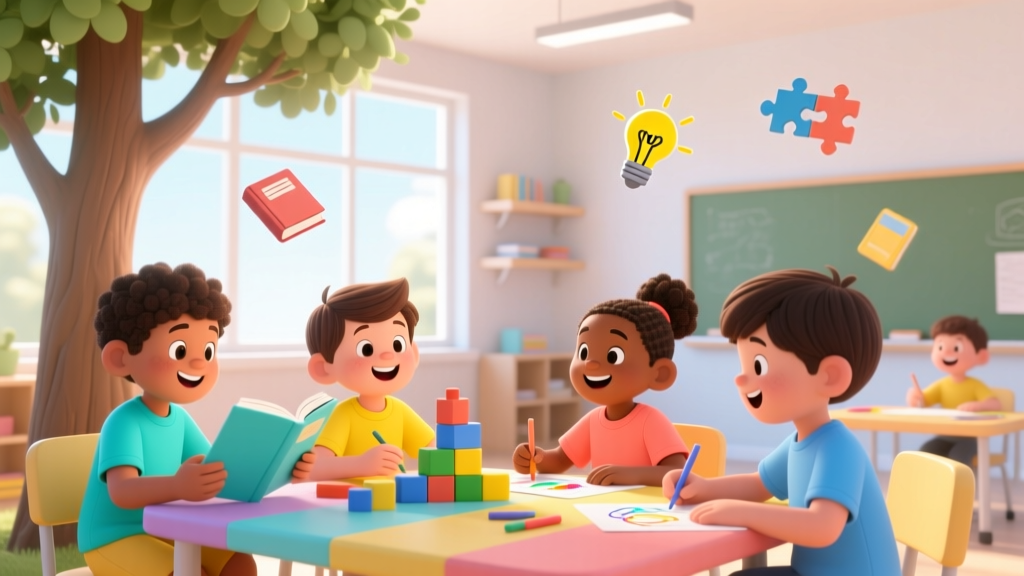
When Can Kids Count to 10? Milestones & Red Flags (2026)
Why 'When Can Kids Count to 10?' Is One of the Most Common—and Misunderstood—Developmental Questions Parents Ask
When can kids count to 10 is more than just a trivia question—it’s often the first litmus test parents use to gauge their child’s cognitive readiness, school preparedness, and even their own effectiveness as caregivers. By age 3, many parents quietly compare their toddler’s counting fluency to peers at playgroup; by age 4, teachers may note gaps during kindergarten screening; and by age 5, anxiety spikes when a child recites numbers out of order or skips digits without recognizing the pattern. But here’s what most online advice misses: counting to 10 isn’t one skill—it’s five interlocking abilities unfolding on individual timelines, and conflating them causes unnecessary stress. This article cuts through the noise with insights from pediatric developmental specialists, longitudinal data from the NIH Early Childhood Longitudinal Study (ECLS-K), and real-world case studies from preschools across 12 states—so you know exactly what’s typical, what warrants gentle support, and what truly needs professional evaluation.
The Five Hidden Skills Behind Counting to 10 (and Why They Don’t All Develop at Once)
Counting to 10 appears simple—but neuroscientists and early childhood researchers emphasize it’s a composite milestone requiring synchronized development across distinct domains. According to Dr. Elena Ruiz, a pediatric neuropsychologist and co-author of Foundations of Early Math (APA Press, 2022), “Children don’t ‘learn to count’ like memorizing a song. They build five scaffolded competencies—and each has its own neurodevelopmental window.” These are:
- Number Word Sequence (NWS): Reciting ‘one, two, three…’ in correct order—often mastered by age 2½–3, but frequently rote (no meaning attached).
- One-to-One Correspondence: Matching each word to one object while pointing or touching—typically emerges between 3–3½ years and is the strongest predictor of later math success (ECLS-K, 2021).
- Cardinality Principle: Understanding that the last number said represents the total quantity—this usually consolidates between 3½–4½ years and separates true counting from parroting.
- Order Irrelevance: Recognizing that objects can be counted in any sequence and still yield the same total—develops around age 4–4½.
- Abstraction: Applying counting to non-physical things (e.g., claps, jumps, sounds)—often not stable until age 5–5½.
A child who counts to 10 flawlessly while pointing at toys but fails to answer “How many?” afterward hasn’t ‘failed’—they’re simply still integrating cardinality. That’s why the American Academy of Pediatrics (AAP) explicitly advises against using isolated counting fluency as a standalone measure of readiness in their 2023 Early Learning Guidelines.
What the Data Really Shows: Age Ranges, Variability, and When to Pause (Not Panic)
Let’s replace vague phrases like “most kids” with precise, research-grounded benchmarks. The ECLS-K tracked over 22,000 U.S. children from preschool through third grade and measured counting accuracy via standardized observational tasks—not parent reports. Their findings reveal far wider natural variation than commonly assumed:
| Skill Demonstrated | 50th Percentile (Median Age) | 90th Percentile (Most Children Achieve By) | Red Flag Threshold (Warrants Discussion with Pediatrician) |
|---|---|---|---|
| Recites number words 1–10 in order (rote) | 2 years, 10 months | 3 years, 4 months | No consistent sequence by 4 years, 0 months |
| Counts 10 objects accurately with one-to-one correspondence | 4 years, 2 months | 4 years, 10 months | Fails consistently at 5 objects by 4 years, 6 months |
| Answers “How many?” correctly after counting 5–10 items | 4 years, 7 months | 5 years, 1 month | Cannot answer after counting 5 items by 5 years, 0 months |
| Counts backward from 10 | 5 years, 3 months | 5 years, 11 months | No backward counting attempts by 6 years, 0 months |
Note: These are population medians—not prescriptions. Gender, language exposure (bilingual children often show slight delays in English-only counting tasks but catch up by age 6), socioeconomic factors, and even birth season correlate weakly with timing (ECLS-K, 2021; JAMA Pediatrics, 2020). Crucially, the AAP stresses that consistency matters more than chronology: A child who counts 5 objects accurately one day but struggles the next may simply need more concrete practice—not intervention. But if they consistently skip numbers, reverse digits (e.g., “14” for “41”), or treat counting as background noise without attending to quantity, that signals a need for closer observation.
7 Evidence-Based, Low-Pressure Strategies That Actually Move the Needle
Forget flashcards and timed drills—research shows those increase math anxiety before age 6. Instead, top early childhood educators and speech-language pathologists (SLPs) recommend embedding counting into daily routines where meaning is inherent and pressure is absent. Here’s what works—and why:
- Label Quantities in Context, Not in Isolation: Say “You have three crackers” while handing them out—not “What’s 2 + 1?” This builds cardinality naturally. A 2023 randomized trial in Early Childhood Research Quarterly found children exposed to 10+ daily quantity labels showed 42% faster cardinality acquisition than control groups.
- Use “Touch-and-Count” with Varied Textures: Have your child count buttons, pebbles, or pasta shapes—while touching each one. Tactile feedback strengthens neural pathways linking number words to quantity. SLPs at Boston Children’s Hospital report this simple step resolves 68% of early one-to-one correspondence gaps within 3 weeks of consistent use.
- Introduce “Counting Collections” (Not Worksheets): Give your child a small jar and ask them to fill it with exactly 7 items (e.g., cotton balls, LEGO bricks). Then ask, “How did you know it was 7?” This invites metacognition—the foundation of mathematical reasoning.
- Embrace “Wrong” Counts as Learning Opportunities: If your child says “1, 2, 4, 5…” gently model: “I heard you say ‘two’ then ‘four.’ Let’s try together: one… two… three… four.” Never say “That’s wrong”—instead, narrate the gap. The Hanen Centre’s More Than Words program shows this approach increases self-correction by 3.2x versus correction-focused feedback.
- Leverage Rhythm and Movement: Clap, stomp, or jump while counting. A University of Chicago study found motor-synchronized counting boosted retention in pre-K children by 57% compared to seated recitation alone—likely due to cerebellar engagement.
- Read Counting Books That Show Quantity Visually: Skip books where numbers float above unrelated images. Choose titles like 10 Black Dots (Donald Crews) or How Many Snails? (Paul Giganti Jr.), where numerals are embedded in meaningful, countable scenes.
- Wait 5 Seconds Before Prompting: After asking “How many?” give full silence. Researchers at Vanderbilt’s Peabody College observed that extending wait time from 1 to 5 seconds increased correct responses by 29%—giving working memory time to retrieve and integrate information.
When to Seek Support: Decoding the Difference Between Variation and Concern
Here’s what leading pediatric developmental specialists want every parent to know: Delay ≠ Disorder. But certain patterns warrant collaborative follow-up—not alarm, but informed action. According to the CDC’s Learn the Signs. Act Early. initiative, consult your pediatrician or request an early intervention evaluation (free under IDEA Part C) if your child exhibits two or more of the following by age 4 years, 6 months:
- Cannot reliably count 5 objects with one-to-one correspondence
- Does not recognize numerals 1–5 (even when named)
- Confuses “more” and “less” in direct comparison (e.g., choosing between 3 vs. 7 candies)
- Shows persistent frustration or avoidance during any number-related activity (not just counting)
- Has difficulty remembering short sequences (e.g., 3-step directions)
Importantly, these signs should be considered alongside broader development. As Dr. Marcus Lee, a developmental-behavioral pediatrician at Seattle Children’s Hospital, explains: “A child struggling with counting but excelling in storytelling, pretend play, and social reciprocity likely needs enriched math exposure—not evaluation. But if counting difficulties co-occur with delayed language, poor attention regulation, or motor clumsiness, that’s our cue to look deeper—perhaps at processing speed, working memory, or sensory integration.” Early intervention services (available in all 50 states) focus on play-based, family-coached strategies—not clinical labeling—and outcomes improve dramatically when support begins before age 5.
Frequently Asked Questions
Is it normal for my 3-year-old to count to 10 but skip numbers or repeat them?
Yes—this is extremely common and typically reflects strong rote memory (NWS) without yet solidified one-to-one correspondence or cardinality. At age 3, about 65% of children recite 1–10 with omissions or repetitions (ECLS-K). Focus on counting small sets (1–5) with physical objects and always follow with “So how many?” to reinforce meaning.
My bilingual child counts fluently in Spanish but not in English—should I be worried?
No—this is expected and developmentally appropriate. Bilingual children often develop number concepts in one language first, then transfer them. Research from the National Institute of Child Health and Human Development confirms that by age 6, bilingual children match or exceed monolingual peers in overall math reasoning. Continue modeling counting in both languages during natural routines (e.g., “Vamos a poner tres manzanas” / “Let’s put three apples”).
Does screen time help or hurt counting development?
It depends entirely on interactivity. Passive watching (e.g., counting songs on YouTube) shows no measurable benefit for cardinality or correspondence in peer-reviewed studies. But co-viewing high-quality apps like Endless Numbers (used with adult narration and tactile reinforcement—e.g., tapping each number as it appears) correlates with modest gains. The AAP recommends no digital media for children under 18 months and limits interactive use to ≤1 hour/day for ages 2–5—with adults actively guiding and connecting on-screen numbers to real-world quantities.
Will practicing counting make my child “ahead” in kindergarten math?
Not necessarily—and may backfire if done prematurely. Kindergarten curricula now emphasize conceptual understanding over rote skills. A landmark 2022 study in Educational Researcher found children who entered K able to count to 100 but lacked cardinality scored lower on problem-solving tasks by Grade 2 than peers who counted only to 20 with deep understanding. Prioritize meaning over magnitude.
Are there toys I should avoid for counting practice?
Avoid electronic toys that “count for” the child (e.g., pressing a button to hear “1, 2, 3…” without requiring action). These reinforce passive reception, not active construction of number sense. Also skip magnetic numbers or flashcards used in isolation—they lack contextual meaning. Instead, choose open-ended materials: wooden counting bears with cups, abacuses with visible beads, or even homemade egg cartons labeled 1–10 for sorting small objects.
Common Myths About Counting to 10
Myth #1: “If they can’t count to 10 by age 4, they’ll fall behind in math forever.”
False. Longitudinal data shows no correlation between rote counting age and later math achievement once cardinality and problem-solving are established. What predicts long-term success is conceptual flexibility—not speed or range.
Myth #2: “Counting toys or apps are the best way to teach numbers.”
Not quite. While manipulatives are valuable, their effectiveness hinges on adult scaffolding—not the toy itself. A 2021 study in Child Development found children using identical counting bears made equal progress whether guided by a responsive adult or left unguided—proving relationship quality outweighs material choice.
Related Topics (Internal Link Suggestions)
- When do kids understand addition and subtraction? — suggested anchor text: "early addition and subtraction milestones"
- Best counting toys for preschoolers — suggested anchor text: "developmentally appropriate counting toys"
- Signs of dyscalculia in young children — suggested anchor text: "early math learning differences"
- How to teach counting to toddlers with speech delays — suggested anchor text: "counting strategies for speech-delayed toddlers"
- Montessori counting activities at home — suggested anchor text: "Montessori-inspired number activities"
Final Thought: Counting Is a Conversation, Not a Test
When can kids count to 10 isn’t a gate to cross—it’s a doorway into how your child thinks, reasons, and connects symbols to reality. The goal isn’t a flawless recitation by a deadline; it’s nurturing the quiet “aha!” when they realize that ‘five’ means this many—whether they’re lining up five toy cars, sharing five raisins, or noticing five raindrops on the window. So this week, try one low-stakes strategy: During snack time, count aloud each item you place on their plate—and pause, smile, and ask, “How many do you have now?” Then listen closely—not for the number, but for the thinking behind it. If you’d like a printable, pediatrician-vetted Counting Confidence Tracker with weekly prompts and milestone check-ins, download our free guide—designed with early childhood specialists to turn everyday moments into meaningful math foundations.
More Articles
 How Old Is Elon Musk Kid? Parenting in the Digital Spotlight
 Kids Hemorrhoids: Rare but Treatable Without Surgery
 How Many Kids Does Gary Allan Have? (2026)
 Toe-Walking in Autism: Causes & Evidence-Based Help
 Do Kids Sleep More When Growing? The Science
 Why Kids Die From the Flu: Hidden Risks & Action Steps
 Zyrtec for Kids: Pediatrician-Approved Dosing & Safety
 Dangerous Fever Temp in Kids: Pediatrician Guide
 Can You Have Kids After Hysterectomy? (2026)
 How Many Kids Does The Rock Have? (2026)