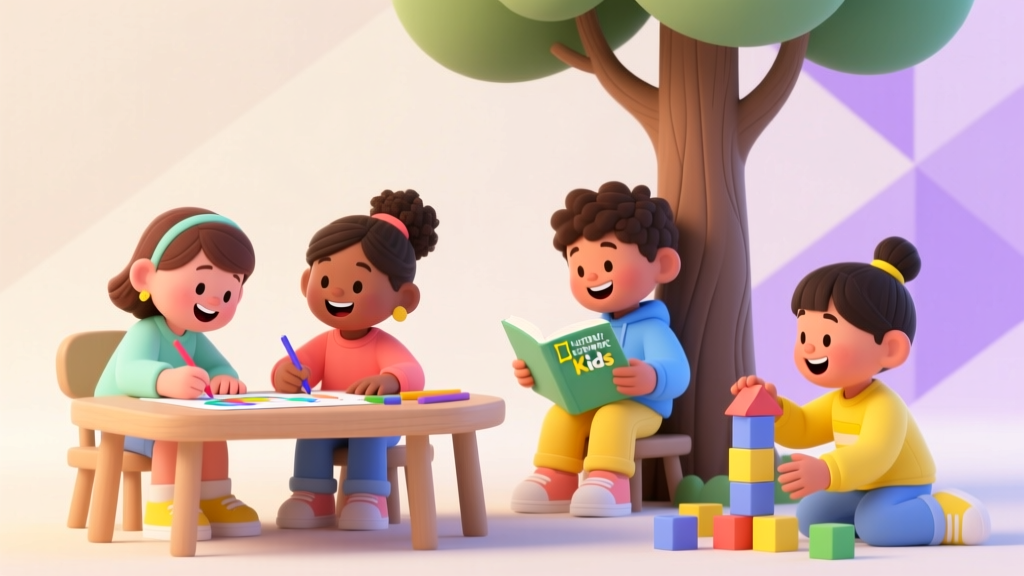
Preschool Skills Kids Really Need (2026)
Why This Question Matters More Than Ever Right Now
What should kids learn in preschool isn’t just a question—it’s a quiet source of anxiety for millions of parents navigating an era of academic pressure, screen-saturated homes, and conflicting advice from influencers, grandparents, and even well-meaning teachers. Yet research from the National Association for the Education of Young Children (NAEYC) and longitudinal studies like the Abecedarian Project confirm: the most powerful predictors of lifelong success aren’t early reading fluency or advanced math drills—but foundational competencies built through play, relationship, and guided exploration. When we misprioritize academics over agency, we risk undermining the very neural architecture that supports learning for decades. This guide cuts through the noise with what truly matters—and how to nurture it, authentically and joyfully.
Social-Emotional Skills: The Invisible Curriculum That Builds Brains
Before a child writes their name, they must learn to name their feelings—and regulate them. According to Dr. Ross Thompson, developmental psychologist and co-author of the AAP’s Clinical Report on Social-Emotional Screening, “Self-regulation at age 4 is a stronger predictor of high school graduation than IQ or early literacy.” Preschool isn’t about eliminating tantrums—it’s about scaffolding emotional literacy: recognizing frustration in a peer’s face, using ‘I feel…’ language, waiting for a turn without physical escalation, and repairing after conflict (e.g., ‘I’m sorry I took your block. Can I help you build?’).
Here’s how it works in practice: At Riverbend Montessori Cooperative, teachers use ‘feeling charts’ with photos of diverse children expressing joy, disappointment, anger, and calm—not as flashcards, but as reference tools during morning circles. When Maya (age 4) stomps away after losing a game, her teacher doesn’t say, ‘Calm down.’ Instead, she kneels, names the emotion (“You look really frustrated”), offers a regulation tool (“Would deep breaths or a squeeze ball help?”), and later co-creates a ‘calm-down plan’ with Maya—complete with her own drawings. This isn’t permissiveness; it’s neuroscience-informed pedagogy. A 2023 study in Child Development tracked 1,200 preschoolers and found those in classrooms with explicit social-emotional curricula (like Second Step or PATHS) showed 32% greater growth in self-regulation and 27% higher peer acceptance scores by kindergarten.
At home, parents can embed this work seamlessly: narrate your own emotions (“I felt impatient waiting in line—I took three slow breaths”), pause before reacting to big feelings (“Let’s both sit for 20 seconds and notice what our bodies feel”), and read books rich in emotional nuance—The Rabbit Listened, When Sophie Gets Angry—Really, Really Angry, or My Many Colored Days. Avoid labeling behavior (“You’re being stubborn”) and instead describe impact (“When you threw the crayon, it broke the tip—and now Sam can’t color”). This builds empathy, not shame.
Executive Function: The ‘Air Traffic Control System’ of the Developing Brain
Forget ABCs for a moment—what preschoolers *actually* need to master are working memory, cognitive flexibility, and inhibitory control. Think of these as the brain’s air traffic control system: holding instructions in mind while shifting between tasks and resisting impulsive reactions. Dr. Adele Diamond, neuroscientist and pioneer in EF research, emphasizes: “EF skills are malleable, trainable, and more predictive of academic achievement than IQ tests—especially for children facing adversity.”
Effective preschool activities target EF *implicitly*, not through worksheets. Consider ‘Freeze Dance’ with layered rules: dance → freeze when music stops → if teacher holds up a red card, hop on one foot while frozen → if green, wiggle fingers only. This builds working memory (remembering multi-step rules), flexibility (shifting responses based on cues), and inhibition (stopping movement mid-dance). Another evidence-backed strategy: ‘Clean-Up Challenges’ with timers and roles (“You’re the Block Captain—find all blue blocks in 90 seconds!”). This transforms routine into goal-directed action, strengthening planning and task persistence.
At home, avoid over-scheduling or constant adult direction. Instead, offer ‘structured choice’: “Do you want to put shoes on before or after brushing teeth?” or “Which two books shall we read tonight?” These micro-decisions build cognitive flexibility and ownership. Also, embrace ‘boredom’—unstructured time forces the brain to generate ideas, plan play, and tolerate uncertainty—the very conditions that strengthen EF. As pediatrician Dr. Claudia Gold notes in The Power of Discord, “Children who regularly experience open-ended time develop richer internal worlds and more resilient attention spans.”
Sensory-Motor Integration: Why Wiggling Isn’t Wasting Time
What should kids learn in preschool includes profound bodily intelligence—how to process sensory input (sound, touch, movement) and coordinate muscles for precise, purposeful action. Occupational therapists stress that handwriting struggles in elementary school often trace back to underdeveloped proprioception (body awareness) and vestibular processing (balance/motion sense)—not lack of pencil practice. Yet many modern preschools unintentionally limit movement: carpet circles, plastic chairs, and screen-based ‘learning apps’ deprive children of the heavy work (pushing, pulling, climbing) and varied terrain (sand, grass, uneven logs) their nervous systems crave.
Look for—or create—environments rich in sensory-motor opportunities: vertical surfaces for painting (builds shoulder stability), scooping dried beans with tweezers (fine motor + tactile input), obstacle courses with tunnels and balance beams (vestibular + proprioceptive input), and mud kitchens where measuring, pouring, and mixing demand bilateral coordination and hand-eye precision. In a 2022 University of Washington study, preschoolers who engaged in daily 20-minute sensory-motor circuits showed 41% faster gains in pre-writing skills and significantly improved attention during seated tasks compared to peers in traditional ‘table-time’ models.
Parents can replicate this without fancy equipment: hang a pull-up bar in a doorway for safe hanging and swinging; create a ‘texture walk’ with taped strips of bubble wrap, sandpaper, and faux fur; bake together using manual mixers and rolling pins; or simply let kids carry full water jugs from sink to table. These aren’t ‘extras’—they’re neurological nutrition.
Language & Communication: Beyond Vocabulary to Meaning-Making
Yes, vocabulary matters—but what should kids learn in preschool goes far deeper than word count. It’s about narrative competence (telling coherent stories), inferential thinking (“Why do you think the bear was hiding?”), conversational reciprocity (taking turns, staying on topic, asking follow-ups), and phonological awareness (hearing rhymes, syllables, beginning sounds)—all best developed through rich oral language, not flashcards. The landmark Hart & Risley study revealed that children in language-rich homes heard 30 million more words by age 3 than peers in less verbal environments—and this gap predicted third-grade reading proficiency more reliably than socioeconomic status.
So how do you cultivate it? Prioritize ‘dialogic reading’: instead of reading *to* a child, read *with* them. Pause to ask open-ended questions (“What do you think will happen next?”), connect stories to lived experience (“Remember when we saw a squirrel like this?”), expand their utterances (“You said ‘dog run!’ — Yes! The brown dog is running fast across the grass!”), and model descriptive, varied language (“The shiny, slippery fish darted *swiftly* behind the seaweed”). Avoid ‘testing’ (“What color is this?”) in favor of co-constructing meaning.
Also vital: unstructured peer talk. At HighScope preschools, teachers intentionally design ‘conversation corners’ with puppets, dress-up props, and open-ended prompts (“Build a place where dragons and robots live together”). Research shows children in such settings produce 3x more complex sentences and initiate 5x more collaborative exchanges than in adult-led Q&A formats. At home, resist finishing your child’s sentences or correcting grammar mid-flow. Instead, listen fully, reflect meaning (“So you’re saying the tower fell because the base wasn’t wide enough?”), and introduce new vocabulary naturally (“That’s a *sturdy* base—you used big blocks at the bottom!”).
| Skill Domain | Age 3–4 Benchmarks (Typical) | Red Flags Requiring Support | Evidence-Based Home Strategy |
|---|---|---|---|
| Social-Emotional | Plays alongside peers (parallel play); shows empathy for others’ distress; uses simple ‘I’ statements (“I’m sad”); begins to take turns with support | Rarely engages with peers; extreme difficulty separating from caregiver beyond 6 months; frequent aggressive outbursts with no recovery; inability to label basic emotions | Use emotion cards during snack time: “Which face matches how you feel right now? Let’s make that face together.” |
| Executive Function | Follows 2-step directions (“Get your coat and put it on”); waits briefly for turn; shifts easily between activities; begins sorting by color/size | Consistently forgets instructions after one step; cannot wait >30 seconds; extreme rigidity (meltdowns over tiny changes); no interest in sorting or matching | Play ‘Simon Says’ with increasing complexity (add “only if wearing blue”); use visual timers for transitions; offer choices with clear limits (“Do you want the red cup or the green cup?”) |
| Sensory-Motor | Stacks 8+ blocks; copies circle/cross; uses scissors with supervision; walks up stairs alternating feet; pedals tricycle | Dislikes messy play (paint, sand, glue); avoids swings/slides; clumsy/falls frequently; cannot hold crayon with thumb/index/middle fingers | Create a ‘sensory bin’ weekly (rice + scoops + cups + hidden toys); draw large shapes on sidewalk chalk; hang a ‘crab walk’ challenge chart on fridge |
| Language & Communication | Uses 4–5 word sentences; tells simple stories; asks ‘why’ and ‘how’ questions; understands spatial concepts (in/on/under); follows classroom routines | Speech unclear to strangers; uses <50 words; no two-word combinations by age 2.5; doesn’t respond to name; avoids eye contact during conversation | Narrate your actions nonstop for 10 minutes daily (“Now I’m washing the red apple. Scrub-scrub-scrub! Now I’ll cut it—slice! Two pieces!”); sing songs with gestures (“Itsy Bitsy Spider,” “Head Shoulders Knees and Toes”) |
Frequently Asked Questions
Is preschool necessary for academic success?
No—preschool is not academically necessary, but high-quality, play-based preschool is profoundly beneficial for long-term outcomes. The Perry Preschool Project, a 50-year longitudinal study, found participants were 20% more likely to graduate high school, 30% less likely to be arrested, and earned 25% more income by age 40—yet none were taught formal reading or math. What mattered was the quality of relationships, the richness of language, and the cultivation of curiosity and persistence. As Dr. Walter Gilliam, Yale Child Study Center director, states: “Preschool isn’t about getting ahead—it’s about building the foundation to keep going.”
Should my child know letters and numbers before kindergarten?
Not necessarily—and pushing rote memorization can backfire. The American Academy of Pediatrics advises against formal academic instruction before age 6, citing risks of stress, disengagement, and narrowed curriculum. What *is* essential is phonological awareness (rhyming, clapping syllables) and number sense (counting objects accurately, understanding ‘more/less’). A child who can count 5 blocks and explain why 5 is more than 3 has stronger math readiness than one who recites numbers to 20 but can’t match quantity to symbol. Focus on meaning, not memorization.
How much screen time is appropriate for preschoolers?
The AAP recommends zero screen time for children under 18 months (except video-chatting), and for 2–5 year-olds: no more than 1 hour per day of *high-quality, co-viewed* programming. Crucially, screens do not teach social-emotional skills, executive function, or sensory-motor integration—the very core of preschool learning. Passive viewing displaces active play, conversation, and hands-on exploration. If using screens, watch *with* your child, pause to discuss (“Why did she feel sad?”), and immediately extend the idea offline (“Let’s draw what happens next!”).
What if my child isn’t ‘school-ready’ socially?
‘School-readiness’ is a myth perpetuated by outdated industrial-era models. Children don’t ‘fail’ preschool—they reveal where their developmental needs lie. A child who struggles with group transitions may need more predictable routines or visual schedules. One who avoids peers may benefit from parallel play invitations (“Let’s both build towers here!”) before direct interaction. Work *with* your child’s temperament—not against it. As early childhood specialist Dr. Laura Jana says: “Readiness isn’t a finish line. It’s a relationship between the child, the environment, and the adults supporting them.”
Are Montessori, Waldorf, or Reggio Emilia ‘better’ than traditional preschools?
Not inherently ‘better’—but each philosophy prioritizes different developmental levers. Montessori emphasizes independence and concrete materials; Waldorf focuses on rhythm, imagination, and nature; Reggio values child-led inquiry and documentation. What matters most is fidelity to the model *and* teacher training—not the label. Visit classrooms unannounced: Do children have sustained choice? Are teachers observing more than directing? Is the environment calm, unhurried, and rich in natural materials? A poorly implemented Montessori program can be as rigid as a drill-based one. Trust your instincts—and your child’s response.
Common Myths
Myth #1: “Preschool is mostly about preparing kids for kindergarten academics.”
Reality: Kindergarten readiness is overwhelmingly defined by social-emotional health, self-regulation, and communication—not letter recognition. NAEYC’s position statement explicitly warns against ‘academic pushdown,’ noting it crowds out play-based learning essential for brain development.
Myth #2: “If my child isn’t talking in full sentences by age 3, they’ll fall behind.”
Reality: Language development varies widely. What matters more is *intent* (does your child communicate wants/needs?), *receptivity* (do they understand directions?), and *engagement* (do they enjoy back-and-forth interaction?). Late talkers with strong nonverbal communication and social connection rarely have long-term delays—and often catch up dramatically once expressive language emerges.
Related Topics (Internal Link Suggestions)
- Signs of developmental delay in preschoolers — suggested anchor text: "early signs your preschooler may need extra support"
- Best preschool curriculum models compared — suggested anchor text: "Montessori vs. Reggio vs. play-based preschool"
- How to choose a preschool: 12 questions to ask teachers — suggested anchor text: "what to look for in a high-quality preschool"
- At-home preschool activities that actually work — suggested anchor text: "evidence-based learning activities for ages 3–5"
- Screen time guidelines for toddlers and preschoolers — suggested anchor text: "healthy digital habits for young children"
Your Next Step Starts With Observation—Not Enrollment
What should kids learn in preschool isn’t a checklist to rush through—it’s a framework to notice, honor, and nurture. Your most powerful tool isn’t a flashcard or app; it’s your attentive presence. For the next 48 hours, try this: spend 10 minutes daily observing your child *without directing*. Note: What captures their focus? How do they solve small problems (e.g., stacking blocks that keep falling)? How do they express joy or frustration? What kinds of play sustain their attention longest? This observational practice builds your intuition—the single greatest predictor of responsive, effective parenting. Then, share your notes with your child’s teacher (or future preschool director) to co-create a learning partnership grounded in your child’s unique strengths and rhythms. Because the best preschool education begins not in a classroom—but in the quiet, curious space between you and your child.
More Articles
 When Can Kids Eat Whole Grapes? (2026)
 Daycare for Kids: What 12 Years of Research Reveals
 Tate and the Kid Breakup: 7 Reasons & Trust-Building Tips
 Cory Booker Kids: Truth About His Family Life (2026)
 Elin Musk’s Kids: Facts & Parenting Insights
 How to Lower Fever in Kids: Pediatrician-Approved Tips
 Measles Vaccine Schedule & Catch-Up Rules (2026)
 Was Liam Ramos Real? Viral Kid Consent Explained
 Sour Patch Kids with Braces? Dentist Answers (2026)
 What Does 6x Mean in Kids Clothes? (2026)