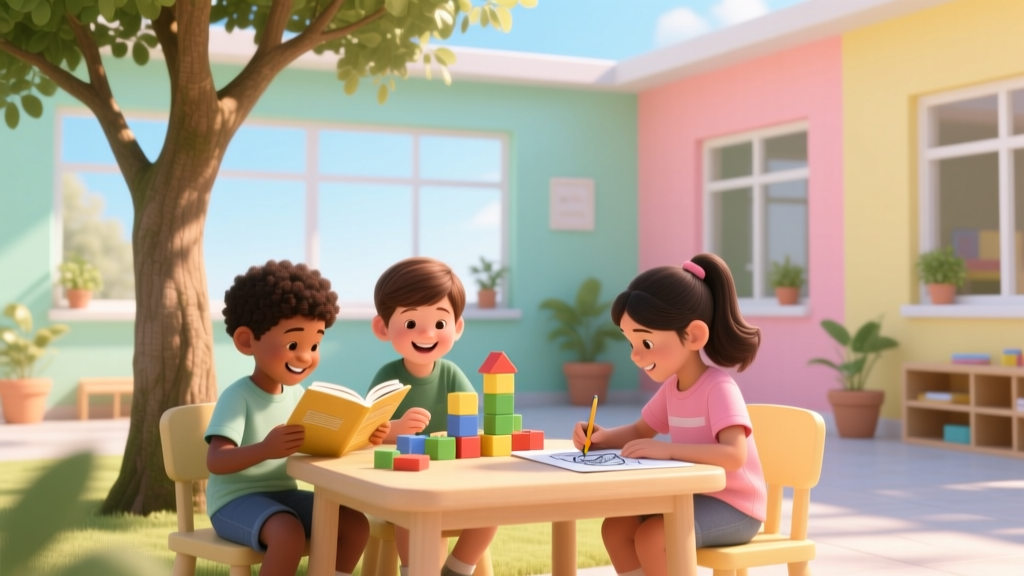
Kindergarten Readiness Skills Parents Need to Know
Why This Question Is the Most Important One You’ll Ask This Summer
If you’ve ever stared at your child’s backpack, wondering what should kids know going into kindergarten, you’re not overthinking—you’re tuning into one of the most consequential developmental inflection points of early childhood. Kindergarten isn’t just ‘school’; it’s the first formal test of a child’s ability to navigate structure, manage emotions, follow multi-step directions, and collaborate without constant adult scaffolding. And yet, national data from the National Center for Education Statistics reveals that nearly 40% of incoming kindergarteners lack foundational self-regulation skills—like waiting their turn or transitioning between activities—making them significantly more likely to experience academic frustration by December. This isn’t about pushing academics earlier. It’s about equipping children with the invisible infrastructure that lets learning take root.
Social-Emotional Readiness: The Bedrock No Curriculum Teaches Explicitly
Before a child can decode ‘cat,’ they must be able to sit beside a peer without grabbing their crayons, raise their hand instead of shouting out, and recover from disappointment—like losing a game or having their block tower knocked over—without prolonged meltdowns. According to Dr. Laura Jana, co-author of The Toddler Brain and AAP-endorsed developmental pediatrician, “Self-regulation is the single strongest predictor of kindergarten success—not letter recognition or counting to 20. A child who can name their feelings and use simple strategies (‘I need a hug’ or ‘I’ll take three breaths’) has already mastered the hardest part of the day.”
Here’s how to build it intentionally—not through drills, but through daily micro-practices:
- Label emotions in real time: Instead of “Don’t cry,” try “You feel frustrated because the puzzle piece won’t fit. That’s hard. Want to try again together?” Research from the Yale Center for Emotional Intelligence shows children whose caregivers consistently name emotions develop empathy 2.3x faster and show 31% fewer behavioral incidents in classroom settings.
- Create predictable transition cues: Use a visual timer + verbal warning (“When the sand runs out, we’ll clean up for lunch”) for 2–3 weeks before school starts. This builds neural pathways for flexibility—the brain learns to anticipate change rather than resist it.
- Practice ‘small group’ play: Host 2–3-child playdates focused on cooperative games (e.g., building a blanket fort, passing a ball in a circle) rather than parallel play. Observe and gently coach: “Maya is holding the tape. What could you say to ask for a turn?”
A real-world case study: When the Portland Public Schools piloted a 6-week summer ‘Readiness Circle’ program emphasizing emotional vocabulary and turn-taking (not letters or numbers), teachers reported 68% fewer referrals for behavior support in September—and those same students scored 15% higher on fall literacy assessments, suggesting emotional safety directly enables cognitive engagement.
Foundational Literacy & Numeracy: Beyond Flashcards and Counting Songs
Let’s dispel a myth upfront: Knowing all 26 letters *by name* is far less critical than understanding that letters make sounds—and that those sounds combine to form words. Similarly, rote counting to 100 impresses grandparents but doesn’t predict math success. What matters is number sense: the intuitive grasp that 5 is more than 3, that 7 can be broken into 4+3 or 5+2, and that adding means ‘more’ while subtracting means ‘less.’
According to the National Association for the Education of Young Children (NAEYC), the most powerful pre-literacy skill is phonological awareness—the ability to hear and manipulate sounds in spoken language. A child who can clap syllables in “butterfly” (but-ter-fly), rhyme “cat/hat/mat,” or identify the first sound in “sun” (/s/) is primed for reading—even if they can’t yet write a single letter.
Actionable strategies:
- Play with language daily: Sing nursery rhymes with exaggerated rhythm. Stretch out words slowly (“ssssuuuunnn”). Play “I Spy” with beginning sounds (“I spy something that starts with /b/”).
- Count meaningfully: Count steps while walking, crackers while setting the table, or toys while packing away. Ask “How many more do we need?” or “If I eat two grapes, how many are left?”
- Introduce print concepts organically: Run your finger under text when reading aloud. Point out environmental print (STOP sign, cereal box). Let them ‘read’ familiar books from memory—this builds story structure awareness and confidence.
Practical Independence: The Skills That Free Up Teacher Time (and Reduce Your Morning Stress)
Kindergarten teachers spend an estimated 22% of instructional time managing basic needs—not because children are incapable, but because these skills are rarely taught explicitly at home. A child who can independently zip their jacket, open a lunchbox, wipe their nose, and flush the toilet isn’t just ‘neat’—they’re reclaiming precious minutes for learning.
Here’s what top-performing kindergarten classrooms report as non-negotiable:
- Self-dressing: Mastering zippers, Velcro, and buttons (shoes included). Skip laces until first grade—opt for slip-ons or Velcro.
- Toileting independence: Wiping, flushing, handwashing with soap (20 seconds), and drying hands completely. Practice at home using a step stool and a timer app.
- Lunchtime autonomy: Opening containers, peeling fruit, using a fork/spoon, and cleaning up crumbs. Pack lunches with easy-open packaging for the first month.
Pro tip: Frame this as “big kid jobs,” not chores. Give specific praise: “You opened your yogurt all by yourself—that took focus!” Avoid rescuing too quickly. As Montessori educator and author Simone Davies notes, “Every time we do for a child what they can do for themselves, we steal a moment of competence-building.”
Developmental Readiness Checklist: Age-Appropriate Benchmarks (Not Rigid Deadlines)
Readiness isn’t binary—it’s a spectrum. Below is a research-informed, pediatrician-reviewed Age-Appropriateness Guide for core kindergarten-entry skills. Note: These are typical expectations for children turning 5 by the district’s cutoff date—not strict requirements. Delays in 1–2 areas are common and often resolve with supportive practice.
| Skill Domain | Typical Expectation by Age 5 | Red Flag Indicators (Worth Discussing with Pediatrician) | Simple Home Support Strategy |
|---|---|---|---|
| Language & Communication | Speaks in full, complex sentences (5–8 words); tells simple stories with beginning/middle/end; understands multi-step directions (e.g., “Put your shoes on, then get your backpack”) | Frequently misunderstood by unfamiliar adults; struggles to name common objects; uses mostly gestures or single words past age 4.5 | Play ‘story chain’: Take turns adding one sentence to a made-up tale (“Once there was a dragon… and he loved tacos…”) |
| Fine Motor Skills | Holds pencil with tripod grip; copies basic shapes (circle, square, cross); cuts along straight lines with scissors | Cannot hold utensils or crayons; avoids drawing/pasting; tires easily during writing/drawing | Strengthen hand muscles with playdough (roll, pinch, cut), stringing large beads, or tearing paper into strips |
| Gross Motor Coordination | Skips, hops on one foot, catches a large ball with both hands, walks up/down stairs alternating feet | Falls frequently; avoids playground equipment; walks with flat feet or unusual gait | Set up obstacle courses (crawl under chairs, jump over pillows, balance on a line of tape) |
| Attention & Focus | Plays independently for 15–20 minutes; completes simple 3-step tasks; returns to task after brief distraction | Cannot sustain attention for >3 minutes on preferred activities; constantly moves or touches everything; extremely sensitive to sounds/textures | Use visual timers + ‘focus jars’ (glitter water bottles) to teach self-calming; break tasks into micro-steps |
Frequently Asked Questions
Is it okay if my child doesn’t know all their letters before kindergarten?
Absolutely—and it’s far more common than most parents realize. According to a 2023 study published in Early Childhood Research Quarterly, only 37% of kindergarteners enter school able to name all 26 letters. What matters is exposure and curiosity—not mastery. Teachers expect to teach letter-sound relationships systematically. Focus instead on phonological awareness (rhyming, clapping syllables) and fostering a love of stories. Pushing rote memorization too early can backfire, creating anxiety around reading before formal instruction begins.
My child has separation anxiety. How can I prepare them?
Separation anxiety peaks between ages 3–5 and is developmentally normal. Start small: practice short, predictable separations (e.g., “I’ll be back after you finish this puzzle”) with consistent return. Visit the school beforehand—meet the teacher, sit in the classroom, walk the route to the door. Create a goodbye ritual (“high-five, hug, wave”) and stick to it—no sneaking away. Most importantly, validate feelings (“It’s okay to miss me. I’ll be thinking of you!”) while expressing calm confidence (“You’re going to have so much fun with your new friends!”). If anxiety persists beyond 3 weeks or causes physical symptoms (vomiting, refusal to enter school), consult your pediatrician or a child therapist.
Should I teach my child to read before kindergarten?
Not formally—and here’s why: Early, pressured reading instruction can lead to ‘word calling’ (decoding without comprehension) and burnout. The National Institute for Literacy emphasizes that the best pre-reading foundation is oral language richness: rich conversations, diverse vocabulary, storytelling, and listening to complex narratives. Children exposed to 30+ minutes of daily read-alouds (with discussion!) enter kindergarten with vocabularies 50% larger than peers—and vocabulary size is the strongest predictor of later reading comprehension. So read widely, ask open-ended questions (“What do you think will happen next?”), and let curiosity—not curriculum—drive the pace.
What if my child is advanced academically? Will they be bored?
Academic acceleration without social-emotional readiness is a recipe for frustration—not enrichment. A child who reads chapter books but can’t wait their turn or handle criticism may disengage or act out. Talk with the teacher about differentiation: enrichment within the curriculum (e.g., more complex story prompts, open-ended math challenges) rather than isolated ‘advanced work.’ Observe your child’s stamina, flexibility, and collaboration skills—not just their knowledge. As Dr. Erika Christakis, early childhood educator and Harvard lecturer, warns: “We confuse precocity with readiness. A 5-year-old’s brain is wired for play, not performance.”
Do boys and girls develop readiness skills at different rates?
Yes—on average, girls tend to develop fine motor, language, and self-regulation skills 6–12 months earlier than boys, while boys often show earlier strength in spatial reasoning and gross motor skills. However, individual variation dwarfs gender differences. The American Academy of Pediatrics cautions against using gender as a benchmark: “Focus on your child’s unique trajectory, not comparisons. A boy who struggles with handwriting at 5 may excel at building complex Lego structures—a sign of strong spatial cognition, not delay.”
Common Myths About Kindergarten Readiness
- Myth #1: “If they can’t read or count to 100, they’ll fall behind.” Reality: Kindergarten curricula are designed for zero prior knowledge. What predicts long-term success is executive function—not academic content. A child who can plan, focus, remember instructions, and adapt is far more likely to thrive than one who memorized flashcards but melts down when asked to share.
- Myth #2: “Kindergarten is like preschool—just longer hours.” Reality: Modern kindergarten is academically rigorous, with 90+ minutes of daily literacy instruction, structured math blocks, and explicit social-emotional learning. The shift is profound—and requires foundational stamina, not just familiarity with circle time.
Related Topics (Internal Link Suggestions)
- Kindergarten supply list essentials — suggested anchor text: "kindergarten supply list 2024"
- How to choose the right kindergarten program — suggested anchor text: "public vs private kindergarten comparison"
- Summer learning activities for rising kindergarteners — suggested anchor text: "fun summer kindergarten prep activities"
- Signs your child may benefit from a delayed kindergarten entry — suggested anchor text: "is my child ready for kindergarten?"
- Back-to-school anxiety in young children — suggested anchor text: "helping kids cope with first-day jitters"
Your Next Step: Download the Ready, Set, Go! Kindergarten Prep Kit
You now know the truth: kindergarten readiness isn’t about cramming facts—it’s about nurturing resilience, curiosity, and connection. You don’t need expensive programs or flashcards. You need consistency, warmth, and 10 minutes a day of intentional practice. To help you start strong, we’ve created a free, printable Ready, Set, Go! Kindergarten Prep Kit—including our pediatrician-approved checklist, 30-minute daily routine planner, emotion card deck, and a 5-day ‘Transition Challenge’ (with scripts for tough moments like drop-off). Download it now—it takes 12 seconds and changes everything. Because the goal isn’t perfection. It’s presence. And you’ve already taken the most important step: showing up, asking the right questions, and believing your child is capable. They are. And you are, too.
More Articles
 Hamilton for Kids: Age-by-Age Guide (2026)
 Why Autism Diagnoses Are Rising: 7 Evidence-Based Reasons
 What Size in Kids Is a Women’s 7? (2026 Chart)
 Pepto Bismol for Kids: Risks & Safe Dosing (2026)
 Kids in Jail for Driving Without License? (2026)
 Multiple 529 Plans for One Child: Smart or Risky?
 How Many Kids Does Bhad Bhabie Have? (2026)
 Nosebleeds in Kids: Causes, Fixes & When to Worry
 When Do Kids Start School? State Rules & Readiness Tips
 Avicii Songs for Kids: Safe Tracks & Parent Guide