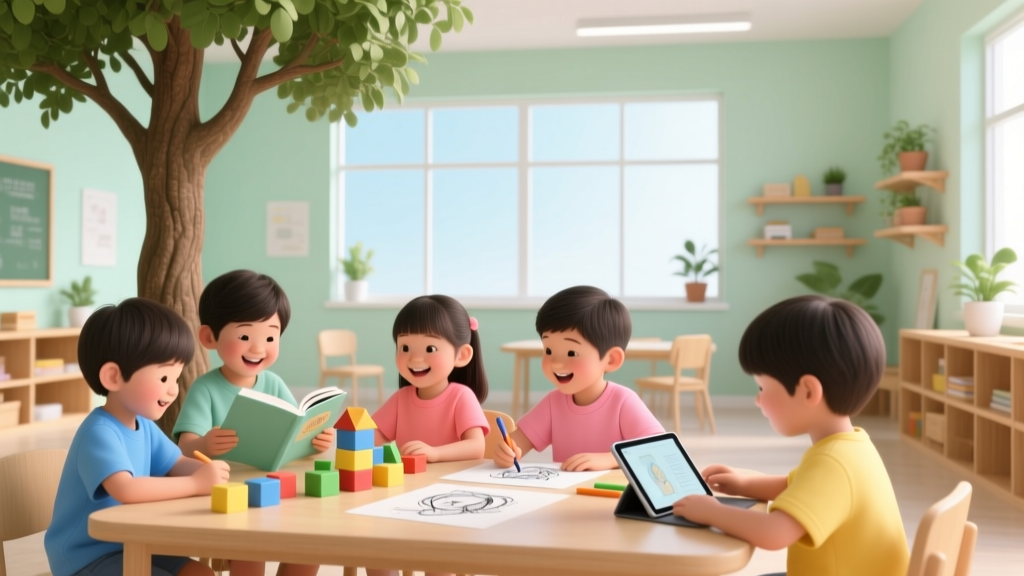
What Should Kids Know by End of Kindergarten? (2026)
Why This Question Matters More Than Ever Right Now
Every year, thousands of parents quietly wonder: what should kids know by the end of kindergarten? It’s not just about letter recognition or counting to 100—it’s about whether their child will feel confident, safe, and capable when they walk into first grade. With rising kindergarten readiness gaps (a 2023 NIEER report found 34% of U.S. kindergarteners enter below benchmark in foundational literacy), this question carries real emotional weight—and tangible consequences. Teachers aren’t expecting perfection, but they *are* expecting baseline fluency in five interconnected domains: cognitive, language, social-emotional, physical, and self-regulation. And here’s what most school handouts won’t tell you: mastery isn’t measured in worksheets—it’s revealed in how your child handles frustration during group time, negotiates turn-taking at centers, or independently opens their lunchbox. This guide cuts through vague district checklists and gives you evidence-based, classroom-tested benchmarks—plus exactly what to do if your child is behind in one (or more) areas.
Academic & Cognitive Foundations: Beyond ABCs and 123s
Kindergarten isn’t ‘preschool plus’—it’s the critical bridge between play-based learning and structured academic expectations. According to Dr. Laura Jana, pediatrician and co-author of The Toddler Brain, “Cognitive readiness isn’t about memorization; it’s about flexible thinking—the ability to sort, compare, predict, and explain.” That means knowing letter names is useful, but recognizing that ‘B’ and ‘D’ are similar yet distinct shapes—and why—signals deeper visual processing maturity.
By June, most children should demonstrate these competencies—not as isolated flashcards, but in authentic contexts:
- Literacy: Recognize all 26 uppercase and lowercase letters *and* match them to beginning sounds (e.g., ‘M’ makes /m/ like in ‘monkey’); segment 3-sound words orally (‘c-a-t’); write their first name legibly; identify rhyming words spontaneously in songs or stories.
- Math: Count 20 objects accurately (one-to-one correspondence); compare sets using ‘more,’ ‘less,’ and ‘same’; recognize and extend simple patterns (ABAB, AABAAB); identify basic 2D shapes *and* describe attributes (‘a triangle has three straight sides’).
- Science & Inquiry: Ask ‘how’ and ‘why’ questions during read-alouds or nature walks; observe and describe changes (e.g., plant growth, weather shifts); classify objects by multiple attributes (size + color, texture + shape).
A real-world case study from Chicago Public Schools’ 2022–23 Kindergarten Progress Monitoring shows that children who could orally blend sounds (e.g., ‘/c/ /a/ /t/’ → ‘cat’) by December were 3.2x more likely to meet end-of-year reading benchmarks than peers who couldn’t—highlighting phonemic awareness as the single strongest predictor of later literacy success.
Social-Emotional & Self-Regulation Skills: The Hidden Curriculum
If academic skills are the visible curriculum, social-emotional competence is the invisible architecture holding everything together. The American Academy of Pediatrics (AAP) emphasizes that kindergarten success hinges less on ‘knowing’ and more on ‘managing’: managing big feelings, managing transitions, managing peer conflict. Yet many parents focus solely on academics—missing the subtle cues that signal readiness.
Look for these observable behaviors—not just ‘being nice’:
- Can wait 2–3 minutes for a turn without tantrums or physical aggression (self-regulation)
- Uses words like ‘I feel frustrated’ or ‘I need help’ instead of shutting down or hitting (emotion vocabulary)
- Follows 2-step directions *without* repeating them back (working memory + attention)
- Plays cooperatively for 15+ minutes—sharing materials, negotiating roles, adapting rules (collaborative play)
Dr. Rebecca London, developmental psychologist at UC Santa Cruz, notes: ‘We see dramatic growth in executive function between ages 5–6—but only when adults scaffold it intentionally. A child who can’t sit still isn’t “defiant”; they may lack the neural pathways to inhibit impulses. What looks like misbehavior is often unmet developmental need.’
Try this: For one week, track your child’s ‘frustration response’ during low-stakes challenges (building a tower, tying shoes). Does frustration escalate quickly? Do they seek help—or give up? If shutdown or aggression occurs >3x/day, consult your pediatrician or school’s early intervention team. Early support (even 15 minutes/week of play-based regulation coaching) yields outsized returns.
Physical & Practical Independence: Why Motor Skills Matter More Than You Think
Here’s what few kindergarten orientation packets mention: fine and gross motor skills directly impact academic stamina. A child struggling to hold a pencil correctly spends cognitive energy on grip—not on forming letters. One who tires easily during circle time may miss key instructions. Physical readiness isn’t ‘extra’—it’s foundational.
End-of-kindergarten benchmarks include:
- Fine Motor: Cut along a line with scissors; copy basic shapes (square, triangle, X); use glue sticks without flooding paper; button/unbutton large buttons; manage zippers on jackets.
- Gross Motor: Hop on one foot for 10 seconds; balance on one foot for 8+ seconds; catch a bounced ball with hands (not body); navigate stairs without railings.
- Self-Care: Open lunch containers independently (no twist-top yogurt cups!); wipe nose/clean up spills with minimal prompting; use restroom fully (including wiping, flushing, handwashing).
Important nuance: These aren’t pass/fail tests. They’re developmental signposts. If your child struggles with scissor use but excels in storytelling and empathy, prioritize OT referral *only* if it impacts daily functioning—not because it’s ‘behind schedule.’ As occupational therapist Sarah Kim, OTR/L, explains: ‘Motor delays often co-occur with sensory processing differences. A child avoiding messy play may need tactile desensitization—not just ‘more practice.’’
What the Data Says: Milestone Benchmarks vs. Reality
While state standards vary, national consensus emerges from longitudinal studies (like the ECLS-K cohort) and AAP guidelines. Below is a research-backed snapshot of expected competencies—categorized by frequency of demonstration (‘consistently,’ ‘often,’ ‘beginning to show’)—to reflect realistic developmental variability.
| Skill Domain | Specific Competency | Expected Frequency by June | Evidence Source |
|---|---|---|---|
| Literacy | Identifies beginning sound in 8+ of 10 common words (e.g., ‘sun,’ ‘dog,’ ‘apple’) | Consistently | National Center for Education Statistics (ECLS-K, 2022) |
| Math | Solves simple addition/subtraction word problems within 10 using objects or fingers | Often | NCTM Early Childhood Position Statement (2023) |
| Social-Emotional | Resolves minor peer conflicts with adult mediation (e.g., ‘I want that block’ → ‘Can I have a turn after you?’) | Often | AAP Clinical Report on School Readiness (2021) |
| Physical | Copies a triangle and diamond shape accurately | Beginning to show | Beery-Buktenica Developmental Test of Visual-Motor Integration (6th Ed.) |
| Self-Regulation | Transitions between activities within 1 minute when given a 2-minute warning | Consistently | Center on the Social and Emotional Foundations for Early Learning (CSEFEL) |
Frequently Asked Questions
Is it normal for my child to still reverse letters (like ‘b’/‘d’ or ‘p’/‘q’) in May?
Yes—letter reversals are developmentally typical through mid-first grade. What matters more is whether your child notices and corrects them *when prompted*. Persistent reversals beyond age 7 *with* other signs (trouble rhyming, slow naming speed, family history of dyslexia) warrant evaluation. But in kindergarten? It’s part of learning visual discrimination. Focus on multisensory reinforcement: tracing letters in sand, air-writing while saying sounds, using ‘bed’ and ‘pod’ mnemonics.
My child knows all letters and sounds but refuses to write. Is that a red flag?
Not necessarily. Reluctance to write often signals fine motor fatigue, not academic delay. Try lowering the barrier: use chalkboards (less pressure), magnetic letters, voice-to-text apps for storytelling, or ‘write’ with finger paint. Observe *why*: Is the pencil uncomfortable? Does writing trigger frustration? If avoidance is paired with extreme sensitivity to textures or poor posture, consult an occupational therapist—but don’t assume it’s ‘laziness’ or ‘not trying.’
Should I teach sight words before kindergarten?
Focus on meaning over memorization. High-frequency words like ‘the,’ ‘and,’ ‘is’ matter—but only when embedded in rich language experiences. Reading aloud daily (pointing to words, asking predictive questions), playing ‘I Spy’ with environmental print (stop signs, cereal boxes), and singing repetitive songs build automaticity naturally. Rote flashcards before age 5 can backfire—creating anxiety without comprehension. As literacy researcher Dr. Susan Neuman advises: ‘Words must live in sentences, not isolation.’
What if my child meets *all* benchmarks except one area—like social skills?
That’s extremely common—and rarely a reason for retention. Kindergarten teachers expect heterogeneity. What matters is *growth trajectory*. Did your child go from needing physical prompts to join circle time in September to sitting independently by March? That progress is gold. Share specific examples with your teacher (e.g., ‘She now initiates play with two peers weekly’) rather than checklist scores. Schools have tiered supports (small-group social skills instruction, peer buddy systems) precisely for these situations.
Are private kindergarten readiness assessments worth it?
Generally, no—unless recommended by your pediatrician or school. Most commercial screenings lack validity for predicting long-term outcomes and can pathologize normal variation. The AAP strongly discourages routine standardized testing for kindergarten readiness. Instead, lean on free, evidence-based tools: the Ages & Stages Questionnaires (ASQ-3), available via your local early intervention program, or your school’s observational checklist completed *by the teacher* over time—not a one-time test.
Common Myths About Kindergarten Readiness
Myth #1: “If they can’t read by kindergarten, they’ll fall behind forever.”
Reality: Only ~2% of kindergarteners read fluently. The National Institute of Child Health and Human Development confirms that formal reading instruction begins *in* kindergarten—and most children achieve decoding proficiency by late first grade. Early readers often plateau; late bloomers frequently surge ahead with strong comprehension foundations.
Myth #2: “More academics = better preparation.”
Reality: Play-based curricula (like Tools of the Mind or HighScope) consistently outperform academically accelerated programs on long-term measures of executive function, creativity, and social adjustment. As Dr. Darcia Narvaez, developmental psychologist, states: ‘Play is the brain’s highest form of learning—it builds neural pathways no worksheet ever could.’
Related Topics (Internal Link Suggestions)
- Signs Your Child May Need Extra Support Before Kindergarten — suggested anchor text: "early signs of learning differences in preschoolers"
- How to Build Executive Function at Home (Without Worksheets) — suggested anchor text: "play-based executive function activities"
- Kindergarten Supply Lists: What’s Actually Essential (and What’s Just Marketing) — suggested anchor text: "kindergarten supplies that boost independence"
- When to Delay Kindergarten: A Pediatrician’s Balanced Guide — suggested anchor text: "redshirting kindergarten pros and cons"
- Montessori vs. Traditional Kindergarten: What Research Says — suggested anchor text: "evidence-based kindergarten approaches"
Conclusion & Your Next Step
So—what should kids know by the end of kindergarten? Not a rigid list of facts, but a living set of capacities: the ability to listen, persist, connect, create, and care—for themselves and others. These skills don’t bloom from drills; they grow through responsive relationships, predictable routines, and joyful, purposeful play. If you’ve read this far, you’re already doing the most important work: showing up with curiosity and compassion.
Your next step? Pick *one* skill from the table above where your child shows emerging interest—even if inconsistently—and lean into it for 5 minutes daily this week. Notice how they engage. Celebrate effort, not perfection. Then, share your observation with their teacher—not as a report, but as a partnership: ‘We’ve been practicing listening for rhymes during car rides—she caught ‘cat’ and ‘hat’ yesterday!’ That tiny act bridges home and school in the most powerful way. Because readiness isn’t a finish line—it’s the steady, loving rhythm of showing up, again and again.
More Articles
 Coffee for Kids: Pediatrician Advice on Caffeine (2026)
 Is Kars for Kids a Jewish Charity? Truth Revealed
 Daycare for Kids: What 12 Years of Research Reveals
 Biggie’s Kids: Verified Facts for Parents (2026)
 What Does 67 Mean to Kids? (2026)
 How to Respond to “Did Trump Eat Kids?” (2026)
 Why Claire Was Recast on My Wife and Kids | 2026
 How Old Are Belichick’s Kids? A Respectful Look (2026)
 Out-of-State Travel with Kids: What Parents Must Know
 Melatonin for Kids: Dosage, Safety & Safer Alternatives