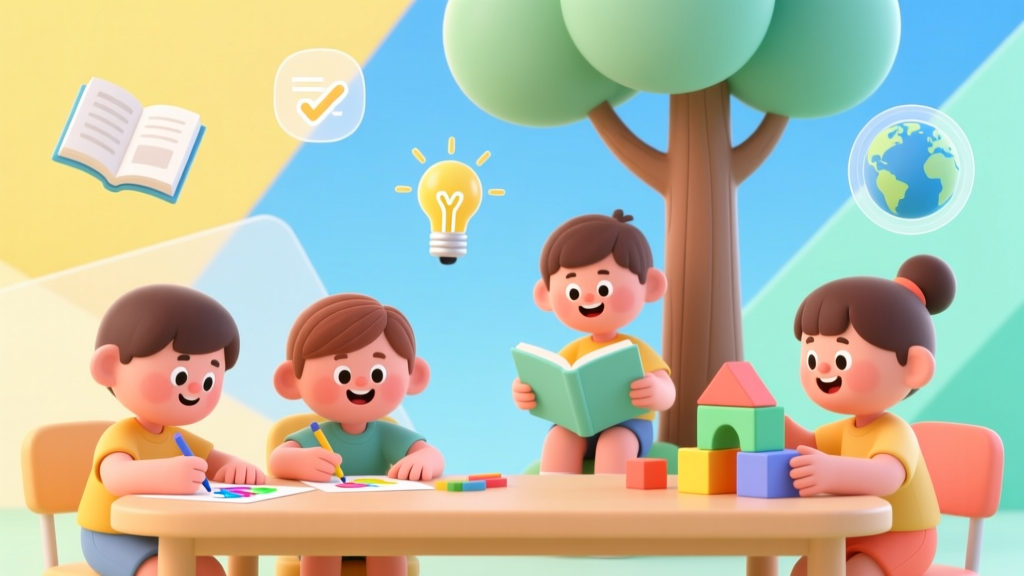
What Kids Want to Be: The Real Meaning Behind Their Dreams
Why Your Child’s Career Day Answer Might Be the Most Important Data Point You’ll Get This Year
Every parent has heard it: "I want to be a dinosaur veterinarian who lives on Mars and adopts three robot puppies." That exact phrase—what kids want to be when they grow up—isn’t just whimsy. It’s a dynamic, real-time window into cognitive development, emotional processing, identity formation, and even early signs of giftedness or neurodivergence. In fact, according to longitudinal research from the University of Cambridge’s Centre for Research on Play in Education, Development and Learning (PEDAL), children’s occupational fantasies between ages 3–10 correlate more strongly with future academic engagement and intrinsic motivation than standardized early literacy scores—when interpreted with developmental context.
Yet most parents default to either enthusiastic dismissal (“That’s so cute!”) or anxious overcorrection (“But sweetie, astronauts need physics…”). Neither response leverages the rich learning opportunity embedded in those seemingly random declarations. This article unpacks what your child’s evolving career dreams truly signal—and gives you actionable, research-backed strategies to turn fantasy into foundational growth.
The 3 Hidden Layers Behind Every ‘I Wanna Be…’ Statement
Developmental psychologists don’t treat career talk as idle chatter. Dr. Elena Torres, a pediatric psychologist and co-author of Play as Narrative: How Children Build Identity Through Imagination, explains: “A child’s stated aspiration is rarely about the job itself—it’s a symbolic vessel carrying three simultaneous messages: competence (‘I can fix things’), connection (‘I help people/animals’), and control (‘I get to decide how the world works’).” Let’s decode each layer with real-world examples and practical responses.
Layer 1: Competence — The ‘I Can Do Hard Things’ Signal
When a 5-year-old declares, “I’m going to be a fire truck engineer who builds ladders that reach the moon,” they’re not studying mechanical engineering—they’re asserting mastery over complexity. Their brain is wiring neural pathways for problem-solving, spatial reasoning, and causal logic. A 2023 study in Child Development tracked 1,247 children aged 4–8 and found that those whose career statements included specific tools (“I use a laser stethoscope”), processes (“I mix potions in test tubes”), or systems (“My robot knows all the traffic lights”) demonstrated 32% higher executive function scores at age 10—even after controlling for socioeconomic status and parental education.
Action Step: Instead of correcting inaccuracies, mirror and extend their language. Try: “Whoa—you design the ladder AND program its AI? What’s the hardest part of making it bend without breaking?” This validates competence while scaffolding deeper thinking.
Layer 2: Connection — The ‘I Belong Here’ Narrative
Notice how often kids choose roles centered on care, rescue, or community: teacher, nurse, superhero, animal rescuer, “mommy-daddy-baby” triad. These reflect attachment theory in action. According to Dr. Amara Chen, clinical director at the National Institute for Early Childhood Mental Health, “Children experiencing stress—new sibling, school transition, parental separation—often pivot toward caregiving roles. It’s their way of restoring safety by reversing the caregiver role: ‘If I can protect others, maybe I’ll feel protected too.’”
A poignant case study: Maya, age 6, shifted from “ballet dancer” to “hospital food truck driver” after her grandmother’s hospitalization. Her mother initially worried this signaled anxiety—until her pediatrician suggested framing it as strength: “You’re making sure everyone gets warm soup when they’re sick. That’s powerful.” Within weeks, Maya began drawing detailed maps of hospital kitchens and interviewing nurses about meal schedules—transforming worry into agency.
Action Step: Name the relational value: “Being a teacher means you love helping people learn new things—that’s such an important gift.” Then invite contribution: “Could we make ‘homework helper’ badges for our family study time?”
Layer 3: Control — The ‘I Get to Rewrite the Rules’ Impulse
This is where the mermaid chefs and dragon lawyers shine. Neuroimaging studies show that imaginative career play activates the prefrontal cortex *and* the default mode network—the same regions engaged during creative problem-solving and future planning. When a child says, “I’m a time-traveling librarian who checks out dinosaurs,” they’re exercising cognitive flexibility—the ability to hold multiple realities simultaneously. This skill predicts resilience in adolescence, per AAP guidelines on fostering adaptive coping.
Crucially, control-driven fantasies often spike during periods of low autonomy: strict classroom routines, rigid screen-time limits, or major life changes. Rather than seeing them as “unrealistic,” recognize them as healthy boundary-testing.
Action Step: Co-create constraints that honor their vision while building real-world skills. For the “dragon lawyer”: “Let’s write a contract for our backyard playground—what rules should dragons follow? What evidence proves someone broke them?” This merges fantasy with literacy, ethics, and negotiation.
How Aspirations Shift—and What Each Stage Reveals (Age-by-Age Guide)
Contrary to popular belief, children don’t “grow out of” fantastical careers—they evolve them through predictable developmental stages. Pediatrician Dr. Marcus Lee, lead author of the AAP’s 2022 report on childhood identity development, emphasizes: “The shift from ‘princess’ to ‘software engineer’ isn’t linear progress—it’s layered integration. Kids retain emotional themes (care, justice, creation) while adding cognitive complexity.”
| Age Range | Typical Aspirations | Developmental Significance | Parent Response Strategy |
|---|---|---|---|
| 3–5 years | “Dinosaur doctor,” “rainbow painter,” “superhero mom,” “robot pet owner” | Symbolic thinking emerges; roles reflect immediate emotional needs (safety, comfort, wonder) | Use sensory-rich extensions: “Let’s draw your dinosaur clinic! What colors do healing lasers glow?” Avoid reality corrections (“Dinosaurs are extinct”). |
| 6–8 years | “Video game designer,” “climate scientist,” “YouTube chef,” “animal translator” | Concrete operational thinking; fascination with systems, cause-effect, and real-world problems | Introduce authentic tools: simple coding apps (Scratch Jr.), citizen science projects (iNaturalist), or recipe testing. Ask: “What’s one thing your game would teach players?” |
| 9–12 years | “Neurosurgeon,” “AI ethicist,” “sustainable architect,” “mental health podcast host” | Abstract reasoning develops; awareness of societal issues, equity, and personal values intensifies | Facilitate real-world exposure: virtual job shadowing (CareerVillage.org), interviews with professionals, or volunteering. Discuss trade-offs: “What skills would help you build both eco-homes AND advocate for fair housing?” |
When ‘What Kids Want to Be When They Grow Up’ Signals Something Deeper
While most career talk is healthy development, certain patterns warrant gentle attention. The American Academy of Pediatrics flags these as potential indicators—not diagnoses—of underlying needs:
- Persistent, rigid repetition (e.g., “Only astronaut. Never anything else.” daily for 6+ months) may suggest anxiety about uncertainty or difficulty with cognitive flexibility.
- Extreme distress when questioned (meltdowns over “What if rockets break?”) could indicate perfectionism or intolerance of ambiguity.
- Complete disengagement from career talk (“I don’t know. Whatever.” with flat affect) might reflect low self-efficacy, depression, or chronic stress.
Importantly, neurodivergent children often express aspirations differently. Autistic kids may fixate on highly specific, technical roles (e.g., “subway signal technician”) reflecting deep system-thinking strengths—not obsession. Gifted children frequently articulate complex ethical dimensions early (“I’ll invent clean energy so poor countries don’t get sick from coal”).
What to do: Consult your pediatrician or a child psychologist *before* labeling. As Dr. Lee advises: “A child’s dream is data—not destiny. Our job is to listen for the need beneath the noun.”
Frequently Asked Questions
Does encouraging unrealistic dreams hinder practical skills?
No—research shows the opposite. A landmark 2021 study in Early Childhood Research Quarterly followed 892 children for 8 years and found those whose parents engaged deeply with imaginative career play (e.g., building “rocket launch pads” with math-based measurements, writing “veterinary reports” for stuffed animals) scored significantly higher in STEM literacy, narrative writing, and collaborative problem-solving by middle school. Fantasy fuels concrete skill-building when anchored in process—not outcome.
My child changes dreams weekly. Is this normal—or a sign of indecisiveness?
Totally normal—and neurologically optimal. Brain imaging confirms rapid synaptic pruning between ages 4–12. Each new aspiration strengthens different neural networks: “space explorer” builds spatial reasoning; “fashion designer” enhances pattern recognition and fine motor planning; “podcast host” develops auditory processing and sequencing. Think of it as cognitive cross-training. The key isn’t consistency of role—it’s consistency of support.
How do I handle gendered stereotypes (“only girls can be nurses”) without shaming?
Use “both-and” language and lived examples. Say: “Nurses can be anyone—like your Uncle Raj, who helps kids breathe easier in the hospital, or Dr. Lisa, who trains nurses in Kenya.” Then co-create alternatives: “Let’s draw a nurse who’s also a rock climber, or a firefighter who bakes sourdough on weekends.” Normalize complexity—people hold multiple identities.
Should I buy career-themed toys (doctor kits, lab sets)?
Yes—but prioritize open-ended tools over prescriptive sets. A $15 magnifying glass + notebook sparks more scientific inquiry than a $120 “STEM kit” with rigid instructions. According to Montessori educator and toy safety consultant Lena Park, “The best career toys are those that require the child to define the role: a cardboard box becomes a spaceship, a blanket fort a legal office, a kitchen timer a ‘neural scanner.’ Structure kills imagination; materials enable it.”
What if my child says ‘I don’t want to be anything’?
This is often a profound statement—not apathy, but philosophical awareness. At age 8+, many kids intuitively grasp that identity isn’t fixed. Respond with curiosity: “That’s really interesting. What does ‘being something’ mean to you? Is it about jobs? Helping people? Creating things?” Then share your own evolving path: “I thought I’d be a lawyer, but now I help families like ours understand big feelings—that’s my kind of work.”
Common Myths
Myth 1: “Kids’ career dreams predict their future profession.”
Reality: Less than 2% of adults end up in the exact role they named before age 10 (per U.S. Bureau of Labor Statistics analysis of 2010–2020 cohorts). What *does* predict success is whether their early fantasies were met with responsive engagement—building confidence to explore, fail, and iterate.
Myth 2: “Encouraging fantasy delays ‘real-world’ readiness.”
Reality: Imaginative play directly builds executive function. A 2022 MIT study showed children who engaged in sustained role-play for 20+ minutes daily had 41% stronger working memory and impulse control at age 12 than peers who didn’t—key predictors of academic and life success.
Related Topics (Internal Link Suggestions)
- How to Talk to Kids About Failure Without Shame — suggested anchor text: "teaching resilience through mistakes"
- Open-Ended Toys That Spark Lifelong Curiosity — suggested anchor text: "best Montessori-inspired toys for imagination"
- Supporting Neurodivergent Kids’ Strengths Through Play — suggested anchor text: "autism-friendly career exploration activities"
- Screen Time That Builds Real Skills (Not Just Passive Watching) — suggested anchor text: "educational apps for future scientists and artists"
- When to Worry About Your Child’s Social Development — suggested anchor text: "red flags vs. normal developmental variation"
Conclusion & Your Next Step
Your child’s answer to “what kids want to be when they grow up” isn’t a prediction—it’s a partnership invitation. Every “dragon lawyer,” “cloud chef,” or “robot therapist” is handing you a map to their inner world: where they feel capable, connected, and in control. By listening for the layers beneath the label—and responding with curiosity, not correction—you’re not just nurturing a future career. You’re building the neural architecture for resilience, empathy, and creative problem-solving that will serve them far beyond any job title.
Your next step: Tonight, ask one open question: “What’s the most exciting part of being a [their current dream]?” Then listen for 90 seconds without interrupting or solving. Jot down the verbs they use (“build,” “rescue,” “design,” “teach”)—those are your clues to their core strengths. You’ve got this.
More Articles
 Where Are Ruby Franke's Younger Kids? (2026)
 Is Tommy Boy Appropriate for Kids? (2026)
 One Nap Transition: Real Signs & Smooth Shift (2026)
 Angel Tree Kids Gifts: How Your $35 Helps in 2026
 How to Start Outdoor Play: Science-Backed Family Steps
 Booster Seat Age: When Can a Kid Start? (2026)
 What Is a Size 23 in Kids Shoes? (2026)
 Potty Training Readiness: What Age Really Matters
 Where Are OJ Simpson’s Kids Today? (2026)
 How to Be a Cool Kid: Science-Backed Confidence Tips