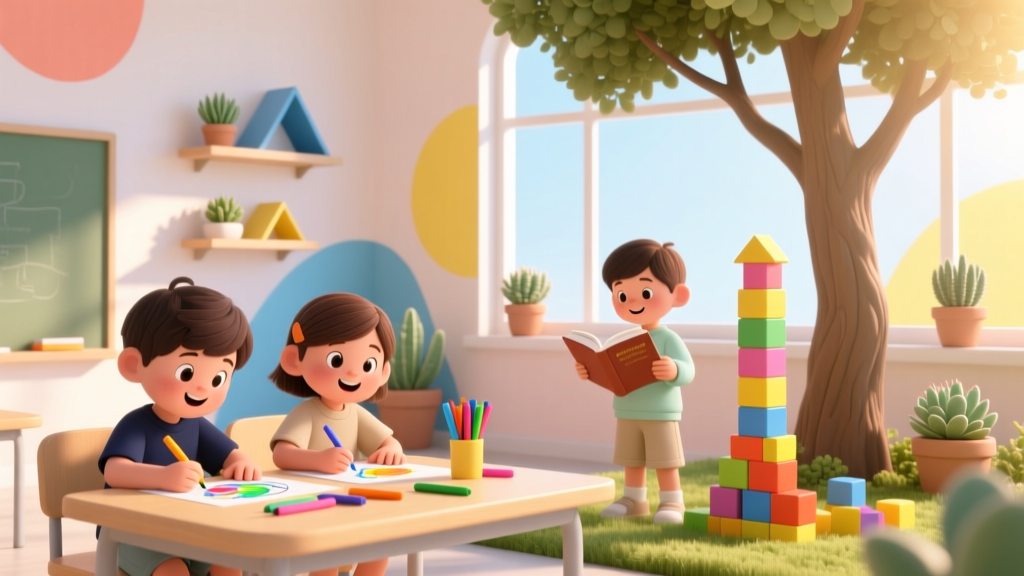
What Is Dyslexia for Kids? Truths, Signs & Strategies
Why Understanding 'What Is Dyslexia for Kids' Changes Everything — Starting Today
If you’ve ever wondered what is dyslexia for kids, you’re not searching for a textbook definition — you’re holding your breath after watching your bright, curious child struggle to sound out 'cat,' reverse letters on homework, or avoid reading aloud at school. You might feel confused, guilty, or even frustrated — especially when others say, 'They’ll catch up' or 'Just practice more.' But here’s the truth: dyslexia isn’t a sign of low intelligence, laziness, or poor parenting. It’s a neurobiological difference in how the brain processes language — and recognizing it early doesn’t just help your child read better. It protects their self-esteem, prevents years of academic erosion, and unlocks their unique strengths in problem-solving, creativity, and big-picture thinking. In fact, according to the International Dyslexia Association, 1 in 5 children has dyslexia — yet fewer than 30% are identified before third grade, when critical reading pathways solidify. That delay isn’t just about spelling; it’s about confidence, belonging, and future opportunity.
What Dyslexia Really Is (and What It Absolutely Isn’t)
Dyslexia is a specific learning difference rooted in differences in the left temporoparietal region of the brain — the area responsible for phonological processing (breaking words into sounds) and rapid automatized naming (quickly retrieving letter and word names). Neuroimaging studies consistently show reduced activation and connectivity in this network during reading tasks, even in highly intelligent individuals. Importantly, dyslexia is not a vision problem (so eye exercises won’t fix it), not a result of low IQ (many dyslexic thinkers score in the gifted range), and not caused by poor teaching — though ineffective instruction can worsen its impact. Dr. Sally Shaywitz, co-director of the Yale Center for Dyslexia & Creativity and author of Overcoming Dyslexia, emphasizes: 'Dyslexia is not a disease to be cured — it’s a different way of thinking that comes with both challenges and extraordinary cognitive advantages.'
Children with dyslexia often demonstrate exceptional abilities in areas like spatial reasoning, narrative reasoning, conceptualization, and hands-on innovation. Think of famous dyslexic minds: Albert Einstein, Whoopi Goldberg, Richard Branson, and Dr. Maggie Aderin-Pocock (space scientist and BBC presenter). Their success wasn’t despite dyslexia — it was often fueled by the very neural wiring that made reading harder. The goal isn’t to ‘fix’ their brain — it’s to equip them with tools, accommodations, and self-knowledge so their brilliance isn’t buried under shame or fatigue.
Spotting the Signs: Age-by-Age Red Flags (Not Just 'Letter Reversals')
Many parents wait for obvious letter reversals ('b' vs. 'd') — but those are common in typical development until age 7. Real red flags appear earlier and cluster across domains. Here’s what pediatric neurologists and reading specialists urge parents to watch for — especially when multiple signs occur together:
- Ages 3–5: Difficulty rhyming (e.g., can’t generate words that rhyme with 'cat'), trouble learning nursery rhymes or song lyrics, slow to learn letter names and sounds, inconsistent recall of familiar words (e.g., calls 'dog' 'gog' one day, 'dawg' the next), avoids pretend reading or scribbling stories.
- Ages 6–7 (Grades 1–2): Very slow, effortful decoding (sounding out every word, even 'the' or 'and'), frequent guessing based on pictures or first letters only, omitting small function words ('a', 'the', 'and'), confusing similar-looking words ('was'/'saw', 'left'/'felt'), poor spelling that doesn’t improve with practice, reluctance to read aloud — often accompanied by physical signs like rubbing eyes, fidgeting, or saying 'I’m tired' or 'My head hurts.'
- Ages 8–10 (Grades 3–4): Avoidance of reading for pleasure, declining comprehension despite good oral vocabulary, difficulty summarizing what was read, poor handwriting or inconsistent spacing, trouble following multi-step oral directions, slow written output (even with strong ideas), anxiety around timed tests or spelling quizzes.
Crucially, these signs persist despite adequate instruction, motivation, and hearing/vision health. As Dr. Nadine Gaab, a Harvard neuroscientist studying reading development, explains: 'Dyslexia isn’t about effort — it’s about inefficient neural circuitry for phonological mapping. When we intervene early with structured literacy, we literally strengthen those pathways.'
What Actually Works: Evidence-Based Strategies That Build Real Skills (Not Just Accommodations)
Too many well-meaning parents invest in apps, colored overlays, or 'brain training' games — only to see little progress. The gold standard, backed by decades of research and endorsed by the National Institute of Child Health and Human Development (NICHD), is structured literacy: explicit, systematic, cumulative, diagnostic, and multisensory instruction. This means teaching phonemic awareness, phonics, fluency, vocabulary, and comprehension — in that order — using methods like Orton-Gillingham, Wilson Reading System, or Lindamood-Bell LiPS.
But you don’t need a certified tutor to start supporting your child today. Here’s how to reinforce key skills at home — with zero pressure and maximum engagement:
- Phonemic Awareness Play (5 mins/day): Clap syllables in names or favorite foods ('el-e-phant', 'straw-ber-ry'). Play 'sound swap': 'Change the /c/ in 'cat' to /b/' → 'bat'. Use magnetic letters to isolate beginning/middle/ending sounds. No worksheets — just playful, rhythmic, auditory fun.
- Decoding Practice with 'Controlled Text': Use decodable books (not leveled readers!) where >95% of words follow taught phonics patterns. Read aloud together — you model fluent reading, then have your child reread the same page. Celebrate accuracy, not speed.
- Build Vocabulary Through Meaning, Not Memorization: Choose 1–2 new words from a book or conversation. Draw them, act them out, find real-life examples ('What’s something 'fragile' in our kitchen?'). Connect to prior knowledge ('How is 'fracture' like 'fragile'?).
- Oral Language First: Before writing, have your child tell you the story. Record it. Transcribe it. Then edit *together*. This separates the cognitive load of generating ideas from the motor/orthographic demands of writing.
And yes — accommodations matter too. Audiobooks (Learning Ally, Bookshare), speech-to-text tools (Dragon, Google Docs Voice Typing), extended time, and quiet testing spaces aren’t 'cheating.' They’re equalizers. As Dr. Kelli Sandman-Hurley, co-founder of the Triton Literacy Group, states: 'Accommodations remove barriers so the student’s knowledge and thinking can shine — they don’t change the learning target.'
Supporting the Whole Child: Confidence, Connection, and Strengths-Based Parenting
Academic support is essential — but it’s only half the equation. Children with dyslexia are 3x more likely to experience anxiety and depression (per a 2023 JAMA Pediatrics study), largely due to chronic feelings of inadequacy in school settings that prioritize speed and conformity over depth and creativity. Your role as a parent extends far beyond flashcards and IEP meetings.
Start with language. Replace 'He’s struggling' with 'His brain learns differently — and he’s working incredibly hard.' Swap 'She needs to try harder' with 'Let’s figure out what tool or strategy helps her access this idea.' Name strengths explicitly: 'You noticed that pattern in the Lego instructions — that’s incredible spatial reasoning!' or 'You told that whole story without notes — your memory for narratives is amazing.'
Create 'dyslexia-positive' routines: designate a 'strengths shelf' with books about dyslexic role models (like The Girl Who Thought in Pictures about Temple Grandin), keep art supplies accessible (many dyslexic kids think visually), and normalize assistive tech — let them see you use voice notes or captions too. Most powerfully: share your own learning challenges. Did you hate math? Get lost in long instructions? Struggle with names? Modeling vulnerability builds trust and dismantles shame.
One parent, Maya R. (whose son Leo was diagnosed at 7), shared: 'We started a 'Superpower Journal' — every Friday, Leo writes or draws one thing he did well that week that used his dyslexic brain: 'I built the tallest tower,' 'I figured out how the tablet broke,' 'I remembered all the Pokémon types.' It’s not about ignoring the hard stuff — it’s about refusing to let it be the only story.'
| Age Range | Key Developmental Milestones Linked to Dyslexia Support | Parent Action Step | Why It Matters |
|---|---|---|---|
| 3–5 years | Emerging phonological awareness, oral language growth, curiosity about symbols | Play rhyming games daily; point out letters in environmental print (stop signs, cereal boxes); narrate routines with rich vocabulary | Early phonological skills predict later reading success more strongly than IQ or socioeconomic status (National Reading Panel, 2000) |
| 6–8 years | Foundational decoding, spelling development, emerging self-concept as a learner | Request a school-based screening if concerns persist; begin structured literacy tutoring (2–3x/week); co-create a 'reading buddy' routine (you read, they listen + discuss) | Intervention before Grade 3 yields 85–90% of students reaching grade-level reading (Florida Center for Reading Research) |
| 9–12 years | Fluency development, comprehension strategies, metacognition, identity formation | Teach self-advocacy scripts ('I learn best when...'); introduce assistive tech; connect with dyslexic mentors or peer groups (e.g., Decoding Dyslexia chapters) | Students who understand their learning profile show higher academic self-efficacy and persistence (International Dyslexia Association, 2022) |
| 13+ years | Executive function growth, long-term goal setting, college/career exploration | Collaborate on accommodations plans (504/IEP); explore career paths leveraging dyslexic strengths (engineering, design, entrepreneurship, coding, law); celebrate neurodiversity in family conversations | 73% of dyslexic adults report their biggest advantage is 'seeing the big picture' and 'creative problem solving' (Dyslexia Foundation Global Survey, 2021) |
Frequently Asked Questions
Is dyslexia just about reading — or does it affect other subjects too?
Dyslexia primarily impacts reading and spelling, but its ripple effects touch many areas. Weak phonological processing makes learning foreign languages challenging. Poor working memory can make multi-step math problems difficult. Slow processing speed may lead to falling behind during lectures or timed tests. However, dyslexia does not affect intelligence, logic, or creativity — and many dyslexic students excel in science labs, art studios, debate clubs, and coding bootcamps where hands-on, conceptual, or visual thinking is valued.
Can dyslexia be 'cured' with enough practice or special diets?
No — dyslexia is a lifelong neurobiological difference, not a disease or deficiency. There is no scientific evidence that special diets, vision therapy, balance exercises, or 'brain training' apps remediate core phonological deficits. What does change with targeted intervention is the brain's efficiency: fMRI studies show increased activation in key reading networks after structured literacy instruction. Think of it like building a stronger bridge, not removing the river.
My child is bright — could they still have dyslexia?
Absolutely — and this is critically important. Dyslexia occurs across the full IQ spectrum. Many gifted children with dyslexia go undiagnosed because their verbal reasoning or problem-solving masks reading struggles — until middle school, when reading demands explode. These 'twice-exceptional' (2e) learners often experience intense frustration and anxiety because they know they’re smart but can’t prove it on paper. Early identification prevents years of unnecessary self-doubt.
How do I talk to my child’s teacher without sounding accusatory or demanding?
Start with collaboration: 'I’ve noticed [specific observation, e.g., “Leo spends 45 minutes on a 10-minute spelling assignment”] and I’d love to partner with you to support him. Are there screening tools the school uses? Could we look at his work samples together?’ Bring data (samples, timing logs, observations) — not assumptions. Focus on solutions: 'What strategies have worked for other students with similar profiles?' Remember: most teachers want to help but lack training in structured literacy. Offer resources (like IDA’s free webinars) rather than directives.
Is dyslexia hereditary — should I get evaluated too?
Yes — dyslexia is highly genetic, with up to 40–60% heritability. If a parent or sibling has dyslexia, a child’s risk increases significantly. Many adults discover their own dyslexia while advocating for their child — and gain profound relief and insight. Adult evaluation (through psychologists or learning specialists) can unlock workplace accommodations and deepen self-understanding. It’s never too late to reframe your own story.
Common Myths About Dyslexia — Debunked
- Myth #1: 'Dyslexic people see letters backwards.'
Reality: Dyslexia is not a visual perception disorder. Letter reversals occur due to underdeveloped phoneme-grapheme mapping and directionality concepts — not because they ‘see’ b/d backwards. Even adults with dyslexia don’t perceive text backward; they struggle to quickly and accurately retrieve sound-symbol connections.
- Myth #2: 'If they just tried harder, they’d catch up.'
Reality: Effort alone cannot rewire inefficient neural pathways. A child with dyslexia expends 3–5x more cognitive energy on decoding than a neurotypical peer — leading to exhaustion, avoidance, and diminished working memory for comprehension. What they need isn’t more effort — it’s the right kind of instruction and support.
Related Topics (Internal Link Suggestions)
- Signs of dyslexia in preschoolers — suggested anchor text: "early dyslexia signs before kindergarten"
- Best structured literacy programs for kids — suggested anchor text: "Orton-Gillingham vs. Wilson Reading System"
- How to get a dyslexia evaluation for your child — suggested anchor text: "school-based vs. private dyslexia assessment"
- Dyslexia-friendly classroom accommodations — suggested anchor text: "504 plan accommodations for reading difficulties"
- Books about dyslexia for kids — suggested anchor text: "children's books that celebrate neurodiversity"
Your Next Step Starts With One Small, Powerful Question
You now know what is dyslexia for kids — not as a deficit, but as a distinct, well-researched learning profile with both challenges and remarkable strengths. You’ve seen the signs, understood the science, and learned practical, evidence-backed ways to respond. So what’s your very next move? Don’t wait for 'more proof' or 'perfect timing.' Pick one action from this article — whether it’s playing a rhyming game tonight, emailing your child’s teacher with a collaborative question, or downloading a free decodable book sample — and do it within the next 24 hours. Early, consistent, strengths-affirming support changes trajectories. And you — armed with knowledge, compassion, and clarity — are the most powerful advocate your child will ever have.
More Articles
 Roofman for Kids: Safety & Developmental Checks (2026)
 Supporting Transgender Kids: Evidence-Based Parent Guide
 Why Do Kids Have Autism? Science-Based Answers
 What Age Do Kids Learn To Tie Their Shoes (2026)
 What Size Is 6.5 Kids in Women’s? (2026 Conversion Chart)
 Should Kids Get Paid For Doing Chores At Home (2026)
 What Size Is Big Kid 6 in Women’s? (2026)
 How to Homeschool Your Kid with NitkaEdu (2026)
 Does Tim Robinson Have Kids? The Truth (2026)
 Kids in Tattoo Shops: Rules, Risks & Safe Alternatives