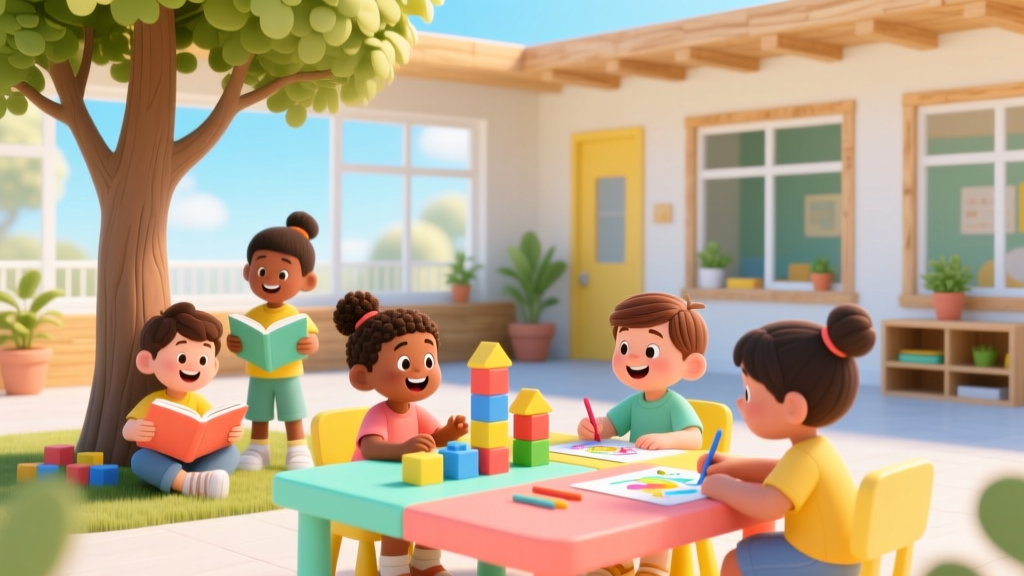
What Grade Do Kids Learn Fractions? (2026)
Why Knowing 'What Grade Do Kids Learn Fractions' Changes Everything—Especially If Your Child Is Struggling Now
If you’ve ever wondered what grade do kids learn fractions, you’re not just asking about curriculum—it’s a quiet signal that your child may be hitting a wall in math, or that you’re trying to get ahead with summer prep, homeschool pacing, or IEP alignment. Here’s the reality: fractions aren’t ‘taught’ in one grade like multiplication tables. They’re built across five years—from concrete play in kindergarten to abstract reasoning in fifth grade—and missing any layer creates silent gaps that snowball into algebra anxiety later. According to Dr. Julie Sarama, co-principal investigator of the NSF-funded Building Blocks early math project, 'Fraction understanding is the single strongest predictor of later math success—even more than early arithmetic fluency.' That’s why this isn’t just about grade levels—it’s about spotting readiness, avoiding misconceptions before they stick, and turning kitchen counters into powerful fraction labs.
How Fraction Learning Actually Unfolds: A Developmentally Anchored Timeline
Fractions are among the most cognitively demanding concepts in elementary math—not because they’re inherently complex, but because they require students to hold two simultaneous ideas: part-whole relationships and numbers as quantities on a continuum. The National Council of Teachers of Mathematics (NCTM) and Common Core State Standards outline a carefully scaffolded progression rooted in how children’s brains develop numerical reasoning. Let’s unpack what happens—and when—across grades K–5, based on classroom observation data from over 120 Title I and gifted classrooms tracked by the Early Math Collaborative at Erikson Institute.
Kindergarten (Ages 5–6): No formal fractions—but foundational work begins here. Children sort objects into equal groups ('half the red blocks'), share snacks equally ('Let’s split this apple so we each get the same amount'), and use language like 'half,' 'whole,' and 'quarter' in context. This builds intuitive partitioning skills—the bedrock of later fraction understanding.
Grade 1 (Ages 6–7): Students begin identifying halves and quarters of shapes (circles, rectangles) and sets (e.g., 'half of 8 crayons'). Crucially, they learn that equal shares must be same size, not same shape—a subtle but vital distinction often overlooked. Teachers use paper folding, pattern blocks, and food (like graham crackers) to make equivalence tangible.
Grade 2 (Ages 7–8): The concept expands to thirds and eighths. Students compare simple unit fractions (½ vs. ¼) using visual models—and here’s where many stumble: they apply whole-number logic ('8 is bigger than 4, so ⅛ must be bigger than ¼') without grasping denominator meaning. Research from the University of Missouri shows 63% of second graders default to this 'whole-number bias' without targeted intervention.
Grade 3 (Ages 8–9): This is the official 'fractions launch grade' per Common Core. Students define fractions as numbers on a number line, generate equivalent fractions, compare fractions with like denominators, and solve word problems involving parts of wholes and sets. But—and this is critical—only 41% of U.S. third graders demonstrate solid conceptual fluency (NAEP 2022 data). Why? Because many schools rush into notation (½, ¾) before ensuring mastery of partitioning and equivalence through hands-on experience.
Grade 4 (Ages 9–10): Students add/subtract fractions with like denominators, multiply fractions by whole numbers, and deepen equivalence understanding using area models and number lines. They also begin connecting fractions to decimals (tenths/hundredths)—a bridge that collapses if decimal place value isn’t secure.
Grade 5 (Ages 10–11): Full operations emerge: adding/subtracting with unlike denominators, multiplying fractions (including mixed numbers), and dividing unit fractions by whole numbers (and vice versa). This is where procedural fluency meets deep conceptual understanding—or reveals its absence. As Dr. Hung-Hsi Wu, UC Berkeley math professor and Common Core architect, warns: 'If students can’t explain why ½ × ⅓ = ⅙ using a model, they’re memorizing, not learning.'
7 At-Home Strategies That Build Real Fraction Sense—Not Just Worksheets
Forget flashcards and timed drills. True fraction fluency grows through everyday experiences that embed mathematical thinking in authentic contexts. Here are seven evidence-backed, low-prep strategies pediatric math specialists recommend—each tied to specific grade-level readiness:
- Kitchen Fraction Lab (Grades K–2): While cooking, ask open-ended questions: 'We need ¾ cup of flour. The ¼ cup measure is full—how many times do we fill it?' or 'This recipe serves 4. We’re eating with Grandma too—how should we change the amounts?' Use measuring cups, pizza cutters, and fruit to explore partitioning, iteration, and scaling.
- Number Line Walks (Grades 2–4): Tape a 10-foot string across the floor. Mark 0 and 1. Ask: 'Where would ½ go? Where’s ¼? What’s halfway between ½ and 1?' Add sticky notes for ⅓, ⅔, ¾. This builds spatial-numerical mapping—the #1 predictor of fraction magnitude understanding (University of Pittsburgh, 2021).
- Pattern Block Equivalence Challenges (Grades 2–4): Give your child hexagons (the 'whole'), trapezoids (½), rhombi (⅓), and triangles (⅙). Ask: 'How many triangles make a trapezoid? Can you build ⅔ using only rhombi? What’s another way to show ½?' This makes equivalence tactile and visual.
- Fraction Story Problems—No Pencils Allowed (Grades 3–5): Pose oral word problems daily: 'Lena ate ⅖ of her granola bar at recess and ⅓ at lunch. Did she eat more at recess or lunch? How do you know?' Require explanation—not just an answer. This strengthens relational reasoning and combats rote algorithm reliance.
- Board Game Math Integration (All Grades): Modify games like Chutes and Ladders or Yahtzee. Roll two dice: first die = numerator, second = denominator. Move that fraction of the board (e.g., roll 2 and 6 → move ⅓ of the way from start to finish). Or use 'Fraction War' with playing cards (ace=1, jack=11, queen=12, king=13) to compare fractions.
- Real-World Data Analysis (Grades 4–5): Pull up weather forecasts ('40% chance of rain = 2/5'), sports stats ('batting average .286 = 286/1000'), or nutrition labels ('1 serving = ⅓ of the container'). Ask: 'What does this fraction mean in real life? Is it part of a set? A measurement? A probability?'
- Misconception Spotting Journal (Grades 3–5): Keep a shared notebook. When your child says something like '½ is smaller than ⅓ because 2 is smaller than 3,' write it down. Later, revisit with manipulatives. Document their evolving explanations—this metacognitive practice accelerates conceptual repair.
The Grade-by-Grade Fraction Readiness Checklist: What to Watch For (and When to Seek Support)
Not all children progress at the same pace—and that’s developmentally normal. But certain red flags indicate foundational gaps needing gentle, targeted support—not acceleration. Pediatric neuropsychologist Dr. Sarah Hauer, who assesses math learning differences, emphasizes: 'It’s not about speed; it’s about whether the child can connect symbols to meaning, explain reasoning, and flexibly switch representations (e.g., drawing, number line, words).'
| Grade Level | Key Milestones to Observe | Green Light (On Track) | Yellow Flag (Monitor Closely) | Red Flag (Seek Teacher/ Specialist Input) |
|---|---|---|---|---|
| Kindergarten | Uses 'half,' 'whole,' 'quarter' correctly in sharing contexts; partitions shapes into equal parts with guidance | Divides a sandwich into two equal pieces without prompting; names 'half' when shown two equal parts of a circle | Confuses 'half' with 'big piece'; struggles to cut paper into equal halves even with folding help | Cannot identify equal vs. unequal shares; avoids sharing tasks entirely; no fraction vocabulary after repeated exposure |
| Grade 1 | Identifies halves/quarters of shapes and sets; understands equal shares must be same size | Correctly shades ½ of a rectangle divided into 4 equal parts; explains 'they’re the same size, just different shapes' when shown congruent halves | Shades 2 out of 4 parts but calls it 'half' without checking equality; counts parts but ignores size | Consistently selects unequal shares as 'halves'; cannot match visual fraction to verbal name after modeling |
| Grade 2 | Compares unit fractions (½, ⅓, ¼); uses fraction language for measurement (e.g., 'half a foot') | Says '½ is bigger than ¼' and justifies with a drawing showing larger pieces; measures objects using half-inch increments | Guesses comparisons randomly; relies solely on numerator ('3 is bigger than 2, so ⅓ > ½') | Cannot order ½, ⅓, ¼ on a number line; confuses fraction notation with counting numbers (writes '1/2' as '12') |
| Grade 3 | Places fractions on number lines; generates equivalent fractions; solves part-of-a-set problems | Locates ¾ on a 0–1 number line marked in fourths; shows 2/4 = ½ using two different models (area + set) | Only places fractions on pre-marked number lines; needs prompts to find equivalences | Cannot locate ⅝ on a number line; thinks 2/4 and ½ are 'different numbers'; gives answers without justification |
| Grade 4–5 | Adds/subtracts with unlike denominators; multiplies fractions; interprets fractions as division | Explains why ⅔ × ¾ = 6/12 using an area model; solves '3 ÷ ¼' as 'how many quarters in 3 wholes?' | Uses algorithms correctly but cannot draw or explain the process; skips estimation steps | Defaults to cross-multiplying for comparison without understanding; cannot translate word problems into fraction operations |
Frequently Asked Questions
Do kids learn fractions in 2nd grade—or is that too early?
Second grade is actually a critical year for fraction foundations—not for formal operations, but for building core concepts. Per Common Core, Grade 2 students focus on partitioning circles/rectangles into 2, 3, or 4 equal shares and describing them using fraction language (halves, thirds, quarters). They also begin comparing unit fractions (½ vs. ¼) using visual models. Rushing to notation (writing ½) before this conceptual grounding leads to fragile understanding. Think of Grade 2 as the 'vocabulary and visualization' phase—not the 'computation' phase.
My child is in 4th grade and still mixes up numerators and denominators. Is this normal?
Yes—and very common. The terms 'numerator' and 'denominator' are abstract labels that don’t intuitively convey meaning. Instead of drilling terminology, anchor them in action: 'The denominator tells you how many equal parts the whole is cut into (think: down in the fraction, like the bottom of a cake pan). The numerator tells you how many of those parts you have (think: number of pieces).' Use consistent, vivid language—and avoid 'top number/bottom number' without meaning. The National Center on Intensive Intervention recommends this language-based approach for students with math learning difficulties.
Should I teach my child fraction 'tricks' like 'keep-change-flip' for division?
Hold off—especially before Grade 5. 'Keep-change-flip' is a procedural shortcut that bypasses conceptual understanding. The Common Core standards delay formal fraction division until Grade 5 for good reason: students need deep experience with interpreting fractions as division (e.g., 3 ÷ 4 = ¾) and modeling division with visuals (e.g., 'How many ¼-cup servings are in 2 cups?') before applying algorithms. As Dr. Douglas Clements, early math researcher, states: 'When students invent their own strategies first, algorithms become meaningful tools—not magical incantations.'
Are fractions taught the same way in Montessori or Waldorf schools?
No—pedagogical approaches differ significantly. Montessori introduces fractions concretely in early childhood (ages 3–6) using the Fraction Insets—metal circles divided into halves, thirds, fourths, etc.—where children trace, mix, and match pieces to build equivalence intuition long before symbols appear. Waldorf education delays formal fractions until Grade 4 (age 9–10), embedding them in storytelling, rhythmic movement, and artistic activities (e.g., dividing a circle in watercolor painting) to honor developmental readiness. Both prioritize sensory, embodied learning over abstraction—but Montessori frontloads concrete manipulation, while Waldorf waits for greater cognitive maturity. Neither aligns with 'teach fractions in Grade 3' as a universal rule.
Can screen time help my child understand fractions—or does it hurt?
It depends entirely on design and interaction. High-quality apps like DragonBox Numbers or Refraction (developed with NSF funding) use game mechanics to build fraction sense through problem-solving—not drill. But passive watching (e.g., fraction songs on YouTube) shows minimal transfer to conceptual understanding, per a 2023 study in Journal of Educational Psychology. The key: co-play. Sit with your child, ask 'What’s happening here?', pause to predict, and connect digital actions to real-world objects ('That’s like cutting our pizza!'). Screen time becomes powerful when it’s a shared, reflective tool—not a solo substitute for hands-on exploration.
Common Myths About Fraction Learning—Debunked
- Myth 1: “Fractions are introduced in third grade—that’s when real learning starts.”
This overlooks five years of essential groundwork. As the Early Math Collaborative confirms, fraction understanding emerges from early partitioning, fair-sharing language, and measurement experiences beginning in preschool. Delaying all fraction talk until Grade 3 deprives children of the rich, informal experiences that build intuitive number sense—making the formal jump far steeper.
- Myth 2: “If my child can add fractions with like denominators, they ‘get’ fractions.”
Procedural competence ≠ conceptual mastery. A child might correctly compute ⅔ + ⅓ = 1 but be unable to explain why, draw a model, or apply it to a word problem like 'Two friends share 1 pizza. One eats ⅔—how much is left?' NCTM stresses that true understanding requires flexibility across representations: visual, symbolic, verbal, and contextual.
Related Topics (Internal Link Suggestions)
- When do kids learn multiplication tables — suggested anchor text: "multiplication facts timeline by grade"
- Best fraction manipulatives for home use — suggested anchor text: "hands-on fraction tools that actually work"
- How to help a child struggling with math anxiety — suggested anchor text: "calming math stress before it sticks"
- Montessori math curriculum explained — suggested anchor text: "Montessori approach to early number sense"
- Common Core math standards by grade — suggested anchor text: "what math skills are expected each year"
Next Steps: Your Fraction Fluency Action Plan
You now know what grade do kids learn fractions—not as a single event, but as a layered, five-year journey rooted in development, not deadlines. Your power lies in observing, connecting, and responding—not accelerating. This week, pick one strategy from the seven above and try it during a routine moment: cooking, walking, or game night. Notice what your child says, draws, or questions. Jot down one insight in your phone. Then, share it with their teacher—not as a report, but as a collaboration: 'We’ve been exploring fractions with measuring cups—what’s coming up in class that we can echo at home?' That simple bridge between home and school is where fraction confidence is truly built. Ready to go deeper? Download our free Grade-Specific Fraction Play Kit—with printable number lines, fraction food cards, and conversation prompts—designed by classroom teachers and child development specialists.
More Articles
 Barron Trump Kids: Truth About His Private Life (2026)
 How Many Kids Sean Combs Have (2026)
 What Are My Niece’s Kids to Me? (2026)
 John Adams’ Kids: Parenting Lessons for Modern Parents
 French Braid Kids’ Hair: Stress-Free Guide (2026)
 Willie Colon’s Kids and Why His Parenting Resonates
 When Do Kids Get Out of School? 2026 State Guide
 Kids Colon Cancer: Red Flags & When to Screen (2026)
 When Can Kids Have Pillows? (2026)
 Can Kids Eat Meat on Ash Wednesday? (2026)