Kindergarten Readiness Skills: What Kids Really Need (2026)
Why This Question Matters More Than Ever—And Why Your Anxiety Is Understandable
If you’ve ever scrolled through Pinterest at 2 a.m. searching for "kindergarten readiness checklists" or panicked after seeing a neighbor’s 4-year-old reading chapter books, you’re not alone. What do kids need to know for kindergarten is one of the most searched, most emotionally charged parenting questions of early childhood—and for good reason. Kindergarten isn’t just a grade level anymore; it’s the first high-stakes academic environment many children encounter, with expectations that have accelerated dramatically over the past two decades. According to a landmark 2023 National Center for Education Statistics report, 68% of public kindergartens now teach literacy and math standards previously reserved for first grade—and yet, research from the Yale Child Study Center confirms that academic acceleration without foundational social-emotional scaffolding correlates strongly with increased anxiety, classroom withdrawal, and even early disengagement by third grade. So what *really* matters? Not how many letters your child can name—but whether they can wait their turn, manage frustration without melting down, or communicate a need when they’re overwhelmed. This guide cuts through the noise with actionable, evidence-based insights from developmental psychologists, veteran kindergarten teachers, and pediatricians who’ve assessed over 12,000 children in school-readiness evaluations.
The 7 Non-Negotiable Readiness Skills (Backed by AAP & NAEYC)
Forget flashcards. The American Academy of Pediatrics (AAP) and the National Association for the Education of Young Children (NAEYC) jointly emphasize that kindergarten success hinges on developmental readiness, not academic precocity. Based on longitudinal data from the Early Childhood Longitudinal Study (ECLS-K), children who demonstrate proficiency in these seven domains are 3.2x more likely to meet end-of-year benchmarks—and far less likely to require intervention later. Here’s what truly counts:
1. Self-Regulation: The Invisible Engine of Learning
This isn’t about “being well-behaved.” Self-regulation is the neurobiological capacity to manage attention, emotions, and impulses—skills housed in the still-maturing prefrontal cortex. A child who can sit for 15 minutes during circle time, raise their hand instead of shouting out, or take three breaths before asking for help is demonstrating robust self-regulation. Dr. Laura Jana, pediatrician and co-author of The Toddler Brain, explains: “We often mistake big feelings for misbehavior—but tantrums in preschoolers are usually neurological overwhelm, not defiance. Teaching regulation isn’t permissive; it’s brain-building.” Try this: Use visual timers (“When the sand runs out, we’ll clean up”), emotion cards (“Point to how you feel right now”), and predictable transitions (“After snack, we wash hands, then line up”)—not rewards or punishments.
2. Oral Language & Active Listening
Kindergarten instruction is overwhelmingly verbal: directions, stories, peer discussions, group problem-solving. Yet many children enter school with strong vocabulary but weak listening stamina or inferencing ability. A 2022 study in Early Childhood Research Quarterly found that oral language comprehension (not letter naming) was the strongest predictor of first-grade reading fluency. Practice active listening with “repeat-back” games (“Tell me what I just asked you to do”), open-ended storytelling (“What do you think happens next?”), and focused listening walks (identifying 3 sounds outside). Avoid correcting grammar—instead, model richer language: If your child says, “I goed,” respond with, “Yes! You went to the park. What did you see there?”
3. Executive Function Basics: Working Memory & Cognitive Flexibility
Working memory lets kids hold instructions in mind (“Get your coat, put on shoes, and line up”). Cognitive flexibility helps them shift rules (“Now we’re counting by twos, not ones”). These aren’t taught via worksheets—they’re built through play. Board games like First Orchard (which requires remembering fruit locations and adapting to changing weather dice) or simple cooking tasks (“Add three blueberries, then stir five times”) strengthen both. As Dr. Adele Diamond, cognitive neuroscientist and pioneer in EF research, states: “The best executive function training for 4–5 year olds isn’t drill—it’s joyful, rule-based play where the stakes are low and the feedback is immediate.”
4. Fine Motor Confidence (Not Perfection)
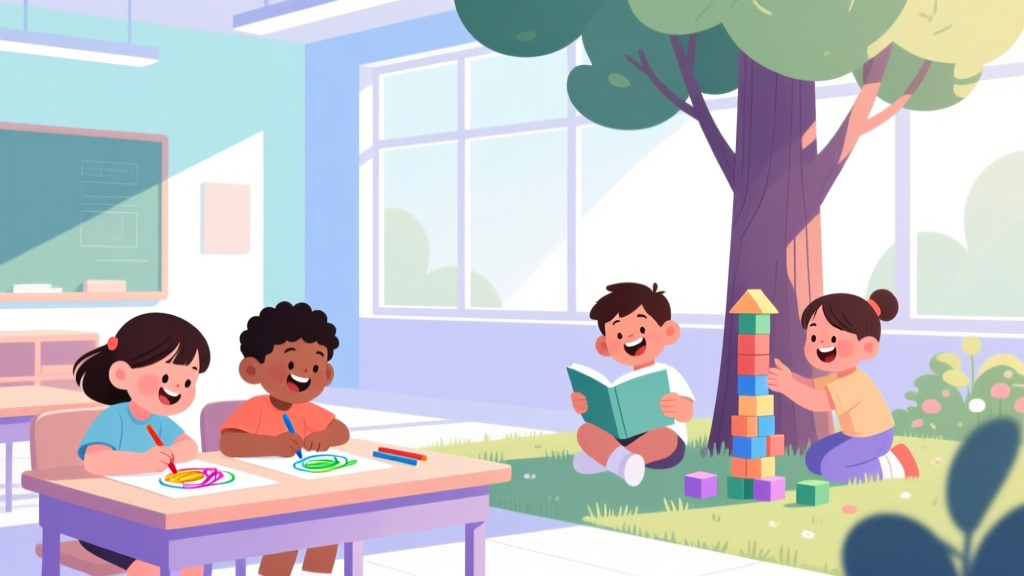
Forget flawless pencil grip. What matters is functional strength and coordination for daily tasks: holding scissors safely, managing zippers, opening lunch containers, and controlling a crayon well enough to draw a recognizable person (head, body, limbs). Occupational therapists note that children who struggle here often avoid writing tasks entirely—not due to laziness, but sensory-motor overload. Integrate practice seamlessly: tearing lettuce for salad, stringing large beads, using tongs to move pom-poms, or kneading playdough with hidden “treasures” inside. A 2021 University of Washington study showed just 10 minutes/day of purposeful fine motor play improved handwriting readiness scores by 42% in 8 weeks.
5. Social Navigation: Beyond ‘Sharing’
“Be kind” is too vague. Kindergarteners need concrete scripts: “Can I play too?” “I don’t like it when you grab my block—can I have it back?” “Let’s take turns: you go first, then me.” Role-play scenarios weekly—not as lectures, but as playful improvisation. Observe playground dynamics: Can your child join a group without adult mediation? Can they negotiate roles in pretend play (“You be the doctor, I’ll be the patient”)? As veteran kindergarten teacher Maria Chen shares: “I watch how kids handle a dropped puzzle piece. Do they ask for help? Try again? Get frustrated and walk away? That tells me more than any letter test.”
Kindergarten classrooms run on autonomy. Teachers cannot tie every shoe, open every juice box, or remind every child to use the bathroom. Children need to reliably: use the toilet independently (including wiping and handwashing), manage clothing (zippers, snaps, Velcro), carry their backpack, and follow multi-step routines. Build this gradually: Assign one “responsibility” per week (e.g., “This week, you pack your lunchbox with help”). Use picture charts—not text—for steps. Celebrate effort, not perfection: “You tried all by yourself—that’s how muscles and brains grow!”
7. Curiosity & Risk-Taking in Learning
The most successful kindergarteners aren’t those who always get answers right—they’re the ones who ask “Why?” after a story, try building a tower taller than last time, or say, “I’ll try it again” after spilling glue. Stanford psychologist Dr. Carol Dweck’s research on growth mindset applies powerfully here: Praise process (“You worked so hard on that drawing!”) over outcome (“That’s the best drawing ever!”). Protect curiosity by resisting the urge to supply answers. Instead, ask: “What do you notice?” “What could we try?” “How might we find out?”
Kindergarten Readiness Benchmarks: What’s Realistic vs. What’s Myth
| Skill Domain | Realistic Expectation (Age 5–6) | Common Misconception | Evidence-Based Insight |
|---|---|---|---|
| Literacy | Recognizes own name in print; identifies 10+ uppercase letters; understands that print carries meaning; enjoys being read to daily | Must read simple sentences or know all 26 letters & sounds fluently | AAP states phonics instruction before age 6 shows no long-term advantage—and may cause avoidance if introduced prematurely. Letter-sound mastery emerges naturally through rich language exposure, not drills. |
| Math | Counts 20 objects accurately; compares groups (“more/less”); recognizes basic shapes; understands one-to-one correspondence | Must add/subtract within 10 or write numbers to 100 | NAEYC emphasizes conceptual understanding over rote calculation. A child who can distribute 12 crackers equally among 3 friends demonstrates deeper number sense than one who memorizes sums. |
| Social-Emotional | Separates from caregiver with minimal distress; initiates play with peers; expresses feelings with words 70% of the time; recovers from minor upsets within 5–10 minutes | Must never cry, share instantly, or always follow rules without reminders | Developmental psychologist Dr. Ross Thompson notes: “Emotional regulation is a marathon, not a sprint. Occasional tears or negotiation attempts are neurotypical—and necessary for growth.” |
| Fine Motor | Holds pencil with tripod grasp (or adaptive grip); draws a person with 3+ body parts; cuts along a straight line with scissors; manages buttons/zippers independently | Must write full name legibly or color perfectly inside lines | Occupational therapy research shows handwriting quality improves dramatically between ages 5–7 with proper muscle development—not early pressure. Focus on strength, not neatness. |
Frequently Asked Questions
My child knows all their letters and can count to 100—but struggles to wait in line. Is that okay?
Absolutely—and it’s far more important than academic knowledge. Research from the University of California, Irvine shows that impulse control (a core self-regulation skill) predicts academic achievement more strongly than early literacy or numeracy. Waiting in line requires working memory, inhibition, and emotional regulation—all foundational for learning. Prioritize games that build patience (like “Red Light, Green Light” or cooperative board games) over extra letter drills. Your child’s brain is wired for mastery in different domains—and that’s completely normal.
Should I enroll my summer-born child in an extra year of preschool?
There’s no universal answer—but data suggests caution. A 2020 study in Pediatrics tracking 12,000 children found that “redshirting” (delaying kindergarten entry) provided only short-term academic advantages that vanished by third grade—and correlated with higher rates of boredom, behavioral issues, and lower self-concept in adolescence. Instead, focus on targeted skill-building: work with your preschool teacher on specific goals (e.g., “practice raising hand during group time”), consult your pediatrician about developmental screening, and visit the kindergarten classroom beforehand to ease transitions.
What if my child has diagnosed ADHD, autism, or a speech delay?
Early intervention is your greatest asset. Under IDEA (Individuals with Disabilities Education Act), children aged 3–5 are eligible for free evaluations and services through your local school district—even before kindergarten. Request an evaluation 6–9 months before enrollment. Many districts offer transition programs (e.g., “Kindergarten Jumpstart”) with small-group instruction and sensory supports. As Dr. Rebecca Landa, autism researcher at Kennedy Krieger Institute, advises: “Focus on functional goals—can they communicate a need? Follow a visual schedule? Tolerate group settings? Those are the levers that create real access to learning.”
Are kindergarten screening tests standardized or required?
No federal law mandates kindergarten screening, and practices vary widely by state and district. Some schools use brief observational tools (like the BRIGANCE Early Childhood Screen III) to identify potential support needs—not to “pass/fail” children. Importantly, the National Association of School Psychologists cautions against using screenings for placement decisions. If your district conducts screening, ask: What’s the purpose? How will results be used? Who sees them? And remember: A snapshot assessment cannot capture your child’s full capabilities, resilience, or growth trajectory.
How much time should we spend “prepping” each day?
Zero minutes of formal prep is needed—and often counterproductive. The most powerful readiness activities are woven into daily life: cooking together (math & sequencing), narrating your actions (“I’m putting the red cup in the cupboard—now the blue one”), reading aloud with expression (language & inference), and letting them solve small problems (“How can we reach that book on the shelf?”). Aim for 15–20 minutes of playful, responsive interaction—not structured lessons. As early childhood expert Erika Christakis writes: “Children learn readiness through living—not through being readied.”
Debunking 2 Common Kindergarten Myths
- Myth #1: “If they’re not reading by kindergarten, they’ll fall behind forever.” Reality: The average child learns to decode words between ages 5.5–7. According to the National Institute of Child Health and Human Development, late bloomers who receive supportive, play-based literacy exposure catch up fully by third grade—with no long-term deficits. Pushing early reading can trigger anxiety and negative associations with books.
- Myth #2: “Kindergarten is basically first grade now—so kids need to be academically advanced.” Reality: While curricula have shifted, effective kindergarten teaching remains rooted in play-based, experiential learning. The NAEYC’s 2023 position statement reaffirms that “play is the primary vehicle for developing self-regulation, language, social competence, and executive function”—not worksheets. Schools with the highest outcomes integrate academics *through* play, not instead of it.
Related Topics (Internal Link Suggestions)
- Kindergarten transition checklist — suggested anchor text: "free printable kindergarten transition checklist"
- Best books to read before kindergarten — suggested anchor text: "top 10 kindergarten-readiness picture books"
- School readiness assessment tools — suggested anchor text: "how to use the BRIGANCE screener at home"
- Signs your child may need extra support — suggested anchor text: "when to request a developmental screening"
- Montessori vs. traditional kindergarten — suggested anchor text: "Montessori kindergarten benefits explained"
Your Next Step: Observe, Connect, Trust
You already know more than you think. You’ve watched your child navigate new playgrounds, recover from scraped knees, negotiate toy swaps, and ask profound questions about rainbows and death. That’s the real curriculum. Start this week by choosing just one of the seven readiness skills—perhaps self-regulation or independence—and observe your child without judgment for three days. Note moments of strength (“She waited patiently while I finished my call”) and opportunities (“He got frustrated when the tower fell—what could help him pause next time?”). Then, connect with your child’s preschool teacher or pediatrician—not to fix, but to understand. And finally, trust: Kindergarten teachers are trained developmental experts who see hundreds of children enter with wildly different starting points. Their job isn’t to sort children into “ready” and “not ready”—it’s to meet each child where they are and build from there. You’ve got this. And your child? They’re already learning exactly what they need to know.
More Articles
 Bono’s Kids: How Many Children Does He Have? (2026)
 Joe Rogan’s Kids’ Ages & Intentional Parenting
 Is Anaconda Good for Kids? Expert Safety Guide
 Will Kids Be Okay? Science-Backed Resilience Guide
 Vecna & Stranger Danger: Talk Safely with Kids (2026)
 Where to Buy Protein Snacks for Kids (2026)
 Enlarged Pupils in Kids: Causes & When to Worry
 Amazon Parenting in DC: Fertility, Leave & Schools (2026)
 John Cusack Kids: Truth Behind His Private Parenting (2026)
 Is AG1 Safe for Kids? Pediatrician-Reviewed Facts