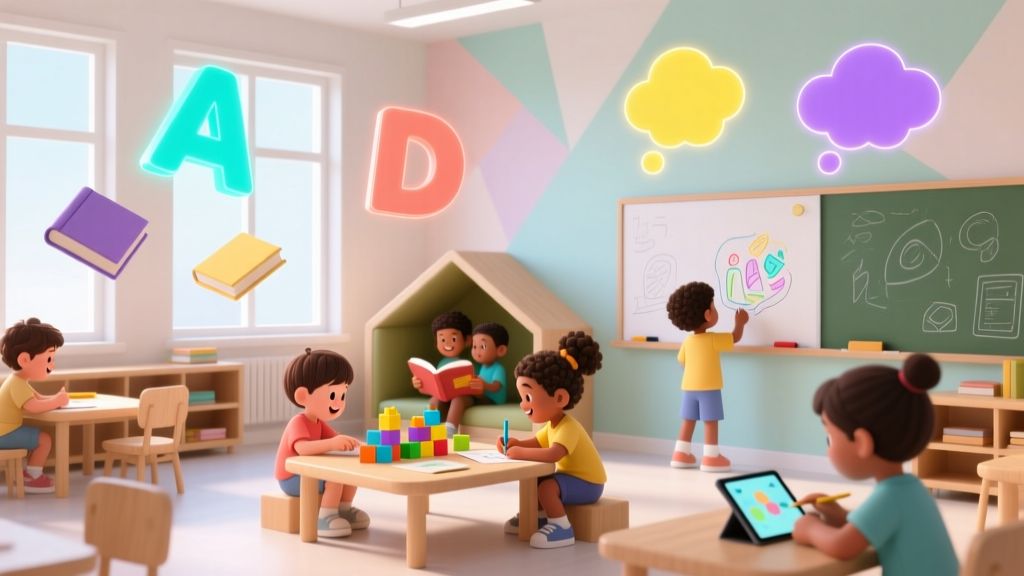
Kindergarten Readiness Checklist: What Kids Really Need
Why This Question Matters More Than Ever Right Now
If you're asking what do kids need for kindergarten, you're not just shopping for supplies—you're standing at one of childhood's most pivotal transitions. Kindergarten is no longer just about coloring and circle time; it's the first formal academic and social proving ground, where foundational executive function, self-regulation, and peer navigation skills are forged. And yet, according to the National Center for Education Statistics, nearly 30% of incoming kindergarteners lack basic classroom-readiness behaviors—like following two-step directions or managing personal belongings—despite having age-appropriate cognitive ability. That gap isn’t about intelligence; it’s about preparedness in the holistic, everyday ways schools quietly expect but rarely spell out. This guide cuts through the noise—not with Pinterest-perfect checklists, but with what pediatricians, early childhood educators, and school psychologists say truly moves the needle.
1. The Non-Negotiable Foundations: Skills Over Stuff
Before you buy a single pencil case, pause: research from the American Academy of Pediatrics (AAP) confirms that academic readiness accounts for only ~15% of kindergarten success. The remaining 85% hinges on three interlocking domains: social-emotional competence, physical self-sufficiency, and executive function. Let’s break them down with actionable benchmarks—not vague ideals.
Social-Emotional Readiness: Can your child wait their turn without tantrums? Accept 'no' without prolonged distress? Name their own feelings (“I’m frustrated”) and recognize basic emotions in others? These aren’t ‘nice-to-haves’—they’re neural prerequisites. Dr. Laura Jana, pediatrician and co-author of The Toddler Brain, emphasizes that children who enter kindergarten with strong emotion-regulation skills show 2.3x higher literacy growth by Grade 2 because they spend less mental energy managing overwhelm and more on learning.
Physical Independence: By August, your child should reliably: use the toilet independently (including wiping, flushing, and handwashing), open lunch containers (think twist-top thermoses, Velcro pouches—not complex zippers), put on/take off jackets and shoes, and carry their own backpack. Why? Because teachers report spending up to 45 minutes per day assisting with basic care tasks—time that could be spent scaffolding reading or math. A 2023 study in Early Childhood Research Quarterly found classrooms where >80% of students managed toileting and lunch prep had 37% fewer behavioral disruptions during instructional blocks.
Executive Function Basics: This includes working memory (holding 2–3 instructions in mind), cognitive flexibility (shifting between tasks), and inhibitory control (stopping an impulse). Try this low-stakes test: ask your child to “touch your nose, then clap twice, then hop once.” If they can sequence it correctly 4/5 times, they’re likely on track. If not, practice daily with playful games like ‘Red Light, Green Light’ or ‘Simon Says’—not flashcards.
2. The School Supply List: What’s Essential vs. What’s Marketing Noise
Yes, you’ll get a district-issued supply list—but it’s often written for uniformity, not developmental appropriateness. Here’s how to decode it with intentionality:
- Pencil Grips & Scissors: Skip the $12 ergonomic sets. AAP recommends standard, child-sized scissors with blunt tips (ASTM F963 certified) and unlined pencils. Why? Fine motor development thrives on resistance—not gadgets. Overly cushioned grips actually delay muscle strength acquisition.
- Backpacks: Choose one under 15% of your child’s body weight (e.g., ≤3 lbs for a 20-lb child). Look for padded, adjustable shoulder straps and a chest strap—not cartoon characters that obscure visibility. A Johns Hopkins ergonomics study found children with poorly fitted backpacks reported 3x more neck/shoulder pain by October.
- Lunchboxes: Prioritize leak-proof, easy-open mechanisms over ‘BPA-free’ labels alone. Test it yourself: can your child open it with one hand while seated? If not, swap it. Also—skip juice boxes. The AAP advises against added sugars before age 5; opt for water bottles with push-button lids (not straws requiring suction strength).
And here’s what most lists omit entirely—and what every teacher wishes parents knew: a labeled change of clothes (including underwear and socks) in a zippered pouch. Not ‘just in case’—but because urinary accidents spike in September as stress hormones rise, and embarrassment can derail confidence for weeks.
3. The Invisible Curriculum: Emotional & Environmental Prep
Kindergarten isn’t just a place—it’s a system with unspoken rhythms. Children who understand the ‘why’ behind routines adapt faster and feel safer. Start 6–8 weeks before school begins:
- Build a ‘Transition Timeline’: Use a visual calendar with photos: ‘Today we visit the school playground,’ ‘Tomorrow we practice our bus stop routine,’ ‘Wednesday = meet our teacher.’ Neurodiverse learners especially benefit—research from the Yale Child Study Center shows visual schedules reduce anxiety-related meltdowns by 62% in the first month.
- Normalize Separation Gradually: Don’t jump straight to full-day drop-offs. Begin with 20-minute playdates at the school library or cafeteria (if permitted), then extend to 45 minutes with a trusted adult present. This builds ‘school as safe space’ neural pathways—not just ‘mom/dad leaves’ associations.
- Practice the ‘Three-Question Rule’: At dinner, ask only: “What made you smile today?” “What was tricky?” “What’s one thing you want to try tomorrow?” This models emotional labeling, problem framing, and growth mindset—without interrogation. Avoid ‘What did you learn?’—it pressures kids to perform academically before they’ve built relational security.
A real-world example: When Maya (age 5) started kindergarten, her parents used a laminated photo strip showing her walking into the classroom, sitting at her desk, and waving goodbye. By Day 3, she pointed to the ‘waving’ photo and said, “I do that now.” No tears. No resistance. That’s the power of predictable, embodied preparation.
4. Safety, Health & Logistics: The Quiet Essentials No One Talks About
Beyond immunizations and emergency contacts, these details prevent daily friction—and sometimes, serious risk:
- Allergy Protocols: Even if your child has no known allergies, confirm your school’s epinephrine policy. Many districts now stock EpiPens for unknown reactions. Provide a photo of your child (not just name/DOB) for quick ID during emergencies—teachers report misidentification spikes during high-stress moments.
- Transportation Clarity: If using the bus, practice the route twice—once with you, once with your child leading. Teach them to identify the bus number (not just color) and recite their stop name. According to the National Highway Traffic Safety Administration, 76% of bus-related incidents involve children missing their stop or boarding the wrong vehicle due to confusion.
- Medication Authorization: Even for occasional Tylenol, schools require physician-signed forms and original packaging. Photocopies or verbal consent won’t suffice—and delays can mean missed instruction time during illness.
| Skill Domain | Developmentally Appropriate by Age 5 | Red Flag (Seek Support If Present) | Simple Home Practice |
|---|---|---|---|
| Social-Emotional | Plays cooperatively for 15+ mins; shares toys without prompting; names 3+ emotions | Frequent aggression (biting, hitting); inability to separate after 5 mins; extreme fear of new people/places | Play ‘Feelings Charades’ daily: act out happy, sad, frustrated, excited—and guess together |
| Language & Communication | Tells simple stories with beginning/middle/end; uses 5–6 word sentences; follows 3-step directions | Hard to understand >50% of the time; rarely initiates conversation; doesn’t ask ‘who/what/where’ questions | Read aloud daily, then ask: “What do you think happens next?” Wait 10 seconds—don’t answer for them |
| Fine Motor | Cuts along straight lines; copies circle + cross; holds pencil with tripod grip | Still uses fist grip; avoids drawing/writing; can’t manage buttons or snaps | String large beads onto shoelaces; tear paper into strips for collages; ‘write’ grocery lists with scribbles |
| Gross Motor & Self-Care | Hops on one foot 5x; balances 10 secs; dresses/undresses with minimal help | Trips/falls frequently; avoids stairs; can’t wash hands independently | Obstacle course in living room: crawl under chairs, jump over pillows, balance on tape line |
Frequently Asked Questions
Do kids need to know the alphabet before kindergarten?
No—and insisting on rote memorization can backfire. The National Association for the Education of Young Children (NAEYC) stresses letter recognition in context over recitation. A child who notices the ‘S’ on their cereal box and says “That’s for ‘snack’!” demonstrates emergent literacy far more meaningfully than one who chants the ABCs without connecting letters to sound. Focus on phonemic awareness: rhyming games, clapping syllables, and identifying beginning sounds (“What sound does ‘ball’ start with?”).
Is it okay to send my child with a comfort item (blanket, stuffed animal)?
Yes—if it’s school-approved and used strategically. Teachers recommend introducing it during short separations (e.g., “This bear stays with you while I run to the mailbox”)—not as a constant crutch. By Week 3, gradually phase it to the cubby unless needed for nap time. Note: avoid items with detachable parts (buttons, ribbons) due to choking hazards—ASTM F963 standards apply even to comfort objects.
How much homework should kindergarteners have?
Virtually none—and the research is clear. The University of Texas’s 2022 meta-analysis of 27 studies found zero academic benefit to formal homework in kindergarten, but a significant increase in family stress and negative attitudes toward learning. What *does* matter? 15 minutes of shared reading nightly and 10 minutes of unstructured play that involves sorting, building, or storytelling. That’s the ‘homework’ that builds neural architecture.
My child is advanced academically—should I skip kindergarten?
Almost never. Social-emotional development doesn’t accelerate on the same timeline as cognitive skills. Skipping kindergarten deprives children of critical peer modeling for conflict resolution, group norms, and collaborative problem-solving—skills no enrichment program replicates. As Dr. Erika Christakis, early childhood educator and Harvard lecturer, states: “You can’t fast-forward social maturity. It requires real-time, messy, human interaction—not accelerated worksheets.”
What if my child has a diagnosed delay or IEP?
Request a transition meeting with the school’s special education team before orientation day—not after. Bring documentation, but also share your child’s strengths: “They love music and learn best through rhythm,” or “They’re incredibly persistent with puzzles.” Co-create accommodations that honor autonomy (e.g., a ‘break card’ they can hand to the teacher instead of melting down). Under IDEA law, schools must provide FAPE (Free Appropriate Public Education)—but specificity from parents makes implementation effective.
Common Myths
Myth 1: “If they can read, they’re ready.” Reading fluency ≠ kindergarten readiness. A child who reads early may struggle with waiting their turn, handling criticism, or adapting to group pacing—leading to behavioral referrals disguised as ‘giftedness challenges.’
Myth 2: “Schools will teach everything they need to know.” While teachers are experts, they serve 20+ children. Foundational self-regulation, communication, and physical independence are family-taught competencies. Schools assume baseline mastery—they don’t remediate gaps in toileting or emotional vocabulary.
Related Topics (Internal Link Suggestions)
- Kindergarten separation anxiety solutions — suggested anchor text: "how to ease kindergarten separation anxiety without tears"
- Age-appropriate chores for 5-year-olds — suggested anchor text: "5-year-old chore chart that builds responsibility"
- Montessori-inspired kindergarten prep activities — suggested anchor text: "Montessori kindergarten readiness at home"
- What to pack in a kindergarten lunchbox — suggested anchor text: "nutritious kindergarten lunch ideas that stay cold"
- Signs your child isn’t ready for kindergarten — suggested anchor text: "kindergarten readiness checklist by pediatricians"
Your Next Step Starts Today—Not on the First Day
Remember: what do kids need for kindergarten isn’t a question about inventory—it’s about intentionality. You don’t need perfection. You need consistency in small, loving actions: practicing zippers at breakfast, naming feelings during tantrums, visiting the school playground at sunset. These micro-moments wire resilience far more powerfully than any supply list. So pick one thing from this guide—maybe the visual timeline or the ‘Three-Question Rule’—and implement it this week. Then watch how your child’s confidence grows not because they’re ‘ready,’ but because they feel deeply, safely held in the process. That’s the foundation no curriculum can replace.
More Articles
 Do Kids Have to Go to Pre-K? State Laws & Readiness (2026)
 How Many Kids Does Trump Have? 5 Children Explained
 Andy Byron Kids' Ages: Truth & Parenting Pressures (2026)
 When Can Kids Have Raw Fish? Pediatrician Guide (2026)
 Is Goat Good for Kids? (2026)
 How to Get Help with Christmas for My Kids (2026)
 Half-Time Show Kid: Truth & Safety for Parents (2026)
 How Many Kids Does Drake Have? (2026)
 Can Kids Take Pepto? Pediatrician-Approved Answers
 Booster Seat Readiness Guide: Age, Size & Behavior (2026)