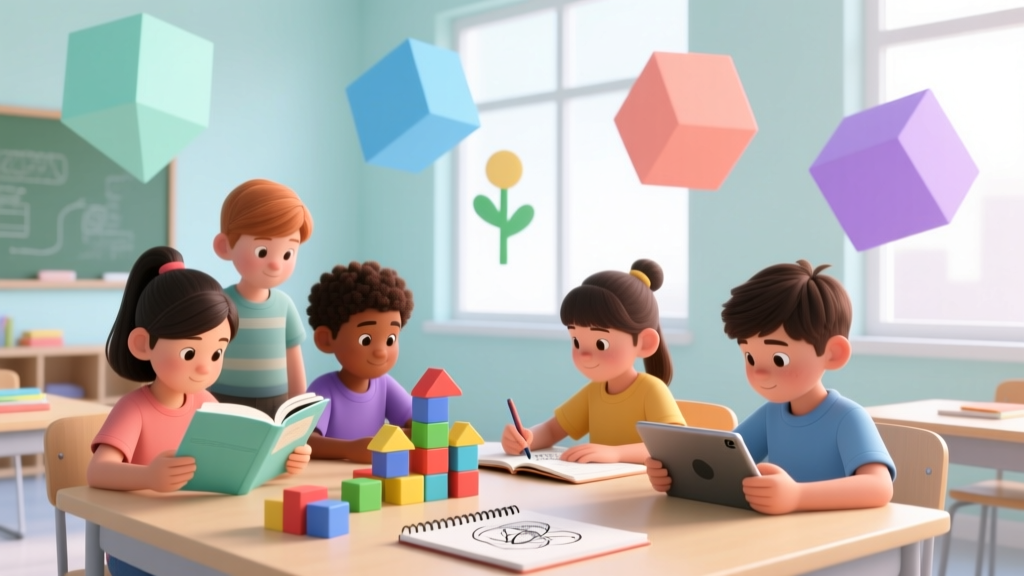
What Kids Learn in Second Grade (2026)
Why Knowing What Kids Learn in Second Grade Is Your Secret Parenting Superpower
If you’ve ever stared at a homework sheet covered in double-digit addition with regrouping—or watched your child hesitate before reading aloud—and wondered, "Is this normal? Are they on track? Am I missing something?"—you’re not alone. What do kids learn in second grade isn’t just a question about curriculum—it’s about decoding the pivotal developmental leap happening between ages 7 and 8, when foundational skills solidify into lifelong learning habits. This is the grade where reading shifts from 'sounding out' to fluent comprehension, where math moves beyond counting to reasoning, and where social confidence begins to hinge on collaboration—not just compliance. And yet, most parents receive only vague report cards or cryptic teacher notes. In today’s landscape—where learning loss recovery, diverse neurodevelopmental profiles (like dyslexia or ADHD), and rising screen-time pressures intersect—understanding the real scope of second-grade expectations isn’t optional. It’s how you advocate, intervene early, and turn everyday moments into meaningful learning. Let’s demystify it—no eduspeak, no assumptions, just what matters.
Literacy: From Decoding to Deep Comprehension (and Why Fluency ≠ Speed)
Second grade is the great literacy inflection point. According to the National Institute of Child Health and Human Development (NICHD), children who achieve grade-level fluency by the end of second grade are 4x more likely to read proficiently by fourth grade—a key predictor of long-term academic success. But here’s what schools rarely clarify: fluency isn’t just about reading fast. It’s accuracy + expression + comprehension, all working together.
By June, most second graders should confidently:
- Read aloud with appropriate pacing, phrasing, and intonation (not robotic or rushed);
- Decode multisyllabic words using phonics patterns (e.g., ‘-tion,’ ‘-sion,’ ‘-ed’ endings);
- Identify main idea and supporting details in nonfiction passages;
- Make inferences (“What might happen next?” “How does the character feel—and why?”);
- Write complete paragraphs with topic sentences, details, and closing thoughts.
Real-world red flag: If your child consistently avoids reading aloud, substitutes words (“house” for “home”), or can’t retell a story in sequence after finishing it—these aren’t ‘just shyness’ or ‘not trying.’ They may signal a gap in phonological awareness or oral language processing. As Dr. Sally Shaywitz, co-director of the Yale Center for Dyslexia & Creativity, emphasizes: “Second grade is the last window for effortless intervention. After that, remediation becomes harder—not because the brain changes, but because the academic load accelerates.”
Actionable tip: Try the ‘Three-Sentence Retell’ nightly. After reading any short passage (even a cereal box or weather app), ask: 1) What was the main thing that happened? 2) What detail proves that? 3) How did it make the character (or you) feel? This builds inferential thinking without worksheets.
Math: Beyond Memorization—Building Number Sense That Lasts
Forget flashcards. Second-grade math is where number sense transforms from concrete (counting blocks) to abstract (mental math, place value reasoning). The Common Core State Standards—and high-performing districts like Singapore Math-aligned programs—focus on three non-negotiable pillars: mastery of addition/subtraction within 100, deep understanding of place value (hundreds, tens, ones), and early problem-solving logic.
Here’s what mastery looks like—not just ‘getting answers right’:
- Fluency with regrouping: Solving 64 − 29 mentally or with a clear written strategy—not guessing or counting backward on fingers;
- Place value flexibility: Recognizing that 247 = 2 hundreds + 4 tens + 7 ones and also = 1 hundred + 14 tens + 7 ones (critical for future multiplication);
- Word problem reasoning: Identifying whether a problem requires addition (“How many total?”) or subtraction (“How many more/less?”)—and explaining why, not just computing;
- Early measurement & data: Measuring objects to the nearest centimeter/inch, creating and interpreting bar graphs with up to four categories.
A powerful real-world case study: A 2023 University of Chicago longitudinal study tracked 1,200 second graders over five years. Those who spent just 10 minutes daily playing ‘math talk’ games (e.g., “I’m thinking of a number between 50 and 70. It has 3 tens. What could it be?”) showed 32% higher standardized math scores by fifth grade—regardless of socioeconomic background. Why? Because these games build flexible thinking, not rote recall.
Actionable tip: Replace ‘drill’ with ‘notice-and-wonder.’ At dinner, say: “We have 12 chicken nuggets and 4 people. How many does each person get? What if one person doesn’t want any? How would that change things?” This embeds division concepts in authentic context.
Social-Emotional Learning & Executive Function: The Hidden Curriculum
While literacy and math dominate report cards, the most consequential second-grade learning happens beneath the surface: self-regulation, collaborative problem-solving, and metacognition (thinking about thinking). The American Academy of Pediatrics (AAP) identifies second grade as the critical window for developing executive function—the mental skills that act like the brain’s air traffic control system.
Key SEL milestones include:
- Working memory growth: Holding 3–4-step directions in mind (e.g., “Get your journal, write the date, draw a picture of your weekend, then share with a partner”);
- Emotional vocabulary expansion: Naming nuanced feelings (“frustrated,” “disappointed,” “proud”) instead of just “mad” or “happy”;
- Peer negotiation: Resolving minor conflicts with phrases like “I feel… when you… Can we try…?” instead of tattling or withdrawing;
- Task initiation & persistence: Starting independent work without repeated prompts and continuing through mild frustration.
This isn’t ‘soft skill fluff.’ Research from the Collaborative for Academic, Social, and Emotional Learning (CASEL) shows students with strong SEL competencies in second grade demonstrate 11% higher standardized test scores and 25% fewer behavioral referrals by fifth grade. Why? Because emotional regulation frees up cognitive bandwidth for learning.
Actionable tip: Use the ‘Stoplight Check-In’ before homework or transitions: Red = “I’m feeling overwhelmed—what’s one small step I can take?” Yellow = “I’m unsure—can I ask one clarifying question?” Green = “I’m ready to try!” This builds self-awareness and agency—not dependence on adult direction.
Science, Social Studies & Creative Expression: Context, Not Content
Second-grade science and social studies aren’t about memorizing facts—they’re about cultivating curiosity and civic identity. Think less ‘planet names’ and more ‘how do seeds know when to sprout?’ Think less ‘state capitals’ and more ‘how do our community helpers keep us safe?’
Typical units include:
- Life Science: Plant and animal life cycles (butterfly metamorphosis, bean seed germination), habitats and adaptations (e.g., “Why do polar bears have thick fur but camels have thin fur?”);
- Earth Science: Weather patterns, seasonal changes, and basic landforms (mountains, rivers, valleys)—often tied to local geography;
- Social Studies: Community roles (firefighters, librarians, farmers), map skills (cardinal directions, simple symbols), and cultural celebrations (diverse family traditions, holidays).
The magic happens in integration. For example, a unit on ‘community helpers’ might involve interviewing a local postal worker (social studies), measuring package weights (math), writing thank-you letters (writing), and designing a ‘safe mail route’ map (geography + art). This interdisciplinary approach mirrors how real-world problems are solved—and boosts retention by 40%, per a 2022 Johns Hopkins School of Education meta-analysis.
Actionable tip: Turn grocery trips into inquiry labs. Ask: “Why do apples stay fresh longer than bananas? What makes this yogurt ‘probiotic’? How is this cereal box designed to catch your eye?” These questions build scientific habits of mind—observation, questioning, and evidence-seeking.
| Milestone Area | End-of-Grade Expectation (Per AAP & NAEYC Guidelines) | At-Home Red Flag | Simple Support Strategy |
|---|---|---|---|
| Reading Fluency | Reads 90+ words per minute with >95% accuracy, expressive phrasing, and consistent comprehension (retells main ideas & details) | Frequently skips lines, re-reads same sentence, or cannot summarize what was just read | Record your child reading for 1 min; count errors. If >5, focus on 5-min daily echo-reading (you read 1 sentence, they repeat with expression) |
| Math Reasoning | Solves 2-step word problems (e.g., “Lila had 23 stickers. She gave 5 to Sam and 4 to Maya. How many left?”), explains thinking verbally or visually | Guesses answers without showing steps; avoids word problems entirely | Use manipulatives (coins, buttons) to model every problem. Ask: “Show me how you know.” |
| Executive Function | Follows 3-step directions independently; initiates tasks within 1 minute of instruction; uses simple planner or checklist | Needs repeated reminders to start tasks; loses materials daily; becomes easily frustrated with multi-step activities | Create a visual ‘First-Then’ board: “First: Put away backpack. Then: Read for 10 minutes.” Add checkmarks. |
| Social-Emotional Awareness | Names ≥5 emotion words accurately; identifies physical cues of feelings (e.g., “My hands get hot when I’m angry”); suggests 1 solution during peer conflict | Uses only “good”/“bad” or “mad”/“sad”; blames others for feelings; withdraws during disagreements | Play ‘Feeling Detective’: Watch cartoons together and pause to ask, “What’s their face doing? What might they be thinking?” |
Frequently Asked Questions
How much homework should my second grader have—and is it effective?
The National Education Association (NEA) and the American Psychological Association (APA) jointly recommend no more than 20 minutes per night for second grade—and emphasize that homework should reinforce known skills, not introduce new concepts. Research shows excessive or poorly designed homework increases stress without boosting achievement. Focus on quality: 10 minutes of targeted reading practice or a single math problem requiring explanation is far more valuable than 30 minutes of repetitive worksheets. If homework consistently takes >30 minutes or causes tears, contact the teacher—this signals either mismatched expectations or an undiagnosed learning need.
My child reads well but hates writing. Is that normal—and how can I help?
Yes—and it’s extremely common. Writing demands simultaneous coordination of fine motor control, spelling, grammar, idea generation, and working memory. Many bright second graders have advanced oral vocabularies but struggle to translate thoughts to paper. Instead of pushing longer essays, try low-stakes, high-engagement alternatives: text-message stories (3 sentences max), comic strips with speech bubbles, or voice-to-text journaling. Occupational therapists note that strengthening hand muscles (play-dough, tweezers, stringing beads) often improves writing stamina faster than handwriting drills alone.
Should I be worried if my child still reverses letters like ‘b’ and ‘d’?
Occasional reversals of ‘b/d’, ‘p/q’, or ‘6/9’ are developmentally typical through mid-second grade—especially in handwriting. The red flag isn’t the reversal itself, but persistence beyond February combined with difficulty sounding out words, confusing similar-sounding letters (‘m/n’), or trouble remembering letter names/sounds. If reversals occur in both writing AND reading (e.g., reading ‘dog’ as ‘bog’), consult your school’s reading specialist. Early screening for dyslexia is highly effective and confidential.
How do I know if my child is ‘gifted’—or just advanced for their age?
Giftedness isn’t just about speed or accuracy. Look for insatiable curiosity (“Why do magnets stick?” → “What makes magnetism?” → “Can we make a magnet stronger?”), complex analogies (“School is like a beehive—everyone has a job”), and intense focus on self-chosen projects. The National Association for Gifted Children (NAGC) stresses that gifted learners often mask struggles in areas like handwriting or social flexibility. If you suspect giftedness, request a school-based cognitive assessment—not IQ tests at home. Public schools are required to evaluate for gifted services upon parental request.
What role does screen time play in second-grade learning—and what’s truly educational?
Under AAP guidelines, high-quality, co-viewed screen time can support learning—but only if it’s interactive, not passive. Apps like Khan Academy Kids or PBS Kids Games show measurable gains in early math and literacy when used with adult scaffolding (e.g., “What strategy did the character use? Could we try that with our math problem?”). Avoid apps that reward speed over thinking or replace hands-on exploration. Crucially: no screens 1 hour before bed—blue light disrupts melatonin, directly impairing memory consolidation. Prioritize sleep over extra ‘educational’ minutes.
Common Myths
Myth #1: “If they’re reading chapter books, they’re definitely on track.”
Not necessarily. Many second graders decode early chapter books (e.g., Junie B. Jones) but lack comprehension depth—missing themes, character motivation, or subtle humor. Fluency without understanding is like driving a car with perfect steering but no brakes.
Myth #2: “Second grade is easy—just review first grade.”
This underestimates the cognitive leap. First grade focuses on foundational decoding and single-digit operations. Second grade demands synthesis: connecting ideas across texts, applying math strategies flexibly, and managing increased independence. Skipping summer reinforcement often leads to the ‘second-grade slump’—a documented dip in reading growth.
Related Topics (Internal Link Suggestions)
- Second Grade Reading Milestones — suggested anchor text: "second grade reading milestones"
- Best Math Games for Second Graders — suggested anchor text: "fun math games for second grade"
- Signs of Learning Differences in Elementary School — suggested anchor text: "early signs of dyslexia in second grade"
- Executive Function Skills by Age — suggested anchor text: "executive function development chart"
- How to Talk to Your Child's Teacher About Progress — suggested anchor text: "questions to ask second grade teacher"
Conclusion & CTA
Understanding what do kids learn in second grade isn’t about turning your home into a mini-school—it’s about becoming a fluent translator between classroom expectations and your child’s unique wiring. You now know the real benchmarks (not just the buzzwords), the hidden SEL engine driving academic success, and the simple, research-backed actions that make the biggest difference. So this week, pick one strategy from this guide—maybe the Stoplight Check-In before homework, or the Three-Sentence Retell at bedtime—and try it consistently for five days. Track one small shift: Did they initiate faster? Explain their math thinking? Name a new feeling? Then, share your observation with their teacher—not as a complaint, but as partnership: “We noticed [specific behavior] at home. How can we reinforce this at school?” That’s how advocacy begins. And that’s how second grade becomes the launchpad—not the pressure cooker.
More Articles
 Is the Barbie Movie for Kids? (2026)
 Charlie Kirk Shooting: 7 Evidence-Based Child Safety Tips
 Denny’s Kids Eat Free 2026: Rules, Dates & Tips
 What Can I Say Books for Kids: Top 5 Picks (2026)
 Hep B Vaccine for Newborns: Why It’s Critical at Birth
 Where Do Kids Eat Free Tonight? (2026)
 Willie Robertson’s Biological Kids: How Many in 2026?
 Franke Kids Custody: Truth & Co-Parenting Tips (2026)
 Child Support for 3 Kids in Missouri (2026)
 Best Debit Card for Kids (2026)