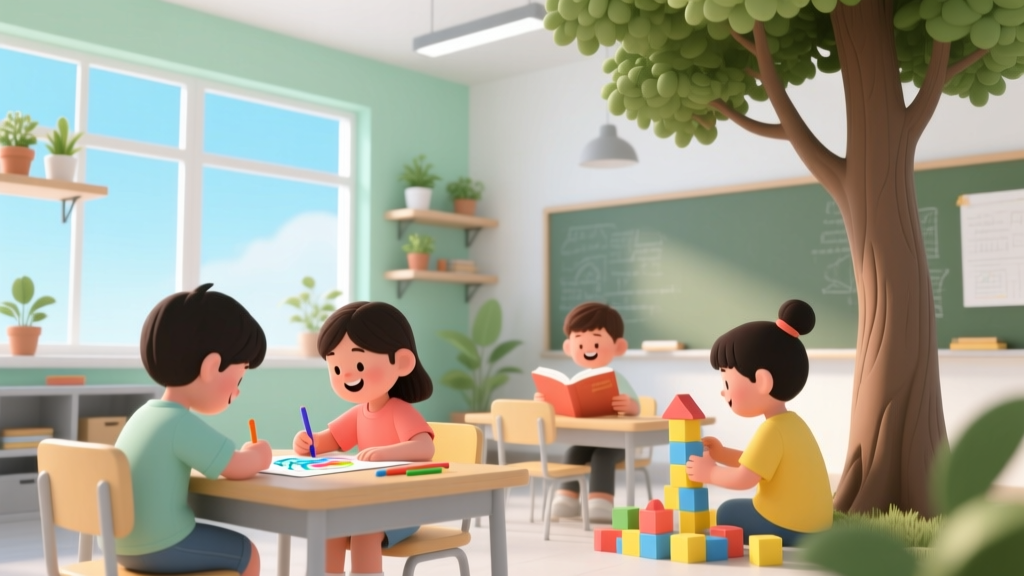
What Do Kids Learn in Kindergarten? (2026)
Why This Question Matters More Than Ever
What do kids learn in kindergarten isn’t just a curiosity—it’s a pivotal question shaping everything from daily routines and home support strategies to long-term academic confidence and emotional resilience. In an era where early childhood education is increasingly scrutinized—and where pandemic-related learning gaps have reshaped expectations—parents are rightly asking: Is my child truly prepared? Are they learning what they need—not just for first grade, but for life? The answer lies far beyond worksheets and flashcards. Modern kindergarten is a dynamic ecosystem of cognitive scaffolding, social negotiation, self-regulation practice, and embodied learning—all grounded in decades of developmental science. And understanding it empowers you—not to 'teach ahead,' but to partner wisely with educators and nurture growth where it matters most.
Academic Foundations: Far More Than Letters and Numbers
Yes, children learn letters, sounds, and counting—but not in isolation. Today’s evidence-based kindergarten curriculum treats literacy and numeracy as integrated, meaning-driven experiences. According to the National Association for the Education of Young Children (NAEYC), effective instruction embeds phonemic awareness in storytelling, connects number sense to real-world problem-solving (e.g., “We have 5 apples and share 2—how many are left for our snack?”), and prioritizes conceptual understanding over rote memorization.
Take Maya, a kindergartener in Portland: Her teacher introduced addition not with equations, but by designing a ‘classroom post office’ where students sorted and delivered mail bundles using tally marks and simple grouping. Within six weeks, Maya independently used ‘+’ and ‘=’ symbols—not because she was drilled, but because she’d experienced their purpose. That’s the power of contextualized learning.
Key academic domains include:
- Emergent Literacy: Phonological awareness (rhyming, syllable clapping), letter-sound correspondence, print concepts (left-to-right tracking, book orientation), and narrative retelling—not just letter naming.
- Early Math Reasoning: Counting with one-to-one correspondence, comparing quantities (more/less/fewer), recognizing patterns, identifying shapes in context (e.g., “This tile is a hexagon—like a bee’s honeycomb!”), and measuring with non-standard units (paper clips, blocks).
- Scientific Inquiry: Observing plant growth over time, predicting weather changes, classifying objects by properties (texture, weight, magnetism), and asking testable questions (“What happens if we add more water to the soil?”).
Social-Emotional Learning: The Unseen Curriculum That Predicts Success
If academic skills are the visible tip of the iceberg, social-emotional learning (SEL) is the massive, stabilizing foundation beneath. A landmark 20-year study published in American Journal of Public Health followed over 750 kindergarteners and found that those with strong SEL competencies (sharing, listening, managing frustration) were twice as likely to earn a college degree and 46% less likely to have legal trouble by age 25—regardless of IQ or socioeconomic background.
Kindergarten intentionally cultivates these through structured routines and responsive teaching. Consider ‘Morning Meeting’: a 20-minute daily ritual where students greet each other by name, share news, collaboratively set classroom goals, and practice active listening. Teachers don’t just model empathy—they engineer opportunities for it. When two children argue over blocks, the adult doesn’t immediately intervene with a solution; instead, they scaffold language: “I see you both want the red block. Can you tell your friend what you need—and listen to what they need too?”
This isn’t ‘soft skill fluff.’ It’s neurodevelopmentally essential. As Dr. Stephanie M. Jones, Harvard researcher and SEL curriculum developer, explains: “The prefrontal cortex—the brain’s executive control center—undergoes its most rapid growth between ages 5–7. Kindergarten is the optimal window to build neural pathways for self-regulation, perspective-taking, and flexible thinking.”
Physical Development: Why Play Is Precision Work
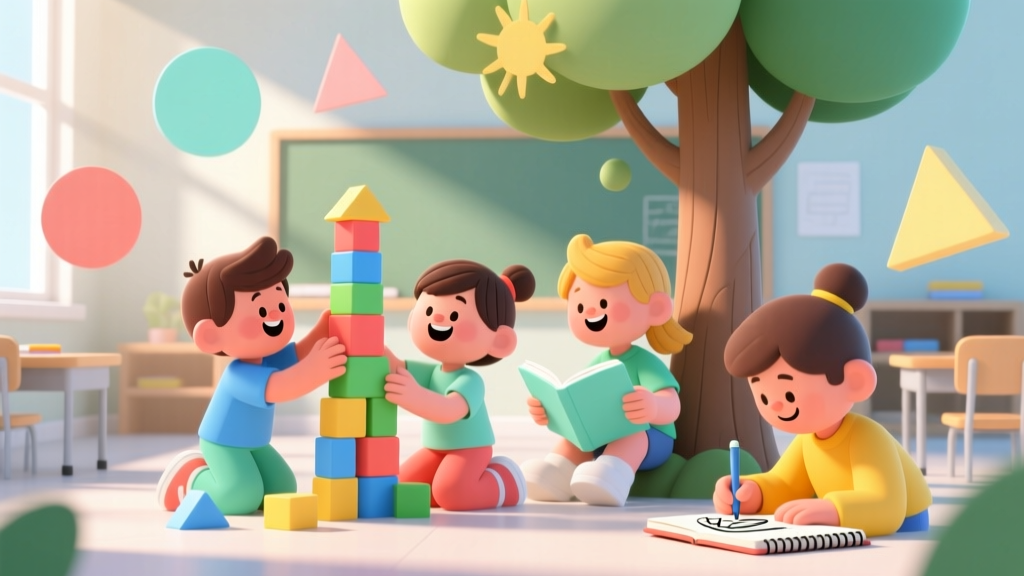
When you see kindergarteners building towers, cutting with scissors, or dancing to rhythm, you’re witnessing targeted motor development. Fine motor skills aren’t just about writing readiness—they’re prerequisites for attention, memory, and even mathematical reasoning. Research from the University of Chicago shows that children who engage in rich manipulative play (beading, clay modeling, threading) demonstrate stronger working memory and visual-spatial processing by second grade.
Gross motor development is equally strategic. Jumping rope, balancing on low beams, and navigating obstacle courses strengthen vestibular and proprioceptive systems—critical for focus, posture, and sensory integration. In fact, occupational therapists report a 30% rise in referrals for handwriting and attention challenges linked to reduced outdoor, unstructured movement in early years—a trend kindergarten programs now actively counter with daily ‘movement breaks’ and nature-based exploration.
Real-world example: At a rural Vermont school, teachers replaced 15 minutes of seatwork with ‘Forest Friday,’ where students collected leaves, measured tree circumferences, and sketched insect habitats. Teachers observed measurable gains in sustained attention and collaborative problem-solving—and standardized test scores in language arts rose 12% district-wide over two years.
The Hidden Curriculum: Routines, Roles, and Responsibility
Beyond academics and behavior lies what educators call the ‘hidden curriculum’—the implicit lessons embedded in daily structure: how to follow multi-step directions, manage personal belongings, transition smoothly between activities, and contribute to a shared environment. These aren’t ‘extras’—they’re the infrastructure of independence.
Consider job charts. A child assigned ‘Line Leader’ learns spatial awareness and responsibility; ‘Weather Reporter’ practices public speaking and data observation; ‘Supply Manager’ develops organizational systems and accountability. Each role rotates weekly, ensuring every child experiences diverse leadership opportunities and builds competence across domains.
Time management is taught concretely: visual timers, color-coded schedules, and ‘choice boards’ (e.g., “After math, choose: read quietly, draw a story, or build with magnets”) foster autonomy while maintaining structure. As veteran kindergarten teacher Lena Chen notes: “We don’t say ‘clean up now.’ We say, ‘In two minutes, the cleanup song will play. When you hear the chime, begin returning materials to their homes.’ That specificity reduces anxiety and builds executive function—because predictability + agency = security.”
| Learning Area | Core Skills Developed | Real-World Classroom Example | Long-Term Impact (Per AAP & NAEYC) |
|---|---|---|---|
| Literacy Integration | Phonemic segmentation, vocabulary expansion, narrative sequencing, environmental print recognition | Creating a ‘Classroom Restaurant’ menu board; students write orders, read ingredients, and categorize foods by food groups | Stronger reading comprehension and writing fluency by Grade 3; 68% higher likelihood of meeting state ELA benchmarks |
| Mathematical Thinking | One-to-one correspondence, ordinal numbers, part-whole relationships, measurement estimation | Designing a ‘Garden Plot’ project: students measure beds with rulers, count seeds, compare plant heights weekly, and graph growth | Improved problem-solving stamina and quantitative reasoning; correlates with STEM persistence in middle school |
| Social-Emotional Practice | Emotion identification, conflict resolution strategies, cooperative goal-setting, empathic listening | ‘Friendship Bracelet’ unit: students co-design patterns, negotiate material sharing, reflect on collaboration challenges in journals | Lower rates of behavioral referrals; higher peer acceptance scores; predictive of high school graduation |
| Motor Skill Integration | Hand-eye coordination, bilateral coordination, grip strength, balance, spatial navigation | Daily ‘Movement Lab’: obstacle courses with crawling tunnels, beanbag toss targets, and rhythm drumming sequences | Better handwriting legibility; improved attention regulation; reduced fidgeting during seated tasks |
Frequently Asked Questions
Is kindergarten focused only on academics—or is play still central?
Play remains the primary vehicle for learning in high-quality kindergarten programs. The National Association for the Education of Young Children (NAEYC) affirms that play is not separate from learning—it is learning. Structured play (e.g., dramatic play centers, math games, science exploration stations) is intentionally designed to advance specific developmental goals. When children build a ‘bridge’ with blocks, they’re engaging physics, engineering, collaboration, and spatial reasoning—far more deeply than a worksheet could achieve. The key is *intentional* play, guided by knowledgeable teachers who observe, ask probing questions, and extend learning naturally.
My child already knows all their letters and can count to 100. Will kindergarten be boring or repetitive?
Not if the program is developmentally appropriate. Strong early skills are assets—not finish lines. Effective kindergarten differentiates instruction: advanced readers might analyze character motivation in leveled texts, while emerging readers focus on sound-symbol mapping. A child who counts fluently may explore skip-counting patterns, create number stories, or use ten-frames to visualize place value. As Dr. Kathy Hirsh-Pasek, Temple University child development scientist, emphasizes: “Kindergarten should stretch every child—not hold them back. Depth, not speed, is the goal.”
How much time do kindergarteners spend on screens or digital tools?
Minimal—and purposeful. The American Academy of Pediatrics recommends no more than 1 hour per day of high-quality programming for children 2–5, and kindergarten best practices align with this. When technology is used, it’s highly interactive and teacher-facilitated: e.g., using tablets to record oral stories (building narrative skills), coding robots to navigate mazes (teaching sequencing and debugging), or collaborating on digital storyboards. Passive consumption or isolated app time is rare in research-aligned classrooms—and never replaces hands-on, social, or outdoor learning.
What should I do at home to support what my child is learning in kindergarten?
Focus on connection, not correction. Read aloud daily—even 10 minutes—and ask open-ended questions (“What do you think will happen next?” “How would you solve that problem?”). Involve your child in authentic tasks: cooking (measuring, sequencing), gardening (observing change, recording data), or organizing toys (sorting, categorizing). Most importantly: narrate their efforts (“You kept trying even when the tower fell—that’s perseverance!”) rather than praising outcomes (“You’re so smart!”). This builds growth mindset—the #1 predictor of long-term academic resilience, per Stanford psychologist Dr. Carol Dweck’s research.
Common Myths About Kindergarten Learning
- Myth 1: “Kindergarten is basically first grade light—just easier.”
Reality: Kindergarten has its own rigorous, research-based standards (e.g., Common Core State Standards for K, NAEYC’s Developmentally Appropriate Practice). It prioritizes how children learn—through play, talk, movement, and inquiry—not just what they learn. First grade shifts toward more abstract thinking and independent work; kindergarten builds the concrete, experiential foundation that makes that shift possible.
- Myth 2: “If my child isn’t reading by the end of kindergarten, they’re behind.”
Reality: Only about 17% of children read fluently by June of kindergarten, according to longitudinal data from the Early Childhood Longitudinal Study. Emergent literacy is a continuum: recognizing environmental print, ‘reading’ pictures to tell stories, writing name and labels, and blending sounds are all critical milestones. Pushing premature decoding can undermine confidence and phonological awareness. As pediatrician Dr. Perri Klass advises: “Focus on joyful engagement with language—not speed of output.”
Related Topics (Internal Link Suggestions)
- Kindergarten Readiness Checklist — suggested anchor text: "kindergarten readiness checklist"
- Best Educational Toys for 5-Year-Olds — suggested anchor text: "best educational toys for 5 year olds"
- How to Support Early Literacy at Home — suggested anchor text: "how to support early literacy at home"
- Montessori vs. Traditional Kindergarten — suggested anchor text: "montessori vs traditional kindergarten"
- Social-Emotional Learning Activities for Preschoolers — suggested anchor text: "social emotional learning activities for preschoolers"
Your Next Step: Partner, Don’t Pressure
Understanding what kids learn in kindergarten transforms you from an anxious observer into an informed ally. You don’t need to replicate the classroom at home—you need to notice, name, and nurture the learning already happening in everyday moments: when your child negotiates turn-taking with a sibling, estimates how many crackers fit on a plate, or draws a detailed map of their neighborhood. Those are the sparks of cognitive, social, and creative growth. So this week, try one intentional act: attend a parent-teacher conference not to ask “What’s missing?” but “What strengths is my child showing—and how can I reinforce them?” Because kindergarten isn’t about filling a bucket. It’s about lighting a fire—and you hold the match.
More Articles
 Does Henry Cavill Have Kids? The Truth (2026)
 How Often Can I Rotate Tylenol And Ibuprofen For Kids
 Kids & Teens in Qualitative Research: 7 Ethical Strategies
 How to Uber with Kids: Safety & Stress-Free Tips
 Autism Regression in Kids: What Parents Need to Know
 Tylenol for Kids: Safe Dosing & When to Call Doctor
 Is Osmosis Jones a Kids Movie? (2026)
 Is Borax Safe for Kids? Science-Backed Facts (2026)
 What Grade Do Kids Learn Multiplication? (2026)
 Pay Kids Tax-Free: IRS-Approved Strategies (2026)