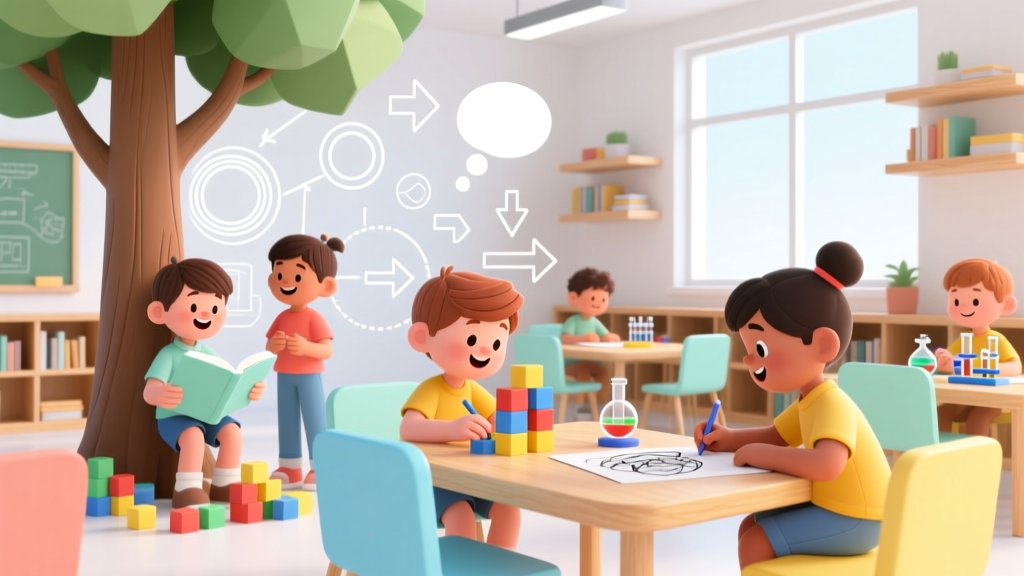
What Do Kids Learn in 5th Grade (2026)
Why Knowing What Kids Learn in 5th Grade Changes Everything
If you’ve ever stared at your child’s math homework — covered in fractions, decimals, and coordinate planes — and wondered, "Wait, when did they start doing that?" — you’re not alone. What do kids learn in 5th grade is one of the most searched yet least clearly explained educational questions among parents navigating the pivotal transition between elementary and middle school. This isn’t just another grade level: it’s the year where foundational skills crystallize into analytical thinking, where reading shifts from learning to read to reading to learn, and where social-emotional growth accelerates alongside academic complexity. According to the National Center for Education Statistics (NCES), over 68% of 5th graders experience measurable cognitive leaps in abstract reasoning — but only if their learning environment supports scaffolding, not speed. Without knowing what’s expected — and why — parents often misinterpret struggle as deficiency, overcorrect with worksheets instead of conversation, or miss golden opportunities to deepen curiosity. This guide cuts through the jargon, aligns with real classroom practice, and gives you actionable insight — not anxiety.
Core Academic Domains: What’s Actually Taught (and Why It Matters)
Fifth grade is intentionally designed as a bridge — not a finish line. Curriculum standards (Common Core, TEKS, NGSS, and state-specific frameworks) converge around three non-negotiable goals: integration (connecting math to science, history to language arts), inquiry (asking testable questions, designing simple investigations), and independence (managing multi-step tasks, citing evidence, self-editing). Let’s unpack each subject with grade-level specificity — and crucially, what mastery *looks like* in practice.
Math: From Concrete to Conceptual Thinking
Fifth-grade math moves decisively beyond computation into structure and relationships. Students aren’t just adding fractions — they’re explaining why common denominators work using visual models (area models, number lines, fraction bars). They’re not just multiplying decimals — they’re estimating products to assess reasonableness ("If I multiply 4.7 × 3.2, should my answer be closer to 10 or 15? Why?"). Key domains include:
- Operations & Algebraic Thinking: Writing and interpreting numerical expressions (e.g., "Add 8 and 7, then multiply by 2" → 2 × (8 + 7)), analyzing patterns and relationships (input-output tables, graphing ordered pairs on coordinate planes).
- Number & Operations — Fractions: Adding/subtracting unlike fractions using equivalent fractions; multiplying fractions by whole numbers and other fractions (with area models); dividing unit fractions by whole numbers (e.g., 1/3 ÷ 4 = 1/12) and vice versa.
- Measurement & Data: Converting units within customary and metric systems (e.g., 5 cm = 0.05 m); representing data in line plots with fractional measurements; understanding volume as an attribute of solid figures (using unit cubes and formulas V = l × w × h).
- Geometry: Graphing points in the first quadrant of the coordinate plane; classifying two-dimensional figures based on properties (e.g., all rectangles are parallelograms, but not all parallelograms are rectangles).
A real-world example: When Maya’s class built a model solar system, her teacher didn’t just assign scale calculations — she asked students to justify their scaling choices, debate whether distance or size should be prioritized, and revise models based on peer feedback. That’s 5th-grade math in action: quantitative reasoning wrapped in scientific context.
Reading & Language Arts: The Shift to Critical Analysis
By 5th grade, fluency is assumed — comprehension is the focus. Students read increasingly complex texts (including historical documents, scientific articles, and literary fiction with nuanced themes) and must move beyond summary to analysis. Per the Common Core State Standards, they’re expected to:
- Cite textual evidence to support analysis of explicit and inferred meanings;
- Determine theme and summarize key supporting details;
- Analyze how visual and multimedia elements contribute to meaning (e.g., captions in a biography, diagrams in a science text);
- Compare and contrast characters, settings, or events across texts;
- Write opinion pieces with logical reasons and relevant evidence; informative/explanatory texts with clear organization and domain-specific vocabulary; narratives with dialogue, description, and pacing.
Here’s what’s often missed: Writing instruction is deeply integrated with reading. Students don’t just write essays — they annotate mentor texts, reverse-engineer author techniques, and revise drafts using peer-led “strength-spotting” protocols. Dr. Susan Neuman, former U.S. Assistant Secretary for Elementary and Secondary Education and literacy researcher at NYU, emphasizes: "Fifth grade is when children begin to see language as a tool for persuasion, not just communication. That shift requires modeling, low-stakes practice, and feedback focused on impact — not just grammar."
Science & Social Studies: Inquiry, Evidence, and Perspective
Science standards (NGSS-aligned) emphasize hands-on investigation and crosscutting concepts. Fifth graders explore:
- Earth Science: Cycles of water, weather patterns, renewable vs. nonrenewable resources — often through local watershed studies or climate data analysis;
- Life Science: Ecosystems (interdependence, food webs, human impact), body systems (circulatory, respiratory, digestive — modeled with analogies and diagrams);
- Physical Science: Properties of matter (states, mixtures vs. solutions), energy transfer (conduction, convection, radiation), basic electricity circuits.
Social Studies builds chronological and geographic reasoning. Students study U.S. history from colonization through the early republic — but critically, they’re taught to interrogate sources. A 2023 Stanford History Education Group study found that only 22% of 5th graders could reliably distinguish primary from secondary sources without scaffolding. So teachers embed source analysis early: comparing a colonist’s diary entry with a modern textbook account of the same event, identifying bias, and asking, "Whose story is missing?" Geography isn’t memorizing capitals — it’s mapping migration routes, analyzing how rivers shaped settlement, or using GIS tools to visualize population density changes.
Developmental Realities: Beyond the Curriculum
Academic content is only half the story. Fifth graders are navigating profound neurodevelopmental shifts. The prefrontal cortex — responsible for planning, impulse control, and working memory — undergoes rapid synaptic pruning. Simultaneously, social awareness intensifies: peer acceptance becomes central, self-consciousness spikes, and moral reasoning evolves from rule-based to principle-based (Kohlberg’s Stage 3). This means:
- A child who excels academically may freeze during oral presentations due to heightened self-monitoring;
- Homework resistance isn’t defiance — it may signal working memory overload (holding multi-step instructions while executing them);
- “Off-task” behavior during group work might reflect emerging leadership attempts or discomfort with unstructured roles.
The American Academy of Pediatrics (AAP) advises parents to frame challenges as skill gaps, not character flaws. Instead of “You’re not trying,” try “What part of this feels overwhelming? Where do you get stuck?” This language aligns with growth mindset research and reduces shame-driven avoidance.
| Subject Area | Key 5th-Grade Milestones | Red Flags (Not Deficits — Signals for Support) | At-Home Support Strategy |
|---|---|---|---|
| Math | Fluently adds/subtracts fractions with unlike denominators; multiplies/divides fractions; interprets coordinate graphs; calculates volume | Consistently avoids word problems; guesses answers without estimation; cannot explain reasoning verbally or visually | Play “Estimation 180” daily (e.g., “How many jellybeans in this jar?”); use cooking to practice fraction scaling (“Double this ¾ cup recipe”); sketch graphs of family screen time vs. outdoor time |
| Reading | Reads grade-level texts with 95%+ accuracy; cites evidence for inferences; summarizes main ideas and supporting details | Skips rereading confusing passages; cannot retell plot without prompting; avoids nonfiction texts entirely | Use “Two Stars & a Wish” feedback on their writing; read aloud together — pause to predict, question, connect; visit libraries and let them choose books (even comics/graphic novels count!) |
| Writing | Writes organized paragraphs with topic sentences, evidence, and concluding statements; uses transitional phrases; revises for clarity | Writes only in fragments; resists revision; relies solely on spell-check without proofreading | Co-write a family newsletter; draft emails to grandparents describing a weekend adventure; use voice-to-text to bypass handwriting fatigue and focus on ideas |
| Social-Emotional | Identifies own emotions and coping strategies; collaborates effectively in small groups; shows empathy for diverse perspectives | Extreme reactions to minor setbacks; difficulty accepting constructive feedback; persistent exclusion of peers | Practice “emotion coaching”: name feelings (“I see you’re frustrated”), validate (“That makes sense”), problem-solve (“What could help next time?”); role-play conflict resolution scenarios |
Frequently Asked Questions
Is 5th grade harder than 4th grade — or is it just me?
It’s both — and it’s developmentally intentional. While 4th grade focuses on mastering foundational skills (e.g., multi-digit multiplication, paragraph writing), 5th grade demands application, integration, and metacognition (thinking about thinking). A 2022 Learning Policy Institute analysis showed that 5th-grade assignments require 42% more inferential reasoning and 37% more self-directed planning than 4th-grade tasks. That cognitive lift feels like “harder” — but it’s scaffolding for middle school independence. The key isn’t lowering expectations; it’s providing targeted strategy support (e.g., graphic organizers for essay planning, checklists for multi-step math problems).
My child hates reading — does that mean they’re behind?
Not necessarily — but it warrants exploration. Disengagement can stem from undiagnosed vision issues, decoding gaps masked by strong oral language, anxiety about performance, or mismatched text complexity. The International Literacy Association notes that 5th graders need access to “high-interest, low-frustration” texts — think graphic novels like Smile or nonfiction series like National Geographic Kids. Try audiobooks paired with physical text (supporting fluency and comprehension simultaneously) and prioritize choice over assigned reading. If avoidance persists for >6 weeks despite varied formats and topics, consult your school’s reading specialist for screening.
Should I be worried if my child doesn’t know cursive yet?
Not at all — and you’re not alone. Cursive instruction has declined significantly: only 21 states currently mandate it, per the National Association of State Boards of Education (2023). Most 5th-grade curricula prioritize keyboarding fluency (touch typing at 25+ WPM) and digital literacy over penmanship. That said, if your child struggles with fine motor control affecting note-taking or standardized test responses, occupational therapy evaluation may be beneficial. Focus on legibility and efficiency — not stylistic flourishes.
How much homework is appropriate for 5th grade?
The National Education Association (NEA) and National PTA recommend 50–60 minutes per night for grades 4–6 — but quality trumps quantity. Homework should reinforce skills already taught, not introduce new concepts. If your child consistently spends >90 minutes nightly on assignments, document the tasks and timing for 3 days, then request a meeting with the teacher. It may indicate pacing issues, unclear instructions, or unmet learning needs. Remember: sleep, unstructured play, and family time are non-negotiable for cognitive consolidation and emotional regulation.
What’s the biggest mistake parents make supporting 5th grade learning?
Over-correcting. Research from the University of Chicago Consortium on School Research shows that when parents provide step-by-step solutions to homework, children develop less persistence and lower self-efficacy. Instead of fixing errors, ask open-ended questions: "What’s the first thing you’d try?", "Where did you get stuck?", "Can you find a similar example in your notes?" This preserves intellectual agency — the single strongest predictor of long-term academic resilience.
Common Myths About 5th Grade Learning
- Myth #1: “If they’re not doing algebra yet, they’re behind.” Reality: Formal algebra (variables, equations) is typically introduced in 6th or 7th grade. 5th grade lays essential groundwork — pattern recognition, order of operations, and proportional reasoning — which are far more predictive of algebra readiness than early symbol manipulation.
- Myth #2: “Standardized test scores tell the full story of my child’s abilities.” Reality: Tests measure narrow slices of learning (often under timed, high-stakes conditions) and ignore critical skills like collaboration, creativity, and perseverance. As Dr. Linda Darling-Hammond, learning sciences expert and president of the Learning Policy Institute, states: "Assessment should inform teaching — not define a child. Look at portfolios, project work, and teacher observations for the complete picture."
Related Topics (Internal Link Suggestions)
- How to Help Your Child With 5th Grade Math Homework — suggested anchor text: "5th grade math homework help"
- Best Books for 5th Graders (2024 Edition) — suggested anchor text: "books for 5th graders"
- Signs Your 5th Grader Needs Extra Academic Support — suggested anchor text: "5th grade learning difficulties"
- Building Executive Function Skills in Upper Elementary — suggested anchor text: "executive function skills 5th grade"
- How to Talk to Your Child’s Teacher About Curriculum Concerns — suggested anchor text: "talking to 5th grade teacher"
Final Thoughts: Knowledge Is Your Calmest Tool
Understanding what kids learn in 5th grade isn’t about becoming a curriculum expert — it’s about shifting from reactive worry to proactive partnership. When you know the ‘why’ behind the fractions, the essays, and the ecosystem projects, you stop asking “Why is this so hard?” and start asking “How can I support this growth?” You notice strengths earlier (like your child’s knack for spotting patterns in data), advocate more effectively (requesting differentiated tasks, not just easier work), and model intellectual curiosity — not just correctness. So take one step today: Ask your child’s teacher for their scope-and-sequence document, or spend 10 minutes exploring the free, standards-aligned resources at Khan Academy or ReadWorks. Then breathe. You’ve got this — and your child’s 5th grade journey is about building confidence, not perfection.
More Articles
 How Many Kids Do T.I. and Tiny Have? (2026)
 Do Fiyero and Elphaba Have a Kid? (2026)
 Does Blake Griffin Have Kids? Family Truths (2026)
 Stranger Things Kids Ages and Teen Resilience
 Juvenile Detention for Kids: Truths & Safer Alternatives
 How Many Kids Does Bindi Irwin Have? (2026)
 How to Start Outdoor Play: Science-Backed Family Steps
 How Many Kids Does Chad Michael Murray Have? (2026)
 Transracial Adoption: What Parents Need to Know
 Valentine’s Day Movie Appropriate for Kids? (2026)