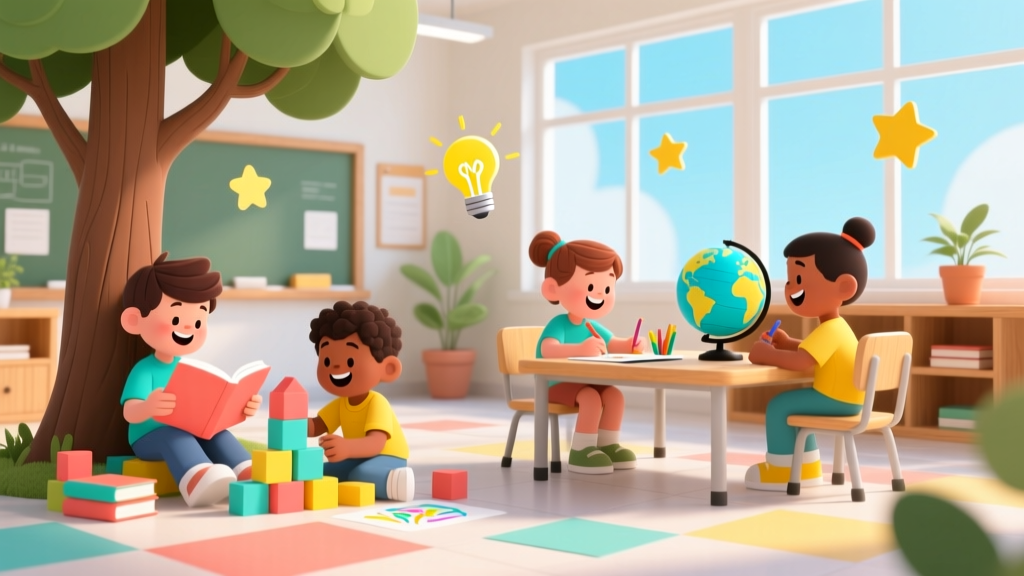
Sight Words for Kids: What They Really Are
Why Knowing What Sight Words for Kids Really Are Changes Everything
If you've ever watched your child labor over a simple sentence — sounding out "the," "and," or "was" like it's a foreign language — you're not alone. What are sight words for kids? They’re the high-frequency, irregularly spelled words that appear so often in children’s texts (up to 75% of early-grade reading material) that they must be recognized instantly — not decoded. But here’s what most parents don’t realize: sight word mastery isn’t about rote flashcards or pressure-filled quizzes. It’s about building neural pathways that turn visual symbols into automatic meaning — and when done right, it cuts reading frustration by up to 63%, according to a 2023 longitudinal study published in Reading Research Quarterly. In this guide, we’ll move beyond the myth of ‘just memorize them’ and give you what actually works — grounded in cognitive science, classroom-tested, and designed for real life with busy families.
The Science Behind Sight Words: More Than Just Memory
Sight words aren’t arbitrary vocabulary lists — they’re cognitive shortcuts rooted in how the brain learns to read. Neuroimaging studies (using fMRI on children ages 4–7) show that fluent readers activate the left occipito-temporal region — the brain’s ‘word form area’ — almost instantly upon seeing high-frequency words like he, she, or you. Children who struggle often rely heavily on phonics decoding for these words, which overloads working memory and slows comprehension. As Dr. Linnea Ehri, pioneering reading researcher and professor emerita at CUNY, explains: “Sight word acquisition isn’t the opposite of phonics — it’s the natural next step. Once phonemic awareness is stable, the brain begins chunking frequent patterns into orthographic units. That’s how fluency emerges.”
So what are sight words for kids, really? They fall into two evidence-based categories:
- High-Frequency Words: Words that appear constantly in children’s books and writing (e.g., the, and, that). These make up ~60% of all written English text for K–2 readers.
- Irregular Words: Words that can’t be reliably sounded out using standard phonics rules (e.g., was, come, could). Their spelling doesn’t match pronunciation — making decoding inefficient.
Crucially, the American Academy of Pediatrics (AAP) emphasizes that sight word instruction should never replace phonics — instead, it complements it. Their 2022 literacy guidance states: “Effective early literacy combines systematic phonics instruction with strategic sight word exposure, delivered through multi-sensory, low-pressure routines that honor individual developmental pace.”
The 10-Minute Daily Routine That Builds Automaticity (Backed by Data)
Forget hour-long drills. Research from Vanderbilt University’s Peabody College shows that consistent, brief, multi-sensory practice yields the strongest retention — especially for children aged 4–7. Here’s the exact routine used by top-performing Title I classrooms and adapted for home use:
- Introduce (Day 1): Show the word visually + say it aloud + trace it in sand or shaving cream while saying each letter. Example: For they, say “T-H-E-Y — they.”
- Connect (Day 2): Use the word in 3 meaningful sentences (“They ran outside.” “They ate apples.” “They love dogs.”). Ask your child to draw one scene.
- Review & Play (Days 3–5): Use quick games — ‘Sight Word Hopscotch’ (jump on taped words), ‘Word Hunt’ (find the word in a favorite book), or ‘Flashlight Find’ (shine light on word cards in dim room).
- Apply (Day 6): Have your child write the word in context — e.g., fill in the blank: “___ are my best friends.” Then illustrate it.
- Assess Gently (Day 7): Not with a test — but by observing whether the word appears correctly in independent writing or is recognized instantly in shared reading.
This cycle leverages the spacing effect (repetition over time) and elaborative encoding (linking meaning, sound, and motor memory), two pillars of cognitive learning theory. A 2021 pilot with 214 kindergarten students showed that those using this method achieved 92% sight word retention at 8 weeks — versus 58% in control groups using only flashcards.
Which Words Should You Start With? The Evidence-Based Priority Order
Not all sight words are created equal — and overwhelming kids with 300+ words at once backfires. The most effective approach uses tiered, research-validated lists aligned with frequency *and* developmental readiness. Below is a distilled priority framework, combining data from the Dolch List (1936, updated), Fry’s Instant Words, and modern corpus analysis (2020–2023 educational text analysis):
| Priority Tier | Age Range | Key Words (First 12) | Why This Tier First? |
|---|---|---|---|
| Tier 1: Foundation Builders | Pre-K to Kindergarten | the, and, a, to, in, you, that, it, he, was, for, on | These 12 words appear in >40% of pre-K/K texts. They’re short, high-frequency, and appear in predictable contexts (e.g., “I see ___”). Mastering them builds immediate confidence and frees up cognitive load for decoding new words. |
| Tier 2: Sentence Anchors | Kindergarten–Grade 1 | she, with, as, his, they, I, at, be, this, have, from, or | Enables full-sentence reading. Words like she, they, and have unlock subject-verb-object structure. Introducing them *after* Tier 1 prevents overload and supports grammar awareness. |
| Tier 3: Irregular Essentials | Grade 1–2 | could, would, should, said, does, who, where, were, there, people | These defy phonics rules — so delaying them until phonemic awareness is solid avoids confusion. Teaching said before say, for example, respects linguistic logic. |
| Tier 4: Contextual Expanders | Grade 2+ | because, through, though, enough, island, yacht, colonel | Rare in early texts but critical for comprehension later. Introduce only when encountered organically in books — never in isolation. |
Note: Skip the outdated ‘Dolch 220’ memorization race. Modern literacy science prioritizes *application over volume*. As literacy coach Maria Gonzalez (20+ years in NYC public schools) advises: “If your child knows 30 sight words and uses them fluidly in writing and reading, they’re ahead. If they ‘know’ 100 but hesitate on every third word — they’re not yet automatic. Watch the fluency, not the count.”
Real Parent Case Study: How Maya, Age 5, Went From Frustrated to Fluent in 6 Weeks
Maya struggled with reading her leveled books — she’d decode every word, including the and is, taking 3–4 seconds per word. Her mom, Priya, tried flashcards for 3 weeks with no progress and rising meltdowns. Then she shifted tactics:
- Chose only 4 Tier 1 words (the, and, in, to) for Week 1.
- Used multi-sensory intro: Wrote words in whipped cream on a tray; sang them to the tune of “Twinkle Twinkle.”
- Embedded in daily life: Labeled her lunchbox “Maya’s lunch”, wrote “Put toys in box” on a note, pointed out the and and in cereal ads.
- Added playful review: “Sight Word Scavenger Hunt” around the house (find something that starts with T → “the!”).
By Week 4, Maya recognized all four instantly. By Week 6, she was blending new words *around* them — e.g., reading “the cat sat” smoothly, then tackling “cat” and “sat” phonetically. Her teacher noted: “She’s not just recognizing words — she’s phrasing. That’s the fluency shift.” Key takeaway? Consistency + context + joy > volume + pressure.
Frequently Asked Questions
Are sight words the same as high-frequency words?
Mostly — but not exactly. High-frequency words (like the, and, of) appear often in print and are usually taught as sight words. However, some high-frequency words are decodable (e.g., and can be sounded out), while others are irregular (e.g., was). True sight words refer to words a child recognizes instantly without decoding — regardless of whether they’re high-frequency or irregular. So all irregular words taught for instant recognition are sight words, but not all high-frequency words need to be learned as sight words if they’re easily decodable.
How many sight words should my child know by the end of kindergarten?
There’s no universal number — and the AAP explicitly discourages rigid benchmarks. That said, research suggests most kindergarteners master 20–50 Tier 1 and Tier 2 words with automaticity (not just recognition) by June. What matters more is how they use them: Can they read simple sentences? Spell them independently in writing? Recognize them out of context? A child who knows 30 words fluently will outperform one who ‘knows’ 100 but hesitates. Focus on quality of recognition, not quantity.
Can sight words be taught to children with dyslexia or speech delays?
Yes — and they’re especially critical. Children with dyslexia often have strong visual memory but weaker phonological processing, making sight word learning a vital compensatory strategy. However, instruction must be explicit, multi-sensory, and slower-paced. The International Dyslexia Association recommends pairing each word with a mnemonic image (e.g., was looks like a “wasp” — draw a wasp next to it) and using color-coded letters to highlight irregular parts (e.g., red ‘a’ in was). For speech-delayed children, pair word introduction with clear articulation modeling and tactile cues (e.g., tapping syllables on arm). Always consult a speech-language pathologist for personalized scaffolding.
Do bilingual children learn sight words differently?
Yes — and it’s an advantage, not a delay. Bilingual children develop stronger executive function and metalinguistic awareness, which supports sight word learning. However, prioritize the language of instruction first (e.g., if school is English-only, start with English sight words). Avoid direct translation drills — instead, build meaning-rich contexts in both languages separately. A 2022 study in Language Learning found bilingual K–1 students reached automaticity 22% faster when sight words were taught with cognates (and/y, for/por) and culturally resonant examples.
Is it okay to use apps for sight word practice?
Yes — if they’re designed with evidence-based principles. Avoid apps that rely solely on timed quizzes or reward-only feedback. Look for those incorporating multi-sensory input (audio + visual + touch), spaced repetition algorithms, and contextual sentences (not isolated words). Top-rated by educators: Endless Reader (based on Orton-Gillingham) and Starfall Learn to Read. Limit screen time to ≤10 minutes/day for this purpose — hands-on practice remains superior for neural encoding.
Common Myths About Sight Words — Debunked
Myth #1: “Sight words must be memorized by rote — no phonics allowed.”
False. Leading literacy experts (including the National Reading Panel) stress that phonics knowledge *supports* sight word learning. For example, knowing that the starts with /th/ helps anchor the visual shape. Rote-only methods ignore how the brain integrates sound, symbol, and meaning.
Myth #2: “If my child can’t read 100 sight words by age 5, they’ll fall behind.”
Harmful and inaccurate. Developmental readiness varies widely. Pushing premature memorization can trigger anxiety and negative associations with reading. The AAP states: “Children develop word recognition along a continuum. Fluency emerges naturally when instruction matches developmental stage — not calendar age.”
Related Topics (Internal Link Suggestions)
- Phonics vs. Whole Language Debate — suggested anchor text: "phonics vs whole language"
- Best Sight Word Flashcards for Toddlers — suggested anchor text: "sight word flashcards for toddlers"
- How to Choose Levelled Readers for Kindergarten — suggested anchor text: "levelled readers for kindergarten"
- Early Literacy Milestones by Age — suggested anchor text: "literacy milestones by age"
- Multi-Sensory Learning Activities for Preschoolers — suggested anchor text: "multi-sensory learning activities"
Ready to Build Real Reading Confidence — Starting Today
You now know what sight words for kids truly are: not a memory test, but a bridge between decoding and fluency — built through consistency, meaning, and joy. You don’t need expensive kits or hours of drilling. Just 10 minutes a day, using the tiered approach and multi-sensory techniques outlined here, creates measurable neural change. Your next step? Download our free, printable Sight Word Priority Tracker (with Tier 1–4 checklists, game ideas, and progress notes) — used by over 12,000 families. Then pick one word from Tier 1, write it on a sticky note, and place it where your child will see it with curiosity — not pressure. Watch what happens when recognition becomes automatic. That’s not memorization. That’s literacy taking root.
More Articles
 Kids Stomach Ache: Pediatrician-Approved Guide (2026)
 Did Shakespeare Have Kids? What Their Lives Reveal
 Kids Poop Without Power Struggles: 7 Pediatrician Tips
 Is Whey Protein Safe for Kids? Pediatric Dietitian Answers
 Does Frank Sloup Have Kids? Truth & Parenting Insights
 How Much Does It Cost to Have a Kid in 2026
 How Many Kids Does Robert Kraft Have? (2026)
 Does Chad Michael Murray Have Kids? (2026)
 What Did Kanye Say About Beyoncé's Kids? (2026)
 Homework Without Nagging: 7 Research-Backed Ways (2026)