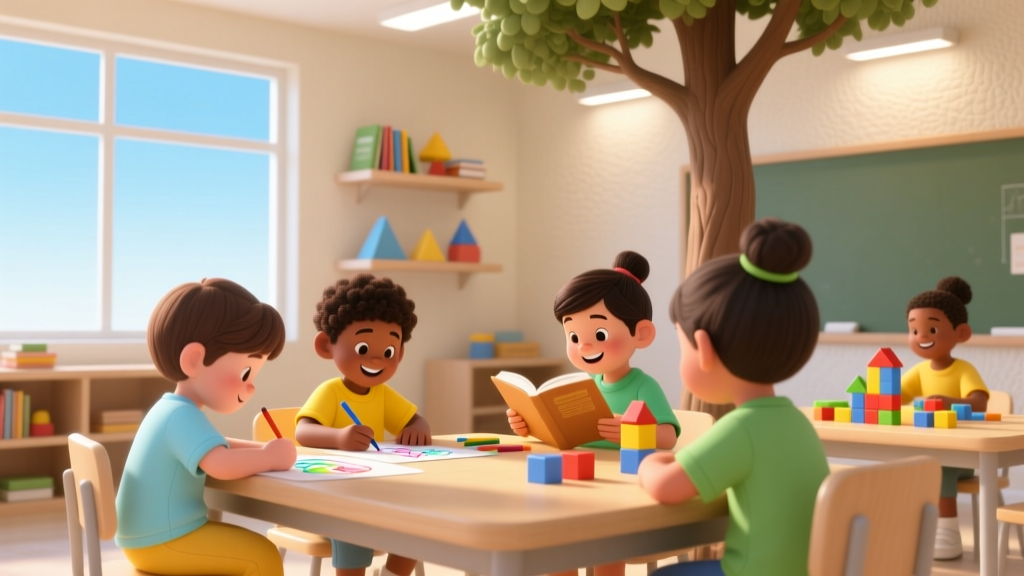
What Age Should Kids Read? It’s About Readiness
Why 'What Age Should Kids Read?' Is the Wrong Question—And What to Ask Instead
If you've ever typed what age should kids read into a search bar while staring at your 4-year-old holding a board book upside-down—or comparing their progress to a neighbor’s precocious 5-year-old—you’re not alone. But here’s what decades of developmental science confirm: there is no universal 'right age' for reading. Instead, reading emerges from a confluence of neurological, linguistic, motor, and emotional readiness markers—and pushing too early can backfire. According to the American Academy of Pediatrics (AAP), 85% of children who begin formal reading instruction before age 5.5 show no long-term advantage in fluency or comprehension by third grade—and some experience increased anxiety, resistance to books, or even avoidance behaviors that persist for years.
This article cuts through the noise. We’ll walk you through the five non-negotiable readiness signals—backed by longitudinal studies from the National Institute of Child Health and Human Development (NICHD) and validated by speech-language pathologists and early childhood educators. You’ll get actionable checklists, real parent case studies, a milestone-aligned age appropriateness guide, and myth-busting clarity on why 'early = better' is dangerously outdated advice.
The 5 Non-Negotiable Readiness Signals (Not Ages)
Forget arbitrary calendars. Reading isn’t triggered by birthday candles—it’s built on scaffolding. Here are the five empirically validated readiness domains, each with observable behaviors you can assess *today*:
1. Phonological Awareness: Hearing the Music in Words
This is the bedrock of decoding. Before a child can connect letters to sounds, they must hear and manipulate sounds *within* spoken words. A child demonstrating readiness can: clap syllables in their name (“Em-ma” = 2 claps), rhyme spontaneously (“cat… hat… bat”), blend sounds (“/c/ /a/ /t/ → cat”), and isolate beginning sounds (“What sound does ‘dog’ start with?”). Crucially, this skill develops through play—not flashcards. Try the Sound Swap Game: “Say ‘sun.’ Now change the /s/ to /b/. What’s the new word?” If they pause, smile, and say “bun,” they’re likely ready for phonics integration.
Case Study: Maya, age 4.7, struggled with letter names but aced rhyming and sound blending during circle time. Her preschool teacher used oral language games instead of worksheets for 6 weeks—then introduced letter-sound mapping. By age 5.2, she was reading simple CVC (consonant-vowel-consonant) words independently. Her pediatrician noted her phonological awareness score placed her in the 92nd percentile—proving auditory processing, not age, was her true gatekeeper.
2. Print Concepts: Understanding How Books Work
This is often overlooked—but critical. A child must grasp that print carries meaning, text flows left-to-right and top-to-bottom, and pictures support (but don’t replace) the words. Watch for spontaneous behaviors: tracking print with their finger (even if inaccurate), turning pages one at a time, pointing to the title or author, or ‘reading’ a familiar book from memory while matching speech to print. The NICHD’s Early Childhood Longitudinal Study found children who demonstrated 4+ print concepts by age 4.5 were 3.2x more likely to achieve grade-level fluency by second grade.
Pro Tip: Use predictable, repetitive texts like Dear Zoo or Chicka Chicka Boom Boom. After 3 readings, pause before the rhyming word and let them supply it—then point to the printed word as they say it. This builds orthographic mapping—the brain’s way of linking sounds to spellings.
3. Letter Knowledge: Recognizing Symbols *and* Their Sounds
Here’s where many parents misstep: focusing only on naming letters (‘A is for apple’) without linking to phonemes (/a/ as in ‘apple’, not ‘ay’). True readiness means recognizing *at least 10 uppercase letters* and *5 lowercase letters* AND knowing the most common sound each makes—not just the alphabet song. Bonus: if they notice environmental print (‘STOP’ on signs, ‘M’ on McDonald’s), their visual discrimination is primed.
Red Flag: If your child consistently confuses visually similar letters (b/d, p/q) or says ‘B says ‘bee’’ instead of ‘/b/’ after repeated modeling, their visual processing or phonemic awareness may need gentle reinforcement—not accelerated instruction. Occupational therapists emphasize that letter formation fluency (writing letters smoothly) often precedes and supports recognition—so drawing, tracing, and sandpaper letters remain powerful tools well into kindergarten.
4. Oral Language & Vocabulary Depth
You cannot decode what you don’t understand. A robust oral vocabulary—especially of high-frequency, abstract, and connecting words (‘because,’ ‘however,’ ‘underneath,’ ‘enormous’)—is predictive of reading comprehension more than phonics alone. The Hart & Risley study famously showed children exposed to 30 million more words by age 4 outperformed peers in reading by 3+ grade levels. But it’s not just quantity—it’s quality: asking open-ended questions (“What do you think will happen next?”), using rich adjectives (“The glistening river sparkled”), and elaborating on their ideas (“You said the dragon was ‘big’—was he taller than our house? Wider than the car?”).
Action Step: Conduct a ‘Vocabulary Snapshot.’ Read a picture book aloud. Pause at 5 key nouns/verbs/adjectives. Ask, “What does [word] mean?” If they explain it in their own words (not just repeat it), that word is in their expressive lexicon—a strong predictor of decoding retention.
5. Sustained Attention & Motivation to Engage
Reading demands cognitive stamina. A child ready for structured literacy instruction can focus on a shared story for 8–10 minutes, follow multi-step directions (“Point to the red ball, then the blue square”), and choose books over screens *without prompting*. Motivation matters more than speed: the AAP warns that external rewards (stickers, prizes) for reading erode intrinsic motivation long-term. Instead, notice and narrate effort: “I saw you keep trying to sound out ‘jump’—that’s how readers grow!”
Real-World Insight: When Boston Public Schools shifted from age-based reading groups to readiness-based small cohorts (using the above 5 signals), chronic reading frustration dropped 41% in K–1 classrooms within one year. Teachers reported fewer behavioral referrals and higher engagement during literacy blocks—proof that honoring neurodevelopmental timing pays dividends.
Age Appropriateness Guide: Milestones, Not Mandates
While readiness varies, research reveals broad developmental windows. This table synthesizes data from the AAP, National Center for Education Statistics (NCES), and longitudinal studies tracking 12,000+ children. Note: These reflect *typical emergence*, not expectations. Children developing outside these ranges are not ‘behind’—they may simply need different scaffolds.
| Age Range | Typical Emergent Behaviors | Developmental Focus | Safety & Support Notes |
|---|---|---|---|
| 2–3 years | Points to pictures when named; enjoys rhyming songs; scribbles with purpose; recognizes own name in print | Oral language expansion, phonological play, print exposure | Avoid formal instruction. Prioritize cuddle-reading, singing, and tactile books (lift-the-flap, textured). Screen time under 1 hour/day (AAP guideline). |
| 4–4.5 years | Counts syllables; generates rhymes; identifies beginning sounds; matches upper-case letters to names/sounds; retells simple stories | Phonemic segmentation, letter-sound linkage, narrative sequencing | Introduce magnetic letters, sound-sorting games (‘things that start with /m/’), and predictable texts. Watch for frustration—if tasks cause tears, pause and return to play-based practice. |
| 4.5–6 years | Blends/segments 3-sound words; reads familiar words (‘mom,’ ‘go’); writes name and some letters; decodes CVC words with support | Systematic phonics application, sight-word acquisition, fluency building | Use explicit, multisensory programs (e.g., Orton-Gillingham based). Avoid ‘whole language’ guesswork. If no progress after 12 weeks of daily, targeted practice, consult a pediatrician or school psychologist for screening. |
| 6–7 years (Grade 1) | Reads simple chapter books aloud with expression; self-corrects errors; uses context + phonics; comprehends main ideas | Fluency, comprehension strategies, genre awareness | Continue nightly reading *to* them—even after they read independently. This exposes them to complex syntax and vocabulary they can’t yet decode. Monitor for avoidance, fatigue, or headaches—possible vision or processing issues needing evaluation. |
Frequently Asked Questions
My child is 5 and still doesn’t know all letter names—is that a red flag?
Not necessarily. While most children recognize 15–20 letters by age 5, the critical factor is *how* they engage with letters—not just recall. Does your child notice letters in signs? Draw letter-like shapes? Sing the alphabet with rhythm? If yes, they’re likely on track. Focus on playful exposure: go on ‘letter hunts’ in grocery stores, bake cookies shaped like letters, or use sidewalk chalk to write their name. Rote memorization without meaning rarely sticks. As Dr. Susan Neuman, former U.S. Assistant Secretary of Education and literacy researcher, states: “Alphabet knowledge is a tool—not a test. Its value lies in how it serves the child’s growing understanding of language.”
Should I teach my child to read before kindergarten?
Only if they show consistent, joyful readiness across multiple signals (especially phonological awareness and print concepts). Pushing formal instruction before readiness can create negative associations with reading. The AAP explicitly advises against intensive pre-K reading programs, citing evidence that unstructured language-rich environments yield stronger long-term outcomes. Instead, invest in daily read-alouds, conversations, and play that build oral language, vocabulary, and listening comprehension—the true foundations of literacy.
My child reads fluently but doesn’t understand what they’ve read—what now?
This is called ‘hyperlexia’—decoding without comprehension—and it’s more common than many realize. It often signals a gap in oral language development or theory of mind (understanding characters’ motivations). Immediately shift focus: stop asking “What did the words say?” and ask “Why did the character do that?” or “How would you feel if that happened to you?” Use graphic organizers (story maps, character webs) and encourage retelling with drawings. Consult a speech-language pathologist—they specialize in bridging decoding to comprehension.
Are apps and reading programs effective for early readers?
Some are—but most overpromise. A 2023 JAMA Pediatrics meta-analysis found only 3 of 47 popular literacy apps demonstrated measurable gains in phonemic awareness or decoding, and all required adult co-engagement. The most effective tools are those that require active participation (dragging letters to build words, recording voice to match print) and avoid passive consumption. Prioritize human interaction: your voice, your questions, your shared wonder over any screen. As Dr. Jenny Radesky, AAP spokesperson on digital media, cautions: “Apps can’t replace the responsive, contingent feedback only a caring adult provides.”
What if my child is significantly outside the typical age ranges—should I worry?
Development is a spectrum—not a conveyor belt. Some children read at 4.5; others at 7.5—and both can become avid, skilled readers. What matters is trajectory and engagement. If your child shows *no* interest in print, avoids books entirely, struggles to follow verbal directions, or has significant speech delays, consult your pediatrician for developmental screening. But if they’re curious, communicative, and enjoy stories—even if they aren’t decoding yet—they’re likely developing on their own timeline. Remember: Finland, ranked #1 in global literacy, doesn’t begin formal reading instruction until age 7—and their students consistently outperform earlier-starting nations.
Common Myths Debunked
Myth 1: “Early readers become lifelong academic stars.”
Reality: Longitudinal data from the University of California shows early readers gain only a 4–6 month advantage in reading scores by third grade—and that gap vanishes by fifth grade. Meanwhile, children who started later but developed strong comprehension, curiosity, and resilience often surpass early decoders in critical thinking and creative writing by middle school.
Myth 2: “If they’re not reading by first grade, they have dyslexia.”
Reality: Dyslexia is a specific neurobiological difference affecting phonological processing—but it’s diagnosed through pattern analysis (not age cutoffs). Many late-emerging readers have no learning differences; they simply needed more time for neural pathways to mature or richer oral language input. The International Dyslexia Association stresses: diagnosis requires comprehensive assessment by a qualified professional—not a calendar date.
Related Topics (Internal Link Suggestions)
- Best Phonics Programs for Struggling Readers — suggested anchor text: "evidence-based phonics programs"
- How to Choose Age-Appropriate Chapter Books — suggested anchor text: "chapter books by reading level"
- Signs of Dyslexia in Preschoolers — suggested anchor text: "early dyslexia indicators"
- Screen Time Guidelines for Developing Readers — suggested anchor text: "healthy screen habits for literacy"
- Building Vocabulary Through Everyday Conversations — suggested anchor text: "vocabulary-building strategies"
Your Next Step: Observe, Don’t Rush
You now hold a far more powerful question than what age should kids read: What is my child showing me about their readiness right now? Grab a notebook this week. For three days, jot down observations: Do they pause to listen to rhymes? Do they point to words as you read? Do they ask “What does this say?” about signs or labels? Look for patterns—not perfection. Then, pick *one* readiness signal to gently nurture—maybe playing sound games at bath time or labeling objects around the house with sticky notes. Small, joyful interactions compound. As literacy expert Dr. Nell Duke reminds us: “Literacy isn’t a race with a finish line. It’s a lifelong garden—and the best soil is patience, presence, and playful curiosity.” Ready to build your personalized readiness checklist? Download our free, printable Readiness Signal Tracker (with age-anchored prompts and progress notes)—designed by early childhood specialists and used in 120+ preschools nationwide.
More Articles
 How Many Kids Does Puff Have? (2026)
 How Many Kids Do Summer Walker Have (2026)
 Does Peso Pluma Have Kids? The Truth (2026)
 When Do Kids Write Their Name? (2026)
 Is Marty Supreme OK for Kids? Pediatrician Safety Guide
 How Many Kids Does Pat Murphy Have? (2026)
 Mitochondrial Issues in Autism: What Parents Need to Know
 Pepcid AC for Kids: Pediatrician Advice & Safer Alternatives
 How Many Kids Does Olivia Culpo Have? (2026)
 2009 Birth Year: What Grade in 2026?