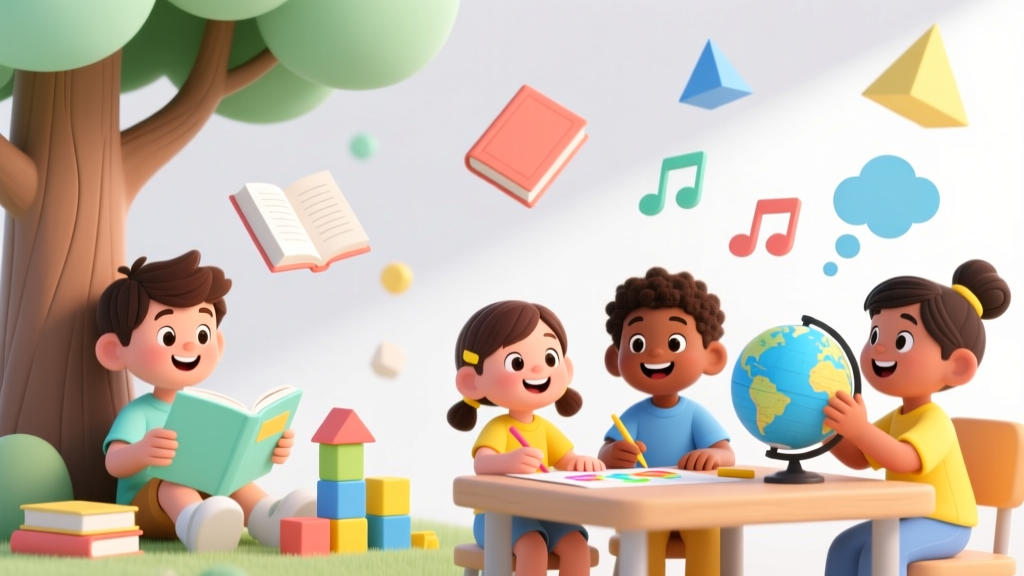
What Age Should Kids Learn to Read? (2026)
Why This Question Keeps Parents Up at Night — And Why the Answer Isn’t a Number
Every parent asking what age should kids learn to read is really asking: “Am I failing my child? Is something wrong? Will they fall behind forever?” That quiet panic — the one that flares when your neighbor’s 4-year-old reads street signs fluently while your bright, curious 6-year-old still struggles with letter sounds — is completely understandable. But here’s what decades of developmental science confirm: reading is not like walking or talking. It’s a complex cognitive skill built on layered neurobiological foundations, and its emergence varies widely — not because of intelligence or effort, but because of individual brain maturation, language exposure, sensory processing, and even birth season. In fact, research from the National Institute of Child Health and Human Development shows that children who begin formal decoding instruction between ages 5 and 7 show no long-term academic advantage over peers who start at 8 — as long as they receive responsive, structured support.
The Myth of the Magic Age — And What Readiness *Actually* Looks Like
Let’s start by dismantling the biggest misconception: that there’s a universal ‘right age’ encoded in biology. There isn’t. What exists instead are readiness indicators — observable, measurable behaviors rooted in oral language, phonological awareness, print concepts, and executive function. According to Dr. Hollis Scarborough, developer of the influential ‘Reading Rope’ model, fluent reading emerges only when two intertwined strands — ‘language comprehension’ and ‘word recognition’ — develop in concert. Neither strand matures on a fixed calendar.
Consider Maya, a vibrant 5½-year-old referred to our early literacy clinic after her kindergarten teacher expressed concern. She knew all her letters, could rhyme ‘cat’ with ‘hat’, and loved being read to — yet couldn’t blend /c/ /a/ /t/ into ‘cat’. An assessment revealed strong vocabulary and narrative skills but weak phonemic segmentation (the ability to isolate sounds in words). Her brain was ready for comprehension — but not yet wired for the fine-grained auditory processing required for decoding. With targeted, play-based phoneme manipulation games (e.g., ‘sound scavenger hunts’ where she collected objects starting with /b/), she began blending confidently by age 6. Her story isn’t delay — it’s neurodiverse timing.
True readiness isn’t about reciting the alphabet. It’s about behaviors you can observe *before* formal instruction:
- Phonological awareness: Clapping syllables in names (“El-i-zab-eth”), identifying rhyming words, or playing ‘I spy’ with beginning sounds (“I spy something that starts with /m/”)
- Print awareness: Knowing books have front/back covers, text moves left-to-right, and that spoken words map to written symbols
- Oral language depth: Using rich vocabulary (e.g., ‘enormous’ instead of ‘big’), telling multi-step stories, asking ‘why’ and ‘how’ questions
- Executive function stamina: Sustaining attention for 10–15 minutes during shared reading or listening to longer picture books without constant redirection
Crucially, these skills bloom most robustly in environments rich in responsive conversation, varied vocabulary, and playful interaction — not flashcards or worksheets. As Dr. Dana Suskind, founder of the Thirty Million Words Initiative, emphasizes: “It’s not how much you talk *at* your child — it’s how much you talk *with* them, building on their cues.”
What the Data Says: A Developmental Timeline (Not a Deadline)
While rigid age targets mislead, large-scale longitudinal studies *do* reveal typical windows — and crucially, where intervention yields the highest impact. The landmark Early Childhood Longitudinal Study (ECLS-K) tracked over 21,000 U.S. kindergarteners and found that 82% demonstrated foundational decoding skills (sounding out CVC words like ‘dog’, ‘sun’) by the end of first grade (age 6–7). But 12% didn’t reach this milestone until second grade — and 94% of those children were reading at or above grade level by fourth grade, provided they received consistent, evidence-based support.
Here’s what the research-based progression looks like — not as a checklist, but as overlapping, fluid phases:
| Age Range | Typical Emergent Literacy Behaviors | Critical Support Strategies | Risk Flags (Warrant Professional Consultation) |
|---|---|---|---|
| 3–4 years | Recognizes own name in print; enjoys rhyming games; points to pictures while ‘reading’ familiar books; asks about letters/sounds | Read aloud daily with animated expression; pause to predict ‘What happens next?’; play sound-matching games (‘Which toy starts with /b/?’); label objects using rich vocabulary | No interest in books/stories; cannot identify any letters by age 4; struggles to follow simple 2-step directions; limited vocabulary (<50 words by age 3) |
| 4–5 years | Names most letters (especially those in own name); isolates beginning sounds; ‘writes’ using scribbles or invented spelling; understands stories have beginning/middle/end | Introduce letter-sound links through multisensory play (sandpaper letters, magnetic letters); encourage storytelling with props; write grocery lists together using child’s invented spelling | Cannot rhyme or segment syllables by age 5; confuses similar-looking letters (b/d/p/q) consistently; avoids all print-related activities |
| 5–7 years | Blends and segments 3–4 phonemes; reads simple CVC words; uses context and pictures to guess unknown words; writes short sentences with phonetic spelling | Use explicit, systematic phonics instruction (e.g., Orton-Gillingham or Wilson Fundations); reread favorite books to build fluency; discuss characters’ feelings/motivations to deepen comprehension | No improvement in decoding after 6+ months of high-quality instruction; reverses letters/numbers beyond age 7; extreme frustration or avoidance during reading tasks |
| 7+ years | Reads chapter books fluently; self-corrects errors; infers meaning; reads for information and pleasure | Provide high-interest, accessible texts (graphic novels, nonfiction on passions); teach metacognitive strategies (‘What do I already know about this topic?’); encourage reading aloud to younger siblings or pets | Persistent letter/word reversals; guessing based solely on first letter; inability to retain meaning after reading a paragraph; significant fatigue or headaches during reading |
When ‘Late’ Isn’t ‘Behind’ — Redefining Progress for Neurodiverse Learners
For children with dyslexia, ADHD, language processing disorders, or auditory neuropathy, the traditional timeline often doesn’t apply — and that’s not failure. It’s neurology. Dyslexia, affecting 15–20% of the population (International Dyslexia Association), is characterized by difficulty with accurate and/or fluent word recognition and poor spelling, despite average or above-average intelligence. Critically, it’s not a vision problem, a lack of motivation, or a sign of low IQ. It’s a difference in how the brain processes written language.
Taking Leo as an example: diagnosed with dyslexia at age 8, he’d spent years frustrated by ‘sight word’ memorization. His school used a whole-language approach, emphasizing context clues — which backfired because his working memory couldn’t hold enough contextual information to guess accurately. When he switched to a structured literacy program with daily, intensive phonemic awareness training and explicit grapheme-phoneme mapping, his progress accelerated dramatically. By age 10, he wasn’t just reading — he was devouring fantasy novels and writing elaborate fan fiction. His ‘late’ start wasn’t a deficit; it was the result of mismatched instruction.
Key principles for supporting diverse readers:
- Assessment before assumption: If a child hasn’t made expected progress by mid-first grade, request a comprehensive evaluation from a licensed educational psychologist or speech-language pathologist — not just a school screening. Look for assessments covering phonological processing, rapid automatized naming (RAN), working memory, and oral language.
- Instruction must be explicit, systematic, cumulative, and diagnostic: Programs like Lindamood-Bell’s LiPS or Barton Reading & Spelling meet these criteria. Avoid ‘balanced literacy’ models heavy on leveled readers and cueing strategies (‘Does it look right? Sound right? Make sense?’) — research shows they hinder struggling readers.
- Leverage strengths: Many dyslexic learners excel in big-picture thinking, spatial reasoning, creativity, and oral storytelling. Integrate audiobooks, graphic novels, and oral presentations to maintain engagement and build knowledge while decoding skills develop.
As Dr. Sally Shaywitz, co-director of the Yale Center for Dyslexia & Creativity, states: “Dyslexia is not a barrier to success — it’s a different operating system. Our job isn’t to make the brain ‘normal,’ but to provide the right interface.”
Your Action Plan: From Worry to Empowered Support
You don’t need a degree in neuroscience to help your child thrive. You need observation, responsiveness, and knowing when to seek expert partnership. Here’s your practical roadmap:
- Observe, don’t compare: Keep a simple journal for 2 weeks. Note: How long does your child sustain attention during shared reading? What kinds of books do they choose? Do they ask questions about words or pictures? Do they enjoy singing songs or playing with rhymes? Patterns emerge faster than judgments.
- Build the foundation, not the skill: Prioritize oral language richness over drill. Describe the rainstorm’s ‘pitter-patter’ and ‘gushing downspouts.’ Compare the ‘crunchy’ apple to the ‘juicy’ orange. Ask open-ended questions: ‘What do you think the squirrel is feeling?’ ‘Why did the character make that choice?’
- Make print meaningful: Label drawers with words and pictures. Write thank-you notes together. Cook using a simple recipe. Let your child ‘read’ the menu at a restaurant — they’ll use pictures, context, and prior knowledge to navigate it.
- Partner with educators — strategically: At parent-teacher conferences, ask: ‘What specific phonological awareness skills is my child mastering? Which ones are emerging? What data supports this?’ Request work samples showing decoding attempts, not just final products.
- Know your rights: In the U.S., IDEA guarantees free appropriate public education. If your child isn’t progressing, you have the right to request a formal evaluation. Document all concerns and communications. Organizations like Decoding Dyslexia offer state-specific advocacy resources.
Frequently Asked Questions
Is it harmful to teach reading before age 5?
Not inherently — but *how* you teach matters profoundly. Pushing formal decoding (sounding out words) before a child demonstrates phonemic awareness (hearing and manipulating sounds) often backfires, creating anxiety and negative associations with reading. However, joyful, play-based literacy experiences — singing nursery rhymes, playing with magnetic letters, ‘writing’ shopping lists — are beneficial at any age. The American Academy of Pediatrics advises against formal academic instruction before kindergarten, emphasizing that play is the essential work of early childhood.
My child reads fluently but doesn’t understand what they’ve read. What’s happening?
This is called ‘hyperlexia’ or more commonly, a ‘decoding-comprehension gap.’ It suggests strong word recognition skills but underdeveloped language comprehension — often linked to vocabulary gaps, weak inference skills, or difficulties with narrative structure. Focus on deep discussion *before*, *during*, and *after* reading: ‘What do you already know about dogs?’ (before), ‘Why do you think she’s hiding?’ (during), ‘How would you feel if that happened to you?’ (after). Audiobooks paired with physical books can also build comprehension while decoding develops.
Are boys really later readers than girls? Is this biological?
Data shows a small average difference (about 3–4 months earlier for girls in early literacy milestones), but it’s largely attributed to socialization and classroom dynamics — not hardwired biology. Boys are often less engaged by early reading materials (dominated by narratives about friendship and emotions) and may respond better to nonfiction, comics, or interactive digital texts. More importantly, labeling boys as ‘late’ can become a self-fulfilling prophecy. Focus on interests: a boy obsessed with dinosaurs will learn to read ‘Tyrannosaurus rex’ long before ‘the cat sat on the mat.’
Can screen time help or hurt early reading development?
It depends entirely on quality and context. Passive consumption (background TV, endless scrolling) displaces the rich, responsive interactions critical for language development. However, high-quality, co-viewed apps with intentional design — like PBS Kids’ ‘Super Why!’ (which explicitly teaches phonics) or Epic! Books for Kids (with read-aloud features and adjustable text size) — can supplement learning. The key is joint media engagement: watch or read *together*, pause to discuss, connect content to real life. Never substitute screens for human interaction — especially for children under 3.
What if English isn’t our home language? Does that change the timeline?
Children learning to read in a language different from their home language face a dual challenge: acquiring academic English *and* mastering decoding. Research shows bilingual children often catch up to monolingual peers in reading by third grade — but they need robust support in *both* languages. Continue speaking your home language richly and authentically; it builds cognitive flexibility and provides the linguistic foundation for learning English. Seek schools with strong dual-language programs or ESL specialists trained in structured literacy. Bilingualism is an asset, not a delay.
Common Myths
Myth #1: “If they’re not reading by first grade, they’ll never catch up.”
False. Longitudinal studies consistently show that children who begin reading in second or even third grade — when provided with evidence-based intervention — achieve grade-level proficiency and often surpass peers in comprehension and critical thinking by middle school. The brain remains highly plastic well into adolescence.
Myth #2: “More practice = faster progress.”
Not always — and sometimes, it’s counterproductive. For struggling readers, repetitive, unstructured practice without corrective feedback reinforces errors and erodes confidence. Effective practice is brief (15–20 mins), highly focused on a specific skill (e.g., blending /sh/ /i/ /p/), immediately followed by feedback and application in a real text. Quality trumps quantity every time.
Related Topics (Internal Link Suggestions)
- Best Phonics Programs for Struggling Readers — suggested anchor text: "evidence-based phonics programs"
- How to Choose Books for Emerging Readers — suggested anchor text: "level-appropriate children's books"
- Signs of Dyslexia in Preschoolers — suggested anchor text: "early dyslexia indicators"
- Building Vocabulary at Home — suggested anchor text: "oral language development activities"
- Screen Time Guidelines for Preschoolers — suggested anchor text: "healthy media habits for young children"
Conclusion & Your Next Step
So — what age should kids learn to read? The most honest, empowering answer is: when their unique brain, language foundation, and supportive environment converge — and that timing is deeply personal, not predetermined. There is no universal deadline, no single benchmark that defines a child’s potential. What matters infinitely more than the calendar date is the presence of warm, responsive adults who notice their child’s strengths, advocate for their needs, and celebrate the profound courage it takes to wrestle with the code of written language. Your role isn’t to force a milestone — it’s to nurture the conditions where literacy can take root and grow. So tonight, put down the worry. Pick up a book you love. Read it aloud with joy, pause to wonder, and watch your child’s mind light up — not because they’ve mastered phonics, but because they’ve felt the magic of a story shared. That’s where real reading begins.
More Articles
 What Size in Kids Is a Women’s 6? (2026 Chart)
 Duke Dennis’ Kids’ Ages & Parenting Truths (2026)
 When Do Kids Learn Addition? Evidence-Based Timeline
 How to Introduce Trump to Kids Safely (2026)
 When Do Kids Learn to Write? Handwriting Milestones (2026)
 Carpet Cleaning Safety for Kids: 7 Science-Backed Truths
 What Helps With Ear Pain in Kids (2026)
 How Many Kids Does Jimmy Carter Have? (2026)
 Shriners Kids Age Limits: What Parents Must Know (2026)
 Divorce Parenting Class: What You Must Take (2026)