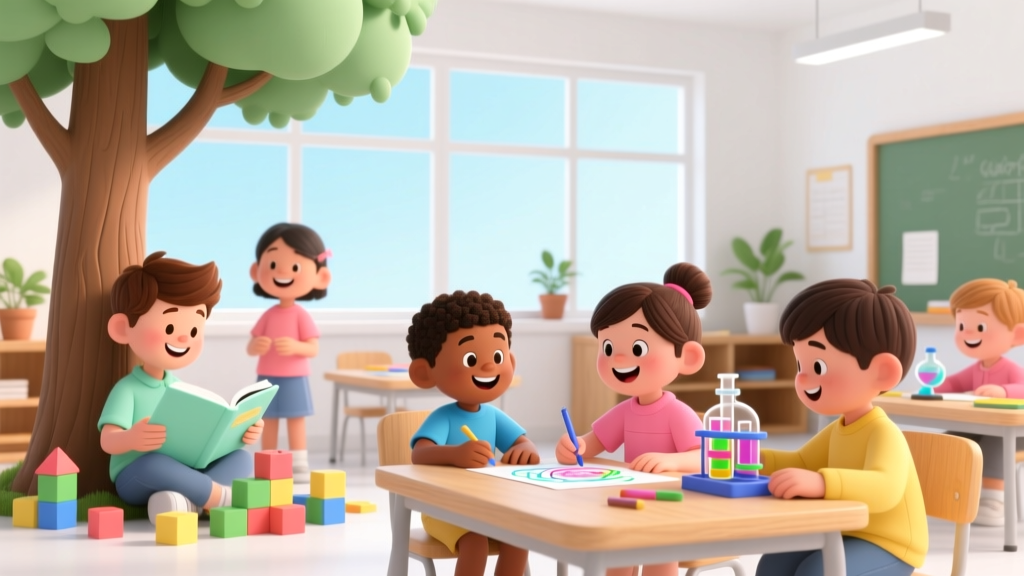
Kids Count to 10: Milestones & Red Flags (2026)
Why This Question Matters More Than You Think Right Now
What age should kids count to 10 is one of the most frequently searched early math questions—and for good reason. In an era where preschool admissions increasingly emphasize pre-academic benchmarks and social media feeds overflow with ‘genius toddler’ videos, parents are quietly anxious: Is my child behind? Am I doing enough? Could this be a sign of something bigger? The truth? Counting to 10 isn’t a pass/fail test—it’s a window into foundational cognitive, language, and motor development. According to the American Academy of Pediatrics (AAP), mastery of rote counting to 10 typically emerges between ages 3.5 and 5 years—but that range masks critical nuance. A child who counts accurately at 36 months may still struggle to count objects meaningfully, while another who doesn’t reach 10 until 60 months might demonstrate advanced one-to-one correspondence and number conservation. Understanding the why behind the ‘when’ transforms anxiety into empowered action.
The Developmental Layers Behind Counting to 10
Counting to 10 looks simple—but it’s actually a sophisticated convergence of five interdependent skills, each maturing on its own timeline:
- Rote memory: Reciting numbers in sequence (like singing the alphabet)—often emerges first, around age 2.5–3.
- One-to-one correspondence: Matching each spoken number word to exactly one object—requires visual-motor coordination and attention control; usually solidifies between 3.5–4.5 years.
- Cardinality principle: Understanding that the final number word in a count tells how many—not just a label. This conceptual leap often happens after age 4.
- Abstraction: Counting non-physical items (e.g., claps, jumps) or invisible things (e.g., ‘how many times did I blink?’)—signals symbolic thinking, typically emerging after age 4.5.
- Stable order principle: Knowing number words must always be recited in the same fixed order—even when starting from ‘3’ or skipping numbers intentionally. This reflects executive function growth and usually consolidates by age 5.
Here’s what that means practically: A 3-year-old who rattles off “1-2-3-4-5-6-7-8-9-10” while pointing randomly at toys likely has strong rote memory but hasn’t yet grasped cardinality. That’s normal—and completely different from a 4.5-year-old who carefully touches each block while saying numbers slowly but stops at ‘7’ and says, ‘That’s seven!’ with confidence. The second child is demonstrating deeper, more durable understanding—even though they haven’t reached 10 yet.
When to Celebrate, When to Observe, and When to Consult
Developmental milestones aren’t rigid deadlines—they’re population-based probabilities. The AAP and CDC’s Learn the Signs. Act Early. initiative emphasizes that patterns matter more than single data points. Below is a clinically validated decision framework used by early intervention specialists:
| Age | Typical Counting Behavior | Supportive Next Steps | When to Gently Monitor | When to Seek Evaluation |
|---|---|---|---|---|
| 24–30 months | Says isolated number words (‘two!’, ‘five!’); may echo counting songs without pointing | Label quantities in daily life: ‘Two shoes!’, ‘Three grapes!’, ‘One more spoon.’ | No number words by 30 months; avoids pointing or joint attention during counting games | Zero functional number use by 33 months + delays in speech, play, or social interaction |
| 30–36 months | Rotes counts to 5–8; points inconsistently; may skip numbers or repeat | Add tactile counters: buttons, dried beans, or LEGO bricks. Count while stacking or lining up. | Still only rotes to 3–4 at 36 months; no attempt to match words to objects | No consistent one-to-one matching by 39 months; difficulty following simple 2-step directions |
| 36–48 months | Counts to 10 with occasional errors; understands ‘more’/‘less’; may answer ‘How many?’ correctly up to 5 | Play ‘count and move’: ‘Hop 4 times’, ‘Clap 7 times’. Use number lines and dot cards. | Counts to 10 but cannot reliably count 5 objects correctly; confuses ‘7’ and ‘9’ consistently | Cannot count 5 objects accurately by 48 months; avoids counting tasks; shows frustration or shutdown |
| 48–60 months | Counts to 10+ accurately; counts backward from 5; solves simple ‘add one more’ problems | Introduce subitizing (instant recognition of small groups), estimation, and grouping (e.g., ‘two groups of three’) | Counts to 10 but struggles with cardinality (e.g., counts 6 blocks then says ‘There are 4!’) | No improvement after 3 months of targeted play-based practice + difficulty with rhyming, letter sounds, or name writing |
Note: ‘Seek evaluation’ doesn’t mean panic—it means contacting your state’s free Early Intervention program (for children under 3) or requesting a developmental screening through your pediatrician or school district (ages 3–5). As Dr. Laura Jana, FAAP and co-author of The Toddler Brain, reminds us: ‘Early identification isn’t about labeling—it’s about giving brains the right input at the right time. Neuroplasticity is highest before age 5, and targeted play is the most powerful intervention we have.’
7 Evidence-Based, Screen-Free Strategies That Actually Work
Forget flashcards and timed drills. Research from the University of Chicago’s Early Math Collaborative shows that embedded, playful counting yields 3.2× greater retention than isolated drill practice. Here’s what works—and why:
- The ‘Count & Carry’ Routine: Assign your child a small basket and ask them to collect exactly 5 crayons, 3 spoons, or 7 socks. Require verbalization (“One… two…”) and physical placement (“Now it’s in the basket!”). This builds motor memory + cardinality. Try it for 90 seconds, twice daily.
- Number Storytelling: Replace ‘The Three Little Pigs’ with your own version: ‘There were four ducks swimming. One flew away. How many ducks are left?’ Pause. Let them gesture or use fingers. This embeds counting in narrative logic—a natural brain pathway for young children.
- Choral Counting with Physical Anchors: Stand side-by-side and count aloud while tapping knees: ‘1’ (tap left knee), ‘2’ (right knee), ‘3’ (left), etc. Add claps or stomps every 5th number. Kinesthetic input strengthens neural pathways for number sequence stability.
- ‘Which Has More?’ Challenges: Place two small piles of snacks (e.g., 6 goldfish vs. 8 pretzels) and ask, ‘Which pile do you want? How do you know?’ Resist giving the answer—wait 8 seconds. This cultivates comparison reasoning, a precursor to formal arithmetic.
- Counting in Non-Linear Contexts: Count stairs up and down, count petals on flowers, count breaths during calm-down time. Variation prevents over-reliance on linear sequences and builds abstraction.
- Number Hunt Scavenger Lists: Create a simple list: ‘Find something that comes in 2s (shoes), 3s (traffic lights), 4s (chair legs).’ Take photos together. This connects symbols to real-world quantity—a key bridge to math fluency.
- ‘Fix My Mistake’ Games: Intentionally miscount: ‘Let’s count these buttons: 1, 2, 4, 5… uh oh! What did I skip?’ Children love correcting adults—and this reinforces stable order and self-monitoring.
A real-world case study from a 2023 pilot in Chicago Public Pre-K classrooms showed that teachers using just #1 and #4 above saw 82% of students reliably count to 10 within 6 weeks—versus 41% in control classrooms using worksheets alone. The difference? Embodied cognition: the brain learns numbers not as abstract symbols, but as actions, sensations, and relationships.
Frequently Asked Questions
My child counts to 10 perfectly—but can’t count 5 blocks correctly. Is that normal?
Yes—and it’s incredibly common. Rote counting (memorizing the sequence) develops earlier and separately from meaningful counting (applying the sequence to quantify objects). Think of it like learning song lyrics versus understanding the story. This gap usually closes between ages 4 and 4.5 with consistent, low-pressure practice. Focus on activities that require touching and moving objects while counting—not recitation alone.
Should I teach my 2-year-old to count to 10 to ‘get ahead’?
Not unless it’s joyful and child-led. Pushing rote memorization before age 3 can backfire: a 2022 longitudinal study in Early Childhood Research Quarterly found toddlers pressured to count early showed lower math motivation and accuracy by kindergarten. Why? It turns number learning into performance—not exploration. Instead, flood their world with quantity language: ‘You ate all three apple slices!’, ‘We need two mittens—where’s the other one?’, ‘Let’s put four books back on the shelf.’
My bilingual child mixes languages when counting (e.g., ‘uno, two, tres’). Should I correct them?
No—celebrate it. Code-switching during counting is a sign of advanced executive function and linguistic flexibility. Research from the UCLA Bilingualism Research Lab confirms bilingual children often master cardinality earlier than monolingual peers because they’re constantly negotiating symbolic systems. Gently model full sequences in each language separately (‘In English: 1-2-3… In Spanish: uno-dos-tres…’), but never interrupt or shame mixing. Their brain is doing sophisticated work.
Are there toys or apps that actually help with counting to 10?
Most ‘educational’ apps show minimal transfer to real-world counting. A 2021 meta-analysis in Pediatrics found zero statistically significant gains in number sense from tablet-based counting games for children under 5. Far more effective: open-ended manipulatives like wooden number puzzles (with tactile grooves), abacuses with large beads, or even homemade ‘counting jars’ filled with rice and numbered lids. Look for toys certified by ASTM F963 (safety) and endorsed by the National Association for the Education of Young Children (NAEYC)—not marketing claims.
Could delayed counting indicate dyscalculia or autism?
Not necessarily—and rarely in isolation. Dyscalculia is rarely diagnosable before age 7–8, and early signs involve persistent difficulty with all quantity concepts (estimating, comparing, remembering math facts), not just counting. Autism spectrum differences may include intense focus on numbers or unusual patterns (e.g., counting ceiling tiles obsessively), but also co-occur with strengths in pattern recognition. What does warrant professional input is a cluster: counting delay + trouble with routines, limited eye contact, delayed pretend play, or sensory sensitivities. Always consult a developmental pediatrician—not Google—for holistic assessment.
Common Myths About Counting to 10
- Myth 1: “If they can’t count to 10 by age 4, they’ll fall behind in kindergarten.” Reality: Kindergarten curricula (per NAEYC standards) assume no prior counting knowledge. Teachers assess and scaffold individually. Many high-achieving kindergarteners didn’t count to 10 until October—and caught up within weeks using play-based instruction.
- Myth 2: “Counting videos or apps accelerate learning.” Reality: Passive screen exposure correlates with delayed expressive language and poorer attention regulation (JAMA Pediatrics, 2020). Active, embodied counting—using hands, voice, and real objects—builds stronger neural connections than any video.
Related Topics (Internal Link Suggestions)
- When do kids understand addition and subtraction? — suggested anchor text: "early addition and subtraction readiness"
- Best counting toys for toddlers — suggested anchor text: "developmentally appropriate counting toys"
- Signs of speech delay vs. late bloomer — suggested anchor text: "speech and language milestones guide"
- Montessori counting activities at home — suggested anchor text: "Montessori-inspired math materials"
- How to support neurodiverse learners in early math — suggested anchor text: "inclusive early numeracy strategies"
Final Thought: Counting Is Connection, Not Competition
What age should kids count to 10 isn’t really about the number—it’s about honoring where your child is, meeting them with curiosity instead of comparison, and turning everyday moments into invitations to wonder: ‘How many steps to the door? How many blue cars passed? How many hugs do you need today?’ The goal isn’t a checklist ticked by age 4. It’s building a child who sees math as meaningful, joyful, and deeply human. So take a breath. Put the timer away. Grab three oranges—or seven socks—or whatever’s nearby. And start counting—together. Your next step? Pick one strategy from Section 3 and try it for just 3 minutes today. Notice what your child does, says, or smiles about—and trust that you’re already doing the most important thing: showing up, paying attention, and making numbers matter.
More Articles
 How Long Do Fevers Last in Kids? (2026)
 Does Dominic Fike Have a Kid? (2026)
 What to Do If Your College Kid Smokes Pot (2026)
 How Many Kids Can I Have in China (2026)
 Kids Sleep Guide: Science-Backed Bedtime Solutions
 Why YouTube Is Bad for Kids: Evidence-Based Risks (2026)
 Is Put in Bay Kid Friendly? Truth & Safety Tips
 Why Did They Switch Claire on My Wife and Kids?
 Kids School Attendance Laws: What’s Required in 2026
 Preschool Readiness: Beyond Age (2026)