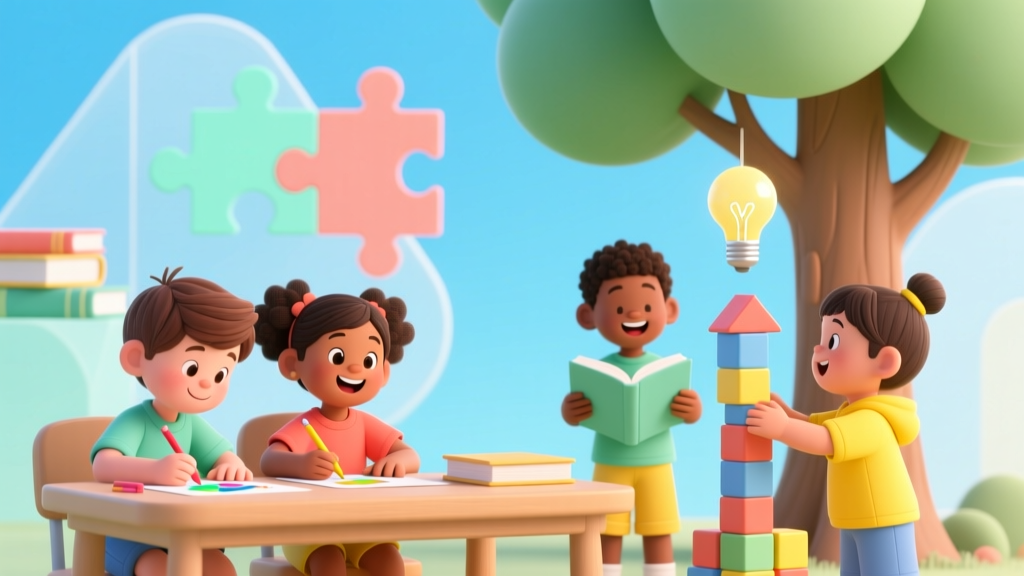
What Age Kids Start Reading: Truth & Tips
Why 'What Age Kids Start Reading' Matters More Than Ever Right Now
Parents searching for what age kids start reading aren’t just asking for a number—they’re seeking reassurance, clarity, and actionable direction in a world saturated with early-academics pressure, screen-based ‘reading apps,’ and comparison-driven social media feeds. The truth? There is no universal ‘on switch’ for reading—and that’s by design. Brain science confirms that reading is a biologically unnatural skill: unlike speaking, it doesn’t emerge automatically from exposure. It must be built, neuron by neuron, through intentional scaffolding, rich language experiences, and joyful repetition. Yet nearly 68% of parents report feeling anxious about their child’s literacy progress before kindergarten (2023 Zero to Three Parent Survey), often misinterpreting normal variation as delay—or worse, accelerating instruction too soon, which can backfire. This guide cuts through the noise with evidence-based milestones, practical tools, and compassionate strategies grounded in decades of developmental psychology and pediatric guidance from the American Academy of Pediatrics (AAP) and the National Institute of Child Health and Human Development (NICHD).
Understanding the Reading Continuum: It’s Not a Single Event—It’s a 5-Stage Journey
Reading isn’t something a child ‘starts’ on their fourth birthday like riding a bike. It’s a layered neurocognitive process unfolding across five interdependent stages—each building on the last, each requiring different kinds of support. Pediatric neuropsychologist Dr. Susan Brady, co-author of the landmark NICHD Early Literacy Study, emphasizes: “We don’t teach reading—we teach the brain to read. And that takes time, variation, and the right kind of input.”
Stage 1: Emergent Literacy (Ages 0–3)
Long before holding a book upright, infants absorb phonological awareness—the rhythm, rhyme, and sound patterns of language. A baby babbling ‘ba-ba-ba’ while listening to nursery rhymes is exercising the same auditory processing circuits used later to distinguish ‘cat’ from ‘bat.’ By age 2, most children recognize their own name in print and point to pictures when named. Key support: daily shared reading (even 5 minutes), singing, sound-play games (‘What starts with /m/? Moo! Mitten! Moon!’), and labeling objects during routines.
Stage 2: Early Pre-Reading (Ages 3–4)
Children begin grasping print concepts: books have front/back, text flows left-to-right, words carry meaning. They may ‘pretend read’ familiar books from memory, track lines with their finger, and identify some letters—especially those in their name. At this stage, letter-sound knowledge begins to crystallize. According to the AAP’s 2022 literacy policy statement, “Letter naming fluency by age 4 predicts later decoding success more strongly than IQ or socioeconomic status.” But crucially: naming ≠ sounding. Knowing ‘B’ is ‘bee’ doesn’t mean they know it makes /b/—and that distinction matters deeply.
Stage 3: Decoding Foundations (Ages 4–5)
This is where explicit, systematic phonics begins to take root—for many children, especially in structured preschool or kindergarten settings. Children learn consonant-vowel-consonant (CVC) word patterns (‘cat,’ ‘dog,’ ‘sun’) and begin blending sounds. They’ll sound out words laboriously: /c/…/a/…/t/ → ‘cat.’ Progress varies widely: some decode 10+ CVC words by spring of pre-K; others need targeted small-group instruction into first grade. Importantly, decoding without comprehension is hollow—and vice versa. That’s why the ‘science of reading’ movement now prioritizes integrating phonics with vocabulary, syntax, and background knowledge from day one.
Stage 4: Fluent Word Recognition (Ages 5–7)
By mid-first grade, proficient readers shift from laborious sounding-out to automatic word recognition—thanks to repeated exposure and orthographic mapping (the brain’s ability to store whole words visually). They read simple chapter books like Frog and Toad or Henry and Mudge with increasing speed, accuracy, and expression. Comprehension becomes the new frontier: answering ‘who,’ ‘what,’ ‘where,’ and beginning to infer motives or predict outcomes.
Stage 5: Strategic Comprehension & Critical Engagement (Age 7+)
Now reading serves thinking. Children analyze character motivation, compare texts, evaluate arguments in nonfiction, and adjust reading speed or strategy based on purpose (skimming a recipe vs. studying a science passage). This stage demands metacognition—thinking about thinking—and is heavily influenced by home literacy culture: how often adults model reading for pleasure, discuss ideas, and value curiosity over correctness.
When to Celebrate, When to Pause: Milestones vs. Red Flags (Backed by AAP & IDEA Data)
Every child develops at their own pace—but certain patterns warrant professional insight. The key is distinguishing expected variation from indicators of potential language-based learning differences like dyslexia (which affects 15–20% of the population, per the International Dyslexia Association). Below is an evidence-based guide grounded in AAP screening recommendations and IDEA Part B eligibility criteria:
| Age Range | Typical Milestones (Most Children) | Consider Professional Input If… | Recommended Next Step |
|---|---|---|---|
| 24–36 months | Points to pictures when named; repeats rhymes/songs; uses 2–3 word phrases; follows simple 2-step directions | Rarely babbles or gestures to communicate; doesn’t respond to name; understands far less than peers; no pretend play with books/toys | Consult pediatrician for hearing screen + referral to early intervention (birth–3 services) for speech-language evaluation |
| 3–4 years | Names 10+ letters (esp. in name); recognizes own name in print; enjoys rhyming games; tells simple stories with sequence | Cannot rhyme words (e.g., ‘cat’/‘hat’); confuses similar-sounding letters (b/d/p/q) consistently; avoids books; shows extreme frustration with songs/stories | Request kindergarten readiness screening; ask school district about free preschool literacy assessment |
| 4–5 years | Matches letters to sounds (e.g., ‘B’ says /b/); writes some letters/numbers; attempts to write name; knows story parts (beginning/middle/end) | Cannot blend 3 sounds into a word (/s/ /u/ /n/ → ‘sun’); reverses letters frequently *and* struggles to correct when shown; cannot segment words into syllables | Seek evaluation from certified reading specialist or educational psychologist; request Response to Intervention (RTI) Tier 2 support at school |
| K–1st Grade | Reads CVC words accurately; decodes unfamiliar words using phonics; reads aloud with some expression; answers literal questions about text | Guesses words from pictures instead of sounding out; reads same word differently on same page; omits/inserts small words (‘the,’ ‘and’); avoids reading aloud | Formal evaluation for specific learning disability (SLD) under IDEA; request multisensory structured literacy (MSL) instruction (e.g., Orton-Gillingham) |
Note: These are guidelines—not diagnostic tools. As Dr. Sally Shaywitz, author of Overcoming Dyslexia, stresses: “Early identification is powerful—but so is avoiding premature labeling. What looks like ‘laziness’ is often neurological inefficiency. What looks like ‘not trying’ is often exhaustion from constant decoding effort.”
The 3 Non-Negotiables: What Actually Moves the Needle (Spoiler: It’s Not Flashcards)
Despite marketing claims, no app, workbook, or flashcard system replaces the foundational pillars of early literacy. Research from the University of Nebraska’s 2021 longitudinal study of 1,200 children found that three factors predicted 82% of reading success by third grade—regardless of income, parental education, or school quality:
- Oral Language Richness: Not just ‘more words,’ but complex syntax, varied vocabulary, and responsive conversation. Example: Instead of ‘What’s that?’ try ‘Why do you think the squirrel is hiding that nut? What might happen tomorrow?’ This builds narrative reasoning and inferential thinking—the bedrock of comprehension.
- Print-Rich Environment + Shared Reading Ritual: It’s not about quantity of books—it’s consistency of interaction. The NICHD found that children who experienced daily 10-minute shared reading with adult ‘dialogic reading’ (asking open questions, expanding responses, praising attempts) gained 3x the vocabulary growth of peers in passive reading-only groups.
- Phonological Awareness Play: This is the #1 predictor of decoding success—and it’s best taught through play, not drills. Try: clapping syllables in names (‘El-i-zab-eth’ = 4 claps); playing ‘I Spy’ with sounds (‘I spy something that starts with /sh/’); singing ‘Apples and Bananas’ changing vowel sounds; or using magnetic letters to build silly rhyming words (‘fog,’ ‘jog,’ ‘bog,’ ‘zog’).
Real-world example: Maya, a mom in Portland, worried her son Leo wasn’t ‘keeping up’ after seeing peers read sight words at age 4. Her preschool teacher suggested shifting focus from worksheets to oral language: narrating cooking steps (“First we crack the egg, then we whisk the yolks”), playing sound-matching games with kitchen utensils (‘spoon’/‘spatula’), and doing ‘story retelling’ after library visits using stuffed animals as characters. By age 5, Leo wasn’t just reading—he was writing multi-sentence stories about his ‘dragon adventures,’ complete with invented spelling that revealed sophisticated phonemic segmentation.
Debunking the ‘Early Reader’ Myth: Why Rushing Backfires (And What to Do Instead)
The cultural obsession with ‘early reading’ has created a dangerous misconception: that earlier = better. But neuroscience reveals the opposite. The brain’s visual word form area—the region that specializes in recognizing written words—doesn’t fully mature until ages 7–9. Pushing intensive phonics before neural pathways are ready can lead to surface-level memorization (‘sight word’ guessing) without true decoding architecture—or worse, anxiety that shuts down engagement entirely.
A landmark 2020 Finnish study compared children who began formal reading instruction at age 5 versus age 7. By age 11, both groups performed identically on standardized reading tests—but the later-starters showed significantly higher motivation, lower stress biomarkers, and greater enjoyment of reading as a leisure activity. As Dr. Daphne Bavelier, cognitive neuroscientist at the University of Geneva, explains: “Literacy is a marathon, not a sprint. The brain needs time to wire language, vision, and attention systems together. Skipping developmental prerequisites is like building a house on sand.”
So what *should* you prioritize before age 5–6? Focus on the invisible infrastructure:
- Executive Function Scaffolding: Games that require turn-taking, rule-following, and working memory (e.g., ‘Red Light, Green Light,’ ‘Simon Says,’ matching card games) strengthen the same attentional control needed for sustained decoding.
- Motor Skill Integration: Fine motor work (playdough, cutting, threading beads) supports hand-eye coordination for tracking text; gross motor play (swinging, climbing) regulates the nervous system for focused learning.
- Emotional Safety: Children learn best when cortisol levels are low. A calm, predictable routine with warm, responsive interactions creates the neurochemical environment where neural connections for literacy thrive.
Frequently Asked Questions
Can a child be a strong reader but still struggle with spelling?
Absolutely—and it’s incredibly common. Reading and spelling rely on overlapping but distinct neural pathways. Strong readers often use ‘whole-word’ recognition (orthographic mapping), while spelling requires precise phoneme-grapheme mapping and morphological awareness (understanding prefixes, suffixes, roots). Many bright readers with dyslexia are ‘compensated spellers’—they memorize high-frequency words but stumble on novel or multisyllabic ones. If spelling difficulties persist beyond age 8–9 despite strong reading, consider an evaluation for specific learning disability in written expression.
My child reads well but doesn’t seem to understand what they’ve read. What’s going on?
This is called ‘hyperlexia’—advanced decoding without commensurate comprehension—and it’s more common than many realize. It often signals a gap in language processing, vocabulary depth, or background knowledge. Try ‘think-aloud’ modeling: read a paragraph, then verbalize your own inferences (“Hmm, she slammed the door—that probably means she’s angry, not just tired”). Ask ‘why’ and ‘how’ questions, not just ‘what.’ And prioritize nonfiction read-alouds on topics your child loves (dinosaurs, space, baking) to build domain-specific vocabulary and schema.
Is screen time ever helpful for early literacy—or is it all harmful?
Not all screen time is equal. Passive video consumption (e.g., YouTube cartoons) correlates with delayed language development in under-3s (per AAP 2016 policy). But interactive, adult-coached digital experiences *can* support literacy—if they mirror real-world scaffolding. Look for apps that require active participation (dragging letters to build words, recording voice to narrate a story), avoid fast-paced rewards that short-circuit attention, and always co-use: pause to ask questions, connect to real-life experiences, and extend learning offline (“Let’s draw the robot from the app!”). Limit to 15–20 minutes/day for ages 2–5, and never replace human interaction.
Should I teach my child cursive first if they’re struggling with print letters?
No—cursive should not be used as an intervention for early letter formation challenges. While cursive can benefit some older students with dysgraphia (due to fewer lifts and consistent flow), it introduces additional complexity—letter connections, slant, size consistency—that most 4–6 year olds aren’t neurologically ready for. Focus first on building fine motor strength, visual-motor integration, and phonemic awareness. If handwriting remains a barrier past age 6, consult an occupational therapist—not a cursive curriculum.
How do bilingual children learn to read—and is it different?
Bilingual children follow the same developmental stages but may show temporary ‘cross-linguistic transfer’—using rules from one language in another (e.g., sounding out Spanish ‘café’ with English /kay-fay/ instead of /kah-feh/). Crucially, bilingualism does *not* cause reading delays. In fact, strong foundation in the home language predicts stronger English literacy. Best practice: read daily in the dominant/home language to build vocabulary, syntax, and narrative skills—then explicitly teach English phonics once the child has solid oral English proficiency. Avoid ‘language mixing’ in early literacy instruction (e.g., don’t teach letter sounds in two languages simultaneously).
Common Myths
Myth 1: “If my child isn’t reading by age 5, they’ll fall behind forever.”
False. Longitudinal data from the National Center for Education Statistics shows that children who begin decoding at age 6–7 (with appropriate support) catch up to peers by third grade—and often surpass them in comprehension and motivation. What matters most is the quality of instruction and emotional safety, not the calendar date.
Myth 2: “Learning sight words first is the fastest path to reading.”
Partially true—but dangerously incomplete. Memorizing 100+ ‘sight words’ (many irregular) creates fragile, inefficient reading habits. The Science of Reading consensus is clear: systematic phonics instruction—teaching how letters represent sounds and how to blend them—is the most effective foundation. Sight words should be taught *alongside* phonics, not instead of it—and only after children understand basic sound-letter relationships.
Related Topics (Internal Link Suggestions)
- Best Phonics Programs for Preschoolers — suggested anchor text: "evidence-based phonics programs for early learners"
- How to Choose Age-Appropriate Books for Toddlers — suggested anchor text: "developmentally perfect toddler books"
- Signs of Dyslexia in Preschoolers — suggested anchor text: "early dyslexia indicators before kindergarten"
- Dialogic Reading Techniques for Parents — suggested anchor text: "how to read with your child (not just to them)"
- Screen Time Guidelines for Early Literacy — suggested anchor text: "healthy digital habits for preschool readers"
Conclusion & Your Next Step
So—what age do kids start reading? The honest, empowering answer is: when their brains, experiences, and relationships align to make it possible—and joyful. There is no magic age, no universal benchmark, and no reason to compare your child’s journey to anyone else’s. What matters is showing up consistently with warmth, curiosity, and evidence-informed support. Your next step? Pick *one* action from this guide to implement this week: reread your favorite board book using dialogic questions; play a 5-minute rhyming game at dinner; or simply observe your child’s current literacy behaviors without judgment—notice what they gravitate toward, what sparks their ‘aha!’ moments, and where they light up. Because reading isn’t about checking a box. It’s about unlocking a lifetime of connection, wonder, and self-expression—one shared page at a time.
More Articles
 Restless Legs Syndrome in Kids: A Parent’s Guide
 Ronald Reagan’s Kids: How Many & What It Reveals
 Who Does Travis Scott Have Kids With? (2026)
 Screen Time for Kids: What Pediatricians Really Say
 Does Tara Lipinski Have Kids? Verified Facts (2026)
 Are Everybody Loves Raymond Kids Real Siblings?
 Why Are the Kids Saying Six Seven? (2026)
 Kids Protein Needs: Truth, Signs & Real-Food Fixes
 Who Was the Little Kid in Halftime Show? (2026)
 Spanking Kids: What Research Shows (2026)