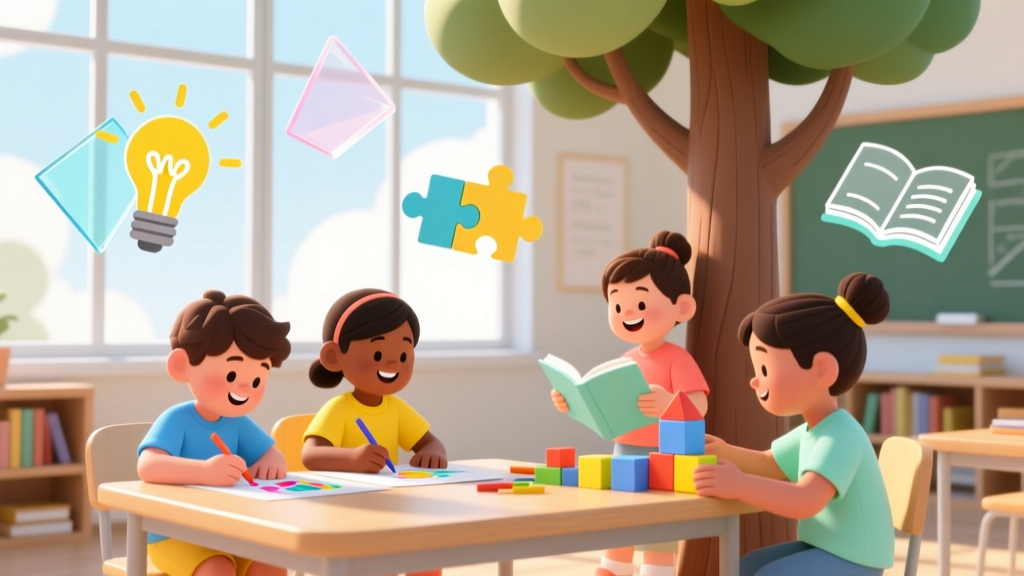
What Age Do Kids Start Writing Letters? (2026)
Why This Question Keeps Parents Up at Night (And Why It Shouldn’t)
What age do kids start writing letters is one of the most searched developmental questions among parents of preschoolers — and for good reason. In an era of early academic pressure, kindergarten entrance assessments, and viral social media comparisons, many caregivers worry their child is 'behind' if they’re not tracing ABCs by age 4. But here’s the truth: handwriting emergence isn’t a race — it’s a neurodevelopmental cascade involving fine motor control, visual-motor integration, language processing, and even emotional regulation. According to the American Academy of Pediatrics (AAP), there is no single 'right' age — and pushing too early can backfire, leading to frustration, avoidance, or even negative self-perception around learning. What matters far more than chronology is whether your child is showing the foundational skills that signal true readiness — and how you respond supports confidence, not compliance.
The Developmental Roadmap: From Scribbles to Structured Letters
Writing letters isn’t a binary event — it’s a layered progression spanning roughly 3–7 years. Pediatric occupational therapists emphasize that handwriting emerges in distinct, overlapping stages — each with observable behaviors, not just age markers. Understanding these phases helps parents spot strengths, identify subtle gaps, and intervene supportively *before* formal instruction begins.
Stage 1: Scribbling & Mark-Making (Ages 18–36 months)
At this stage, children aren’t ‘trying’ to write — they’re exploring cause-and-effect, building hand strength, and developing bilateral coordination. A 22-month-old gripping a thick crayon and making rhythmic up-down strokes isn’t ‘practicing letters’ — they’re strengthening the intrinsic hand muscles needed later for pencil control. As Dr. Sarah Johnson, pediatric occupational therapist and co-author of Foundations First: Motor Skills Before Marks, explains: ‘Scribbling is neurological weight training for the hand. If we skip it or rush past it, we’re asking kids to lift weights before they’ve built muscle tone.’
Stage 2: Controlled Shapes & Symbolic Play (Ages 3–4)
Children begin intentionally producing circles, crosses, vertical/horizontal lines, and ‘tadpole people’ — often labeling them (“This is Mommy!”). Crucially, they start associating marks with meaning. A 3.5-year-old who draws a wobbly circle and says, “That’s my ‘O’!” is demonstrating symbolic representation — a cognitive prerequisite for letter formation. This isn’t yet handwriting, but it’s the brain wiring that makes handwriting possible.
Stage 3: Letter-Like Forms & Name Writing (Ages 4–5)
Here, recognizable attempts appear — often first with capital letters (easier due to straight lines and symmetry), especially in names. A child may write “J” and “A” repeatedly, mixing invented forms with correct ones. Importantly, accuracy varies wildly: one child might form 10 letters correctly by age 4.5; another may only produce 3 legibly but demonstrate exceptional spatial awareness in block play or puzzle assembly — both are on track.
Stage 4: Consistent Formation & Automaticity (Ages 5.5–7)
This is where classroom instruction typically kicks in — but only after neural pathways for motor planning, visual memory, and working memory mature sufficiently. By age 6–7, most children achieve consistent letter size, spacing, and directionality (left-to-right, top-to-bottom) — not because they’ve ‘learned’ it, but because their brains have automated the sequence. Rushing this phase without foundational strength leads to fatigue, poor posture, and inefficient grip patterns that persist into adolescence.
What Actually Predicts Readiness — And What Doesn’t
Many parents equate letter recognition with letter writing — but research from the National Institute of Child Health and Human Development shows they’re dissociable skills. A child who can name all 26 letters fluently may still lack the fine motor control to form them. Conversely, a child struggling with phonics may write letters beautifully — indicating strong visual-motor integration.
So what *does* reliably predict handwriting readiness? Occupational therapists use a 5-domain checklist — not age alone:
- Postural Control: Can the child sit upright for 10+ minutes without slumping or sliding? Core stability directly impacts shoulder and wrist stability.
- Hand Strength: Can they tear paper, squeeze a spray bottle, or manipulate playdough with thumb-index-middle fingers (tripod grasp)?
- Visual Perception: Can they match shapes, complete puzzles, or trace simple paths without losing place?
- Motor Planning: Can they imitate multi-step actions (e.g., ‘touch nose, then ear, then hop’) or copy a cross or square?
- Attention & Regulation: Can they sustain focus on a hands-on task for 5–8 minutes and tolerate mild frustration?
If 3+ of these are consistently present, your child is likely ready for structured letter practice — regardless of age. If fewer than 2 are evident, prioritize playful skill-building over drills. As Dr. Lena Torres, developmental psychologist and AAP Early Childhood Committee member, states: ‘We don’t teach handwriting — we grow the child who writes. The timeline follows biology, not benchmarks.’
7 Evidence-Based Strategies That Build Real Readiness (No Worksheets Required)
Forget tracing sheets and flashcards. The most effective pre-writing interventions are sensory-rich, movement-based, and embedded in daily life — proven to strengthen the neural networks underlying handwriting. Here’s what works, backed by clinical trials and classroom studies:
- Vertical Surface Play: Tape paper to a wall or easel. Drawing, painting, or sticking magnets vertically builds shoulder stability and wrist extension — critical for proper pencil grip. A 2022 University of Michigan study found children who engaged in 15 mins/day of vertical surface activities showed 42% faster letter formation acquisition within 8 weeks.
- Tool-Free Hand Strengthening: Use tweezers to sort pom-poms, peel stickers off wax paper, or thread large beads onto shoelaces. These build finger isolation and pinch strength — the foundation of tripod grasp. Avoid plastic ‘writing grips’ before age 5; they compensate rather than build.
- Environmental Print Hunting: Walk through your neighborhood spotting letters on signs, mailboxes, or food packaging. Ask: ‘Which letter starts “STOP”? Where does the ‘S’ curve?’ This links symbols to real-world meaning — far more powerful than isolated ABC recitation.
- Multi-Sensory Letter Formation: Trace letters in shaving cream, sand, or finger paint — then say the sound *as* you move. Kinesthetic input reinforces motor memory better than visual-only practice. Bonus: add rhythm (clap-say-trace) to engage auditory and motor systems simultaneously.
- Story-Driven Writing: Instead of ‘Write your name,’ try ‘Draw a picture of your favorite pet, then help me write its name.’ Contextual motivation increases engagement and reduces performance anxiety.
- Modeling Without Correction: When your child writes, narrate what you see: ‘I notice you made a tall line and a circle — that looks like a ‘P’!’ Avoid ‘That’s not right’ or red pens. Research shows error-focused feedback suppresses neural reward pathways linked to learning.
- Delay Formal Instruction Until Kindergarten (or Later): Per AAP and NAEYC joint guidelines, explicit handwriting instruction before age 5.5 offers no long-term academic advantage — and correlates with higher rates of writing aversion by Grade 2. Let play be the curriculum.
When to Seek Support: Red Flags vs. Normal Variation
Developmental variation is vast — but certain patterns warrant professional evaluation. Distinguishing typical delay from potential underlying needs prevents both unnecessary worry and missed opportunities for early intervention.
| Age Range | Typical Milestones | Green Light (Normal Variation) | Yellow Flag (Monitor Closely) | Red Flag (Consult OT/Pediatrician) |
|---|---|---|---|---|
| 3–4 years | Draws circles, crosses, imitates vertical/horizontal lines; scribbles with purpose | Writes 1–2 letters inconsistently; prefers drawing over writing | No attempt to copy shapes after age 4; avoids all mark-making; uses fist grip exclusively | Cannot hold crayon; drops objects frequently; avoids using hands for play |
| 4.5–5.5 years | Writes name (often capitals); copies squares/triangles; traces simple paths | Letters reversed (b/d, p/q); inconsistent sizing; mixes print/cursive | Still cannot copy a cross or circle at 5; writes only with adult hand-over-hand | No interest in drawing/writing despite modeling; extreme fatigue during fine motor tasks |
| 6–7 years | Writes full sentences legibly; spaces words; uses lowercase consistently | Slow speed; occasional reversals; uneven spacing | Illegible writing despite practice; avoids writing tasks; complains of hand pain | Cannot write own name; confuses letter/sound relationships; avoids all paper-based tasks |
Note: Reversals (like writing ‘b’ for ‘d’) are normal until age 7 — and occur in 30% of typically developing 6-year-olds. They only become concerning when paired with other signs like poor phonemic awareness or difficulty with directional concepts (left/right, up/down).
Frequently Asked Questions
Can handwriting delay indicate dyslexia?
Not necessarily — and it’s important not to conflate the two. Dyslexia primarily affects phonological processing (sound-symbol mapping), not motor skills. While some children with dyslexia also have handwriting challenges (often termed ‘dysgraphia’), many children with significant handwriting delays have no reading difficulties — and vice versa. According to Dr. Mary Chen, a neuropsychologist specializing in learning differences, ‘Handwriting struggles are more commonly tied to motor planning or visual-motor integration deficits than language-based disorders. A comprehensive evaluation should assess multiple domains — not assume causation from one symptom.’
Should I teach my child cursive before print?
No — and major educational bodies strongly advise against it. The International Dyslexia Association and the Handwriting is Fun! coalition recommend mastering manuscript (print) first. Cursive requires greater motor planning, sustained attention, and spatial organization — skills that typically consolidate after age 7. Introducing cursive prematurely often leads to illegible, effortful writing and undermines confidence. Manuscript provides clearer letter boundaries and reduces confusion between similar shapes (e.g., ‘a’ vs. ‘o’).
My child hates writing — what should I do?
First, pause all formal practice. Then, investigate the ‘why’: Is it physical discomfort (poor chair height, weak hands)? Sensory aversion (dislikes texture of paper/pencil)? Emotional (fear of mistakes, comparison)? Or cognitive (difficulty organizing thoughts)? Try low-stakes alternatives: voice-to-text for stories, whiteboard doodling, or typing short messages. As occupational therapist Rachel Kim notes: ‘When a child resists writing, the resistance is data — not defiance. Follow their lead to uncover the barrier.’
Are apps and tablets helpful for learning to write letters?
With caveats. Touchscreen tracing apps *can* support visual-motor integration — but only if used alongside tactile, 3D experiences. A 2023 meta-analysis in Early Childhood Research Quarterly found apps improved letter recognition but showed no transfer to paper-based writing unless paired with physical practice. Also, avoid passive watching; choose apps requiring active gesture (e.g., drawing the letter, not just tapping). Limit screen time to ≤15 mins/day for this purpose — and always follow with hands-on reinforcement (e.g., ‘Now let’s make that ‘S’ in sand!’).
Does handwriting still matter in a digital world?
Yes — profoundly. Neuroimaging studies show handwriting activates unique brain networks involved in memory encoding, idea generation, and conceptual understanding — far more than typing or swiping. A landmark 2021 study at Johns Hopkins found students who took handwritten notes retained 27% more conceptual information than peers using laptops. Handwriting isn’t obsolete — it’s a cognitive tool. The goal isn’t perfect penmanship, but building the neural architecture for learning itself.
Common Myths
Myth 1: “If they know the alphabet song, they’re ready to write.”
Letter naming is auditory-linguistic; letter formation is visual-motor. A child can sing the ABCs flawlessly but lack the hand strength to hold a pencil. Confusing these domains leads to premature pressure and missed opportunities to build foundational skills.
Myth 2: “More practice = faster progress.”
Neuroscience shows that forced, repetitive drills without engagement or sensory input reinforce inefficient motor patterns — not fluency. Ten minutes of joyful, multi-sensory practice yields better outcomes than 30 minutes of frustrated tracing. Quality trumps quantity — every time.
Related Topics (Internal Link Suggestions)
- Fine Motor Activities for Preschoolers — suggested anchor text: "fine motor activities for 3 year olds"
- When Do Kids Learn to Tie Shoes? — suggested anchor text: "what age do kids tie shoes"
- Signs of Dysgraphia in Early Elementary — suggested anchor text: "dysgraphia symptoms in kindergarten"
- Best Pencils and Tools for Beginning Writers — suggested anchor text: "best pencils for preschoolers"
- How to Teach Letter Sounds Effectively — suggested anchor text: "teaching letter sounds to toddlers"
Final Thought: Trust the Process, Not the Calendar
What age do kids start writing letters isn’t the question that changes outcomes — how you respond to their unique journey does. Handwriting isn’t a finish line; it’s one thread in the rich tapestry of development. Your role isn’t to accelerate the clock, but to provide the soil: space to explore, tools that fit their hands, language that affirms effort over perfection, and patience rooted in science. So put down the worksheets. Pick up the playdough. Tape paper to the wall. And watch — truly watch — what your child’s hands, eyes, and mind are already telling you. Ready when they are. Not before.
More Articles
 Is the New Superman Movie OK for Kids? (2026)
 How Many Kids Does Andy Reid Have? (2026)
 How Many Kids Go Missing on Halloween? (2026)
 Joan Jett Childfree by Choice: Why It Matters
 How Many Kids Did Hulk Hogan Have? Family Truths
 George Clooney’s Age When He Had Kids (2026)
 How to Teach Kids to Read: Research-Backed Steps
 Shakira’s Kids & Co-Parenting: Truth, Tips, Balance (2026)
 Kids Size 130: How to Measure, Convert & Shop (2026)
 Rob Zombie Kids: The Truth About His Private Parenting