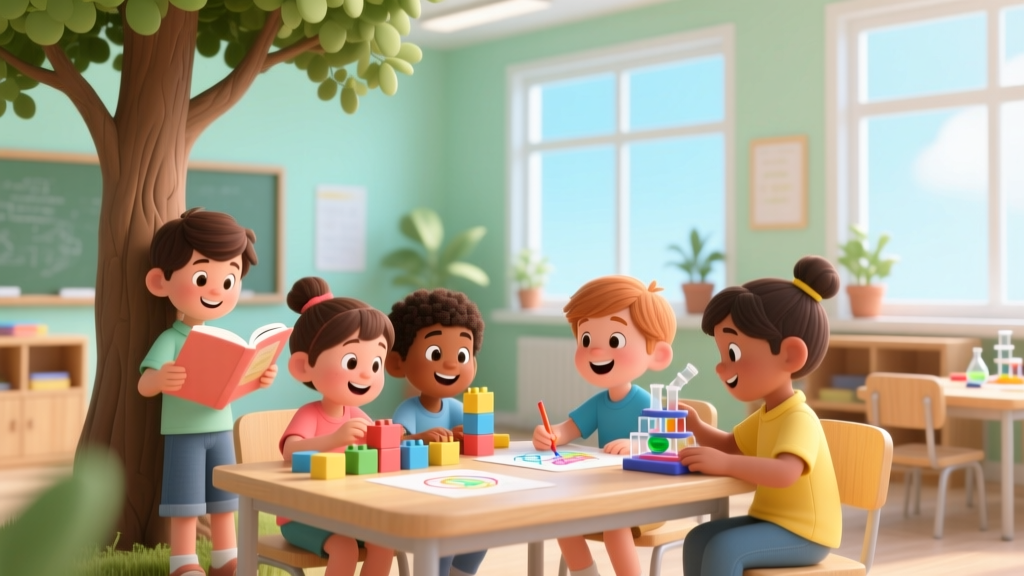
What Age Do Kids Start Reading? Truth & Tips
Why 'What Age Do Kids Start Reading' Is One of the Most Misunderstood Milestones
If you've ever scrolled through parenting forums wondering what age do kids start reading, you're not alone — and you're probably feeling more anxious than you let on. Maybe your 4-year-old still points to pictures instead of words. Or your 6-year-old reads fluently while their classmate struggles with letter sounds. You’re not failing. You’re navigating one of the most variable, neurologically complex milestones in early development — and the truth is far kinder, more flexible, and more evidence-based than most headlines suggest.
Literacy isn’t a switch that flips on a birthday. It’s a layered, years-long process built on oral language, phonological awareness, print concepts, vocabulary, and motivation — all developing at different paces across children. According to the American Academy of Pediatrics (AAP), only about 17% of children read independently by age 5, while the majority achieve foundational decoding skills between ages 6 and 7 — and that’s not delayed. It’s typical. In fact, longitudinal studies from the National Institute of Child Health and Human Development show that children who begin formal reading instruction at age 6 (vs. 5) demonstrate stronger comprehension and lower anxiety by third grade — not because they’re ‘behind,’ but because their executive function and auditory processing were ready to sustain the cognitive load.
How Reading Actually Develops: The 4 Stages No Parenting Book Tells You
Most parents picture reading as ‘sounding out words’ — but that’s just Stage 3. True literacy unfolds across four interwoven, overlapping stages — each with observable behaviors, neurological underpinnings, and distinct support strategies.
Stage 1: Emergent Literacy (Birth–Age 4)
This isn’t ‘pre-reading.’ It’s full-spectrum brain-building. Babies track your finger under text. Toddlers ‘read’ familiar books from memory, turning pages left-to-right. They scribble with intention, name letters in logos (‘McDonald’s’, ‘Stop’), and ask, “What does this say?” — even before knowing letters. Neuroimaging studies confirm that shared book reading at age 2 activates the same left-hemisphere language networks later used for decoding. This stage is less about skill and more about wiring: building phonological sensitivity (hearing rhymes, clapping syllables), narrative understanding (predicting ‘then what happens?’), and print awareness (knowing books have front/back, words go left-to-right).
Stage 2: Letter-Sound Mastery & Print Concepts (Ages 4–6)
Here’s where alphabet knowledge becomes functional — not just reciting A–Z, but matching /b/ to ‘b’, noticing that ‘cat’ and ‘cup’ start with the same sound, and recognizing that changing one letter changes meaning (‘hat’ → ‘bat’). Children begin tracking print with their finger, noticing punctuation, and writing their name with consistent letter formation. Crucially, this stage thrives on play — not flashcards. Think: sorting magnetic letters by sound, singing ‘The Name Game’, tracing letters in sand, or playing ‘I Spy’ with beginning sounds during grocery trips. As Dr. Susan Neuman, former U.S. Assistant Secretary of Education and literacy researcher, emphasizes: “When phonics is embedded in meaningful, joyful contexts — not isolated drills — neural pathways form faster and stick longer.”
Stage 3: Decoding & Blending (Ages 5–7)
This is the ‘reading’ most adults recognize: sounding out C-V-C words (‘dog’, ‘sun’), blending phonemes, recognizing high-frequency ‘sight words’ (the, and, is), and self-correcting misreads (“That says ‘jump’ — not ‘jimp’!”). But here’s what’s rarely discussed: decoding speed matters more than accuracy early on. A child who reads ‘c-a-t’ slowly but correctly is building neural fluency; one who guesses ‘car’ for ‘cat’ may be compensating for weak phonemic segmentation. Research from the University of Oxford shows children who spend just 10 minutes daily practicing *blending* (not just naming letters) gain 3.2x more decoding fluency in 8 weeks than those drilling letter names alone.
Stage 4: Fluent Comprehension & Strategic Reading (Ages 7–9+)
Now reading shifts from ‘getting the words out’ to ‘getting the meaning in.’ Children infer character motives, summarize paragraphs, monitor their own understanding (“Wait — that doesn’t make sense”), and adjust reading speed for purpose (skimming a comic vs. studying a science caption). This stage depends heavily on background knowledge — which explains why a child who’s visited a farm may breeze through a story about cows, while another stumbles over familiar words in unfamiliar contexts. As cognitive psychologist Dr. Daniel Willingham notes: “Reading comprehension is 90% knowledge retrieval — not decoding skill.”
What the Data Says: Age Ranges, Variability, and When to Pause & Observe
Forget rigid benchmarks. The following table synthesizes findings from the AAP, NAEP (National Assessment of Educational Progress), and longitudinal studies tracking over 12,000 children:
| Milestone | Typical Age Range | What’s Normal Variation? | When to Gently Monitor | Red Flag Threshold (Consult Specialist) |
|---|---|---|---|---|
| Recognizes own name in print | 2.5–4 years | Some children identify it at 22 months; others not until 4.5 years | No concern unless no interest in any environmental print (signs, logos) by age 4 | Cannot distinguish letters from random shapes by age 5 |
| Matches letters to sounds (e.g., ‘B’ = /b/) | 3.5–5.5 years | Highly dependent on exposure — children in language-rich homes often master this earlier | Still struggling after 6 months of playful, daily sound games (rhyming, syllable clapping) | Cannot hear rhymes (e.g., ‘cat/hat’) or segment 2-syllable words (‘ba-na-na’) by age 5.5 |
| Decodes simple CVC words (‘map’, ‘sit’) | 5–7 years | ~35% begin decoding by age 5; ~58% by age 6; ~89% by age 7 | Child avoids all print-based play, resists shared reading, or shows extreme frustration with letter work | No decoding attempts by age 7 despite consistent, multisensory support |
| Reads aloud with expression & comprehension | 7–9 years | Fluency correlates strongly with oral language exposure — not innate ‘reading talent’ | Can decode but cannot retell or answer basic questions about what was read | Consistently misreads >30% of words in grade-level text AND cannot self-correct or infer meaning |
Your Toolkit: 5 Evidence-Based Strategies (No Worksheets Required)
You don’t need expensive programs or daily drills. What works best is low-effort, high-impact integration into daily life — backed by decades of literacy research.
- “Sound Hunt” Walks (Ages 2–5): Turn errands into phonemic play. At the park: “Let’s find something that starts with /s/ — slide! swing! squirrel!” At the store: “Can you spot three things that rhyme with ‘box’? (socks, locks, rocks).” This builds phonological awareness — the strongest predictor of later reading success (National Reading Panel, 2000).
- Dialogic Reading (Ages 1–6): Don’t just read *to* your child — read *with* them. Pause to ask open-ended questions: “What do you think will happen next?” “Why is the bear sad?” “How would you feel if that happened to you?” This boosts vocabulary, narrative skills, and inference — all critical for comprehension. A landmark Vanderbilt study found children using dialogic reading gained 40% more expressive vocabulary in 6 months than control groups.
- Environmental Print Immersion (Ages 2–7): Label household items with words *and* photos (‘door’, ‘refrigerator’, ‘shoes’). Create a ‘word wall’ with family names, pet names, favorite foods. Point out print everywhere: cereal boxes, street signs, game instructions. Children learn that print carries meaning long before they decode — and this motivation fuels later effort.
- Shared Writing (Ages 3–6): Let your child dictate stories while you write. Then read it back together, pointing to each word. Ask: “Which word starts with /m/? Can you find ‘mom’?” This bridges speaking → writing → reading and reinforces left-to-right tracking.
- “Read-Aloud + Think-Aloud” (Ages 4–8): Model how skilled readers think. While reading aloud, pause to verbalize: “Hmm — I’m not sure what ‘gigantic’ means. Let me look at the picture… oh! The mouse is tiny next to the cheese. So ‘gigantic’ must mean ‘really, really big.’” This teaches comprehension strategies explicitly — and normalizes confusion as part of reading.
Frequently Asked Questions
My child is 5 and still mixes up b/d/p/q — is this a sign of dyslexia?
Mixing up visually similar letters (b/d, p/q, m/w) is extremely common through age 7 — especially in children with strong visual-spatial learning styles. Dyslexia is not defined by letter reversals. It’s a neurobiological difference in how the brain processes speech sounds, leading to persistent difficulty with accurate/fluent word recognition and spelling. Key indicators include: trouble rhyming by age 4, inability to segment words into sounds (‘cat’ → /k/ /a/ /t/) by age 5.5, or slow, laborious decoding beyond age 7. If concerns persist, request a free evaluation through your public school (IDEA law guarantees this) — but avoid labeling before age 6.5 unless multiple red flags align.
Should I teach my 3-year-old to read using apps or flashcards?
Not yet — and here’s why. Apps and flashcards often prioritize speed and recall over meaning-making, which can create anxiety and shallow learning. For children under 4, the brain learns best through embodied, multisensory experiences: tracing letters in shaving cream, building words with blocks, singing songs with repetitive sounds. A 2023 JAMA Pediatrics study found toddlers using literacy apps showed no advantage in later reading outcomes — but *did* show reduced attention spans during shared book reading. Save screen time for co-viewing interactive story apps *with* you, not solo drills.
My bilingual child is ‘late’ to read in English — should I stop speaking our home language?
Absolutely not. Bilingualism is a cognitive asset — not a delay. Research from the Max Planck Institute shows bilingual children develop metalinguistic awareness (thinking about language itself) earlier, giving them an edge in phonics once formal instruction begins. However, literacy develops separately in each language. Your child may read fluently in Spanish by age 6 but not in English until age 7 — and that’s perfectly aligned with typical bilingual development. Continue rich, consistent input in both languages. Code-switching (mixing languages) is normal and healthy — not confusion.
Is it okay to use leveled readers like Bob Books or PM Readers?
Yes — with caveats. Leveled readers are excellent tools *if* used flexibly. Avoid rigid progression (‘must finish Level 2 before Level 3’). Instead, choose books where your child can decode ~95% of words — enough challenge to grow, but not so much that frustration sets in. Also, balance with authentic literature: poetry, nonfiction picture books, comics. A 2022 meta-analysis in Reading Research Quarterly found children exposed to diverse text types developed broader vocabulary and stronger comprehension than those using only controlled-vocabulary readers.
My child reads well but hates it — how do I build motivation?
Motivation trumps skill every time. If reading feels like work, shift focus from ‘what they can read’ to ‘what they love to read.’ Let them choose graphic novels, joke books, cookbooks, or field guides about dinosaurs or Minecraft. Read aloud *to* them daily — even at age 10 — modeling joy, pacing, and expression. Track progress with enthusiasm, not grades: “You read that whole chapter without help — your brain is getting so strong!” Research shows intrinsic motivation (reading for pleasure) predicts lifelong academic success more powerfully than early decoding speed.
Common Myths About Early Reading
- Myth #1: “If they’re not reading by kindergarten, they’ll fall behind forever.” Reality: The largest longitudinal study on reading development (the Avon Longitudinal Study of Parents and Children) followed 14,000 children and found zero correlation between reading age and adult literacy or income — once children reached age 11. What mattered most was access to books, parental engagement, and emotional safety around learning.
- Myth #2: “Phonics-first is the only evidence-based method.” Reality: The Science of Reading confirms systematic phonics is essential — but only as one pillar. Balanced literacy integrates phonics *with* rich vocabulary, oral language development, comprehension strategy instruction, and authentic reading experiences. Schools using only phonics drills see gains in decoding but flatline in comprehension — the ultimate goal.
Related Topics (Internal Link Suggestions)
- Signs of dyslexia in preschoolers — suggested anchor text: "early dyslexia warning signs"
- Best books for reluctant readers ages 6–9 — suggested anchor text: "engaging chapter books for emerging readers"
- How to choose age-appropriate chapter books — suggested anchor text: "chapter book selection guide by age"
- Screen time guidelines for preschoolers — suggested anchor text: "healthy digital habits for young children"
- Montessori-inspired literacy activities at home — suggested anchor text: "hands-on Montessori reading materials"
Final Thought: Reading Isn’t a Race — It’s a Relationship
What age do kids start reading isn’t a question with one right answer — it’s an invitation to observe, celebrate small victories, and trust your child’s unique rhythm. The child who traces letters in mud at age 3, the one who narrates elaborate stories at 4, the one who decodes ‘elephant’ at 6 — they’re all building the same foundation. Your role isn’t to accelerate, but to illuminate: point to print, play with sounds, listen deeply, and protect the joy. If you take away one thing today, let it be this: The most powerful predictor of lifelong reading isn’t when they start — it’s whether they believe their voice matters in the story. Ready to nurture that belief? Download our free Print Awareness Checklist — a 1-page, observation-based tool to track your child’s natural literacy cues (no tests, no timers, just noticing).
More Articles
 Is VR Safe for Kids? A Pediatrician-Reviewed Guide
 Who Was the Kid on the Halftime Show? (2026)
 Kids Chiropractor: Safety, Benefits & Certified Providers
 Does Sam Hyde Have Kids? Parenting Privacy Truths
 Barney’s Kid? The Viral Misconception (2026)
 Kids Birthday Gift Budget: What to Spend (2026)
 Marshawn Lynch Kids: Fatherhood & NFL Balance (2026)
 2026 Child Tax Credit Amounts & Eligibility
 How Many Kids Are in the World? (2026)
 Why Does My Voice Sound Like a Kid at 13?