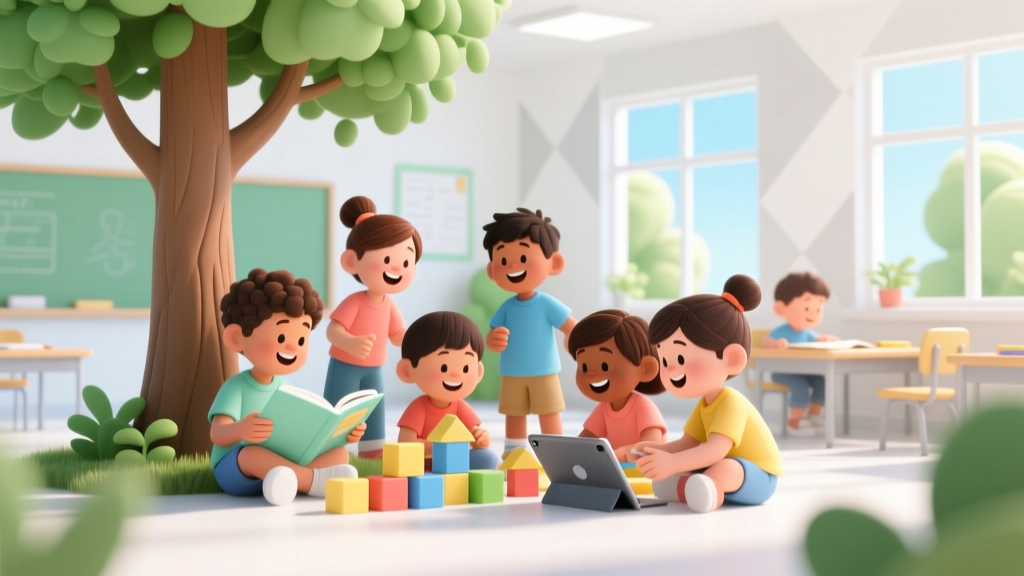
When Do Kids Read Chapter Books? (2026)
Why This Question Matters More Than Ever
What age do kids read chapter books is one of the most frequently searched literacy questions among parents—and for good reason. In an era where standardized testing begins as early as second grade and digital distractions compete for attention, caregivers are increasingly anxious about whether their child is 'on track.' But here’s what most online resources miss: chronological age is only one piece of the puzzle. According to the American Academy of Pediatrics (AAP), reading readiness is a confluence of decoding fluency, vocabulary depth, working memory capacity, sustained attention, and emotional stamina—not just turning seven. Rushing into chapter books before these foundations are secure can backfire, leading to frustration, avoidance, and even long-term disengagement from reading. This guide cuts through the noise with evidence-based benchmarks, real classroom observations, and practical tools you can use starting today.
Decoding the Developmental Timeline: It’s a Spectrum, Not a Switch
There is no universal 'chapter book birthday.' Research from the National Institute of Child Health and Human Development (NICHD) shows that independent chapter book reading typically emerges between ages 6.5 and 9.5—but with significant nuance. What matters more than the calendar is where your child lands on four interlocking developmental pillars:
- Phonemic & Decoding Fluency: Can they smoothly blend multisyllabic words (e.g., 'adventure,' 'mysterious') without laborious sounding-out?
- Vocabulary & Comprehension Stamina: Do they understand abstract concepts like 'justice' or 'betrayal' in context—and retain plot threads across multiple chapters?
- Working Memory & Attention Span: Can they hold character motivations, setting details, and cause-effect sequences in mind for 10+ minutes without rereading or losing focus?
- Emotional Resilience: Are they comfortable encountering ambiguity, mild tension, or unresolved endings—or do they need immediate resolution to feel safe?
Dr. Susan B. Neuman, former U.S. Assistant Secretary of Education and literacy researcher at NYU, emphasizes: 'A child who reads The Magic Tree House fluently at 6 may still need scaffolded support for inference-making at 8. Conversely, a 9-year-old who reads Harry Potter independently might struggle with historical fiction due to background knowledge gaps—not ability.' In other words: genre, text complexity, and scaffolding matter as much as age.
Spotting True Readiness: 7 Observable Signs (Not Just 'They Know All Their Sight Words')
Forget arbitrary grade-level labels. Instead, watch for these behavior-based indicators—observed consistently over 2–3 weeks—not just once:
- Self-Selected Sustained Reading: They choose books independently and read for 15+ uninterrupted minutes without prompting, doodling, or looking up every 30 seconds.
- Chapter Navigation Without Prompting: They flip back to re-read a passage, check a character list, or locate a prior clue—demonstrating metacognitive awareness of how chapter books work.
- Oral Retelling With Causal Logic: When asked 'What happened?', they don’t just list events ('Then she found the key. Then she opened the door.') but connect them ('She found the key because the cat knocked over the vase—and that’s why the door was unlocked.')
- Asking Text-Based Questions: 'Why did he lie to his mom?' or 'What does 'reluctant' mean in this sentence?'—not just 'What’s that word?'—signals engagement with subtext.
- Tolerating Ambiguity: They’re okay with cliffhangers, unanswered questions, or morally gray characters (e.g., 'Is the villain really bad, or is he scared?').
- Using Context Clues Strategically: When encountering unknown words, they pause, reread the sentence, look at illustrations (if present), and make an educated guess—rather than immediately asking for help.
- Expressing Preference by Genre/Author: 'I like books with animals that talk' or 'I want another book like Wayside School' reveals developing literary identity—not just compliance.
A real-world case study from a 2023 longitudinal study in Portland Public Schools tracked 42 third graders over 18 months. Only 62% met all 7 criteria by age 8.5—but 100% of those who did showed accelerated growth in inferential comprehension on standardized assessments (NWEA MAP Growth), outperforming peers by 1.3 grade levels within one year. Crucially, the 38% who hadn’t yet met all 7 weren’t 'behind'—they were simply developing different strengths first (e.g., advanced oral storytelling or nonfiction analysis).
Choosing the Right First Chapter Books: Beyond 'Level 3' Labels
Book leveling systems (like Guided Reading Levels or Lexile) are helpful—but dangerously incomplete. A 'Level M' book might be accessible to one child and overwhelming to another based on content density, sentence structure, and thematic load. Consider these five dimensions when selecting:
- Sentence Complexity: Average clause count per sentence (e.g., Junie B. Jones uses 1.2 clauses/sentence; Charlotte’s Web averages 2.4)
- Illustration Support: Are images used decoratively (minimal aid) or strategically (reinforcing sequence, emotion, or inference)?
- Character Constancy: Fewer than 5 main characters with clear distinguishing traits reduces cognitive load.
- Thematic Familiarity: Stories grounded in school, family, pets, or friendship require less background knowledge than historical or sci-fi settings.
- Pacing & Chapter Length: Early chapter books (Mercy Watson, Cam Jansen) average 5–8 pages/chapter; later ones (Because of Winn-Dixie) run 12–18 pages—demanding greater stamina.
Here’s a practical, research-informed guide to match books with developmental readiness—not just age:
| Developmental Profile | Typical Age Range | Recommended First Chapter Books | Why These Work | Red Flags to Pause |
|---|---|---|---|---|
| Emerging Decoder Strong phonics skills, limited sight vocabulary, high motivation but low stamina |
6.5–7.5 years | Henry and Mudge (Rylant), Frog and Toad (Lobel), Elephant & Piggie (Willems) | Repetition, predictable patterns, high-frequency words, generous white space, emotional clarity | Child skips entire paragraphs, substitutes nonsense words, or closes book after 2 pages |
| Confident Connector Fluent decoding, grasps cause/effect, asks 'why' questions, enjoys rereading favorites |
7.5–8.5 years | The Magic Tree House (Osborne), My Weird School (Gutman), Nate the Great (Sharmat) | Short chapters (5–7 pp), clear problem-solution arcs, humor that supports comprehension, controlled vocabulary with embedded definitions | Child summarizes only surface events ('She went to the library'), misses motives or consequences |
| Reflective Reader Tracks multiple characters, infers feelings/motives, connects story to personal experience, tolerates ambiguity |
8.5–10+ years | Because of Winn-Dixie (DiCamillo), The Tale of Despereaux (DiCamillo), Wonder (Palacio) | Complex emotions, layered narration, thematic depth, longer chapters (12–20 pp) balanced with rich dialogue and varied syntax | Child becomes distressed by character conflict, needs frequent reassurance, or refuses to read past Chapter 3 |
Supporting the Transition: What Parents (and Teachers) Actually Need to Do
Pushing harder doesn’t accelerate readiness—it often stalls it. Effective support is subtle, responsive, and rooted in co-reading. Here’s what works, backed by 2022–2024 classroom action research from the University of Michigan’s Literacy Achievement Council:
- Read Aloud Strategically: Choose chapter books slightly above their independent level (e.g., if they read Cam Jansen solo, read Frindle aloud). Pause every 2–3 pages to ask: 'What do you think will happen next—and what in the text made you think that?' This builds prediction and inference muscles without pressure.
- Create 'Chapter Book Rituals': Dedicate 10 minutes nightly to shared silent reading—where you both read your own books side-by-side. No quizzing. No corrections. Just modeling sustained focus. A 2023 study in Reading Research Quarterly found this simple habit increased independent reading time by 47% in 8 weeks.
- Normalize Struggle: Share your own reading stumbles: 'This sentence confused me—I had to read it twice. Let’s figure it out together.' Normalize rereading, looking up words, and saying 'I don’t know yet.' This reduces shame and builds growth mindset.
- Leverage Audiobooks Intentionally: Use them *alongside* physical books—not instead of. Follow the text while listening. Pause to discuss: 'How did the narrator show she was scared? What words helped you hear that?' This strengthens auditory processing and prosody awareness.
- Resist the 'Grade = Level' Trap: A child in third grade may thrive with early chapter books while their peer in fourth grade needs picture books with sophisticated themes (The Arrival, They All Saw a Cat). As Dr. Maryanne Wolf, cognitive neuroscientist and author of Reader, Come Home, states: 'The brain doesn’t develop on a school calendar. It develops on its own biological and experiential timeline.'
Frequently Asked Questions
Can a 5-year-old read chapter books?
Rarely—and only under very specific conditions. A small subset of profoundly gifted readers (estimated 0.1% of children) may decode early chapter books at age 5, but true comprehension (inferring, connecting, evaluating) almost never aligns this early. More commonly, what appears to be 'reading' is exceptional memorization or pattern recognition from repeated read-alouds. If your 5-year-old seems to read chapter books, prioritize comprehension checks: 'Who caused the problem in Chapter 2? How do you know?' If answers rely solely on illustrations or rote recall, they’re not yet ready for independent chapter book engagement. Focus instead on rich picture book discussions and oral storytelling.
My child reads early chapter books but hates reading. Why?
This is a critical red flag—and extremely common. Often, adults misinterpret decoding fluency as enjoyment. A child may read Boxcar Children accurately but feel exhausted, bored, or anxious because the text demands constant decoding effort with little emotional or intellectual payoff. The solution isn’t more practice—it’s matching text to interest and affective needs. Try: (1) Swap for high-engagement nonfiction (e.g., National Geographic Kids), (2) Co-create stories using voice notes or comic strips, or (3) Read aloud a beloved chapter book *together*, taking turns paragraph-by-paragraph. Joy precedes stamina—not the other way around.
Should I correct every mistake my child makes while reading chapter books?
No—over-correction kills flow and confidence. Research shows effective correction happens in three tiers: (1) If the error changes meaning ('He ran to school' vs. 'He ran to school'), gently prompt: 'Does that make sense? Try again.' (2) If it’s a decoding stumble on a multisyllabic word, break it down: 'Let’s chunk 'un-believ-a-ble.' (3) If it’s a minor substitution that preserves meaning ('big' for 'huge'), let it go. Your goal is comprehension and engagement—not perfection. As literacy coach Kylene Beers advises: 'When you interrupt to correct, you’re teaching them to fear mistakes—not to think like readers.'
Are graphic novels 'real' chapter books for this transition?
Absolutely—and often superior bridges. High-quality graphic novels (e.g., Smile, El Deafo, Science Comics) demand sophisticated inference (reading facial expressions, interpreting panel sequencing, synthesizing text and image), build vocabulary through visual context, and sustain narrative across dozens of pages. The International Literacy Association explicitly endorses them as 'complex multimodal texts' that support developing readers. If your child gravitates toward graphic novels, lean in—not away. They’re not a detour; they’re a different on-ramp.
Common Myths
Myth 1: 'If they’re not reading chapter books by second grade, they’ll fall behind permanently.'
False. Longitudinal data from the Early Childhood Longitudinal Study (ECLS-K) shows that children who began independent chapter book reading at age 9 (not 7) caught up to and often surpassed early readers in comprehension and critical thinking by middle school—when given consistent, joyful exposure and appropriate scaffolding. Late bloomers often develop deeper analytical habits because they’ve built stronger foundational skills first.
Myth 2: 'More reading time = faster chapter book readiness.'
Counterproductive. Forced reading beyond stamina erodes motivation. The AAP recommends 20 minutes of daily pleasurable reading—not drill-based practice. Quality trumps quantity: one deeply engaged, emotionally resonant 10-minute session builds more neural pathways than 30 minutes of resistant, distracted decoding.
Related Topics (Internal Link Suggestions)
- How to choose leveled readers for emerging readers — suggested anchor text: "best leveled readers for beginning chapter book readers"
- Signs of dyslexia in early readers — suggested anchor text: "early dyslexia indicators before chapter books"
- Best audiobooks for reluctant readers — suggested anchor text: "audiobooks that build chapter book stamina"
- Picture books with chapter-book depth — suggested anchor text: "sophisticated picture books for pre-chapter readers"
- How to read aloud chapter books effectively — suggested anchor text: "read aloud strategies for chapter books"
Conclusion & Your Next Step
So—what age do kids read chapter books? The honest answer is: whenever their unique constellation of skills, confidence, and curiosity aligns with the right book at the right time. There is no universal deadline, no magic birthday, and no shame in waiting. What matters is protecting the joy of story, honoring neurodiversity, and responding—not prescribing. Your next step is simple but powerful: Tonight, pull out three books—one slightly below, one at, and one slightly above your child’s current comfort zone. Sit together. Flip through. Ask: 'Which one feels exciting to read? Which one feels like work? Which one makes you curious about what happens next?' Listen closely—not to their answer, but to the tone in their voice, the light in their eyes, and the pause before they choose. That’s where readiness lives. Not on a chart. Not in a gradebook. In their quiet, unfolding love of language.
More Articles
 Lil Jon’s Kids: Parenting Teens & Blended Families (2026)
 Disney World Must Haves for Kids (2026)
 Do Kids Crocs Run Big or Small? (2026 Guide)
 How Do They Test Kids for Autism? (2026)
 How Old Are Ruby Franke’s Kids? Ethics & Privacy (2026)
 How Many Kids Does Catherine Paiz Have? (2026)
 Does Hello Kids Toothpaste Have Lead? (2026)
 What Age Do Kids Read? The Real Milestones (2026)
 Does Stevie Wonder Have Kids? The Truth (2026)
 What Are Neurodivergent Kids? A Parent’s Guide