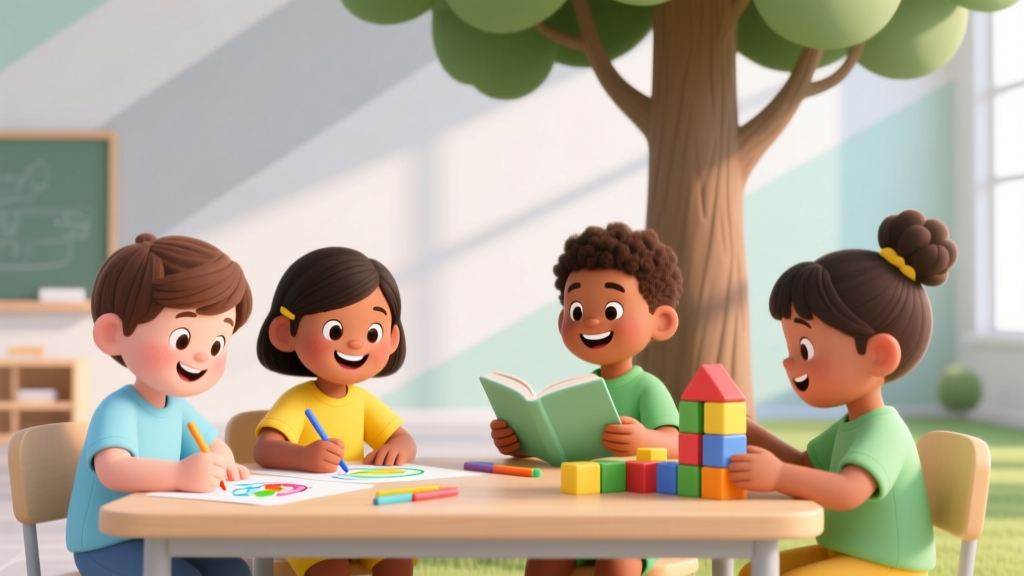
When Do Kids Learn to Identify Letters? (2026)
Why This Milestone Matters More Than You Think—Right Now
What age do kids learn to identify letters is one of the most frequently searched developmental questions among parents of toddlers and preschoolers—and for good reason. Letter identification isn’t just about 'knowing the alphabet'; it’s the foundational cognitive gateway to phonemic awareness, decoding, and ultimately, reading fluency. Yet today’s caregivers face unprecedented pressure: social media feeds flood with 3-year-olds reciting phonics rules, kindergarten readiness checklists demand pre-literacy benchmarks before age 5, and well-meaning relatives ask, 'Does she know her letters yet?'—as if it’s a pass/fail exam. In reality, neurodevelopmental science shows wide, healthy variation—and misinterpreting timing can lead to unnecessary stress, premature academic push, or missed opportunities for joyful, play-based literacy scaffolding. Let’s reset expectations with what’s truly typical, what’s cause for gentle support, and how to nurture this skill without worksheets or flashcards.
What the Research Really Says: A Developmental Timeline (Not a Deadline)
According to the American Academy of Pediatrics (AAP) and longitudinal studies from the National Institute of Child Health and Human Development (NICHD), letter identification emerges gradually across early childhood—not as a single 'aha!' moment, but as a layered progression tied to visual processing, memory development, and oral language growth. It begins long before formal instruction: infants as young as 4–6 months show preferential attention to high-contrast letter-like shapes over random patterns, suggesting innate visual bias for symbolic forms (Johnson & de Haan, 2015). But functional recognition—naming or pointing to letters on request—follows a predictable arc:
- Ages 2–3: Most children recognize 1–5 letters—often those in their own name (e.g., 'M' for Maya) or highly salient environmental print (e.g., the 'K' on a Kool-Aid box). This is name recognition, not abstract symbol knowledge.
- Ages 3–4: Recognition expands to ~10–15 letters, often uppercase first (simpler shapes), with strong preference for letters in names of family members or favorite characters ('D' for Dora, 'B' for Blue). At this stage, children may confuse similar shapes (P/Q, b/d) or reverse letters (E/Ǝ)—both developmentally appropriate.
- Ages 4–5: Many children identify 15–26 letters consistently, including lowercase forms. They begin connecting letters to sounds (letter-sound correspondence)—a critical bridge to reading. However, mastery varies widely: NICHD data shows only 62% of U.S. kindergarteners enter school able to name all 26 letters, with socioeconomic, language exposure, and teaching quality accounting for significant variance.
- Ages 5–6: By end of kindergarten, 85–90% of children reliably identify all uppercase and lowercase letters, though automaticity (speed and accuracy under time pressure) continues developing into first grade.
This isn’t theory—it’s observed daily in early childhood classrooms. Take Lena, a speech-language pathologist in Portland who assessed 127 preschoolers over three years: 'I saw zero correlation between early letter naming and later reading success—but I *did* see a strong link between playful, multimodal exposure (songs, tactile letters, storytelling) and sustained engagement. One child named only 3 letters at age 4 but became a fluent reader by second grade after his teacher embedded letter work into puppet shows and garden sign-making.'
The 4 Pillars of Natural Letter Learning (No Flashcards Required)
Forcing rote memorization undermines neural pathways. Research from the University of Virginia’s Curry School of Education confirms that children who learn letters through embodied, meaningful contexts develop deeper orthographic mapping—the brain’s ability to store letter-sound patterns for instant word retrieval. Here’s how to build those four pillars:
1. Environmental Print Immersion
Surround your child with authentic, purposeful text—not isolated letters. Label drawers ('Socks', 'Toys'), point out logos ('McDonald’s arches = M'), read cereal boxes together, and co-create grocery lists. A 2022 study in Early Childhood Research Quarterly found children exposed to rich environmental print at home recognized 37% more letters by age 4 than peers in low-print environments—even when controlling for parental education.
2. Name-Centered Literacy
Your child’s name is their first 'word.' Write it everywhere: on artwork, lunchboxes, bathroom mirrors. Cut out magnetic letters to spell it. Compare names: 'Your name starts with J like Jack’s—but Jack has two J’s! Does yours?' This builds phonological awareness *and* letter identity simultaneously. As Dr. Laura Justice, a leading early literacy researcher at Ohio State, notes: 'A child’s name isn’t just personal—it’s their first anchor point in the alphabetic principle.'
3. Multisensory Play
Touch, movement, and sound activate more neural networks than visual-only learning. Try: tracing letters in sand or shaving cream; forming them with pipe cleaners or playdough; singing the ABC song while tapping each letter on a drum; or using a flashlight to 'draw' letters on the ceiling during bedtime routines. A meta-analysis in Reading Research Quarterly showed multisensory interventions increased letter recognition gains by 2.3x compared to traditional methods.
4. Story-Driven Discovery
Choose books where letters are central characters or plot devices: Eating the Alphabet (featuring fruits/veggies), Chicka Chicka Boom Boom (letters climbing a coconut tree), or The Little Red Hen (spotting 'H' in 'Hen,' 'Hoe,' 'Harvest'). Pause and ask: 'Which letter starts “hen”? Can you find another word on this page that starts with H?' This embeds letter knowledge in narrative context—making it memorable and meaningful.
When to Gently Support vs. When to Consult: Red Flags & Green Lights
Developmental variation is normal—but certain patterns warrant collaborative exploration with your pediatrician or early intervention specialist. Use this table to assess your child’s progress holistically:
| Age Range | Typical Letter Identification Skills | Green Light (Encouraging Signs) | Yellow Flag (Monitor & Enrich) | Red Flag (Seek Guidance) |
|---|---|---|---|---|
| 2–3 years | Recognizes 1–5 letters, usually in name/environment | Points to letters when named; hums along to ABC song; enjoys alphabet books | Rarely notices print; no interest in books; avoids looking at signs/books | No response to familiar letters after repeated exposure; inconsistent eye contact during shared reading |
| 3–4 years | Names 10–15+ letters; distinguishes some uppercase/lowercase | Asks 'What letter is that?'; traces letters spontaneously; connects letters to sounds ('B says /b/') | Confuses >5 similar letters (b/d/p/q); cannot name letters in own name after modeling | No letter naming by age 4; difficulty distinguishing rhyming words; limited vocabulary (<200 words) |
| 4–5 years | Names most/all letters; attempts writing; links letters to beginning sounds | Writes name legibly; spells simple words phonetically ('cat' → C-T); enjoys word games | Struggles with lowercase letters; reverses >3 letters consistently; slow to recall names | Cannot name >10 letters by age 5; avoids writing/drawing; frustration during literacy activities |
| 5–6 years | Automatic letter naming; uses letters in invented spelling | Reads environmental print independently; identifies letters in new words; self-corrects errors | Needs prompting for less-familiar letters; slow letter-sound recall | Still unable to name >15 letters; confuses letters with numbers; avoids all print-based tasks |
Note: These flags assume no known vision/hearing impairments. Always rule out sensory issues first—a 2023 AAP policy statement emphasizes that undiagnosed vision problems account for ~18% of early literacy delays misattributed to 'slow learners.'
Frequently Asked Questions
My child knows all letters but can’t connect them to sounds—Is that normal?
Absolutely—and it’s actually very common. Letter naming and phonemic awareness (hearing/producing sounds) are distinct cognitive skills that develop along different timelines. Research shows many children master letter names by age 4 but don’t reliably match sounds until age 5–6. Focus on playful sound games: 'I spy something that starts with /m/… yes, milk! What else starts with /m/?' Avoid drilling; instead, emphasize listening and speaking. As Dr. Timothy Shanahan, literacy expert and former director of the U.S. Department of Education’s Reading First program, advises: 'If a child knows the letter, the sound will follow—especially when embedded in rich oral language experiences.'
Should I teach uppercase or lowercase letters first?
Start with uppercase—but introduce lowercase early and intentionally. Uppercase letters have simpler, more distinct shapes (e.g., 'L' vs. 'l'), making them easier for young eyes to discriminate. However, lowercase letters appear in 95% of printed text, so delaying their introduction creates a gap. Best practice: Teach both simultaneously using paired materials (e.g., 'A' and 'a' on same card), emphasizing that they’re 'big' and 'small' versions of the same letter. Montessori educators use sandpaper letters that include both cases to build tactile memory for shape differences.
My 3-year-old reverses letters constantly—is this dyslexia?
Reversals (b/d, p/q, m/w) are developmentally typical through age 7. The brain’s visual processing system matures gradually, and mirror-image recognition is actually an evolutionary advantage (helping us recognize faces and objects from any angle). Dyslexia diagnosis requires persistent, cross-domain difficulties—like trouble rhyming, remembering sequences, or learning nursery rhymes—*plus* family history and formal assessment. As Dr. Sally Shaywitz, co-director of the Yale Center for Dyslexia & Creativity, states: 'Letter reversals alone are never sufficient for diagnosis. Look at the whole profile.'
Do bilingual children learn letters slower?
No—they often learn faster, but the pattern differs. Bilingual children may initially mix scripts (e.g., using Spanish 'ñ' in English words) or show stronger recognition in their dominant language. Crucially, research from the Harvard Graduate School of Education shows bilingual preschoolers develop metalinguistic awareness earlier—meaning they understand that letters represent sounds, even if those sounds differ across languages. This strengthens their overall literacy foundation. Support by labeling items in both languages and celebrating dual-script books (e.g., ¡Vamos a Leer!).
Is screen time helpful for letter learning?
Only if it’s interactive, adult-coached, and limited. Passive video (e.g., alphabet cartoons) shows near-zero transfer to real-world letter recognition (JAMA Pediatrics, 2021). But co-viewing an app like PBS Kids’ Super Why! while pausing to ask 'What letter is on the door?' or tracing letters on the tablet screen *with your hand guiding theirs* activates multiple learning pathways. The AAP recommends no screen-based literacy instruction before age 2 and limits to 1 hour/day of high-quality programming for ages 2–5—with consistent adult mediation.
Common Myths About Letter Identification
- Myth #1: 'If they don’t know all letters by age 4, they’ll fall behind in reading.' Reality: Longitudinal data from the Early Childhood Longitudinal Study shows letter-naming speed at kindergarten entry predicts reading outcomes—but *accuracy* does not. Children who knew only 12 letters at age 5 but demonstrated strong phonological awareness and vocabulary caught up to peers by third grade.
- Myth #2: 'Alphabet songs guarantee letter mastery.' Reality: Singing the ABC song helps sequence memory, but doesn’t teach letter identity or sound. Children often sing it without knowing individual letter names—a phenomenon researchers call 'rote recitation without referent knowledge.' Pair singing with pointing to letters, writing them, or finding them in books to build true understanding.
Related Topics (Internal Link Suggestions)
- Phonemic Awareness Activities for Toddlers — suggested anchor text: "phonemic awareness games for 2-year-olds"
- Best Alphabet Books for Preschoolers — suggested anchor text: "top research-backed alphabet picture books"
- When to Start Teaching Sight Words — suggested anchor text: "sight word introduction timeline by age"
- Signs of Early Literacy Delay — suggested anchor text: "early literacy red flags checklist"
- Montessori-Inspired Letter Learning — suggested anchor text: "tactile letter learning for preschoolers"
Next Steps: Your Low-Pressure Action Plan
You now know the truth: what age do kids learn to identify letters isn’t a rigid benchmark—it’s a dynamic, individualized journey shaped by environment, interaction, and joy. Instead of comparing or testing, try this 7-day reset: (1) Spend 5 minutes daily noticing print *with* your child—not quizzing them ('Look at the 'C' on the cereal box! What food starts with C?'); (2) Write your child’s name in large letters and hang it where they’ll see it daily; (3) Replace one flashcard session with a letter scavenger hunt in your backyard or kitchen. Track not mastery, but moments of curiosity—'She paused at the 'S' on the stop sign and said “snake!”' That’s the real milestone. If you’d like a printable version of the Age Appropriateness Guide above—or a curated list of 12 no-prep, play-based letter activities tailored to your child’s current stage—download our free 'Letter Learning Without Pressure' toolkit. Because literacy isn’t built on deadlines—it’s grown, one joyful, meaningful connection at a time.
More Articles
 How Many Baby Teeth Do Kids Lose? (2026)
 When Do Kids Drop Nap? Signs, Not Age (2026)
 Billy Joel’s Kids’ Ages in 2026
 John Candy’s Kids’ Ages in 2026 | Legacy & Privacy
 How Many Kids Do Most People Have? (2026)
 What Drug in Welcome to Derry? | Parent Tips (2026)
 Kids Whitening Toothpaste: Age Limits & Safe Alternatives
 Mini Schnauzers With Kids: Truth, Safety & Real Families
 ADHD in Kids: Latest Stats & What They Mean (2026)
 Ringworm in Kids: Pediatrician-Approved Treatment