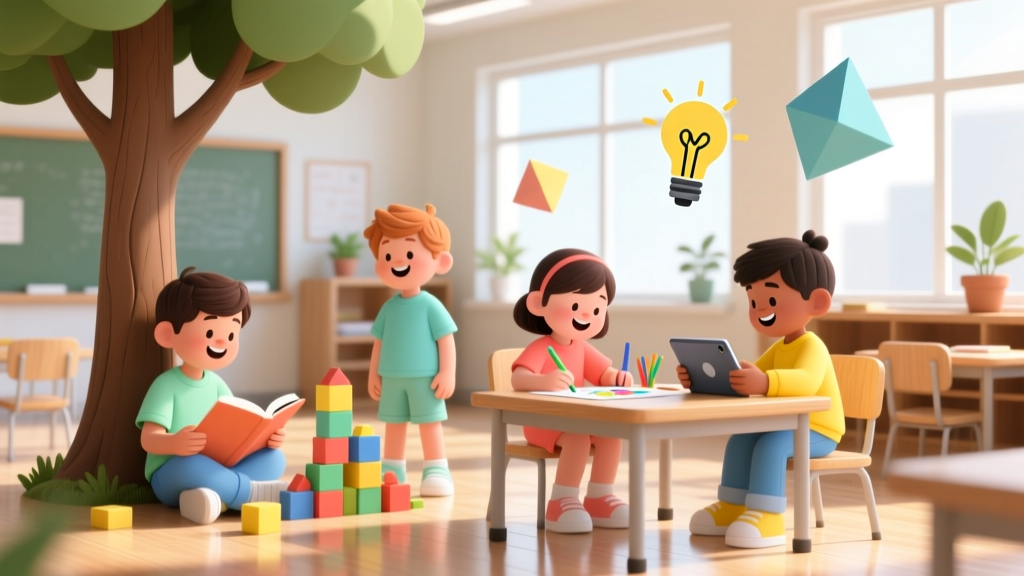
What Age Do Kids Learn to Count? Science-Backed Timeline
Why 'What Age Do Kids Learn to Count' Isn’t Just About Numbers—It’s About Brain Wiring, Confidence, and Lifelong Math Identity
If you’ve ever caught yourself whispering, "What age do kids learn to count?" while watching your 3-year-old confidently chant "1–2–3–4–5…12…18…22" without touching a single object—or staring blankly when asked to give you "two" crackers—you’re not behind. You’re witnessing neurodevelopment in real time. Counting isn’t a switch that flips on a birthday; it’s a layered cognitive skill built across 24–48 months through sensory experience, language exposure, and responsive interaction. And yet, 68% of parents report moderate-to-high anxiety about their child’s early math progress (2023 Zero to Three Parent Survey), often mistaking memorization for understanding—or worse, comparing their child to viral ‘genius toddler’ reels. This guide cuts through the noise with pediatric-developmental science, real classroom observations, and actionable, screen-free strategies grounded in Montessori, NAEYC, and AAP guidelines.
How Counting Actually Unfolds: From Rote Chant to Conceptual Mastery
Counting is deceptively simple—but developmentally complex. Researchers at the University of Chicago’s Early Math Collaborative identify five distinct, sequential competencies, each requiring different neural pathways and environmental support:
- Rote Counting (Ages 2–3): Reciting number words in order—often learned like nursery rhymes. No connection yet to quantity.
- One-to-One Correspondence (Ages 3–3.5): Matching one number word to one object while pointing or moving items. This is where true counting begins.
- Cardinality (Ages 3.5–4): Understanding that the last number said represents the total quantity (“Five” means all five blocks—not just the final one).
- Order Irrelevance (Ages 4–4.5): Recognizing that objects can be counted in any order and still yield the same total.
- Abstraction (Ages 4.5–5+): Counting non-physical things—sounds, claps, imaginary objects—demonstrating flexible number concept mastery.
Crucially, these don’t appear in rigid lockstep. A child might nail cardinality with blocks but struggle with sounds—a sign of normal variation, not delay. According to Dr. Julie Sarama, co-director of the NSF-funded Building Blocks early math project, "Children who skip rote counting entirely and jump straight to meaningful counting often develop deeper number sense—because they’re focused on quantity, not sequence." That’s why forcing flashcards before age 3.5 can backfire: it trains memory, not math reasoning.
The 7 Low-Pressure, High-Impact Strategies Backed by Preschool Teachers & Developmental Psychologists
Forget worksheets and timed drills. The most effective counting support happens invisibly—in daily routines, with zero prep. Here’s what works, why, and how to adapt it:
- Label Quantities—Not Just Numbers: Instead of “Let’s count the grapes!” say, “You have three grapes. One for you, one for baby sister, one for Daddy.” Embedding number words in relational, meaningful contexts builds semantic understanding faster than isolated counting.
- Pause Mid-Count & Invite Correction: When your child says “1, 2, 3, 5…” pause, point to the missing item, and ask, “What comes after three?” This leverages the brain’s error-detection system—proven to deepen learning more than passive repetition (Journal of Educational Psychology, 2022).
- Use ‘Touch-and-Move’ Objects Daily: Not plastic counters—real, manipulable things: spoon beans into a bowl (counting transfers), line up shoes by size (ordinal + cardinal), stack books and knock them down while counting falls. Kinesthetic input wires number concepts to motor memory.
- Ask ‘How Many?’ Only After They’ve Counted: Never lead with the question. Let them initiate counting during play (“Look—I made five towers!”). Then respond, “Five! Yes—let’s check: 1, 2, 3, 4, 5.” This honors agency and reinforces accuracy as a shared discovery—not a test.
- Introduce ‘Zero’ Early & Playfully: “Where are the cookies? Zero left! We need zero more—we need five!” Zero is a conceptual gateway to place value and negative numbers later. Children grasp it intuitively when framed as absence—not just an abstract digit.
- Count Backward from Small Numbers: Start with “3…2…1…POP!” (balloon, bubble, or silly sound). Backward counting strengthens working memory and predicts later subtraction fluency better than forward-only practice (National Council of Teachers of Mathematics, 2021).
- Notice & Name Their Strategy: “You pointed to each car—that’s how we make sure we count them all!” or “You moved the buttons aside—that’s a super smart way to keep track!” Verbalizing their method makes implicit thinking explicit, accelerating metacognition.
When to Pause, Observe, or Seek Support: Milestones vs. Red Flags
Developmental timelines vary widely—and that’s healthy. But certain patterns warrant gentle observation or professional consultation. The American Academy of Pediatrics emphasizes that concern arises not from timing alone, but from consistency, engagement, and responsiveness. For example, a child who consistently skips numbers *and* avoids eye contact during counting games, or shows no interest in matching quantities despite rich exposure, may benefit from screening.
Below is an evidence-based Age Appropriateness Guide synthesizing AAP, CDC, and NAEYC benchmarks—with emphasis on functional use over isolated recitation:
| Age Range | Typical Counting Behaviors | Supportive Adult Actions | When to Gently Monitor |
|---|---|---|---|
| 24–30 months | Says number words up to 5–10 in sequence (often jumbled); points randomly at objects; may repeat “one” for everything. | Chant numbers during routines (stair climbing, hand-washing); count steps aloud; label small sets (“Two socks!”). | Doesn’t imitate number words by 30 months; shows no interest in matching actions to words (e.g., won’t tap objects when you count). |
| 30–36 months | Counts 3–5 objects accurately with pointing; understands “more”/“same”; may miscount but self-corrects occasionally. | Play “give me X” games (“Give me three crayons”); compare groups (“Which has more berries?”); count snacks during prep. | Cannot reliably match 3 items by 36 months; confuses “four” and “five” consistently; avoids counting tasks entirely—even playfully. |
| 36–48 months | Counts 10+ objects accurately; knows “how many” after counting; counts backward from 5; groups objects by twos/fives informally. | Introduce simple board games with dice; count items while setting table; ask “What’s one more?” or “What’s one less?” | No cardinality understanding by 48 months (e.g., counts five blocks but says “seven” when asked “how many?”); cannot follow simple “give me X” requests involving 3–5 items. |
| 48+ months | Counts beyond 20; solves simple addition/subtraction with objects; estimates quantities (“about ten”); uses numbers in pretend play (prices, ages, scores). | Involve in cooking (measuring cups = fractions); discuss time (“We’ll leave in five minutes”); play “I’m thinking of a number between 1 and 10.” | Struggles with one-to-one correspondence or cardinality despite consistent, playful exposure; significant frustration or avoidance around any quantity-based task. |
Frequently Asked Questions
Can counting too early cause anxiety or burnout?
Yes—if it’s forced, evaluative, or disconnected from meaning. Research from Stanford’s Graduate School of Education shows that children subjected to drill-based number instruction before age 4 show lower math motivation and higher math anxiety by Grade 2. The key is autonomy: let counting emerge from curiosity—not compliance. If your child walks away, stop. If they initiate (“How many stars?”), lean in. As Dr. Douglas Clements, founding researcher of Building Blocks, states: “Early math isn’t about speed or output—it’s about joyful noticing.”
My child counts perfectly—but doesn’t understand “five” means five things. Is that normal?
Absolutely—and incredibly common. This is called “rote-counting without cardinality,” and it’s a typical, necessary stage. In fact, a longitudinal study published in Child Development found that 72% of children aged 3.2–3.7 demonstrated this exact gap. It closes naturally with repeated, low-stakes opportunities to connect number words to sets—especially when adults model checking (“Let’s count again to be sure!”) and emphasize the final word (“That’s five—all of them!”).
Do bilingual children learn to count later?
No—bilingualism does not delay counting. In fact, studies from the University of Washington show bilingual preschoolers often demonstrate stronger executive function during counting tasks (like inhibiting the urge to skip numbers) due to constant language-switching practice. However, they may temporarily mix languages (“uno, two, tres”) or master rote counting in one language first. This is normal code-mixing—not confusion. Support both languages equally: count in Spanish at dinner, English at bath time.
Is using fingers for counting bad for development?
Not only is it not bad—it’s essential. Neuroimaging confirms finger representation areas overlap heavily with number-processing regions in the brain. The “finger gnosis” test (identifying which finger was touched with eyes closed) strongly predicts future arithmetic success. Let children use fingers freely until age 6–7. As Dr. Daniel Ansari, cognitive neuroscientist at Western University, explains: “Fingers are the original calculator—and suppressing them is like asking a writer to type with gloves on.”
Should I buy counting toys or apps?
Most commercial “counting toys” (flashing lights, voice-output buttons) teach rote recitation—not number sense. AAP advises against screen-based counting apps before age 2.5, and even then, only with adult co-engagement. Far more powerful: a $2 bag of dried beans, a muffin tin, and your voice. If purchasing, choose open-ended materials: wooden number puzzles with tactile numerals, abacuses, or counting bears with matching cups—where the child controls the action, not the toy.
Common Myths About Early Counting
- Myth #1: “If they can’t count to 20 by age 4, they’ll fall behind in kindergarten.” Reality: Kindergarten standards (Common Core & state frameworks) expect accurate counting to 20 with objects—not rote recitation. Many children who chant to 100 at 3 still can’t count 7 blocks correctly at 4. Depth > breadth. Focus on meaning, not range.
- Myth #2: “More practice = faster learning.” Reality: Over-practice without conceptual grounding creates fragile knowledge. A 2023 study in Early Childhood Research Quarterly found children who engaged in 5 minutes of playful counting daily outperformed peers doing 15-minute structured drills 3x/week—because play sustains attention, reduces stress hormones, and embeds learning in memory networks.
Related Topics (Internal Link Suggestions)
- When do kids recognize letters? — suggested anchor text: "early literacy milestones timeline"
- Best Montessori counting materials for home — suggested anchor text: "Montessori-inspired math tools under $30"
- Signs of dyscalculia in preschoolers — suggested anchor text: "early math learning differences checklist"
- How to teach shapes and colors together — suggested anchor text: "integrated early learning activities"
- Screen time guidelines for toddlers by age — suggested anchor text: "AAP-recommended digital balance for preschoolers"
Wrap-Up: Your Role Isn’t Teacher—It’s Number Storyteller
You don’t need to “teach” counting. You need to notice it, name it, and nurture it—like tending a tiny, resilient plant. Every time you count stairs, portion snacks, or wonder aloud “How many ducks did we see?”, you’re building neural architecture far more durable than any app or worksheet. So breathe. Trust the process. And next time your child points at three apples and says “one-two-three!”, kneel down, make eye contact, and say: “Three apples. Yes—all of them.” That’s not just counting. That’s the foundation of logic, reasoning, and confidence. Ready to go deeper? Download our free, printable ‘Counting in Context’ card deck—30 everyday moments (laundry, gardening, bath time) with simple, research-backed prompts to spark authentic number talk.
More Articles
 Does Tylenol Cause Autism? What Research Shows
 How Many Kids Does Nelly Have? Real Parenting Lessons
 How Many Kids Does Flavor Flav Have? (2026)
 How Many Kids Does Philip Rivers Have? (2026)
 Kate Hudson Kurt Russell Kids: Blended Family Truth (2026)
 Funny Mike's Kids: How Many and Why Parents Love It
 Decaf Coffee for Kids: Pediatrician Advice (2026)
 Adam Sandler’s Kids in His Movies? Truth & Privacy (2026)
 How Many Carter Kids Are Still Alive? (2026)
 Where Winds Meet: Pediatric Safety Facts (2026)