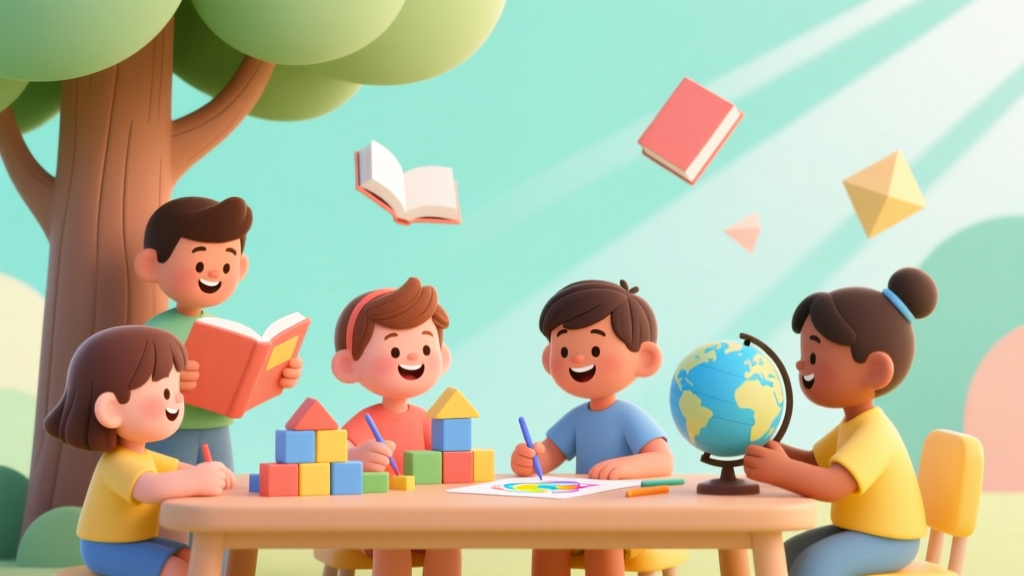
What Age Do Kids Learn Letters? Evidence-Based Timelines
Why This Question Matters More Than Ever Right Now
If you've ever scrolled through parenting forums wondering what age do kids learn letters, you're not overthinking — you're responding to real pressure. Between preschool admissions checklists, viral 'alphabet mastery by 3' TikTok challenges, and well-meaning relatives asking, 'Can she write her name yet?', many caregivers feel like they're racing an invisible clock. But here’s what decades of child development research confirms: letter learning isn’t a race — it’s a neurological unfolding, deeply influenced by language exposure, sensory integration, motor development, and emotional safety. Getting the timing right isn’t about acceleration; it’s about alignment with your child’s unique wiring.
What the Research Really Says: It’s Not One Age — It’s a Range With Guardrails
Let’s start with clarity: there is no single 'right' age when all children learn letters. According to the American Academy of Pediatrics (AAP) and the National Institute for Literacy, letter recognition typically emerges between ages 3 and 5, but with meaningful variation. A landmark 2022 longitudinal study published in Early Childhood Research Quarterly tracked 1,247 children from toddlerhood through kindergarten and found that only 12% recognized all 26 uppercase letters by age 3, while 68% achieved this milestone between ages 4.2 and 4.9. Crucially, the study emphasized that children who reached full letter recognition at age 5.1 showed identical reading outcomes by third grade as those who did so at age 4.3 — proving that pace ≠ potential.
What matters far more than calendar age is how the learning unfolds. Dr. Elena Torres, a developmental psychologist and co-author of the AAP’s 2023 Early Literacy Guidelines, explains: 'We see strong predictive power not in *when* a child names letters, but in *how* they engage with them — whether they notice letters in environmental print (like cereal boxes), connect sounds to symbols spontaneously (“B says /b/ like ball!”), or show curiosity about writing their own name. These are authentic indicators of emergent literacy — not rote memorization under pressure.'
Here’s what the data reveals about typical progression:
- Ages 2–3: Children begin noticing letters as visual shapes — often recognizing the first letter of their name or logos (e.g., the golden arches for McDonald’s). They may hum alphabet songs without naming letters.
- Ages 3–4: Most children recognize 5–10 uppercase letters, especially those in their name or frequently seen (A, B, O, S). They start matching letters to beginning sounds in familiar words.
- Ages 4–5: Recognition expands to 15–20+ letters, including both upper- and lowercase forms. Children begin writing some letters — often starting with vertical/horizontal lines (L, T, H) before curves (O, S, C).
- Ages 5–6: By kindergarten entry, most children recognize all 26 letters and can produce corresponding sounds — though fluency varies widely and remains normal across this window.
The Hidden Risks of Premature Pressure (And What to Do Instead)
When parents or educators push formal letter instruction before a child’s brain and body are ready — say, drilling flashcards with a 2.5-year-old who hasn’t yet mastered pencil grip or sustained attention — we risk more than frustration. Neuroscientist Dr. Roberta Chang, lead researcher at the Early Brain Development Lab at UC Berkeley, warns: 'Forcing symbolic abstraction before foundational skills like phonological awareness, fine motor control, and working memory mature can create negative associations with learning itself. fMRI scans show heightened amygdala activation (the brain’s fear center) during forced letter drills in pre-4s — literally wiring stress into literacy.'
Instead, evidence points to play-based priming. Consider Maya, a speech-language pathologist in Portland who worked with twin brothers — one identified as neurodivergent (ADHD/dyspraxia), the other developing typically. At age 3, neither could name letters on demand. So Maya introduced 'Letter Treasure Hunts': hiding foam letters in kinetic sand, singing ‘Bingo’ with letter cards, and labeling toy bins with large-print letters ('T for Trucks', 'B for Blocks'). By age 4.5, both boys knew all letters — but more importantly, they’d built neural pathways linking symbol → sound → meaning → joy.
Here’s how to replicate this approach:
- Anchor letters to identity: Start with the first letter of your child’s name — print it large, trace it in glitter glue, find it on street signs. Personal relevance builds neural hooks.
- Embed in movement: Use gross motor play: 'Jump to the letter that starts your friend’s name!' or 'Crawl under the 'C' taped to the floor.' Kinesthetic learning strengthens memory.
- Follow their lead, don’t lead them: If your child points to an 'M' on a milk carton, say, 'Yes! That’s M — it makes the /m/ sound, like “mmm-milk.”' Don’t quiz; narrate and expand.
- Limit screen-based letter apps: While some apps claim 'early literacy,' a 2023 JAMA Pediatrics meta-analysis found zero evidence that tablet-based letter games improved letter knowledge in children under 4 — but did correlate with reduced joint attention time with caregivers.
- Protect the 'why': Never separate letters from meaning. 'A' isn’t just a shape — it’s the start of 'apple,' 'ant,' 'airplane.' Connect symbol to story, sound, and sensation.
When to Pause and Pivot: Red Flags vs. Normal Variation
Understanding typical ranges helps spot genuine concerns — but distinguishing red flags from healthy variation requires nuance. The AAP advises consulting a pediatrician or early intervention specialist if, by age 5, a child shows multiple of these patterns:
- No interest in books or environmental print (signs, labels, menus)
- Difficulty rhyming or clapping syllables in words ('ba-na-na' = 3 beats)
- Consistent letter reversals with confusion (e.g., calling 'b' 'd' and 'p' interchangeably and struggling to correct even with cues)
- Extreme frustration or avoidance during any letter-related play
- No attempt to scribble, draw shapes, or imitate writing by age 4.5
Note: Occasional reversals (b/d/p/q) are normal until age 7 — it’s the persistence, lack of self-correction, and co-occurring language or motor delays that warrant evaluation. As Dr. Arjun Patel, a pediatric neurologist at Boston Children’s Hospital, clarifies: 'Reversals alone aren’t dyslexia. Dyslexia is a language-processing difference — not a visual one. We look at the whole profile: phonemic awareness, rapid naming speed, family history, and response to targeted instruction.'
Importantly, neurodivergent learners often follow different pathways. Children with autism may hyper-focus on letters early (e.g., reciting the alphabet backward at 2.5) but struggle with sound-symbol connection. Those with dyspraxia may know letters perfectly but lack motor planning to form them. Individualized, strengths-based support — not accelerated drill — is the gold standard.
Age-Appropriateness Guide: Matching Activities to Developmental Readiness
Choosing activities based on where your child is — not where charts say they 'should' be — transforms letter learning from stressful to joyful. This table synthesizes AAP milestones, Montessori principles, and occupational therapy best practices into actionable guidance:
| Age Range | Typical Developmental Strengths | High-Impact, Low-Pressure Activities | Safety & Sensory Notes |
|---|---|---|---|
| 2–3 years | Strong visual discrimination for high-contrast shapes; emerging phonological awareness (notices rhymes); limited fine motor precision | • Sing alphabet songs with hand motions • Match large foam letters to textured letter cards (sandpaper, felt) • Point out letters in favorite books ('Find the 'S' on the snake!') |
Avoid small-letter manipulatives (choking hazard). Prioritize tactile, multisensory input — avoid screens. |
| 3–4 years | Improved hand-eye coordination; can copy simple shapes; recognizes some environmental print; begins sound-play | • 'Letter of the Week' with themed snacks (B for banana, B for blueberries) • Form letters with playdough or pipe cleaners • Sort magnetic letters by shape (curves vs. lines) |
Supervise magnet use closely. Ensure playdough is non-toxic and scent-free for sensory-sensitive children. |
| 4–5 years | Can write some letters independently; understands left-to-right directionality; connects some letters to sounds; longer attention span | • Create a 'Name Book' with photos and printed letters • Play 'I Spy Sounds' ('I spy something that starts with /t/') • Use chalk to write letters on sidewalks — then jump on them |
Introduce pencils with ergonomic grips. Watch for fatigue — 5–10 minutes of focused writing is ample. |
| 5–6 years | Writes name legibly; sequences letters correctly; blends sounds into simple words; asks 'How do you spell…?' | • Invent 'secret codes' using letter-sound substitution • Label classroom items with student-written words • Play word-building games with letter tiles (e.g., 'Make a word with B, A, T') |
Transition to pencil-and-paper tasks gradually. Celebrate effort over perfection — praise specific strategies ('You remembered the 'c' makes /k/!'). |
Frequently Asked Questions
My child is 4 and still doesn’t know any letters — should I be worried?
Not necessarily — but it’s a good time to deepen engagement. At age 4, many children recognize 5–10 letters, but 'zero' falls within the lower end of normal variation, especially if they’re strong in other areas (vocabulary, storytelling, social play). Focus on joyful, low-stakes exposure: point out letters in their world, sing songs, play with magnetic letters. If there’s no progress after 2–3 months of consistent, playful interaction — or if they also struggle with rhyming, following multi-step directions, or holding a crayon — consult your pediatrician for a developmental screening.
Is it better to teach uppercase or lowercase letters first?
Uppercase letters are developmentally easier for young children — they’re simpler to form (fewer curves, straighter lines) and appear more frequently in environmental print (store signs, book titles). Most experts recommend starting with uppercase, then introducing lowercase around age 4.5–5, emphasizing that lowercase letters appear in 95% of written text. A smart bridge: teach 'capital A' and 'little a' together once uppercase is solid, highlighting similarities (A/a, B/b, C/c).
Does bilingualism delay letter learning?
No — bilingualism does not cause delays in literacy development. In fact, research from the University of Miami’s Bilingualism Research Lab shows bilingual children often develop stronger metalinguistic awareness (understanding how language works), which supports later reading. However, they may distribute knowledge across languages (e.g., know letters in English but sounds in Spanish). Support both languages equally — read bilingual books, sing songs in both, and celebrate cross-linguistic connections ('A is 'a' in English and 'a' in Spanish — same letter, same sound!').
Are letter tracing worksheets helpful for preschoolers?
They can be — but only if used mindfully. Worksheets become counterproductive when they’re repetitive, timed, or correction-focused. Occupational therapists recommend using them after multisensory practice (e.g., tracing in sand first, then on paper). Better alternatives: write letters in shaving cream on a tray, 'paint' them with water on pavement, or build them with LEGO bricks. The goal is motor memory, not perfect formation.
My child mixes up 'b' and 'd' constantly — is this dyslexia?
Letter reversals like b/d, p/q are extremely common and developmentally appropriate until age 7. Dyslexia involves persistent difficulty with phonological processing — connecting sounds to symbols — not visual confusion. Key indicators include trouble remembering letter sounds, slow/effortful reading, poor spelling despite good instruction, and family history. If reversals persist beyond age 7 and co-occur with these issues, seek evaluation from a reading specialist or educational psychologist.
Common Myths
Myth #1: “If they’re not reading by 5, they’ll fall behind forever.”
Decades of longitudinal data (including the Abecedarian Project and Perry Preschool Study) prove that early academic pressure doesn’t predict long-term success — but early emotional security and rich language environments do. Many strong readers don’t decode fluently until age 6.5–7 and thrive academically.
Myth #2: “More flashcards = faster learning.”
Flashcards rely on rote memorization, which engages short-term memory circuits — not the deep, connected neural networks needed for literacy. Play-based, contextual learning (letters in stories, songs, names) builds durable, flexible knowledge.
Related Topics (Internal Link Suggestions)
- Phonemic Awareness Activities for Toddlers — suggested anchor text: "phonemic awareness games for 2-year-olds"
- Best Non-Toxic Alphabet Toys for Preschoolers — suggested anchor text: "safe wooden letter toys"
- When Do Kids Learn Sight Words? — suggested anchor text: "sight word timeline by age"
- Signs of Speech Delay vs. Late Bloomer — suggested anchor text: "speech development checklist"
- Montessori-Inspired Letter Learning at Home — suggested anchor text: "DIY Montessori sandpaper letters"
Conclusion & Your Next Step
So — what age do kids learn letters? The answer isn’t a number. It’s a process rooted in relationship, rhythm, and respect for neurodevelopmental timing. Whether your child names every letter at 3 or discovers them joyfully at 5, what truly builds lifelong literacy is your calm presence, your curious questions, and your willingness to meet them where they are — not where a chart says they should be. Your next step? Pick one low-pressure strategy from this article — maybe start a 'Letter of the Day' ritual using their favorite food or toy — and observe what sparks their attention. Then, pause. Notice. Celebrate the tiny 'aha' moments: the finger tracing a letter in condiment, the giggle when 'S' sounds like a snake, the proud pointing at 'STOP' on a sign. That’s not just letter learning — that’s the foundation of confident, joyful learning for life.
More Articles
 Kids’ Protein Shakes: Safe? What to Check (2026)
 Don Jr Kids: How Many Children in 2026
 Can Kids Get Giardia from Dogs? (2026)
 When Do Kids Start School? State Rules & Readiness Tips
 How Many Kids Does Flacco Have? (2026)
 Randy Orton Kids: Truth About His Parenting & WWE Balance
 How Long Do Kids Need Booster Seats? (2026)
 What Generation Are Kids Now? Gen Alpha Explained
 Angie Stone’s Kids Ages and Parenting Wisdom
 Screen Time for Kids: Science-Backed Limits & Strategies