Booster Seat Age, Weight & Height Rules (2026)
Why Getting Booster Seat Timing Right Isn’t Just About Age — It’s About Spinal Safety
What age can kids use booster seats? That question lands in parents’ inboxes, pediatrician waiting rooms, and late-night Google searches after a car seat technician says, “She’s *almost* ready” — but no one explains what ‘almost’ means. The truth? Age alone is the weakest predictor of booster seat readiness. According to the American Academy of Pediatrics (AAP), no child should move to a booster seat before age 4, but most children need to stay in a forward-facing harnessed seat until at least age 5–7 — and many benefit from staying harnessed even longer. Why? Because booster seats rely entirely on proper seat belt geometry to protect a child’s developing spine, pelvis, and internal organs during sudden stops or crashes. A poorly positioned lap belt can cause catastrophic abdominal injuries; a shoulder belt across the neck or face risks airway compromise or spinal cord trauma. In this guide, we cut through outdated rules and state-by-state confusion to give you the evidence-backed, developmentally grounded, legally compliant roadmap for when — and how — to make this critical transition.
Booster Readiness: It’s Not a Birthday Party — It’s a 4-Point Safety Assessment
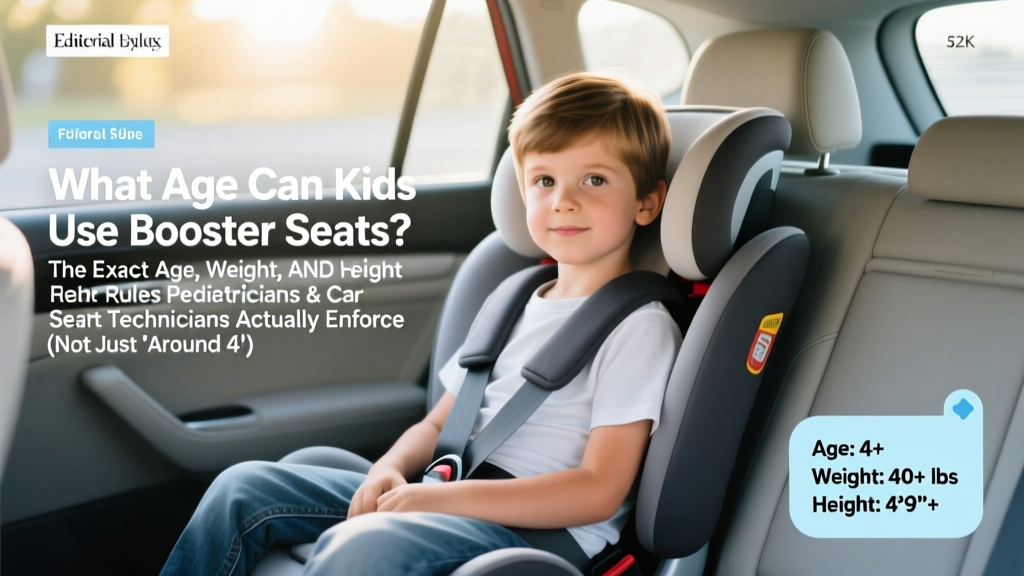
Forget the myth that turning 4 automatically qualifies your child for a booster. The AAP, National Highway Traffic Safety Administration (NHTSA), and certified Child Passenger Safety Technicians (CPSTs) all agree: readiness hinges on four non-negotiable criteria, each rooted in biomechanics and crash test data. If any one fails, your child isn’t ready — regardless of age.
- Age ≥ 4 years: Minimum legal and developmental baseline. Children under 4 lack sufficient pelvic bone ossification and trunk muscle control to maintain proper belt positioning during sleep or distraction.
- Weight ≥ 40 lbs: Required to ensure the vehicle’s lap-and-shoulder belt fits correctly over bony landmarks (not soft tissue). Below 40 lbs, crash forces can cause belt-induced abdominal injury (‘seat belt syndrome’) — documented in 22% of unrestrained or improperly restrained pediatric crash injuries (Journal of Trauma and Acute Care Surgery, 2021).
- Height ≥ 44 inches: Critical for shoulder belt geometry. At under 44”, the belt crosses the clavicle or neck — increasing cervical spine injury risk by 3.8x in frontal collisions (NHTSA Crash Test Report #DOT-HS-813-219).
- Maturity to sit still, upright, and properly belted for the entire trip: No slouching, no leaning, no tucking the shoulder belt under the arm or behind the back. A 2023 CPST field audit found 68% of children aged 4–5 failed this behavioral criterion — even when meeting all physical metrics.
Dr. Elena Ruiz, a pediatric emergency physician and AAP Injury Prevention Committee member, puts it plainly: “I’ve treated children who ‘passed’ the 40-lb/44-in rule but slid under the lap belt during a 25 mph collision because they fell asleep leaning forward. Their injuries weren’t from the crash — they were from the belt failing to hold them in place. Maturity isn’t optional. It’s physiological.”
The Hidden Danger Zone: Ages 4–7 — When Most Parents Get It Wrong
This is the most perilous window — and where well-intentioned parents unintentionally compromise safety. Consider Maya, age 5, 42 lbs, 45 inches tall. She meets height and age requirements — but her pediatrician noted she still falls asleep mid-trip with her head lolling forward. Her parents moved her to a high-back booster at age 5. Three months later, during a rear-end collision at 18 mph, she slid forward in the seat, the lap belt riding up onto her abdomen. She survived — but required surgery for a bowel perforation.
This isn’t rare. NHTSA data shows children aged 4–7 in boosters are 42% more likely to sustain abdominal or spinal injuries than those remaining in harnessed seats — but only when used before full readiness. Why? Harnessed seats distribute crash forces across the strongest parts of the body (shoulders, hips, pelvis); boosters simply lift the child so the adult belt *can* fit — but only if the child maintains perfect posture.
Here’s what the data says about optimal timing:
- Ages 4–5: Only 12% of children meet all four readiness criteria. Most benefit from staying in a convertible or combination seat with a 5-point harness rated to 65+ lbs.
- Ages 6–7: 57% meet all criteria — but behavioral consistency remains the biggest gap. CPSTs recommend a 2-week ‘booster trial’ with daily observation logs before permanent transition.
- Ages 8+: 91% meet physical criteria — but 34% still fail the maturity test (per Safe Kids Worldwide 2023 observational study).
Bottom line: If your child is age 5 but still sleeps sitting up, slumps, or plays with the shoulder belt, keep them harnessed — even if the seat allows it. Your minivan isn’t a race to ‘graduation.’ It’s a safety cocoon.
State Laws vs. Science: Where Legal Minimums Fall Dangerously Short
Every U.S. state has booster seat laws — but most set dangerously low floors. Alabama, for example, permits booster use at age 5 and 40 lbs. Texas allows it at age 4. These laws reflect political compromise, not pediatric biomechanics. They’re designed to prevent the worst-case scenario (unrestrained children), not optimize protection.
That’s why top-tier CPSTs and the AAP urge parents to treat state law as the absolute floor, not the target. Here’s how science stacks up against statute:
| State | Legal Minimum Age | Legal Minimum Weight | AAP Recommended Minimum Age | Key Gap Risk |
|---|---|---|---|---|
| California | 8 years OR 4'9" | None specified | 8 years + 4'9" + maturity | Allows transition at 8 even if child is 4'5" and slouches — lap belt rides up |
| Texas | 4 years | 40 lbs | 5–7 years + 44" + maturity | Permits boosters for 4-year-olds — 83% fail maturity test per CPST audits |
| New York | 8 years OR 4'9" | None | 8 years + 4'9" + consistent posture | Doesn’t require maturity assessment — 29% of 8-year-olds still tuck belts |
| Florida | 5 years | 40 lbs | 6–7 years + 44" + behavioral consistency | Allows 5-year-olds at 40 lbs — average 5-year-old is only 42.5" tall |
| Oregon | 8 years OR 4'9" | None | 8 years + 4'9" + demonstrated 30-min seated focus | Most progressive law — includes implied maturity standard via ‘properly restrained’ clause |
Note: Oregon’s law comes closest to aligning with science — its ‘properly restrained’ language requires the belt to lie flat across the upper thighs and center of the shoulder, which inherently demands postural control. But even there, enforcement relies on officer discretion — not objective assessment.
Choosing the Right Booster: High-Back vs. Backless — And Why Your Car’s Seat Design Changes Everything
Once readiness is confirmed, choosing the right booster isn’t about preference — it’s about matching your vehicle’s seat geometry and your child’s physical needs. Backless boosters get headlines for portability, but they’re appropriate for only ~30% of families.
High-back boosters are the gold standard for most families because they:
- Provide head and neck support in vehicles with low seat backs (common in SUVs, trucks, and older sedans)
- Guide the shoulder belt across the clavicle — not the neck or face — using adjustable belt guides
- Offer side-impact protection (tested to FMVSS 213 standards)
- Help maintain upright posture for sleepy or distracted children
Backless boosters are safe — only if:
- Your vehicle has a high, rigid seat back (≥ 20” tall from seat cushion to top of headrest)
- Your child’s ears are below the top of the vehicle seat back
- You have a shoulder belt that doesn’t cut across the neck — verified with the ‘5-Step Test’ (see below)
Real-world tip: Try both in your car with your child. Sit in the driver’s seat and observe belt path. If the shoulder belt hits above the collarbone or rubs the neck, high-back is mandatory — no exceptions.
Frequently Asked Questions
Can my 3-year-old use a booster seat if they’re tall and heavy?
No — and it’s illegal in all 50 states. Even a 3-year-old weighing 45 lbs lacks the pelvic bone density and neuromuscular control to withstand crash forces without a 5-point harness. The AAP explicitly states: “Children under age 4 must remain in a forward-facing harnessed seat.” Early transition increases risk of spinal cord injury, internal organ damage, and ejection. There are zero exceptions for size or maturity.
What is the ‘5-Step Test’ — and when should I use it?
The 5-Step Test is the definitive readiness check — performed with your child seated in the vehicle, buckled in the booster. All five must pass every time, for every trip:
1. Does the child sit all the way back against the vehicle seat?
2. Do knees bend comfortably at the edge of the seat, with feet flat on the floor?
3. Does the lap belt lie snugly across the upper thighs (not the belly)?
4. Does the shoulder belt cross the center of the shoulder and chest (not the neck or arm)?
5. Can the child stay seated like this for the entire ride — without slouching, sleeping, or moving the belt?
If any step fails, your child isn’t ready — even if they’re 8 years old.
Do booster seats expire? How do I know if mine is still safe?
Yes — all booster seats expire, typically 6–10 years from manufacture date (check the label on the seat shell or base). Expiration occurs due to plastic degradation from UV exposure and temperature cycling, which weakens structural integrity. Also check for recalls at nhtsa.gov/recalls using your seat’s model number and manufacture date. Never use a booster involved in a crash — even a minor fender-bender compromises energy-absorbing materials.
My child hates their booster. What can I do?
First, rule out discomfort: Is the belt too tight? Is the seat too narrow? Try a different model — some have memory foam pads or wider bases. Second, involve them: Let them pick the color or design (within safety specs). Third, create positive reinforcement: A ‘Booster Badge’ chart for 10 consecutive trips with perfect posture. But never negotiate on safety — if they refuse to sit properly, revert to the harnessed seat. As CPST trainer Marcus Lee says: “A tantrum in the driveway is safer than a broken pelvis on the highway.”
When can my child finally use just the seat belt?
Not until they pass the 5-Step Test without a booster — typically between ages 10–12, and almost always at or above 4'9". The AAP recommends staying in a booster until age 12 or until the vehicle seat belt fits perfectly. Remember: Adult seat belts are designed for 5'2"+ adults — not children.
Common Myths
Myth 1: “If my child fits the booster, they’re safe in it.”
False. Fit ≠ safety. A child may physically fit a booster but lack the postural control to keep the belt in the correct position for 100% of the ride. Crash testing shows that a 2-second lapse in belt position increases abdominal injury risk by 300%.
Myth 2: “Backless boosters are just as safe as high-back ones.”
Only in specific vehicle-seat combinations. Without head and torso support, backless boosters offer no side-impact protection and cannot guide the shoulder belt. NHTSA crash tests show high-back boosters reduce head excursion by 47% compared to backless in angled collisions.
Related Topics (Internal Link Suggestions)
- When to switch from rear-facing to forward-facing car seat — suggested anchor text: "rear-facing car seat duration guidelines"
- Best high-back booster seats for small cars — suggested anchor text: "compact high-back booster recommendations"
- How to install a booster seat correctly — suggested anchor text: "booster seat installation checklist"
- Car seat expiration dates and safety recalls — suggested anchor text: "how to check your car seat recall status"
- 5-Step Test printable worksheet — suggested anchor text: "free booster seat readiness checklist PDF"
Conclusion & CTA
What age can kids use booster seats isn’t answered in years alone — it’s answered in anatomy, behavior, and evidence. The safest child isn’t the one who transitions earliest; it’s the one who stays harnessed until their body and brain are truly ready to manage the complexity of an adult seat belt. Use the 4-point readiness assessment. Run the 5-Step Test monthly. Consult a certified Child Passenger Safety Technician for a free, 30-minute in-person evaluation — they’ll watch your child buckle up, simulate motion, and confirm belt geometry with precision tools. Don’t wait for a milestone birthday. Wait for the moment your child sits tall, still, and secure — every single time. Your next step? Download our free Booster Readiness Tracker — a printable log to document posture, height, weight, and 5-Step Test results over 30 days. Because when it comes to your child’s spine, certainty beats assumption — every time.
More Articles
 When Do Kids Start Pretend Play? (12–36 Months)
 David Temple & Heather Scott Kids? Truth Revealed
 Is Twitch Safe for Kids? A Parent’s Evidence-Based Guide
 Debbie Gibson Kids: Truth About Her Family Choices (2026)
Skills Trends 2026: What Parents Must Know for Kids' Future
Debbie Gibson Kids: Truth About Her Family Choices (2026)
Skills Trends 2026: What Parents Must Know for Kids' Future
 Zyrtec Dosing for Kids: Pediatrician-Approved Guide
 Vocal Stimming in Autistic Kids: What It Is & Why
 How to Start a Business for Kids: A Parent’s Guide
 Laughing Gas for Kids: Dental Sedation Safety (2026)
 Bedwetting Age Norms & What Actually Works